- “Chinese Calligraphy Brush Sets”
- “Qin Dynasty History Books”
- “Great Wall of China Travel Guides”
- “Traditional Chinese Ink Stones”
- “Ancient Chinese Warfare Books”
Meng Tian: The Qin Dynasty General Who Gave China the Brush Pen
When we think of the great inventions that shaped Chinese civilization, our minds often turn to the Four Great Inventions—papermaking, printing, gunpowder, and the compass. But there’s another invention, quieter but no less transformative, that changed the way humans would communicate for millennia: the Chinese brush pen. And according to Chinese tradition, the man responsible for this revolutionary writing tool was a military general named Meng Tian (蒙恬), a legendary figure who lived during the tumultuous final century of the Qin Dynasty.
Meng Tian stands at a fascinating crossroads of Chinese history—a place where military conquest meets cultural innovation, where the brutal consolidation of the Chinese empire under Emperor Qin Shi Huang gave rise to achievements that would outlast the dynasty itself. Though he is best known in popular memory as the inventor of the brush pen, Meng Tian’s legacy extends far beyond that single contribution. He was a general who defeated the Xiongnu nomads and expanded China’s territory northward. He was an engineer who contributed to the construction of the Great Wall. And he was a man whose life ended in tragedy when the very emperor he served turned against him in his final years. To understand Meng Tian is to understand something essential about the Qin Dynasty itself—its ambitions, its achievements, and its ultimately short-lived hold on power.
A General Rises: Meng Tian’s Early Career and Loyalty to Qin Shi Huang
Meng Tian was born into a family with a proud tradition of military service. The Meng family had served the Qin state for generations, and young Meng Tian was raised with the expectation that he would follow in his ancestors’ footsteps. He received rigorous training in both martial arts and strategy, and it quickly became clear that he possessed exceptional talent in both arenas. By the time he reached adulthood, Meng Tian had established himself as one of the most promising military officers in the Qin kingdom.
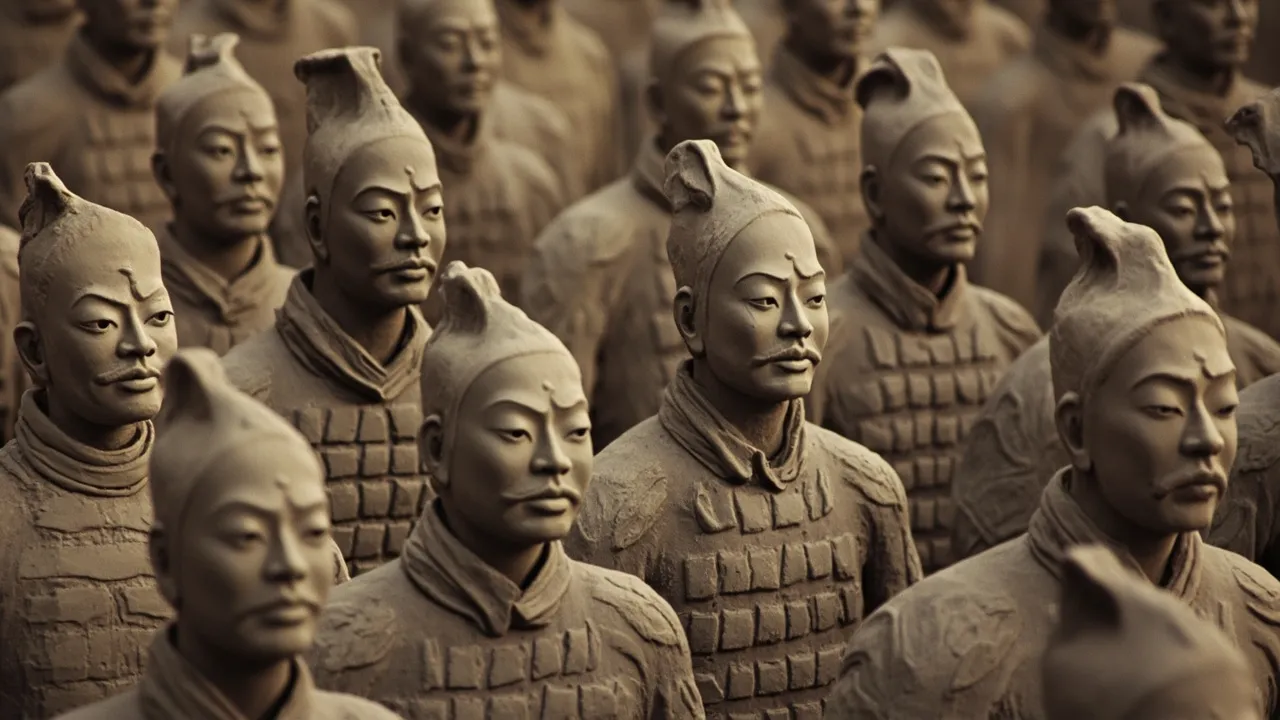
The timing of his rise was fortuitous—or perhaps命运的捉弄, as the Chinese might say. The late third century BCE was a period of extraordinary upheaval in China, as the state of Qin under the leadership of Ying Zheng systematically conquered all of its rival states and unified the Chinese world under a single ruler for the first time in history. In 221 BCE, when Ying Zheng declared himself Emperor Qin Shi Huang, Meng Tian was among the officers who had served loyally through these campaigns of unification.
Emperor Qin Shi Huang was a man of immense ambition and equally immense paranoia. He rewarded those who served him well, but he was quick to eliminate anyone he perceived as a threat. Meng Tian navigated this treacherous political environment with considerable skill, maintaining the emperor’s trust while building a reputation as both an effective military commander and a capable administrator. He was the kind of man the emperor needed—someone who could fight his battles, build his fortifications, and remain loyal even as others around them fell from favor.
What set Meng Tian apart from many other military men of his era was not just his skill with weapons and tactics, but his intellectual curiosity and his appreciation for craftsmanship. While most generals concerned themselves solely with winning battles, Meng Tian took an interest in the tools and technologies that made civilization possible. This broader perspective would serve him well in the years to come, particularly when he turned his attention to the challenge of creating a new writing instrument.
Conquering the Xiongnu: Northern Campaigns and the Birth of an Empire
Perhaps the most significant of Meng Tian’s military achievements was his campaign against the Xiongnu, the nomadic tribes who posed the primary threat to Qin’s northern borders. The Xiongnu were skilled horsemen who had plagued Chinese states for centuries, conducting raids into Chinese territory and disappearing before any organized response could be mounted. Their mobility and familiarity with the northern steppes gave them advantages that conventional Chinese armies struggled to match.
Emperor Qin Shi Huang recognized that the Xiongnu problem required a two-pronged solution: military force to punish raiding parties and push them further north, and defensive fortifications to protect Chinese settlements from future attacks. In 215 BCE, he dispatched Meng Tian with an army of 300,000 soldiers to the northern frontier with orders to drive the Xiongnu out of the region and secure the border.
Meng Tian proved more than equal to the task. His campaign was meticulously planned and executed with precision. Rather than simply chasing the Xiongnu across the steppe—a strategy that had repeatedly failed for earlier Chinese commanders—Meng Tian used a combination of direct military engagement and strategic maneuvering to gradually push the nomads northward. His forces established fortified positions throughout the region, creating a network of garrisons that could respond quickly to any incursion. The campaign lasted several years and achieved remarkable success, effectively driving the Xiongnu out of the Ordos region and securing a buffer zone that would protect central China for generations to come.
The territorial gains from this campaign were substantial. Qin China extended its borders significantly northward, incorporating regions that would later become important agricultural and pastoral lands. More importantly, the campaign established a template for how Chinese empires would deal with northern nomadic threats for centuries to come—a template that combined military expeditions with infrastructure development and defensive positioning.
It was during this period of northern campaigns, according to traditional accounts, that Meng Tian made his most famous contribution to Chinese civilization. The legend goes that while stationed at a military post in the north, Meng Tian found himself frustrated with the writing implements available for communicating with the emperor’s court. The existing methods—for carving characters into bamboo strips or using crude stylus-like tools—were slow, cumbersome, and inadequate for the demands of military administration. Drawing on both his own observations and the expertise of local craftspeople, Meng Tian developed a new writing tool: a brush made from animal hair that could hold and distribute ink smoothly, allowing for the fluid, expressive characters that would become the foundation of Chinese calligraphy.
The Legend of the Brush Pen Invention
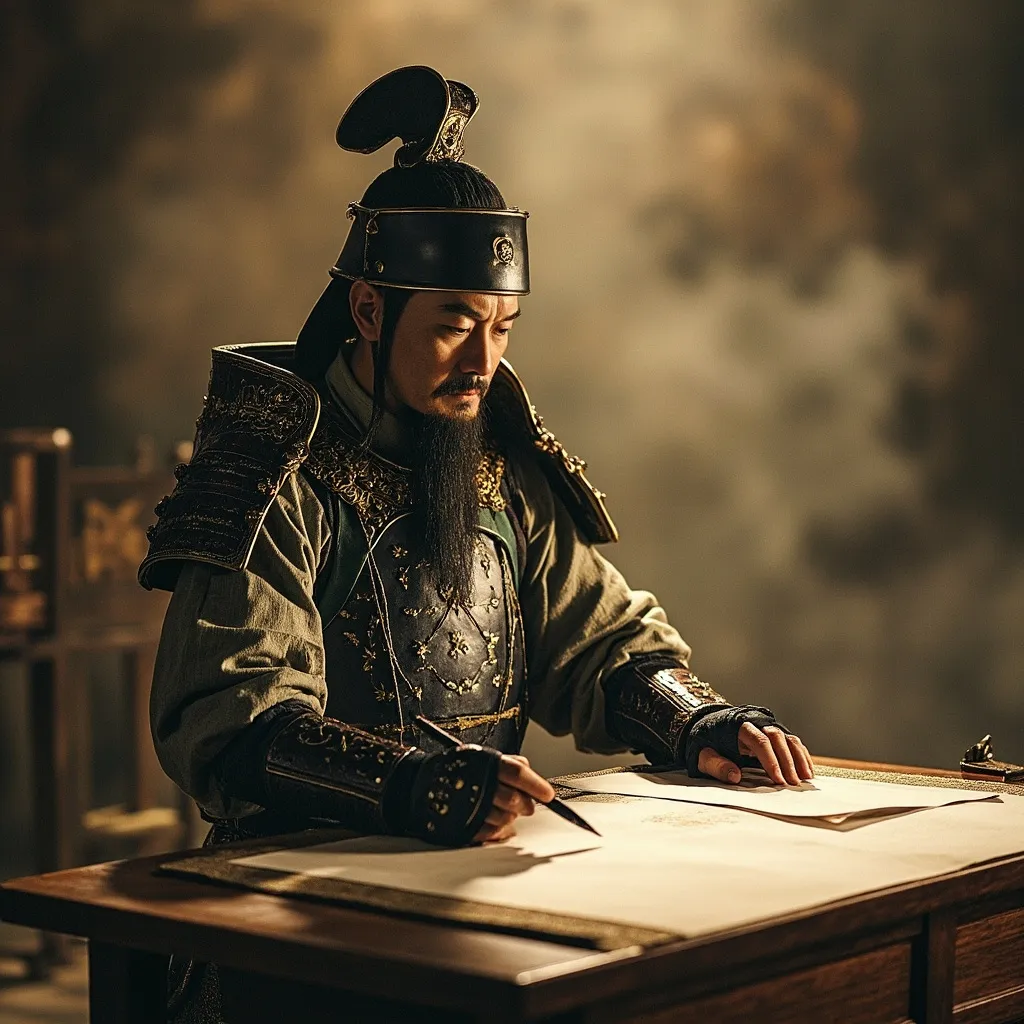
The story of how Meng Tian invented the Chinese brush pen has become one of the most enduring legends in Chinese cultural history. According to the traditional account, Meng Tian was stationed at a military camp in the northern frontier when he encountered a captured Xiongnu scout who was using a primitive form of brush to mark messages. Observing this tool, Meng Tian began experimenting with different materials—trying various combinations of animal hair, bamboo, and ink—until he developed a writing instrument that was far superior to anything previously used in China.
The legend has it that the first brush pen was made using hair from a live rabbit, which Meng Tian pulled from the animal and fitted into a bamboo tube. He then tested the instrument by writing characters on a piece of silk, and found that it produced lines far more elegant and expressive than any he had achieved with previous tools. He refined the design further, eventually creating a brush pen that could produce the flowing, dynamic characters that Chinese writing would come to require.
While modern historians acknowledge that writing tools probably evolved gradually rather than being invented by any single individual, the association of the brush pen with Meng Tian reflects something important about his cultural legacy. The brush pen was not merely a convenient writing tool—it was the instrument through which Chinese civilization would record its history, compose its poetry, conduct its governance, and transmit its values across generations. By linking this fundamental tool to a figure like Meng Tian, Chinese tradition was acknowledging that the creation of a culture’s means of expression is as significant an achievement as any military conquest.
The brush pen’s impact cannot be overstated. Before its development, Chinese writing had been limited by the constraints of carving or scratching characters onto hard surfaces. The brush allowed for a fluidity and expressiveness that transformed writing from mere record-keeping into an art form. Calligraphy would become one of the highest art forms in Chinese culture, and the brush pen was its essential instrument. From the moment of its creation, the brush pen was central to Chinese civilization in a way that few other tools have ever been to any culture.
Building the Great Wall: Meng Tian’s Contribution to an Enduring Symbol
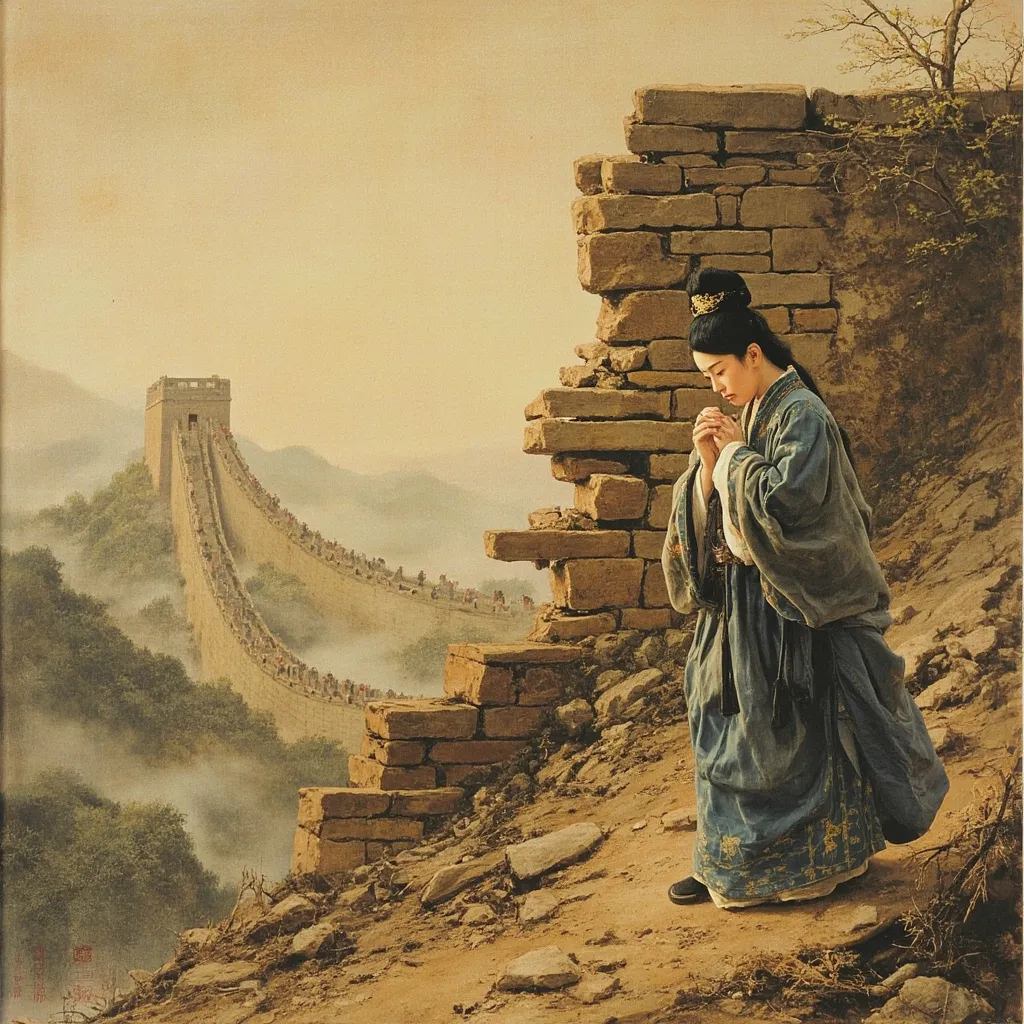
The Great Wall of China is so closely associated with the Qin Dynasty and with Emperor Qin Shi Huang that it’s easy to forget that the wall was not built all at once, nor was any single person responsible for its construction. Nevertheless, historical records suggest that Meng Tian played a significant role in the wall’s early development, particularly in connecting and reinforcing existing fortifications across the northern frontier.
Following his successful campaigns against the Xiongnu, Meng Tian was placed in charge of coordinating the massive infrastructure project that would eventually become the Great Wall. This involved not only physical construction but also the organization of labor, the movement of materials, and the integration of various sections built by different teams under different conditions. The work was brutal and dangerous—thousands of workers died from accidents, disease, and exposure—but the completed sections formed a defensive line of considerable strategic value.
What made the wall particularly effective was not just its physical presence but the system of signaling and rapid response that accompanied it. Towers were positioned at regular intervals along the wall, allowing signals to be passed from one end of the empire to the other in a matter of days. Soldiers stationed at these towers could spot approaching enemies and alert central command, giving the imperial forces time to mobilize and respond. This early warning system was a military innovation as significant as the wall itself.
The connection between Meng Tian and the Great Wall has become fixed in Chinese historical memory. Though the wall that exists today was built and rebuilt over many centuries, often using very different techniques and materials than the original Qin constructions, the association with Meng Tian remains strong. He is remembered as one of the key figures who transformed a series of disparate fortifications into a unified defensive system—one that would protect Chinese civilization from northern threats for centuries to come.
A Tragic End: The Fall of Meng Tian
Despite his years of loyal service and his substantial contributions to the Qin Empire, Meng Tian’s life ended in tragedy—a reminder that even the greatest achievements could not protect a person from the paranoid ruthlessness of Emperor Qin Shi Huang in his later years.
The circumstances of Meng Tian’s downfall are rooted in the complex politics of the imperial court in the final years of Qin’s dominance. When Emperor Qin Shi Huang died in 210 BCE, his death was initially kept secret by the chancellor Li Si and the eunuch Zhao Gao, who sought to manipulate the succession. They installed a less capable son, Huhai, on the throne, while systematically eliminating those who might oppose their control.
Meng Tian, with his military prestige and his connections to the imperial family, was a obvious target. The conspirators fabricated evidence suggesting that Meng Tian was planning a rebellion, and the easily manipulated Emperor Huhai ordered his execution. The general who had conquered the Xiongnu and built the Great Wall—who had given China one of its most essential cultural tools—was condemned to die.
According to historical accounts, Meng Tian accepted his fate with the dignity befitting a man of his stature. Before his execution, he reportedly said something to the effect that his death was of little consequence, but that he worried about the fate of the empire without its northern defenses. His concerns proved prophetic; within a few years of his death, the Qin Dynasty had collapsed, overwhelmed by the very rebellions and external threats that men like Meng Tian had spent their lives containing.
Legacy and Cultural Significance
Today, more than two thousand years after his death, Meng Tian remains a figure of considerable cultural significance in China. Schoolchildren learn about him as both a military hero and the inventor of the brush pen. Calligraphers invoke his name when discussing the origins of their art. And historians continue to debate the precise details of his achievements and the circumstances of his fall.
What makes Meng Tian enduringly fascinating is the way his life embodies so many different aspects of the Qin Dynasty experience. He was a warrior who defended the empire’s frontiers. He was an administrator who helped govern its vast territories. He was an innovator who contributed tools that would shape Chinese culture for millennia. And he was ultimately a victim of the same political turbulence that brought the dynasty itself to ruin.
Perhaps the most fitting tribute to Meng Tian is the simple fact that every time someone picks up a brush pen to write Chinese characters, they are using a tool whose creation is attributed to him. The empire he served has long since crumbled, the walls he helped build have been rebuilt and restored beyond recognition, and the specific battles he fought are remembered only by historians. But the brush pen endures—a small, elegant instrument that carries within it the accumulated expression of a civilization, tracing its lineage back to a general who allegedly created it while stationed on China’s northern frontier.
The next time you see Chinese calligraphy— whether in a museum, on a traditional scroll, or even in the carefully crafted characters of a contemporary advertisement— take a moment to consider the long chain of tradition that connects those brush strokes back to a legendary figure named Meng Tian, who may have given Chinese civilization its most expressive voice.
Recommended Reading and Products
Whether you’re interested in exploring the Qin Dynasty further, learning traditional calligraphy, or visiting the Great Wall yourself, these resources can help you on your journey:
Chinese Calligraphy Brush Sets — Experience the tool that Meng Tian allegedly invented. Traditional brushes made from animal hair offer an authentic writing experience for beginners and experienced calligraphers alike.
Qin Dynasty History Books — Dive deeper into the era that shaped modern China. From Emperor Qin Shi Huang’s unification campaigns to the empire’s dramatic collapse, these histories offer comprehensive coverage.
Great Wall of China Travel Guides — Plan your own journey to see the fortifications that Meng Tian helped construct. The Great Wall remains one of the most impressive architectural achievements in human history.
Traditional Chinese Ink Stones — Complete your calligraphy setup with a proper ink stone. The grinding of ink is itself a meditative practice that connects you to centuries of Chinese artistic tradition.
Ancient Chinese Warfare Books — Explore the military strategies and campaigns that defined the Warring States period and the Qin Dynasty. Understanding the context of Meng Tian’s campaigns enriches appreciation of his achievements.