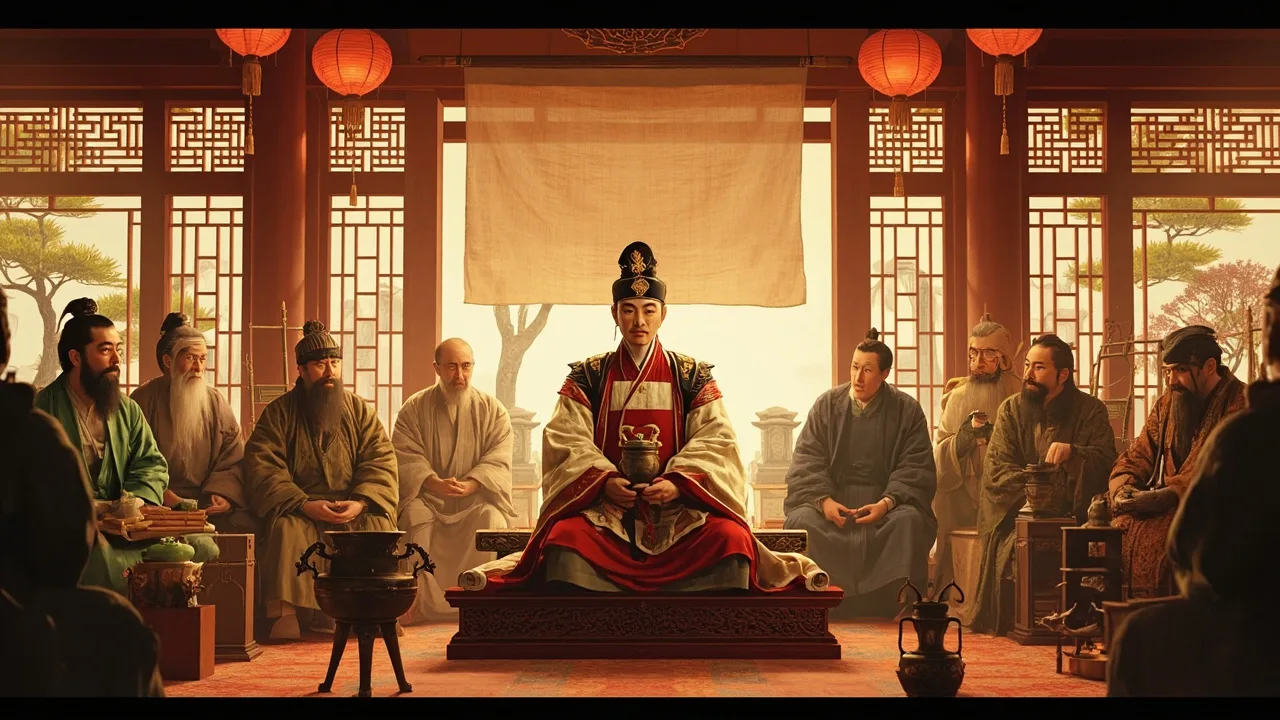
In the Warring States period, when seven great kingdoms fought for supremacy and betrayal was more common than breakfast, one man built his power not from armies or borders but from people. Tian Wen — known to history by his posthumous title Mengchang Jun — kept an entourage of three thousand retainers at his court in the city of Xue. He welcomed criminals, hermits, disgraced officials, and wandering scholars with equal hospitality, fed them, gave them shelter, listened to their advice, and asked only for their loyalty in return. For nearly half a century this strange household of outcasts and geniuses made Mengchang Jun the most powerful nobleman in China — and gave the Chinese language some of its most enduring stories about how to lead, who to trust, and why a clever rabbit always needs three burrows.
The Man Behind the Title: Tian Wen of Xue
The name most people remember is Mengchang Jun (孟尝君), which is not actually a personal name. It is a posthumous title — the honorific given after death, the way Chinese tradition recognized public virtue. The man’s real name was Tian Wen (田文), and his family was one of the strangest success stories of the Warring States era. The Tian clan had not originally been rulers of Qi at all. They were foreign merchants from the state of Zhao who had moved to Qi during the Spring and Autumn period, slowly bought up land and influence, and through a combination of wealth, marriage, and sharp political maneuvering had effectively displaced the original ruling house. By the time Tian Wen was born, his family was the dominant force in Qi, and his father had accumulated such vast territory that dividing it among the sons became a problem.
Tian Wen was not, by any account, the favored heir. He was born on the fifth day of the fifth month — an inauspicious date by the superstitions of the time — and his father initially considered having him exposed as an infant. His mother, a minor consort, hid him and raised him in secret until his father relented. The experience may have shaped him: from his earliest years, Tian Wen seems to have understood what it meant to be on the margins, and he made it his life’s work to make sure no useful person was ever thrown away.
The Warring States period (475–221 BCE) was the great age of the mengjia — the noble hosts who maintained private retinues of scholars, soldiers, and advisers outside the official state bureaucracy. The seven major states — Qi, Chu, Yan, Han, Zhao, Wei, and Qin — were in constant tension, and the formal court often could not provide the flexible, high-quality counsel that rapid-fire crises demanded. So powerful aristocrats began keeping their own households of talent, drawing from across the entire Chinese world. The four most famous of these hosts became known collectively as the Four Lords of the Warring States (战国四公子): Mengchang Jun of Qi, Pingyuan Jun of Zhao, Xinling Jun of Wei, and Chunshen Jun of Chu. Mengchang Jun is generally regarded as the first among them, the model the others imitated, and the one whose household produced the most legendary stories.
When Tian Wen’s father died, the inheritance was divided. The youngest brother, the future Tian Wen, used his inheritance to do something nobody quite expected. Instead of enlarging his personal estates or bribing his way into a court appointment, he opened a kind of guesthouse. He began inviting strangers, travelers, scholars with nothing to recommend them but their words, to come and live at his expense. The idea was not generosity in the modern sense. It was strategic. Tian Wen believed, with the cold clarity of a man who had nearly been killed as a baby, that talent was the only currency that did not depreciate. Lands could be confiscated, titles could be revoked, armies could be defeated. But a man with a clever idea, properly fed and properly listened to, would produce value forever.
This was the foundation of everything that followed.
Burning the Contracts: How Mengchang Jun Bought a County
The most famous story about Tian Wen’s early career involves an act that looks, at first glance, like economic madness. He had been appointed cheng — the chief administrator — of the county of Xue, the territory his family controlled. Xue was prosperous, and one of the standard practices of local administration in the Warring States period was for the chief official to lend money to peasants at the start of the agricultural season, when seed grain and tools were needed but cash was not. The peasants paid back the loans after the harvest, with interest. This was not exploitation in the way the modern reader might assume — it was a genuine public service, smoothing the seasonal mismatch between income and expense that plagued every farming society. But it did mean that the chief administrator kept careful records of who owed what.
Tian Wen, freshly appointed, asked his staff to bring him the loan records so he could understand the economic state of his county. When the records were laid out, he did something that must have made his financial officers faint. He called the loan records out in front of the people, declared that he had no use for them — they were records of debts owed to him personally, but he chose to release everyone from the obligation — and then he had the documents burned. Fenquan (焚券), the burning of the contracts, is the technical phrase. He literally destroyed the evidence of the loans in front of the assembled peasants, telling them they owed him nothing, that the debts were forgiven, and that they should go home and prosper.
This was, by any accounting measure, a catastrophic financial decision. He had just destroyed the county’s revenue stream. His staff was horrified. But Tian Wen understood something they did not. The loans were not generating significant revenue. Most peasants paid them back grudgingly and slowly. Many could not pay at all and lived in constant anxiety about the debt. By burning the contracts, Tian Wen did two things at once. First, he relieved the peasants of a chronic source of anxiety, converting grudging obligation into enthusiastic goodwill. Second, he demonstrated, in the most public and irreversible way possible, that he was a different kind of ruler — one interested in their loyalty, not the last coin. Within a year, the population of Xue had doubled. People streamed in from neighboring counties, drawn by the rumor of a ruler who had actually forgiven debts.
This is the first lesson of the Mengchang Jun playbook: buy loyalty when it is cheap, because you cannot buy it when it is expensive. Tian Wen spent a small amount of money to acquire something no amount of money could later purchase — a population that genuinely believed in him. Years later, when political trouble forced him to flee the Qi court, he would discover just how valuable that belief was.
Feng Xuan and the Three Burrows of the Clever Rabbit
The retainer most associated with Mengchang Jun is Feng Xuan (冯谖), a man whose biography reads like a cross between a sage and a con artist. The story of how Feng Xuan joined the household is itself a classic of Chinese management literature, and it illustrates the deliberate, almost mercenary, openness of Tian Wen’s recruiting.
Feng Xuan arrived at the household of Mengchang Jun in tattered clothes, barefoot, begging for food. The staff tried to send him away. Tian Wen, who personally interviewed anyone who seemed unusual, agreed to feed him. But Feng Xuan had a habit of leaning against his pillar, whistling, and singing an angry song about how no one in the household recognized real talent. He was, by all accounts, insufferable. Other retainers complained. Tian Wen’s staff asked him to be rid of this troublesome guest.
Tian Wen, characteristically, asked Feng Xuan what he wanted. The answer was simple: he wanted to be treated as an honored guest, not as a beggar. He wanted meat on the table, a carriage to ride in, money to give to his friends. Tian Wen agreed, and from that moment Feng Xuan became one of the most trusted members of the household.
The next test was a strange one. Tian Wen asked Feng Xuan to go to the county of Xue and collect the outstanding debts owed to the household. When Feng Xuan arrived, he found the local administrator unable to pay and the people struggling. Instead of squeezing them, Feng Xuan did something dramatic: he took the loan contracts back to Tian Wen, declared that he had bought back the people’s goodwill for the household by forgiving the debts (the fenquan story may have happened in two versions, one involving Tian Wen directly and one involving his agent Feng Xuan), and reported that he had secured something more valuable than money — the loyalty of the people of Xue. Tian Wen was initially furious, then thoughtful, then quietly impressed.
The third test was the most famous. Years later, Tian Wen fell out of favor at the Qi court. The king — fearful, as later kings would be of all four lords, of a man who commanded more loyalty than the throne itself — stripped Mengchang Jun of his titles and ordered him to leave the capital. Tian Wen was forced to flee. He tried to take refuge in the state of Wei, but the king of Wei, hearing of his fall, refused him audience. He tried the state of Zhao; same result. His retainers began to drift away. The man who had spent his life cultivating loyalty was discovering, painfully, what it felt like when institutions turned against him.
It was Feng Xuan who saved him. Feng Xuan pointed out, with the calm logic of a man who had planned for this eventuality years earlier, that Mengchang Jun had spent his life building three sources of security — three “burrows,” as the story famously puts it — for exactly this moment. The first burrow was the loyalty of the people of Xue, who loved him. The second burrow was the respect of the other great lords of the Warring States, several of whom owed him past favors. The third burrow was the strategic position of Xue itself, a fortified territory with the resources to sustain him even if every external alliance failed. The advice: go back to Xue, raise your own forces, and negotiate from a position of strength. The king of Qi, facing the prospect of an enemy nobleman with a private army and a friendly population, would soon realize that exile was a worse outcome than accommodation.
Tian Wen did exactly that. He returned to Xue, raised his retainers, and within a year the king of Qi had no choice but to invite him back to court, restoring his titles and influence. The phrase that captures the principle is 狡兔三窟 (jiǎo tù sān kū) — “a clever rabbit has three burrows.” It is one of the most quoted idioms in Chinese, used to describe anyone who has built redundancy into their strategy, anyone who refuses to depend on a single source of support. The rabbit with only one hole is the rabbit the hunter catches. The rabbit with three holes is the rabbit that survives.
“The Host Who Gains Retainers Thrives”: Mengchang Jun’s Philosophy of Power
The broader philosophy that emerges from Mengchang Jun’s career is captured in another famous saying: 得士者昌,失士者亡 (dé shì zhě chāng, shī shì zhě wáng) — “the host who gains retainers thrives; the host who loses them perishes.” This was not, in the original context, an abstract proverb. It was a strategic observation about how the Warring States actually worked. In an era when formal institutions were weak, when borders shifted with every treaty, when a single brilliant general or a single clever negotiator could change the fate of a kingdom, the quality of the people around you was the only reliable form of power.
Tian Wen applied this insight ruthlessly. He is famous for recruiting retainers of every social background — a fact that scandalized the more aristocratic-minded noblemen of the time. The Shiji records that he once took into his household a convicted criminal whose particular talent was the ability to imitate the voice of the king of Qi. The story is that Mengchang Jun was preparing a delicate diplomatic mission and needed a way to test the loyalty of a particular minister. He had the criminal hide behind a curtain and call out in the king’s voice. The minister, hearing what sounded like a direct order from the king, obeyed without question. The criminal was not punished for his past crime; he was rewarded for his current usefulness.
The point of the story, in the Chinese tradition, is not to praise crime but to illustrate the depth of Mengchang Jun’s commitment to talent over pedigree. He did not care who you were. He cared what you could do. The famous retainer stories — Feng Xuan’s clever schemes, the criminal mimic, the scholars who arrived in rags and left as ambassadors — all illustrate the same principle: judge the man, not his clothes.
This philosophy produced a household that was famously chaotic. Retainers competed for prestige, argued constantly, and occasionally tried to murder one another. Mengchang Jun kept them all. The historian Sima Qian, in the Biographies of the Mengchang Jun (《史记·孟尝君列传》) chapter of the Shiji, records the household’s dysfunction with a mixture of admiration and horror. It was, in modern terms, a startup before its time — a place where the boss believed that even the most troublesome people could be useful, given the right environment.
The principle extended beyond his own household. Mengchang Jun’s reputation was such that Qi itself became a magnet for talent. When the state of Qin — the rising power of the era — sent a delegation to Qi, the Qin officials were reportedly astonished to find that the Qi court, and especially Mengchang Jun’s household, had access to intelligence, scholars, and diplomatic connections that should have been impossible for a smaller state. Over the next century, every major nobleman tried to build a comparable household, and the Four Lords of the Warring States became the template.
The downside was that Mengchang Jun’s household eventually became powerful enough to threaten the throne. The kings of Qi grew increasingly nervous. By the end of his life, Mengchang Jun had retired to his territory at Xue and spent his final years as an independent power within Qi — respected but feared, consulted but suspected, never quite trusted and never quite attacked. The same principle that made him powerful — that talent matters more than pedigree, that loyalty matters more than law — was the principle that made the throne uneasy with him.
Legacy: Why Mengchang Jun Still Matters
The story of Mengchang Jun has been told for two thousand years because it captures something true about how power actually works. The official histories of China tend to focus on kings, emperors, and the great state-to-state conflicts. But the Shiji’s chapter on Mengchang Jun, and the parallel chapters on the other three lords, suggest that the real engine of historical change was often smaller, more local, and more personal. The man who could attract and keep extraordinary people, who could feed them, listen to them, and deploy them effectively, could change the course of an era — even if he never sat on a throne.
This lesson has been applied in every generation since. In Chinese business culture, the phrase “得士者昌” is invoked whenever a company is described as “talent-driven.” In Chinese diplomacy, the practice of building deep relationships with potential future leaders — sometimes called the mengjia model — is traced back to households like Mengchang Jun’s. In Chinese literature, the image of the wandering scholar who finds a worthy patron became one of the deepest clichés of the tradition, and Mengchang Jun gave the cliché its definitive form.
There is, of course, a darker side. The same talent-attraction that made him great also made him dangerous, and the throne eventually turned against him. The Chinese tradition tells his story not as simple inspiration but as cautionary success: yes, gather talent, but remember that gathering too much in one place is itself a threat. Sima Qian, writing in the century after Mengchang Jun’s death, treats him with the complicated respect of a man who understood both sides — admiration for brilliance, melancholy about the cost. The principle “the host who gains retainers thrives” turned out to have an implication the Four Lords’ descendants learned the hard way: the host who fails to renew that gain loses everything.
For modern readers, the takeaway is not that you should imitate his methods exactly. Times have changed and ethics have moved on. But the core insight remains: the people you attract and keep are the most reliable measure of your real power. Build your three burrows. Judge by what people can do, not where they came from. And never confuse the size of your household with the quality of your judgment — the rabbit with three holes escapes the hunter only because the holes were chosen wisely.
If you want to read more about the Warring States period and the retainer tradition that Mengchang Jun embodied, our article on Guan Yu and the loyalty code that shaped Chinese warrior culture explores how the master-retainer relationship evolved into something even more dramatic in later centuries. For the broader picture of how the Warring States era collapsed into the chaos of the Three Kingdoms, see our piece on the Battle of Red Cliffs, the confrontation that finally ended the age Mengchang Jun’s household had helped to shape.