- “Great Wall of China History Books”
- “Traditional Chinese Winter Clothing”
- “Qin Dynasty History Collection”
- “Chinese Historical Fiction Novels”
- “Great Wall China Travel Guides”
Meng Jiangnu Weeping at the Great Wall: A Woman’s Grief That Shook an Empire
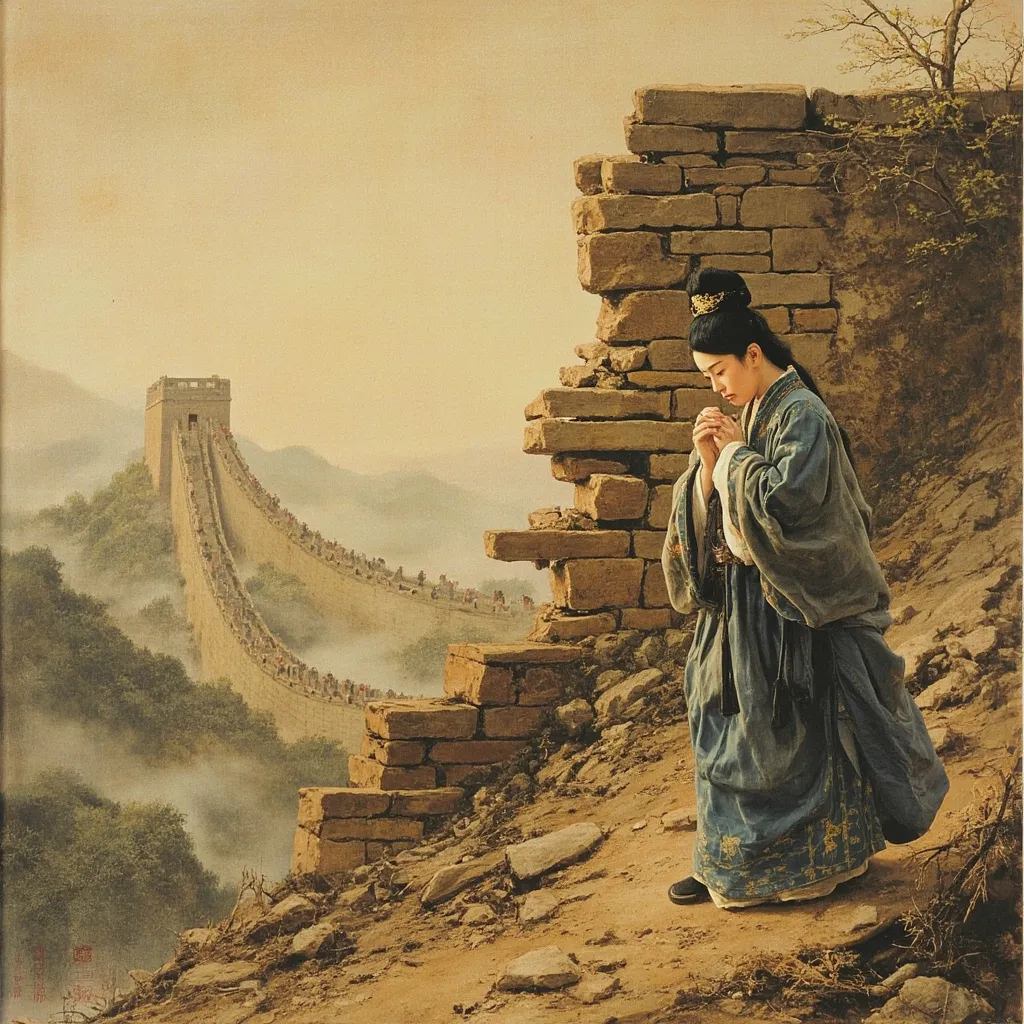
Of all the legendary figures who haunt the Great Wall of China, none is more poignant, more politically charged, or more enduring than Meng Jiangnu (孟姜女, Mèng Jiāngnǚ), a young woman whose story has been told and retold for over two thousand years. According to legend, Meng Jiangnu was a bride newly married to a man named Fan Xiliang, who had been seized by Qin Dynasty officials and forced to labor on the construction of the Great Wall—a massive fortification project that consumed the lives of hundreds of thousands of workers through starvation, disease, and brutal overwork. When Meng Jiangnu trekked hundreds of miles to deliver winter clothing to her husband, she found only his grave. Her grief was so profound, so all-consuming, that her weeping caused a section of the wall to collapse, revealing the bodies buried beneath and exposing to the world the terrible human cost of the emperor’s ambition.
This is a story that operates on multiple levels simultaneously. On the surface, it is a simple tale of marital love and tragedy—a woman who lost her husband and mourned him with extraordinary intensity. But it is also a story about tyranny and resistance, about the way that absolute power crushes ordinary people beneath its wheels, and about the capacity of individual grief to challenge and expose systems of oppression that seem too vast and too entrenched to fight. The Great Wall was built to protect China from invaders; in this story, it becomes a monument to human suffering, a wall made not only of stone and earth but of the bones and bodies of the workers who died building it.
What makes Meng Jiangnu so remarkable is not just her grief, but her response to it. She does not accept the injustice quietly. She does not bow her head and return home to live out her days in sorrowful obscurity. She weeps, and her weeping has a power that no army, no emperor, no force of arms could match. Her tears are a weapon that brings down walls—not through violence, but through the sheer force of human emotion unleashed against an empire that had forgotten the humanity of the people it ruled.
A Love Story in Troubled Times
The story of Meng Jiangnu begins not with tragedy, but with love—a love story set against the backdrop of one of the most tumultuous periods in Chinese history. The year is the third century BCE, and the Qin Dynasty under Emperor Qin Shi Huang has recently unified China after centuries of warring states. The new emperor is obsessed with consolidation and security. He has standardized weights and measures, built roads and canals, and begun construction on what will become the largest single construction project in human history: a massive defensive wall stretching across the northern frontier of the new empire.
To build this wall, the emperor’s officials requisitioned labor from across the land. Men were taken from their farms and workshops, their families, their wives and children, and marched north to the frontier where they would labor under brutal conditions, building walls, digging trenches, and dying in enormous numbers from exposure, disease, and simple exhaustion. This was not volunteer work. Refusal meant death. Desertion meant death. Even attempting to escape was punished by execution. The workers had no rights, no recourse, no hope of justice. They were, for all practical purposes, slaves building a monument to their own suffering.
Into this world of forced labor and imperial tyranny came Meng Jiangnu—or so the legend tells us. She was the daughter of a wealthy family, though accounts differ on the precise details of her parentage. Some versions say she was adopted; others claim unusual circumstances surrounding her birth. What all versions agree on is that she was a woman of exceptional beauty, virtue, and intelligence, and that she fell in love with a young man named Fan Xiliang—a scholar or merchant, depending on the version, who won her heart through his character rather than his wealth.
Their courtship was brief, and they married with the hope of building a quiet, happy life together. But the Qin Empire had other plans. Shortly after their wedding, Fan Xiliang was seized by officials and conscripted into the labor force building the Great Wall. He was taken north with thousands of other men, leaving behind his young bride without even a proper farewell. Meng Jiangnu was devastated, but she was not broken. She waited, as wives throughout history have waited, for news of her husband’s fate. And then, as winter approached, she made a decision that would define her legacy: she would go to the frontier herself, find her husband, and deliver to him the winter clothing she had made for him with her own hands.
The Long Journey North
What followed was an extraordinary journey—the story of an ordinary woman walking hundreds of miles across the harsh northern frontier of China to find her husband. This was not a task for the faint of heart. The northern frontier in winter was a brutal landscape of frozen plains, mountain passes, and the ever-present danger of bandits, wild animals, and exposure. A woman traveling alone, without escort or protection, would have been highly unusual in Han Dynasty society. That Meng Jiangnu made this journey anyway, driven by love and determination, is itself a testament to the extraordinary power of her character.
The legend describes her passing through mountain after mountain, river after river, each new obstacle overcome through sheer will. She carried with her only the bundle of winter clothing she had made for her husband, and the hope that she would find him alive. In some versions, she was aided by kind strangers who gave her shelter and food along the way. In others, she endured the journey entirely alone, sustained only by her determination and her love. The journey took weeks or months, the story does not specify exactly, but when she finally arrived at the construction site of the Great Wall, she was exhausted, cold, and desperate to find her husband.
What she found there was not her husband, but his fate. The other workers told her the truth: Fan Xiliang had died months earlier, from exhaustion and exposure, and his body had been buried somewhere beneath the wall itself—a common practice on the construction sites, where dead workers were simply interred in the foundations rather than being returned to their families for proper burial. The wall stretched endlessly before her, a massive monument to human suffering, and somewhere beneath its stones lay her husband, alone and forgotten.
The Grief That Brought Down a Wall
The moment of Meng Jiangnu’s discovery of her husband’s fate is the emotional climax of the entire story. In some versions, she found his grave at a specific location along the wall; in others, she simply wept and wailed, calling out his name, and her cries were so piercing, so full of genuine and inconsolable grief, that they carried for miles. The workers who heard her wept with her. The earth itself seemed to shudder in response. And then, in a moment that transcends the natural order of things, a section of the wall collapsed—a massive rupture exposing the bodies buried within, including, the legend says, the body of Fan Xiliang.
This is the moment that has made Meng Jiangnu immortal. The power of her grief was so great, so overwhelming, that it accomplished what no army or natural force could have done: it broke through the Great Wall itself. The symbolism is impossible to miss—the wall, built to protect the empire from external enemies, is breached not by any foreign invader but by the grief of a woman whose husband was destroyed by the very system the wall represented. The emperor built the wall to consolidate power and protect his realm from the north; the wall became instead a monument to the human cost of that ambition, and Meng Jiangnu’s weeping exposed what the emperor wanted to hide.
Accounts differ on what happened after the wall collapsed. In some versions, Meng Jiangnu’s tears continued to flow, and she drowned in the waters that gathered in the breach she had created. In others, she was taken by gods or spirits to a higher realm, freed from the world of suffering that had destroyed her husband. In still others, she lived out her days as a hermit, forever changed by what she had experienced, her tears flowing whenever she thought of the wall and the men buried within it. The ending varies, but the essential truth remains the same: she had challenged an emperor, an empire, and a monument, and she had won—not through violence, but through the simple, devastating power of genuine human grief.
The Wall of Bones
The story of Meng Jiangnu has been told and retold for over two thousand years, and its political resonance has never diminished. In every era of Chinese history, the story has been invoked to criticize tyranny and to assert the fundamental humanity of ordinary people against the power of states and emperors. The Great Wall was built by forced labor—historically, this is not legend but fact. The Qin Dynasty’s construction projects are estimated to have killed hundreds of thousands of workers, and subsequent dynasties continued to use forced labor to maintain and extend the wall. The story of Meng Jiangnu gave voice to this suffering, personifying it in the figure of a grieving wife whose love for one man was powerful enough to bring down the monuments built on the bodies of countless others.
There is a version of the story, popular in some regions, that adds an even darker political dimension. In this version, when Emperor Qin Shi Huang heard of the wall’s collapse, he was furious—but when he investigated and discovered the truth, he was so moved by Meng Jiangnu’s beauty and virtue that he attempted to seduce her. She resisted, and rather than submit to the emperor’s advances, she threw herself into the sea or was swallowed by the waves, choosing death over dishonor. This version adds another layer to the story: not only does Meng Jiangnu’s grief expose the emperor’s tyranny, but she also rejects the emperor’s own power, refusing to become another object of imperial possession. Her defiance is complete and total.
The story’s political resonance made it particularly useful in later Chinese dynasties, especially during periods of foreign rule such as the Mongol Yuan Dynasty and the Manchu Qing Dynasty. Telling the story of an emperor who oppressed the Han Chinese and was defied by a Han woman was a way of expressing resistance to foreign domination without openly challenging the authorities of the day. The legend of Meng Jiangnu became, over the centuries, a story about the triumph of the individual conscience over state power—a story that ordinary people could tell themselves in times of oppression, as proof that even the greatest empires cannot entirely silence the human spirit.
A Legacy Written in Stone and Story
Today, the story of Meng Jiangnu is remembered at sites along the Great Wall itself, where monuments and pavilions mark the places where she supposedly wept and where the wall supposedly fell. Visitors to these sites can read inscriptions and buy souvenirs depicting the legendary scene—a woman standing before the massive wall, her arms outstretched, tears streaming down her face, the wall crumbling behind her as if unable to withstand the weight of her sorrow. These monuments are, in their own way, a form of historical correction—a way of ensuring that the workers who died building the wall are not entirely forgotten, that their suffering is remembered alongside the stone and mortar they were forced to lay.
The power of Meng Jiangnu’s story lies precisely in its simplicity. It does not require elaborate supernatural machinery or complex political analysis. It requires only the image of a woman standing before a wall, weeping for the husband she has lost, and the wall falling down because her grief is stronger than the emperor’s ambition. In that simple image is contained everything the story needs to say about power, about grief, about the human spirit, and about the possibility of resistance even in the most overwhelming circumstances. The wall was built to last forever. Meng Jiangnu’s grief was stronger.
For a thousand years, Chinese people have told this story and found in it a reflection of their own struggles against forces too large and too powerful to fight directly. The empire, the state, the wall—these are all images of overwhelming power that seem impossible to challenge or resist. But Meng Jiangnu proves that there is something the powerful cannot control and cannot overcome: the genuine, uncontainable, transformative power of human love and human grief. A wall built on suffering will eventually be breached by the truth of that suffering. And a single person’s tears, if they are genuine enough, can bring down what armies could not.
Recommended Reading & Products
Affiliate products for this article:
Great Wall of China History Books & Academic Studies - Amazon US Search - Explore the fascinating and often tragic history of the Great Wall’s construction with scholarly books covering the Qin Dynasty building projects and the human cost of this engineering marvel.
Traditional Chinese Winter Clothing & Down Jackets - Amazon US Search - Like the winter clothing Meng Jiangnu carried for her husband, quality winter gear was essential for workers on the Great Wall. Modern traditional-style winter clothing honoring this heritage.
Qin Dynasty History Collection Books - Amazon US Search - Learn more about Emperor Qin Shi Huang, the unification of China, and the massive construction projects that defined his reign, including the Great Wall and the Terracotta Army.
Chinese Historical Fiction & Romance Novels - Amazon US Search - Enjoy sweeping historical fiction set in the era of the Qin Dynasty and the Great Wall’s construction, bringing to life the romance and tragedy of ancient China.
Great Wall China Travel Guidebooks & Maps - Amazon US Search - Plan your own journey to the Great Wall with comprehensive travel guides featuring maps, practical information, and the history and legends of this world wonder.
Disclosure: This article contains affiliate links. We earn a commission on qualifying purchases.