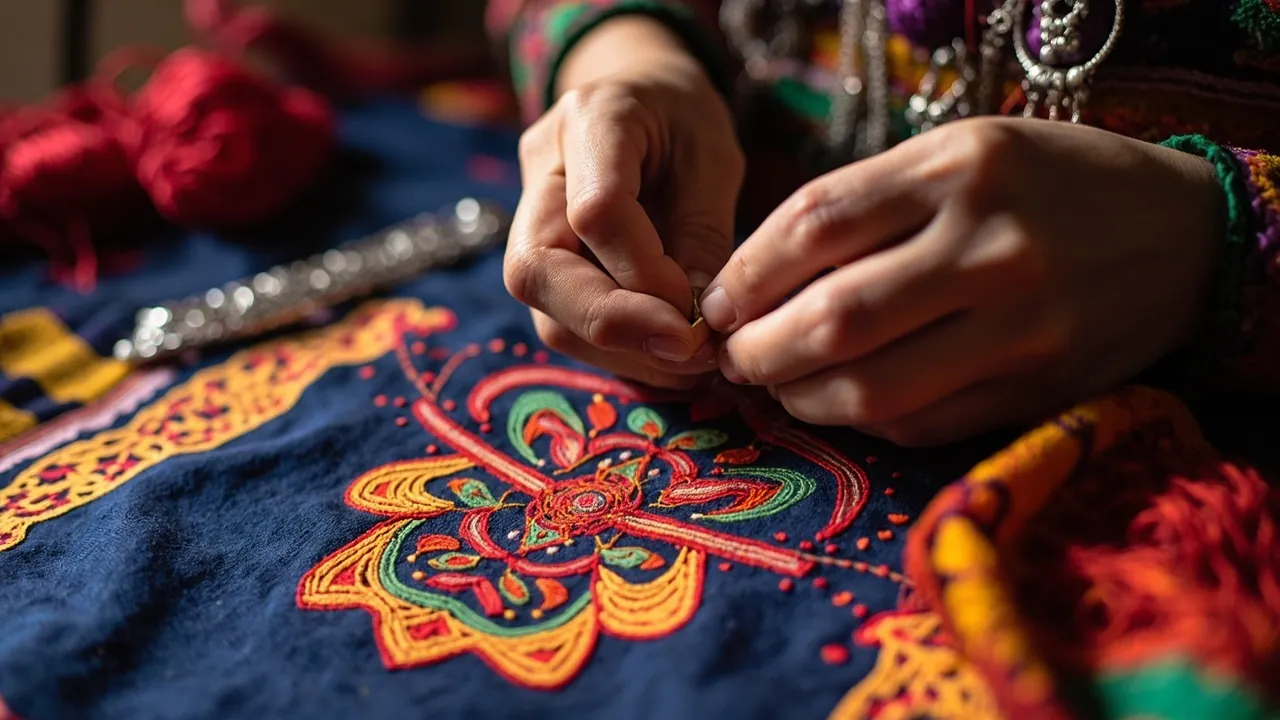
There is a saying among the Miao people of southwest China that you might find strange the first time you hear it: a Miao girl writes her history on her body. Not in words. Not in the pages of a book. But in stitched silk — sometimes running into millions of individually placed stitches in a single garment — covering her shoulders, her arms, her lap, the back of her baby carrier.
For most of their history, the Miao had no written language. Into the 20th century, almost none read or wrote standard Chinese, and most Miao dialects still lack a standardized writing system even today. Histories, myths, genealogies, clan affiliations, the story of where they came from and the gods they believe in — none of this could be jotted down in a notebook or carved on a stone. It had to live somewhere. And that somewhere was cloth.
Embroidery, for the Miao, was not a craft hobby or a tourist commodity. It was an archive. It was a library. It was the way grandmothers handed the same stories to granddaughters that they had been told by their own grandmothers. When a Miao girl sat down to embroider, she was not just decorating cloth — she was copying a page of an invisible book, one whose only copy was the cloth in front of her.
That is what makes Miao embroidery worth understanding: it is a civilization’s memory, threaded in silk.
Who the Miao Are, and Where Their Cloth Comes From
The Miao are one of China’s officially recognized ethnic minorities. Their population is largest in Guizhou province, where most live in the southeast highland regions around the city of Kaili and Qiandongnan prefecture. Significant Miao populations also live in the highlands of Yunnan, eastern Sichuan, the Hunan–Guizhou border, the Guangxi–Guizhou border, and — this matters for our story later — across national boundaries in Vietnam, Laos, Thailand, and Myanmar.
The Miao have been politically and culturally distinct for as long as historical records exist. Chinese dynastic chronicles mention “Miao” peoples from the Shang and Zhou periods onward, sometimes interchangeably with other southern non-Han peoples. The Miao were never a single centralized state. They were scattered across the southern Chinese highlands in village clusters, each relatively independent, each developing its own embroidery conventions, dialect, and subtle variation on the broader culture.
What tied them together was a sense of common origin. The epic running through every Miao sub-tradition is the story of a long migration from somewhere north or west — often, in a poetic sense, “from a place near the sea” — across rivers and over mountains, eventually settling in the southern Chinese highlands. The details of that journey are encoded in embroidery: rivers as wave patterns, mountains as diamond grids, the path of the clans as winding spirals.
So when we say “Miao embroidery,” we are talking about a regional constellation of traditions, not a single uniform style. Embroidery from western Hunan, eastern Guizhou, southeastern Guizhou, Yunnan’s Wenshan prefecture, and the Sichuan–Yunnan border can be visually distinguishable to a trained eye even when both pieces sit next to each other in the same case. The same motifs reappear, but their style, scale, and stitching technique differ.
The Motifs, and What They Mean
If you learn one thing about Miao embroidery, learn this: every motif means something. There is no purely decorative element. There is no wasted thread. The Miao view their embroidery as a language, and the motifs are the vocabulary.
The single most important motif is the butterfly mother (蝴蝶妈妈, hudie mama). In Miao mythology, a butterfly laid eggs on a tree; those eggs hatched into the first human beings and the ancestors of all the Miao clans. So the butterfly mother is at once creator goddess, mother of the world, and the most foundational image in the textile vocabulary. Embroidered butterflies appear everywhere in Miao textiles — stylized, often symmetrical, often with elaborate wing patterns containing secondary motifs. Some butterflies occupy the entire back panel of a baby carrier; others nestle inside other motifs as small symbolic touches.
Next most important is the bird — usually interpreted as a sort of ancestral bird, sometimes called the “soul bird” or “ancestral spirit bird” in older Western accounts. The bird is closely related to the butterfly mother in Miao cosmology because in some versions of the myth the butterfly’s eggs are incubated by a bird. So butterflies and birds appear together, sometimes merging, sometimes paired in a yin-yang composition.
Fish appear as fertility symbols and as reminders of the Miao’s migration through great river systems. A pair of fish, often forming a circle or spiral, is one of the most recognizable of all Miao motifs and sometimes encodes the marriage of a particular bride and groom, or the union of two clans.
Dragons exist in Miao embroidery as well, but they look nothing like the long imperial dragons of Han Chinese culture. Miao dragons are often short, coiled, and rendered with feathers, sometimes more like a snake-bird hybrid than a serpent. Their style and their meaning differ from region to region, but they consistently represent natural power and fertility rather than imperial authority.
The whirlpool or spiral (sometimes called the “nail head” motif in older Western sources) encodes the migration journey. Concentric spirals, when you see them on Miao textiles, almost always refer to the path the clans took across rivers. They are not abstract decoration; they are the recorded shape of a journey.
Then there are geometric patterns — diamonds, triangles, crosses, herringbones, lattice grids. These too are not purely abstract. The diamond, in particular, is widely interpreted as a mountain or a piece of land a particular clan owns; different clans use slightly different diamond arrangements as a kind of heraldic signature.
Putting it all together, the composition of a Miao embroidered panel is a layered iconographic statement. A baby carrier worn by a girl from the Long Hair Miao of Congjiang might display butterfly mother, ancestral bird, migration spirals, the clan diamond, and the flower-and-butterfly pattern of her grandmother’s house — all in one piece, layered in silk thread dyed with indigo, natural reds, and sometimes saffron.
Technique, and Why It Takes So Long
A traditional Miao embroidered baby carrier (背带) can contain anywhere from thirty thousand to several hundred thousand stitches. Large ceremonial jackets can run into the millions. A typical panel might be 60 by 90 centimeters and contain roughly fifty thousand individual stitches, each placed by hand.
The technical foundations of Miao embroidery are several. The most distinctive is counted-thread stitch (sometimes called “Miao stitch” or “seed stitch” in English-language sources, where you count the warp and weft threads of the underlying fabric and place each stitch at a fixed position relative to the count). Counted-thread embroidery produces the dense, blocky look of many Miao pieces, where the entire surface is filled with tightly packed colored stitches arranged in a regular grid.
But there’s an even more demanding variant: the “flipped thread” or “wrapping stitch” technique, in which the thread is wrapped around individual fabric threads to create a textural pattern with two distinct sides. You see the wrapped side from the front, but the structural threads on the back are visible too. The most skilled Miao embroiderers can switch between techniques within a single motif, using counted-thread where fine pattern definition matters and wrapping where texture matters.
Many Miao pieces also use batik as a backing layer. The cloth itself is first batiked with the basic outline of the design using beeswax and indigo dye. Then the embroiderer stitches over the pattern in colored silk thread. In some regions — particularly eastern Guizhou — the batik itself becomes part of the visual identity of the piece, with the wax-resist lines visible between embroidered sections.
The dyes are also worth noting. Indigo is the foundation — the dark blue dye that comes from the leaves of the indigo plant (primarily Indigofera tinctoria in Miao cultivation) and which Miao women have cultivated and fermented for centuries. Reds come from madder root or from the lac insect, depending on region. Yellows and browns from various plant sources. None of this is synthetically dyed; the colors hold for decades on these pieces because they are mineral and plant dyes applied with patient technique.
The Role of Embroidery in a Miao Girl’s Life
Let’s get specific about the place this craft holds in a Miao girl’s life, because it is not metaphorical. From somewhere around the age of seven — sometimes younger — a Miao girl begins learning embroidery in earnest, on small practice cloths. By ten or eleven, she is producing small finished pieces. By twelve or thirteen, she is starting to contribute to her family’s larger textile work. The decade between ten and twenty is when the bulk of her skill develops.
These years are also when she begins producing her own dowry. A Miao bride traditionally arrives at her new home with embroidered goods — sometimes dozens of pieces — that she has made herself. The total quantity, and the skill displayed, are public signals of her diligence, her aesthetic taste, and her family’s standing. A bride arriving with elaborate, finely stitched pieces signals a family that invested years in training her and a young woman whose hands worked for years to produce something beautiful. A bride arriving with mass-produced, machine-stitched fabrics would be a stranger in her own new home.
Embroidery is therefore at the center of premarital display culture. This matters for our story, because the period of adolescence and young adulthood in which embroidery skills are built is also the period in which girls are publicly evaluated as marriage candidates. The Song Festival — a major Miao holiday, celebrated by some Miao sub-groups at the first month of the lunar new year, by others at the fourth or fifth month depending on region — is part festival, part marriage market. Girls and young women dress in their finest embroidered gowns, sometimes in head-to-toe hand-embroidered sets, and parade to specific gathering grounds where they are seen by young men from neighboring villages. This is a romantic and joyful event, but it is also an occasion in which every thread on a girl’s dress carries social weight. Cloth is identity. Cloth is biography. Cloth is what you show the world when the world comes to look.
So when I say embroidery is an archive, I also mean it is a public act. The library is not hidden in some back room. It is worn into the village square.
Miao and Hmong: One Culture, Two Names, Many Countries
Here’s the part of the story that often confuses English-language readers. The people called Miao in mainland China are called Hmong in parts of Southeast Asia — particularly in Laos, Vietnam, and Thailand. They are the same ethno-linguistic group, but their national identities diverged over the 19th and 20th centuries because of war, displacement, and forced resettlement. Today there are Hmong communities in Laos, Vietnam, Thailand, Myanmar, the United States, France, Australia, and elsewhere, most of them descended from Miao-origin populations who migrated southward over centuries, particularly after the Hmong involvement in Vietnam-era conflicts drove large refugee flows to the West.
Miao and Hmong embroidery share most of the same core motifs — butterfly mother, ancestral bird, spiral migration journeys, geometric clan patterns — but they have evolved in different directions under different pressures. Hmong textile traditions that developed in exile (particularly in the United States after the 1970s) sometimes incorporate new motifs, new color palettes, and new aesthetic conventions adapted to international market tastes. Some of the most beautiful Hmong textiles you’ll see for sale today were made by Hmong refugees in Thailand and the US, using cotton thread rather than the silk favored in many Miao regions of Guizhou.
This shouldn’t be read as the authentic tradition “decaying.” It’s the natural drift of a living art. In Guizhou, Miao embroidery continues to develop within Miao communities, with younger women adding new elements while still preserving the core iconographic vocabulary. In Laos, Thailand, and the diasporic communities of the West, the same craft has continued through the upheavals of war and migration, taking on new forms. Both branches are still, in their own way, the library.
When you buy embroidered textiles from either branch, you are acquiring a piece of a tradition whose original context — a young woman stitching her way into adulthood while leaning against a wooden house in a mountain village — is still alive in Guizhou, in Yunnan’s highland valleys, in pockets of Southeast Asia, and increasingly in diaspora communities from Minneapolis to Lyon.
Preservation, Tourism, and the Politics of Cloth
Mention Miao embroidery to any Chinese cultural official in 2026 and you’ll hear about preservation difficulties. The tradition is changing. Mass-produced textiles from factories in Kaili and elsewhere are cheap and widely available; machine embroidery has eroded the market for handwork in many places. Younger women have access to formal education and urban job markets their grandmothers did not. Traditional weddings are less common. The aesthetic context in which a girl’s embroidery used to be her social signal has shifted.
At the same time, official interest in preserving the tradition is high. UNESCO has inscribed several Miao embroidery elements onto its intangible heritage lists. Provincial cultural authorities in Guizhou fund embroidery training centers, sometimes specifically aimed at younger Miao women, sometimes at the elderly women who still remember the most demanding traditional techniques. Tourism in villages around Kaili is built around performing embroidery — visitors can watch women working, buy embroidered cloth, and tour workshops. Museums in Beijing, Guiyang, and overseas exhibit loans of master Miao embroiderers.
The politics of this preservation are complicated. State-led tourism development has brought money into Miao villages, but it has also accelerated the conversion of embroidery into a commodity, with predictable effects on style. The official emphasis on the butterfly mother and major ceremonial motifs sometimes flattens the regional diversity that made Miao embroidery so visually rich in the first place. And the UNESCO recognition has sometimes turned out to be more useful for cultural officials than for the embroiderers themselves.
What has not changed is the central fact: in one way or another, Miao embroidery is still carrying memory. Some of that memory is ritualized, performed for tourists and the state. Some is still living, with young women in small villages continuing to put migration spirals and butterfly mothers into cloth the way their great-grandmothers did. Both kinds matter. The living kind matters most, because a tradition made of human hands doesn’t truly survive except when someone is doing the work.
If you want to experience Miao embroidery as it has been made for centuries, you don’t need to go to a museum. You need to find a village — ideally in southeastern Guizhou, in places like the Xijiang Thousand Households Miao village (西江千户苗寨) or smaller settlements around Kaili — during an off-tourist-season afternoon. Sit with an elder. Watch her work. Bring patience and respect. The cloth she’s stitching is older than any language and younger than any child she’ll show it to.
Recommended Products for Miao Embroidery Cultural Exploration
1. Chinese Folk Embroidery Kit with Silk Thread and Pattern Transfers A beginner-friendly embroidery starter kit including natural-fiber fabric, silk embroidery thread in the warm reds, indigos, and earthy tones that dominate Miao textile palettes, hoop or frame, needles, and pattern transfers based on simplified Miao motifs (butterfly mother, ancestral bird, basic spiral). Suitable for beginners interested in hand stitching traditional Chinese patterns. Most kits include English-language instructions; for serious study, supplement with a more specialized book on Miao or ethnic-minority embroidery motifs.
2. “Hmong Patterns: The Colors of Memory” (Pattern Reference Book) A visually rich book compiling traditional Hmong textile patterns with both ethnographic commentary and practical pattern diagrams. Although focused on Hmong rather than Miao work specifically, the two traditions share a fundamentally overlapping vocabulary of motifs (butterfly mother, bird, spiral migration, geometric clan patterns), and pattern studies of one tradition illuminate the other. Excellent reference for fiber artists, designers, and anyone interested in the iconographic grammar of Miao and Hmong textiles. Look for editions published within the last decade for the most current research and high-quality color reproduction.
3. “Textiles of Southeast Asia” Regional Textile Art Cookbook A wide-ranging survey that places Miao embroidery in its broader regional context, covering textile traditions from across southern China and Southeast Asia — Yunnan’s Dai brocades, the Zhuang brocades of Guangxi, Miao embroidered panels, Hmong paj ntaub, and more. Combines historical context with practical photography. Useful for readers who want to see how Miao embroidery relates to neighboring traditions and for general textile-art enthusiasts.
4. “Traditional Chinese Textile Art” Fine Art Print Series Quality reproductions of museum-held Chinese textiles, including select Miao embroidered panels from Guizhou collections. These art prints — often available unframed or framed depending on the supplier — offer a way to live with pieces whose original historical context is in a museum case in Guiyang or Beijing. Look for prints published by reputable museums or academic press to ensure accurate color reproduction; mass-market reproductions tend to oversaturate the natural indigo and madder tones that make Miao cloth distinctive.
5. Silk Embroidery Thread Multi-Color Set (Traditional Chinese Palette) A set of silk embroidery threads in colors selected to approximate the natural-dye palette dominant in traditional Miao embroidery: deep indigo blue, several intensities of red (from madder root), golden yellow, and additional supporting tones. Real silk thread produces a different visual effect than cotton or synthetic thread — softer, more luminous, with a slight sheen — and silk thread was the traditional medium for serious Miao ceremonial embroidery. Buying silk thread is also a small way of supporting the broader market for traditional materials, which matters for the women who still produce pieces using them.