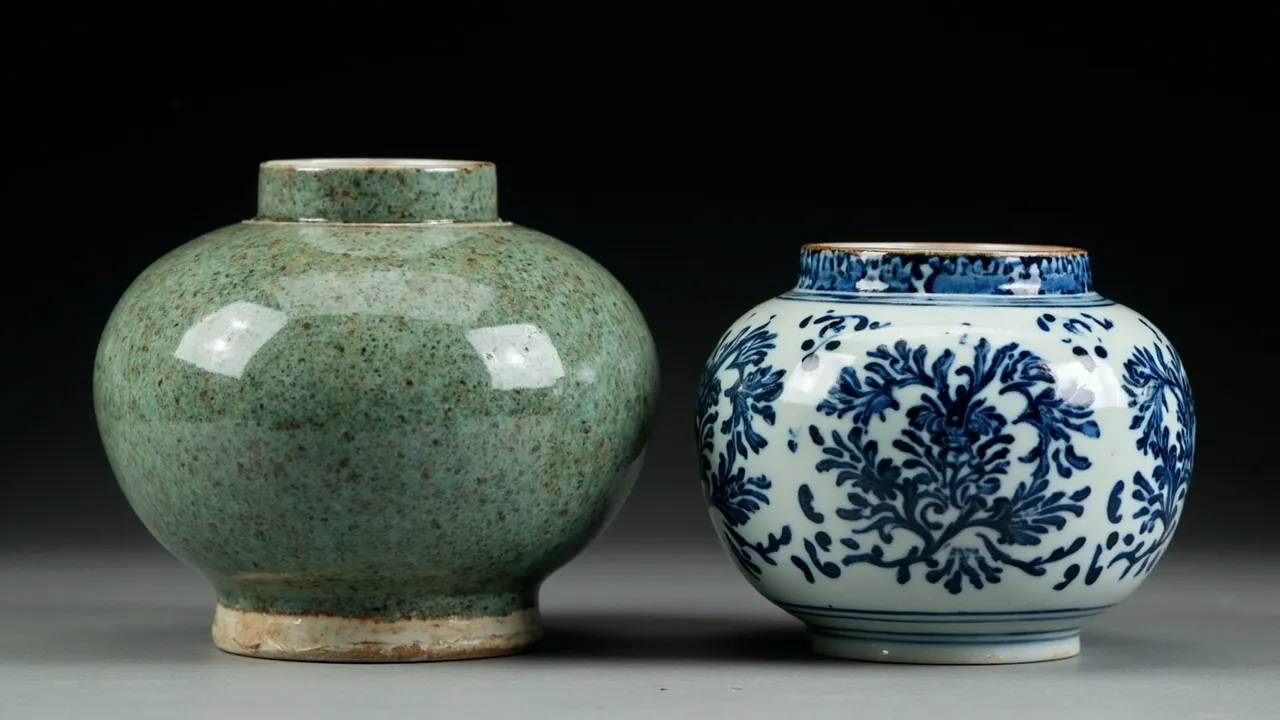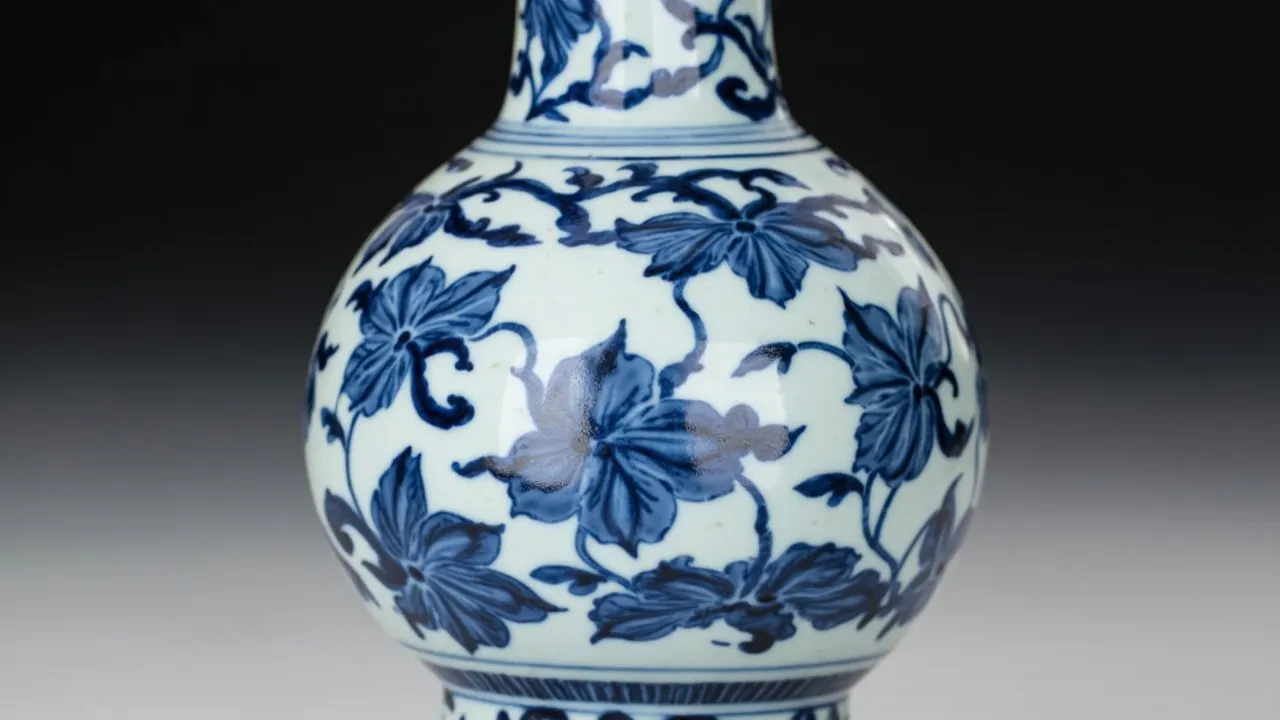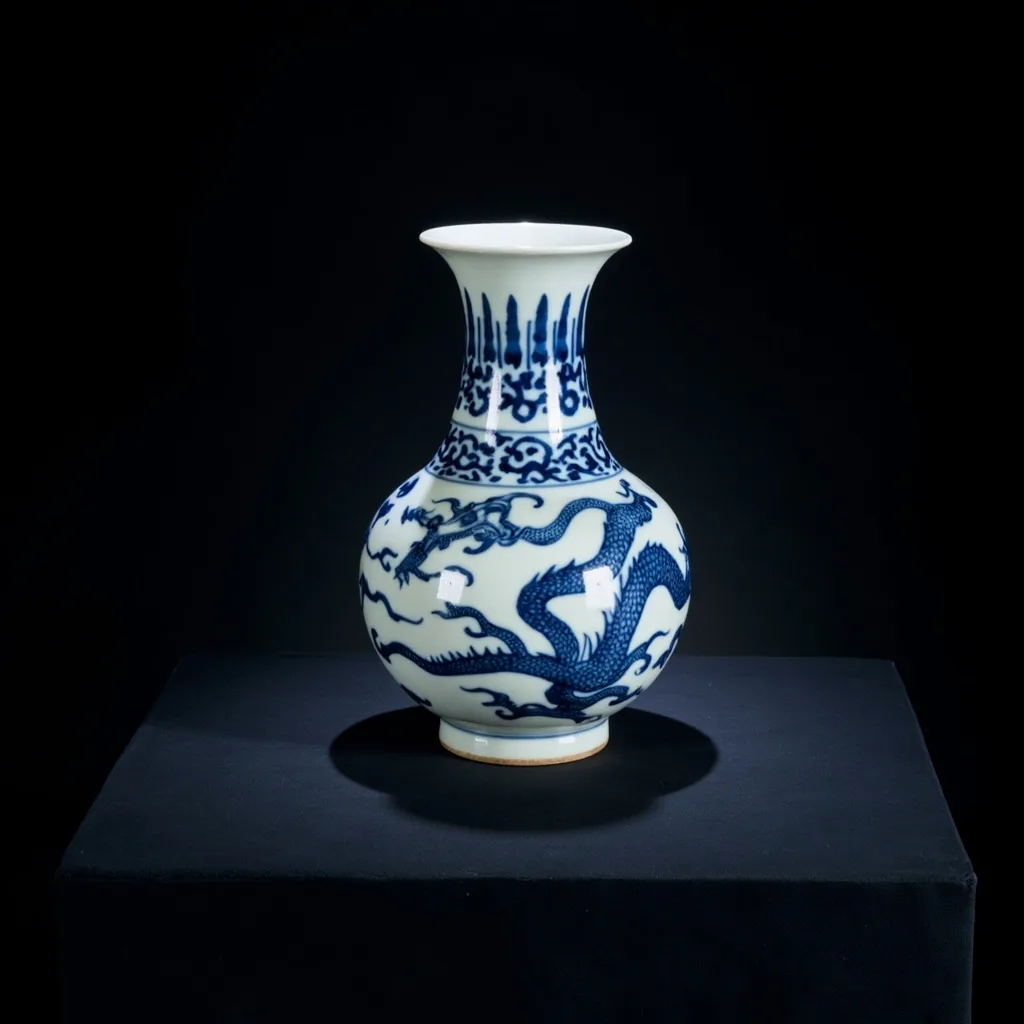
Most people can recognize a Chinese blue-and-white vase without naming what they are seeing. White background, deep blue painting, a curving shape that holds flowers or stands as a sculptural object. The pattern feels instantly identifiable. That familiarity is itself a story. A ceramic tradition that began as a luxury for one imperial family became a global visual habit, entering Dutch still-life painting, Ottoman palace decoration, English country-house cabinets, and modern kitchen shelves.
The Ming dynasty (1368–1644) and its Qing successor (1644–1911) shaped that trajectory. When the Ming founder consolidated his new state, he inherited a long ceramic inheritance and a new priority: dramatic, finely painted, cobalt-on-white porcelain that could rival anything available elsewhere. Over time, Jingdezhen, a city in Jiangxi province, became the workshop of an empire, producing wares for court, domestic market, regional trade, and international export.
For American readers, the story may sound distant. It is, in fact, a familiar kind of world story: one region perfects a material, ships it to customers who may misunderstand its makers, watches the form change as tastes shift, and lives with the consequences long after the original customers are gone.
The Material and the Recipe
Porcelain is not simply decorated white clay. The body is made from a refined mixture, often including a clay called petuntse (also spelled petuntze or baidunzi), a feldspathic rock that vitrifies at high temperatures, and a plastic clay called kaolin, after a mountain in Jiangxi where it was originally mined. Fired above roughly 1,300 °C, the body fuses into a translucent, ringing, glassy material. It is harder than most stoneware, lighter than many western faience or earthenware, and surprisingly strong for its thinness.
Blue painting uses cobalt oxide. Cobalt can produce a wide range of blues depending on the ore, the kiln, and the paint preparation. Some Chinese blue-and-white cobalt came from the Yunnan–Guizhou region; other periods used imported cobalt from Persia, often identified as Mohammedan blue or “sumali” in older sources. The cobalt was ground, washed to remove impurities, and mixed with water and binder. Painters applied it directly on the unfired, leather-hard body. The piece then went under a clear glaze, and the kiln did the rest.
High-temperature cobalt under glaze is technically demanding. A small mishap during firing, an impurity in the wash, or an iron contamination can transform a masterpiece into a kiln reject. Countless pieces were broken, buried, or downgraded across the long history of Jingdezhen’s workshops.
Decoration sits under the glaze, protected from wear, and the surface carries a soft depth, like clouds beneath ice. The cobalt’s color can blur slightly during firing, producing soft edges that many call “heaped and pooled” in English. Black spots, called “iron spots,” are sometimes visible where the cobalt was thick; they are not defects in the traditional sense but signs of concentrated pigment.
A blue-and-white vase is therefore the result of geology, chemistry, workshop organization, and painting. The imperial supply chain stretched from miners and kiln workers to imperial eunuchs, court officials, and shipping clerks. The story is not just about beautiful objects; it is about the immense labor system that produced them.
From Yongle to Xuande: Imperial Porcelain at Its Peak
Early Ming porcelain under the Hongwu emperor was conservative, in part because the founder preferred modest, practical wares. His successors, especially the Yongle and Xuande reigns (1403–1424 and 1425–1435, respectively), are associated with a flowering of the form. The imperial kilns produced bold shapes: large basins, meiping (plum vases), pear-shaped vases, slender wine cups, and a range of covered jars and dishes.
Decoration evolved from denser, more crowded composition toward clearer, more spacious scenes. Early Ming pieces sometimes used imported cobalt that fired with a rich, slightly violet tone, sometimes with bluer tints. Workshops experimented with brushes, palette balance, and subject matter. Dragons, phoenixes, lotus, peony, rocks, clouds, and waves are common. Religious and literary themes appear too, including Daoist and Buddhist motifs and even Persian-influenced designs for export and tribute contexts.
Reign marks began to appear on bases in the Xuande era. The famous Xuande six-character mark is found on many pieces; some may be authentic period marks, while others were added later. A mark on a base is not a guarantee; connoisseurship combines base mark, body, glaze, brushwork, weight, and provenance.
A 1421 shipwreck discovered near the former court of the Yongle emperor at Nanjing has provided remarkable evidence about early Ming imperial porcelain. Many pieces carry the same stylistic traits, helping scholars refine their understanding of period manufacture. Shipwreck finds in general, including later Ming cargoes, transformed our knowledge of what was actually being shipped, and to whom.
The Yongle era’s treasure fleet of Zheng He made ceremonial voyages across the Indian Ocean. Imperial porcelain, silk, and lacquer went to Southeast Asia, South Asia, the Swahili coast, and elsewhere. Objects made in China circulated in the courts of rulers who traded for them or received them as diplomatic gifts. These voyages did not introduce Chinese porcelain to the world, since the trade was already well established, but they underline how thoroughly Ming ceramics operated in a global network.
Not every piece was imperial. Ming kilns produced a wide range of wares for the domestic market, including export-quality pieces for foreign trade, temple and ritual objects, funerary figurines, and everyday tableware. Looking at Ming porcelain only through court treasures can distort the picture. Most pieces, even today, were probably middle-class or trade items rather than imperial commissions.
The Qing Continuation: New Colors and New Markets
The Qing dynasty’s conquest in 1644 did not interrupt Jingdezhen production. The new Manchu rulers inherited the imperial kiln and reinforced its importance. Kangxi, Yongzheng, and Qianlong reigns (1661–1795 in various periods) oversaw vast ceramic output.
Qing cobalt underglaze often differs visually from Ming blue. Kangxi cobalt is famed for its brilliant sapphire tone and varied shades within a single piece. Later Qing blues sometimes appear brighter, sharper, and more uniform because the cobalt supply and firing practice were standardized.
Blue-and-white remained central, but Qing kilns also developed overglaze enamel families: the famous famille verte and famille rose palettes, with greens, yellows, and pink tones added on top of the glaze. Many Qing pieces are polychrome rather than blue-and-white. Collecting them as if they were one category would miss the variety. The blue-and-white tradition continued, often with intricate, controlled drawing suited to formal display.
International trade expanded dramatically during the Qing. Dutch East India Company records, Portuguese, French, and English accounts, and Ottoman court inventories all show that Chinese porcelain entered every major economy. Dutch potters in Delft, German Meissen factories, French Saint-Cloud, and English Bow and Chelsea responded by producing their own blue-and-white imitations, often using tin-glaze to mimic the white ground.
The appetite was intense. A century of this trade in turn shaped Jingdezhen itself. Some Ming and Qing porcelains were produced in shapes suited to foreign customers: large dishes for European dining, specific wine-bottle forms, or plates designed for the Middle Eastern market. Chinese kilns also worked for Japanese tea masters, who valued a rougher, more austere style called ko-sometsuke, often called “old blue-and-white” in the trade.
Early export porcelain was sometimes called “Swatow ware” after a port, though production was not always local. Pieces shipped to the Philippines, the Americas, and Africa came from various centers and decades. Provenance can be slippery. Many supposed “Ming exports” were Qing, and many Qing objects were marketed with Ming-style decorations.
The result, in any case, is that we should not separate Ming and Qing porcelain from their export markets. They were always entangled with global desire. To treat blue-and-white as an “old China” artifact separated from a modern commercialized world is to misunderstand the trade as it actually operated.
How to Read a Blue-and-White Vase Without Being Fooled
Blue-and-white reproductions began centuries ago and continue today. Famous reigns are commonly copied. Two questions are useful: is the object old, and is the decoration correct for its claimed period?
The glaze, body, and brushwork give strong clues. Old porcelain bodies from Jingdezhen generally feel fine-grained and can show a slightly orange or white body edge where unglazed, and the glaze can have a warm, slightly milky quality. A modern copy may have a chalkier, whiter body, an overly glossy glaze, and cobalt that looks chemically bright under simple inspection. None of these clues is decisive on its own. They help a collector build a judgment, especially when combined with weight, sound, base inspection, and how the object has aged.
The base matters. A reign mark is a useful beginning, not a conclusion. Reign marks were used out of period as a gesture of respect, and later marks were often faked. A legitimate Xuande mark is rare; a Xuande-marked piece in a suburban antique mall is suspect. Even when a mark seems plausible, examine how the characters are written. A brush so skilled that the imperial factory had a special formula may be too good. Honest period marks often show small inconsistencies or natural wear. Faked marks tend to look like calligraphy book samples.
Decoration also helps. A genuine Ming dragon has a recognizable silhouette: a long body, deliberate scaling, an open mouth, and a particular relation to surrounding clouds. A Qing dragon is often more decorative and densely feathered. A 1920s vase may combine a Ming-style shape with a Qing-style drawing, which is itself a clue.
Provenance is the most powerful tool. Documentation of a piece’s history, ideally with a chain of reputable dealers and owners, can make up for many physical ambiguities. Without provenance, the best move is to learn from the object in a museum before you buy. Most world-class blue-and-white pieces are in museum collections, and seeing them in person trains the eye.
Reputable dealers explain what they know and what they do not. A dealer who guarantees authenticity without a written refund policy is not offering much. Several international organizations and auction houses publish standards, and major museums regularly publish new findings. The field is alive, and old certainties change as scholarship progresses.
If your interest is decorative, a contemporary reproduction has its own value. Cobalt blue painting in the historical style is a real craft. Hold it lightly, pay a fair price, and enjoy the design. Insisting that every blue-and-white object be a museum piece can ruin the simple pleasure of living with one on a shelf.
The Global Afterlife of a Cobalt Pattern
Even people who know almost nothing about Chinese ceramics can usually recognize the cloud collar, the double happiness character, the lotus scroll, the dragon, the prunus, the phoenix, and the bamboo-and-rock composition. Those patterns are part of modern global design. They show up on cushions, packaging, tattoos, dinner plates, and advertising.
Some uses are respectful and some are not. The line is not hard to draw. Borrowing inspiration, with credit to the source, in collaboration with Chinese artists or informed by history, is very different from cutting and pasting a vaguely “Asian” design onto a product that ignores the culture. A simple guideline: would this design make sense without attributing it to a real tradition? If the only meaning of the image is “exotic,” that is reductive.
A second guideline is scale and context. A small celebratory item that uses a fenghuang for decoration differs from a major exhibition that recasts the bird as a brand mascot. The first might be endearing; the second should explain its choices.
Museums have begun revisiting their early acquisitions. A blue-and-white plate that once read as a neutral decorative object may now be seen through histories of trade, labor, and colonial exchange. The exhibit label may name a kiln worker or describe the journey from Jingdezhen to a European dining table. That is a richer story, not a less beautiful object.
For collectors, the global afterlife matters because the market reflects these changes. Chinese museums, scholars, and government authorities have asked for the return of certain pieces. Some sales have been paused or canceled. Legal frameworks vary by country and treaty. A serious collector pays attention to ethics, not only aesthetic merit.
I find it helpful to remember that every great blue-and-white vase was a worker’s work. A sketch was approved, cobalt was washed, brushes were worn down, glazes were dipped, a kiln was loaded, and a temperature held for hours. A piece that has survived a sea voyage, a continental sale, and centuries in someone’s collection has been touched by a great many lives. Its arrival in your room is part of a long chain, not a moment of pure beauty.
A Living Tradition in a Modern World
The form is not finished. Jingdezhen remains a working ceramic city, with students, independent potters, and contemporary artists building on the blue-and-white tradition. Their cobalt work appears in galleries, on museum shelves, and on the internet, where new audiences can watch brush technique on a phone.
Some modern Jingdezhen artists use methods inherited from imperial kilns, painting classical motifs with trained discipline. Others use the same materials in unexpected ways, with abstracted or politically charged designs. Tradition and innovation are not opposites here; they are partners, the way they have always been in productive Chinese ceramic workshops.
If you visit a museum with a blue-and-white collection, go slowly. Look at a single piece for several minutes. Notice the white space. Notice the small variations in tone. Notice the foot, the rim, the base. A vase is a sentence; a wall of vases is a paragraph. The more you slow down, the more you see that Chinese porcelain is, at heart, an extreme refinement of basic human ideas about clay, fire, and pattern.
Continue Exploring Chinese Culture
For another figure whose fabled appearances also signal ordered civilization, read Huangdi, the Yellow Emperor. Fenghuang and Phoenix Mythology explains the auspicious bird that decorates many fine porcelains. The other half of that famous decorative pairing appears in Dragon and Phoenix Symbolism. And for a Tang-era imagination that shaped Chinese poetry about moonlight, rivers, and immortals, meet Li Bai, China’s Poetry Immortal.