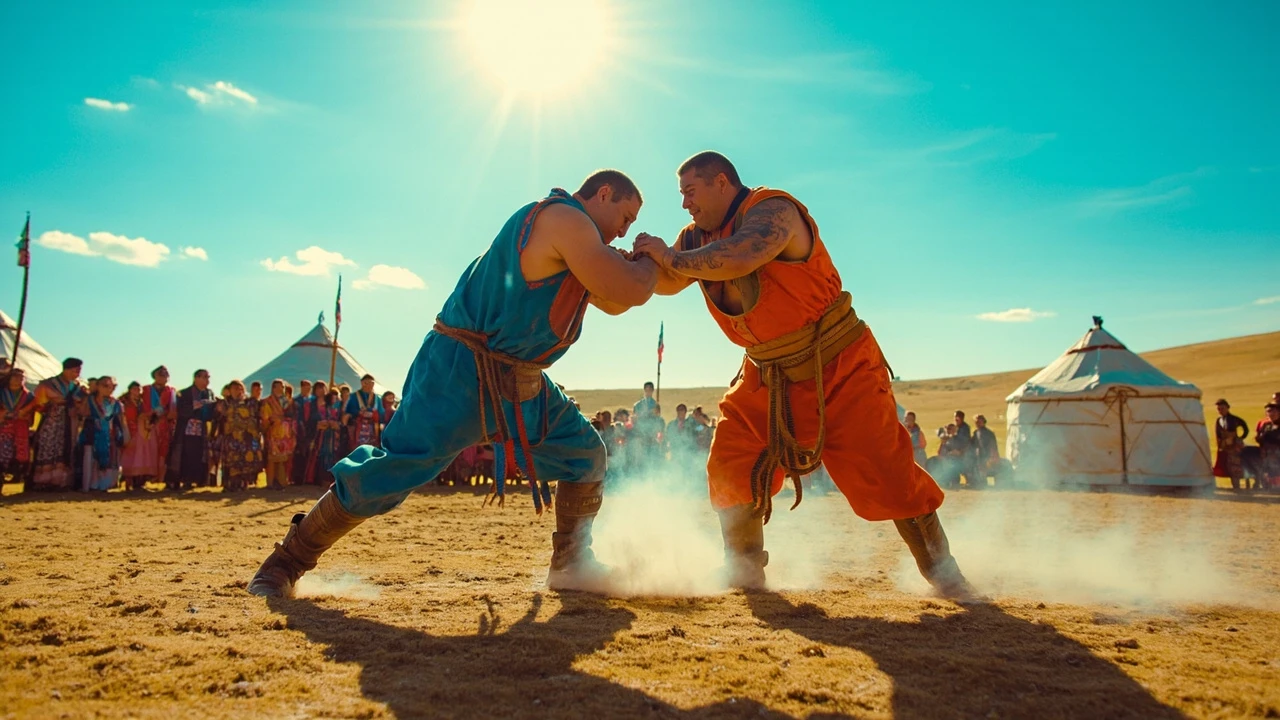
If you’ve ever seen a photograph of Mongolia — vast grasslands rolling to a hazy horizon, a blue sky so big it bends your sense of scale, a man on a small horse galloping across the steppe at full tilt — then you already have half the picture of Naadam. The other half is the dust, the shouting, the smell of roasted mutton and fermented mare’s milk, and the feeling of standing in a stadium where 30,000 people in deels (the colorful traditional Mongolian robe, often belted with silk at the waist) are watching two wrestlers lock arms while a child on a pony vanishes over the horizon.
Naadam is the biggest festival of the Mongolian year. Held in mid-summer across Mongolia and Inner Mongolia (the autonomous region of northern China), it’s the time when herders come down from the grasslands, when families gather, when children ride, men wrestle, and arrows fly. The central Naadam in Ulaanbaatar — held every July 11 and 12 — is a national holiday that draws more than half the country’s population to the capital. Local Naadams are held in every province, every county, every village. In Inner Mongolia, similar festivals happen from late June through August in cities like Hohhot, Ordos, and the grasslands around Hulunbuir.
If you’re an American trying to imagine what Naadam feels like, the closest cultural cousin isn’t the county fair or even the rodeo — it’s something like the Fourth of July, the Super Bowl, and Thanksgiving rolled into one, with horsemanship. It’s the festival that says, more clearly than any other, “this is who we are.”
The festival is built around three sports called the Eriin Gurvan Naadam — literally, the “Three Manly Games.” Wrestling (bökh), horse racing, and archery. Together they sum up the traditional Mongolian virtues: strength, horsemanship, and precision. Every Mongolian boy (and increasingly, every Mongolian girl) grows up watching these games.
This article is going to walk you through the three sports, the legends around them, the regional differences between Mongolian and Inner Mongolian Naadams, and some of the controversies — particularly the long-running debate about child jockeys — that have followed the festival into the modern era.
The Three Manly Games
The Mongolian phrase for the Three Manly Games is eriin gurvan naadam. Eriin means “manly” or “masculine,” though the games are no longer exclusively male. Naadam means “games” or “festival,” and comes from a root meaning to play or to compete. The Three Manly Games have been associated with Naadam for centuries. Today, when people refer to Naadam, they almost always mean these three sports in particular.
Wrestling (Bökh)
Mongolian wrestling is the most visually striking of the three. Two wrestlers, both stripped to the waist except for a small open-front vest called a zodog, step into the circle. The vest is deliberately designed so the chest and stomach are bare — a wrestler can be picked up by the chest without the opponent’s hands slipping off. Wrestlers wear tight-fitting briefs (shuudag) and traditional Mongolian boots (gutal). Their hair is tied back in a topknot, and a length of ribbon may be tied around the waist. The whole costume is meant to be both functional and beautiful.
The rules are simple. A wrestler wins when his opponent touches the ground with any part of the body above the elbow or knee. Both hands and one knee can be on the ground; that’s fine. Elbow down, that’s a loss. There’s a single referee per bout. There are no weight classes. There are no time limits in the traditional rules — a wrestler wins as long as the bout lasts, and on a long day at the festival, bouts can stretch on for hours.
A wrestler who wins seven bouts in a local Naadam earns the title of zassan. One who wins seven at the central Naadam in Ulaanbaatar earns the title of arslan. The highest title of all is avarga, won by a wrestler who defeats every opponent at the central Naadam. An avarga earns a miniature silver cup as a trophy — the design hasn’t changed in centuries.
The wrestling has its own rituals. Before each bout, the wrestlers step into the ring and perform an eagle dance, arms spread wide like a soaring bird. The gesture isn’t merely decorative — it’s a declaration of intent and a salute to the ancestors. Each wrestler has a yöröl (a ceremonial poem praising his qualities and listing his past victories) shouted before his bout by an otogch (a kind of herald or hypeman). At Naadam, the air fills with the chants of these heralds, each one trying to outdo the others in praising his wrestler.
Horse Racing
If wrestling is the soul of Naadam, horse racing is the spectacle. The races are held on the open steppe, sometimes a few kilometers outside town. Distances vary — there are short sprints for two-year-olds, middle distances for adult horses, and the famous long-distance races that can cover 30 kilometers or more. There are no saddles. The jockeys are children, usually between five and twelve years old, and this is the part of Naadam that has drawn the most international attention.
Why children? Because they’re light. A 25-kilogram child puts much less stress on a young horse’s back than a 70-kilogram adult, which means a horse can develop its racing abilities earlier and last longer. There’s also a long tradition that says children have less fear than adults, and that a small body is more aerodynamic on horseback. The races are run with a mix of traditional pre-start rituals (the horses are lined up behind a rope, riders wait for the signal) and rough-and-ready organization. In Mongolia, spectators often crowd the finish line on horseback or in vehicles, and a stampede of small horses coming over the steppe at full gallop is one of those sights you don’t forget.
The controversy is real and has been for decades. International animal welfare organizations have documented horse deaths and injuries at Naadam races, and children have sometimes been hurt when thrown from horses. Beginning around 2010, Mongolia’s government tightened regulations: minimum age limits for jockeys, mandatory helmets, limits on race distances for young riders, and stricter veterinary oversight. Inner Mongolia has followed a similar trajectory.
Cultural defenders point out that the practice is centuries old, that families depend on the income from successful racehorses, and that the children themselves are usually willing participants from horse-handling families. Critics counter that small children shouldn’t ride uncontrolled horses at full gallop. Both sides have a point, and the festival is in the middle of a slow transition that will probably take another generation to settle.
Archery (Surkharban)
The third manly game is archery. Each archer fires twenty arrows at a target made of cork or leather — the targets are usually stacked in groups, with small leather cups or cylinders positioned along the top of a low wall. The scoring is cumulative: an archer whose twenty arrows land closest to the target wins.
Traditional Mongolian archery uses a composite bow — layers of wood, horn, and sinew glued together — that’s smaller and more curved than a Western longbow. Modern Naadam archers often use more standardized equipment for fairness, but the traditional bow is still prized. The competition is usually conducted with a kind of courtly formality: archers take turns in order, their companions sing the yöröl (praise poem) for each archer as they step up to shoot, and misses are greeted with a kind of ritualized sympathy from the crowd.
Winners receive titles, horses, and other honors. The archery competition at the central Naadam is one of the more photographed events, because the bows, the colorful deels, and the open sky make for dramatic images.
The Origin Story: Genghis Khan and the Founding of Naadam
Like many festivals with deep roots, Naadam has both an official origin story and a more complicated historical reality.
The official story says that Genghis Khan instituted the Three Manly Games in 1206, the year he unified the Mongol tribes and was proclaimed Khagan of the Mongol Empire. According to this account, Genghis wanted to keep his warriors fit, his commanders sharp, and his people unified through shared tradition. The Three Manly Games became an annual event at the imperial court.
The historical reality is more layered. There’s no question that wrestling, horse racing, and archery were central to Mongolian life long before Genghis Khan — archaeological evidence from the Xiongnu and other steppe empires (the Xiongnu were a confederation of nomadic peoples who dominated the Mongolian steppe from about the 3rd century BCE to the 1st century CE) suggests that all three activities were practiced as both sport and military preparation for over two thousand years. What Genghis Khan and his successors likely did was to formalize the combination of the three into a single annual festival and connect it to the imperial calendar.
The yöröl — the praise poems shouted before wrestling bouts and archery — come from this imperial era. Some of the most famous yöröl date to the Yuan Dynasty (1271-1368), when the Mongol Empire extended from Korea to Eastern Europe and the imperial court sponsored enormous Naadam gatherings. The Mongol conquest of China and the establishment of the Yuan Dynasty by Kublai Khan spread the games across a vast territory.
After the Yuan collapsed and the Mongols retreated to the steppe, Naadam continued in local forms. By the Qing Dynasty (1644-1912), when the Mongols were under Manchu rule, Naadam had become both a religious and political festival, often held at monasteries during Buddhist holidays. The Qing authorities allowed the festivals but tried to keep them under imperial oversight, and the yöröl were sometimes censored to remove anti-Qing sentiment.
The modern revival of Naadam as a national holiday came in 1922, when the Mongolian People’s Republic (the Soviet-aligned communist government) established the central Naadam in Ulaanbaatar as a state event. The date was originally set as August 1, but in 2003 was moved to July 11, the anniversary of the 1921 revolution that established communist rule. This made Naadam both a celebration of traditional culture and an anniversary of modern political change.
In Inner Mongolia (the Chinese autonomous region), Naadam has a more complicated recent history. During the Cultural Revolution (1966-1976), Naadam was banned as feudal and bourgeois, and many traditional Mongolian cultural practices were suppressed. Since the 1980s, the festival has been revived, and major Naadam gatherings are now held annually in cities across Inner Mongolia. The Inner Mongolian version is sometimes called Naadam and sometimes Na’er, and it incorporates Chinese-language elements alongside the traditional Mongolian ones.
The Festival Itself: What It Looks Like
If you arrive in Ulaanbaatar in early July, the city is already buzzing. Hotels are full. Planes from Beijing, Seoul, Tokyo, and Moscow are packed with tourists and returning diaspora Mongolians. Souvenir stalls pop up around Sükhbaatar Square selling everything from cashmere sweaters to miniature wrestling figurines.
The central Naadam opens on July 11 with a ceremony in the national stadium. The President of Mongolia arrives. There’s a parade of athletes, military units, and cultural delegations. Each province sends a team wearing its own distinctive deel, often with regional embroidery and hat styles that distinguish the Khalkha Mongols of the central provinces, the Buryats of the north, the Oirats of the west, and the Kazakhs of the far west.
The opening ceremony includes performances of traditional music, dance, and throat singing (khoomei). This is the Mongolian vocal technique where a single performer produces two or three notes simultaneously — a fundamental drone, a high whistle-like overtone, and sometimes a rhythmic undertone. American listeners sometimes describe it as sounding like bagpipes; it’s actually closer to a one-person choir.
The three days of Naadam then unfold. Wrestling goes all day in the stadium, with hundreds of bouts. The archery and horse racing happen on the outskirts of the city, and you can wander out to the racecourse on the steppe and watch the long-distance races finishing in the dust. Food is everywhere: buuz (steamed dumplings, the Mongolian cousin of Chinese baozi or Russian pelmeni), khuushuur (fried meat pies), and airag (fermented mare’s milk, mildly alcoholic and an acquired taste for most outsiders).
The atmosphere is part county fair, part Olympics, part family reunion. Mongolians travel from the countryside to Ulaanbaatar for Naadam, sometimes sleeping in gers (the round felt tents Americans usually call “yurts”) pitched in parks or relatives’ yards. The whole city takes on a festive, slightly chaotic, slightly euphoric feel.
Local Naadams in Inner Mongolia are similar but smaller and more intimate. The Ordos Naadam in Inner Mongolia draws tens of thousands of spectators and includes a strong showing of equestrian events. The Hulunbuir grassland Naadam in the far northeast of Inner Mongolia is famous for its horse racing and its display of traditional Mongolian life — herds of sheep and horses moving across the steppe, families in full traditional dress, eagle hunters displaying their birds.
The Deel and Other Traditions
The traditional Mongolian robe, the deel, is itself a cultural symbol — a long, wrapped garment, buttoned at the shoulder and tied with a sash at the waist. The design varies by region, age, and occasion. Married women wear different colors from unmarried women; herders wear practical sheepskin deels; dancers wear silk with brocade borders. The four-peaked hat worn by the Khalkha Mongols is said to represent the four cardinal directions. At Naadam, these distinctions are on full display — you can tell at a glance which province someone is from. The festival is partly a fashion show.
Other Naadam traditions include the ritual of the Dezhii (a sacred cairn of stones where worshippers make offerings of dairy and blue silk), the display of the Nine White Banners (representing the nine original tribes of the Mongol Empire), and the khuumiin (throat singing, now on UNESCO’s Intangible Cultural Heritage list).
Eagle Hunting: A Related Inner Asian Tradition
Strictly speaking, eagle hunting isn’t part of Naadam proper, but it’s a closely related steppe tradition worth knowing.
Eagle hunting is the Kazakh and Kyrgyz practice of training golden eagles (berkut) to hunt foxes, hares, and young wolves across the snow-covered steppes of Central Asia. The tradition is strongest in the Kazakh regions of western Mongolia — particularly Bayan-Ölgii province — and in the Kazakh communities of Xinjiang in northwestern China. Eagle hunters travel to the annual Golden Eagle Festival in Ölgii each October to display their eagles and compete. The festival has become a major tourist draw, and the partnership between hunter and bird — birds with six-foot wingspans and unsettlingly focused gazes, often developed over years — is one of the great human-animal relationships of the steppe.
If you visit Mongolia in summer for Naadam and have time to travel west, the eagle hunters of Bayan-Ölgii are a stunning cultural counterpoint to the central festival.
Mongols Across Borders: Naadam and Identity
Naadam also quietly does important work connecting Mongols across national borders.
There are roughly 10 million Mongols in the world. About 3.4 million live in the independent country of Mongolia. Another 6 million live in the Inner Mongolia Autonomous Region of China. Smaller communities live in Russia (the Republic of Buryatia, the Republic of Kalmykia, the Tuva Republic), in Kazakhstan, and in diaspora around the world. Each has its own version of Naadam or a similar festival: the Buryats have Surkharkhan, the Kalmyks celebrate Tsagan Sar, the Torguud Mongols of Xinjiang have their own gatherings.
In the early 2000s, the Chinese government was wary of Inner Mongolian Naadams as potential focal points for ethnic Mongolian cultural nationalism. Over time, the festivals have been accommodated as expressions of ethnic minority heritage — there’s even a “Chinese Mongolian Naadam Festival” that has become a tourist attraction in Hohhot and Ordos. Across all these communities, Naadam-like events become opportunities for Mongols in different countries to maintain cultural contact, even when politics makes that contact complicated. The games themselves are a kind of quiet diplomacy.
A Note on Visiting Naadam
Mongolia is one of the least densely populated countries on earth, and getting around requires either internal flights or patience on rough roads. Inner Mongolia is much more accessible — direct flights from Beijing to Hohhot are short and frequent.
July in Mongolia can be surprisingly warm — up to 30°C in Ulaanbaatar during the day, with cool nights. Dust is the main issue. Bring layers, sunscreen, and a willingness to try unfamiliar meat and dairy dishes. Book accommodation months in advance — Ulaanbaatar fills up completely. Budget at least three days. If you want to see horse racing in a more relaxed setting, get out of the city on day two or three and find a local racecourse. And if you have the chance to stay with a Mongolian family in a ger on the steppe, take it.
Recommended Products
A few items that can help you bring a bit of the Mongolian steppe into your home:
- mongolian-yurt-model: A miniature model of a Mongolian ger (yurt) — a beautiful desk object and a great conversation starter.
- horse-breed-figurine: A figurine of a Mongolian horse, the small, tough breed that has carried Mongol riders across Asia for centuries.
- archery-set-asian: A traditional Asian-style archery set for beginners, perfect for trying your hand at one of the Three Manly Games.
- traditional-deel-clothing: A traditional Mongolian-style deel robe or accessory for cultural events or costume.
- steppe-history-book: A well-researched book on the history of the Mongol steppe empires, including Genghis Khan and the Naadam tradition.
Conclusion
The Three Manly Games are an old answer to a question that remains urgent: how does a small nation on the edge of a vast continent remember who it is? Mongolia has been invaded, occupied, and reshaped many times. The empires built by Genghis Khan’s descendants ruled half the world, and then they fell apart. The Qing Dynasty ruled Mongolia for nearly three centuries, and then they fell too. The Soviet Union transformed Mongolian society for seventy years, and then it too dissolved. Today Mongolia sits between two enormous neighbors, China and Russia, and its identity as a distinct people depends on continuities that no political rearrangement can erase.
Naadam is one of those continuities. A child on a small horse, a wrestler in an open vest, an archer with a composite bow — these are images that say “Mongolia” more clearly than any flag or anthem. They say it in a way that tourists can photograph but that Mongolians feel in their bones.
If you ever have the chance to attend, take it. You don’t have to understand every ritual or know every yöröl. Just stand on the steppe with the dust in the air and the children galloping past, and you’ll know what Naadam is.