Nezha Trampling the Sea: The Boy God Who Defied the Dragon King
There are few figures in Chinese mythology more electrifying than Nezha. Born with divine power pulsing through his veins, raised by a Buddhist monk in a coastal Chinese town, and destined to clash with one of the most fearsome deities in the celestial bureaucracy, Nezha’s story has thrilled Chinese audiences for over a thousand years. The tale of Nezha Trampling the Sea (哪吒闹海) is not just an adventure story — it’s a meditation on justice, family obligation, and the radical proposition that even a child can stand up to corruption and win.
Most Western audiences first encountered Nezha through the extraordinary 2019 animated film Ne Zha, which broke box office records across Asia and introduced millions to this fiery young deity. But the legend itself is far older, reaching back to the Ming dynasty novel Investiture of the Gods (封神演义) and even earlier sources in Buddhist and Taoist scripture. If you’ve ever wondered what makes Nezha such an enduring cultural icon, pull up a seat. This one’s worth your time.
The Miraculous Birth of a Deity
The story begins, improbably enough, with a father who couldn’t have been less prepared for what was coming. Li Jing was a military commander stationed in Chentangguan, a garrison town along China’s northern coast. He was a man of duty, discipline, and absolutely no experience with the supernatural. His wife, Lady Yin, was pregnant for three years and six months — an impossibly long gestation that had the whole household scratching their heads.
When the baby finally arrived, it wasn’t a typical infant that emerged. According to the legend, the child materialized inside a giant red sphere, a cosmic egg that floated into Lady Yin’s chambers during a violent thunderstorm. Li Jing, alarmed and confused, drew his sword and sliced open the sphere. What tumbled out was a bouncing baby boy, already able to walk and talk, wearing a red sash and golden bracelets on his wrists.
But this wasn’t an ordinary child. The sphere had contained one of the most powerful spiritual entities in the universe: a pearl incarnation sent from the heavens. The boy was named Nezha — a corruption of “Nalakuvara,” a deity from Buddhist tradition — and from his first breath, he radiated divine energy.
A local Taoist master named太乙真人 (Master Taiyi) recognized the child’s extraordinary origins and took him as his disciple. Under Taiyi’s guidance, Nezha trained in martial arts and magic. He received three treasures that would define his legend: the Wind Fire Wheels (风火轮), a pair of flaming discs that let him fly at incredible speeds; the Cosmic Ring (乾坤圈), a golden bracelet with devastating offensive power; and the Red Silk String (混天绫), an enchanted cloth that could bind even the strongest opponents.
With these gifts, Nezha became virtually unstoppable. But raw power without wisdom can be a dangerous thing, and the legend was about to take a dark turn.
The Dragon King’s Tyranny
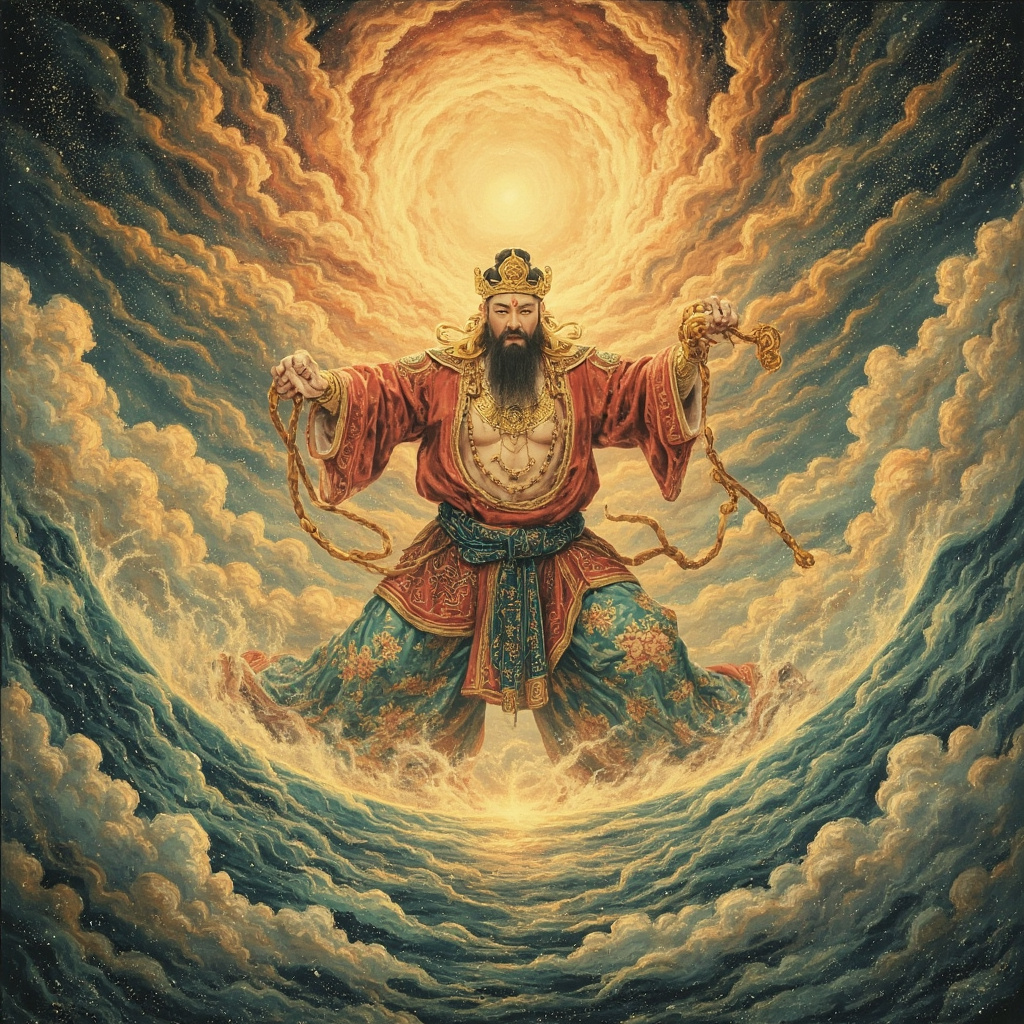
About thirty miles from Chentangguan lay the Eastern Sea, a vast body of water ruled by Ao Guang, the Dragon King of the Eastern Sea (东海龙王敖广). In Chinese cosmology, the Dragon Kings were not merely powerful creatures — they were divine bureaucrats, responsible for controlling weather, storms, and floods across the empire. Their authority came from the Jade Emperor himself, and they wielded it with varying degrees of benevolence.
Ao Guang, unfortunately, fell firmly into the “tyrannical” category. The legend paints him as a petty, vindictive ruler who cared little for the suffering of ordinary people. He demanded regular human sacrifices from the coastal villages, treating the mortals in his domain as little more than subjects to be taxed and terrorized. Local fishermen lived in constant fear, forced to surrender their best catches and even their children to appease the dragon’s insatiable appetite.
It was into this climate of fear that the teenage Nezha wandered one scorching summer day. The boy had grown into a wild, headstrong youth with incredible abilities and very little supervision. He came to a particular inlet called Nine Crimson River Bend (九河湾), where he happened upon some local boys playing by the water. They challenged him to prove his bravery by swimming out to a set of rock pillars and back.
Nezha, never one to back down from a dare, plunged into the water. What the boys hadn’t told him was that those pillars were the property of the Dragon King — specifically, they were the support posts of the Dragon King’s underwater palace. When Nezha dove down, he accidentally crashed straight into the palace’s outer walls, shattering them like glass.
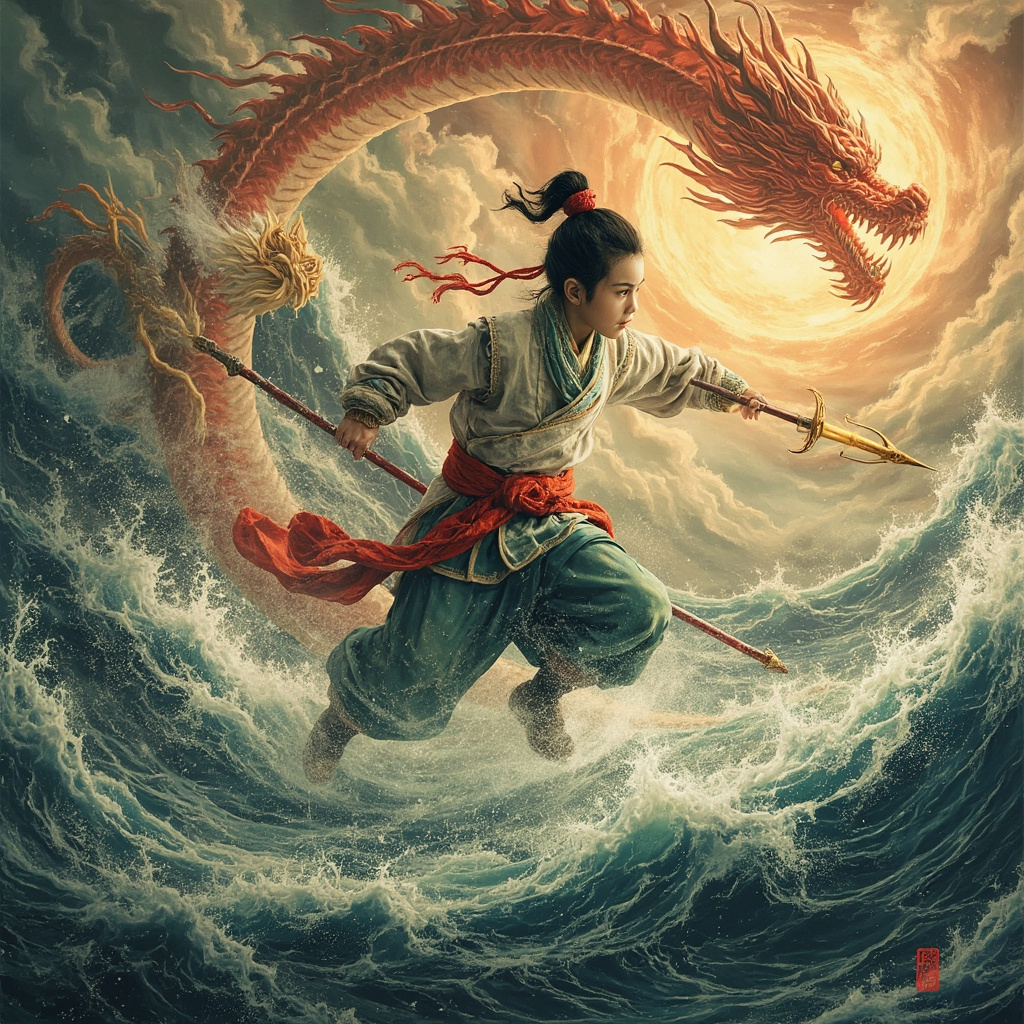
The Dragon King’s palace guards swarmed him, but Nezha fought them off with terrifying ease. He grabbed the Red Silk String and began thrashing it through the water, creating currents that stirred the entire sea into chaos. The Dragon King’s soldiers were beaten back, and in the confusion, Nezha did something truly audacious: he plucked a dragon scale right off the Dragon King’s own body.
When Ao Guang emerged to confront this interloper, he found himself facing a teenage boy who showed no fear whatsoever. Nezha’s audacity shocked even the Dragon King. Here was a child who had literally ripped a scale from a divine ruler’s body and was standing there, still ready to fight.
The Boy’s Defiance and the Dragon’s Revenge
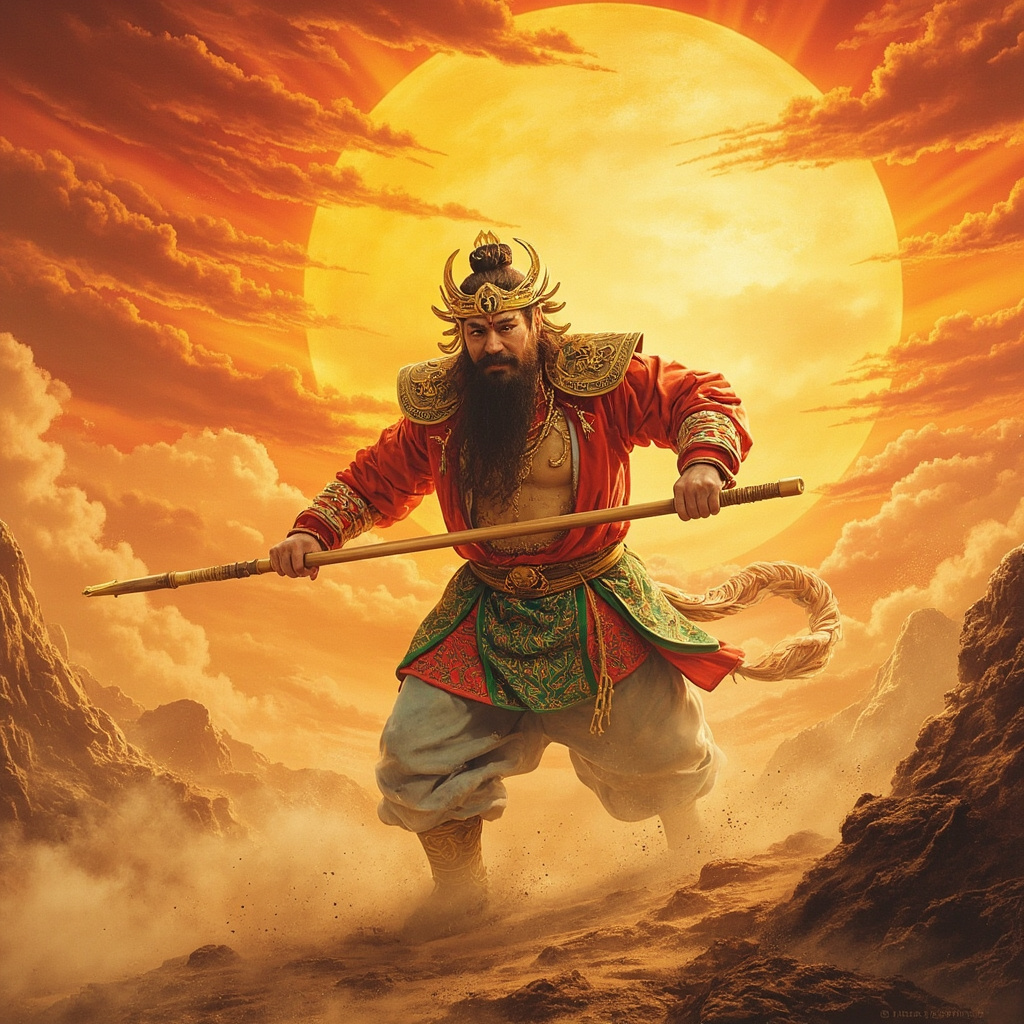
The encounter could have ended there, but Ao Guang was too proud and too furious to let the insult pass. He decided to teach Nezha — and by extension, all mortals — a brutal lesson. The Dragon King summoned his fellow dragon kings from the four seas and together they hatched a plan: they would freeze the sun, plunge the world into eternal darkness, and freeze the rivers and crops, destroying the harvest and starving millions into submission.
The dragons’ logic was simple and vicious: if mortals didn’t learn to fear them, they would make them suffer until they did.
When Nezha learned of this plan, he was horrified. He hadn’t meant to start a war — he’d just been swimming, and the Dragon King’s palace happened to be in the way. But the dragon’s plan to punish innocent villagers for his own transgression was unforgivable.
This is where the legend takes its most dramatic turn. Rather than flee or bow to the dragons’ demands, Nezha did something that would become the defining moment of his story: he chose to sacrifice himself to save the people.
He knelt before his father Li Jing and mother Lady Yin and told them what he intended to do. Then, in a scene that has moved Chinese audiences for centuries, Nezha drew his sword and cut his own flesh from his bones, returning his body to his parents in an act of supreme filial devotion. He wrote his father’s name across his palm as a final gesture of respect, then used his own hair to tie his bones together and present them formally to his parents.
The dragons, seeing that their leverage had evaporated and that Nezha’s death had removed any excuse for their planned retribution, withdrew their threat. The world was saved, but at an unimaginable cost.
Resurrection and Cosmic Vindication
Death, however, was not the end for Nezha. Master Taiyi, his Taoist teacher, had always known that this boy’s destiny was far greater than a simple life in Chentangguan. When he learned of Nezha’s self-sacrifice, he immediately set about bringing the boy back.
Master Taiyi gathered Nezha’s remains and took them to a place called Mount Wenshan, where he performed an elaborate resurrection ritual. He reconstructed Nezha’s body using lotus roots — a plant associated with purity and rebirth in Chinese culture — and breathed new divine energy into the reconstructed form. When Nezha opened his eyes, he was reborn as an even more powerful being, with the ability to shapeshift and command supernatural forces far beyond what he’d possessed before.
Armed with his new abilities and a body made of imperishable lotus root, Nezha was finally ready to settle accounts with the Dragon King once and for all. The two clashed again, and this time Nezha was utterly dominant. He beat Ao Guang so thoroughly that the Dragon King was forced to flee his own palace and transform into a small, pathetic snake to hide among the rocks.
Nezha captured the snake and was about to kill it when his father Li Jing, horrified at the idea of his son killing a divine being, intervened and forced Nezha to release the Dragon King. The humiliated dragon king fled to the heavenly court to petition the Jade Emperor for justice.
But when the Jade Emperor heard the full story — the Dragon King’s tyranny, his demand for human sacrifices, his plan to freeze the world out of spite — he didn’t punish Nezha. Instead, he recognized the boy as a true defender of the innocent and formally inducted him into the celestial bureaucracy as a deity of the Five Stars and a guardian against evil spirits.
Why Nezha Still Matters Today
The legend of Nezha has persisted for so long not because it’s a simple story of good versus evil, but because it grapples with genuinely complex moral questions. Nezha is impulsive, hot-headed, and occasionally reckless — he’s not a perfect hero, and the legend doesn’t pretend he is. But when it mattered most, he was willing to sacrifice everything for people who hadn’t asked him to protect them.
There’s also something profoundly subversive about the story’s treatment of authority. The Dragon King isn’t some foreign villain — he’s a government official, a bureaucrat with the Jade Emperor’s official sanction to rule the seas. His tyranny is systemic, backed by divine authority, and almost impossible to challenge through normal means. Nezha’s victory is the victory of individual courage over institutional corruption, a theme that resonates just as strongly today as it did a thousand years ago.
The story also speaks to the tension between filial piety and personal conscience. Nezha’s self-sacrifice isn’t just an act of heroism — it’s the ultimate expression of his devotion to his parents, even as his actions repeatedly brought shame and danger upon their household. Chinese audiences have long debated whether Nezha’s choice was the right one, and that ambiguity is part of what keeps the story alive.
Products Related to the Nezha Legend
If this story has sparked your interest in Nezha and Chinese mythology more broadly, here are some products that bring this legend to life:
1. The Legend of Nezha (Chinese Edition) — A beautifully illustrated Chinese-language edition of the classic novel that first popularized the Nezha story, perfect for readers exploring original sources.
2. Chinese Mythology for Kids — An accessible introduction to stories like Nezha’s, designed for younger readers but engaging enough for adults new to Chinese folklore.
3. Nezha Action Figure Collection — Highly detailed collectible figures based on the 2019 film’s iconic designs, featuring the Wind Fire Wheels and Cosmic Ring accessories.
4. Chinese Dragon King Statue — An ornate handcrafted statue depicting Ao Guang in his full divine regalia, perfect for collectors of Chinese mythological art.
5. Traditional Chinese Mythology Books — A curated collection of foundational texts including Investiture of the Gods, the novel that first told Nezha’s full story in print.
Last updated: 2026-01-05