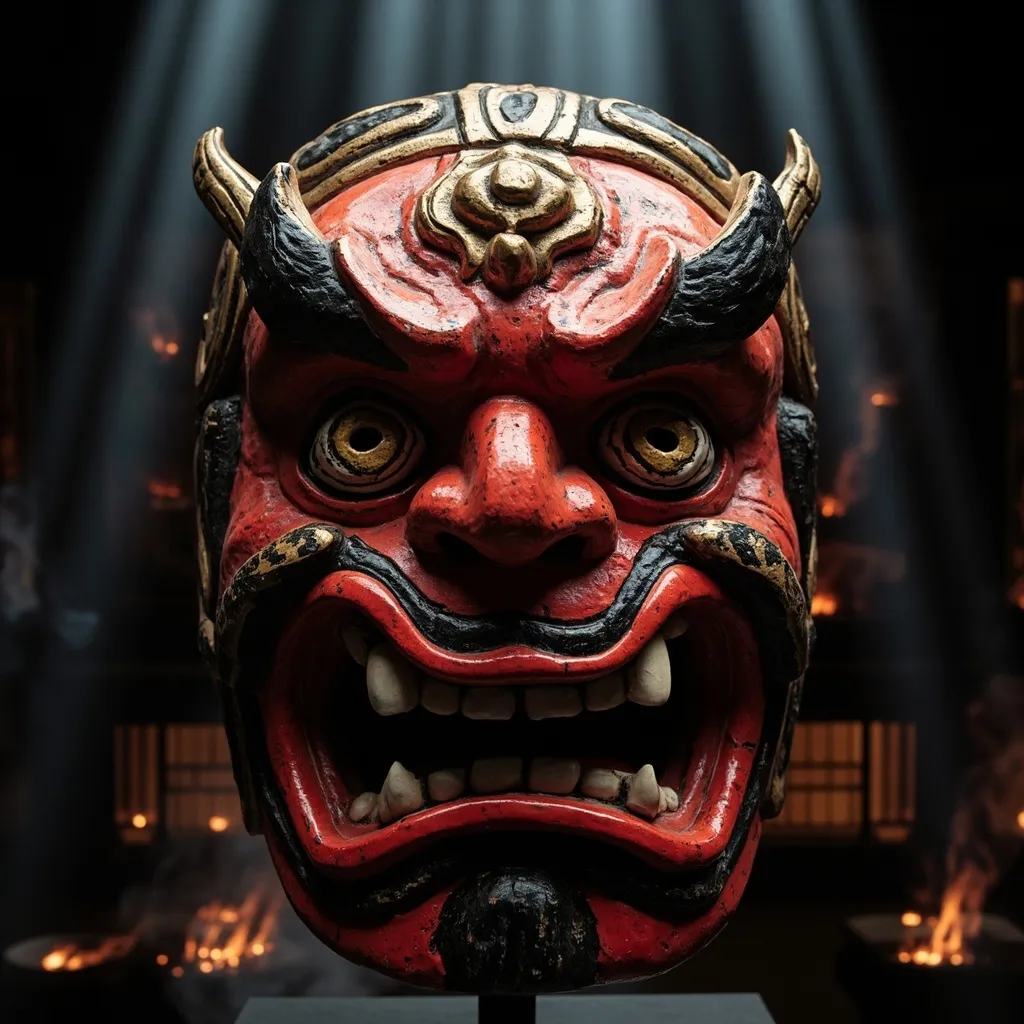
The performance begins at dusk. The musicians take their positions — gongs, cymbals, and a double-headed drum that drives everything — and from backstage, a figure emerges that is not quite human. The mask is wooden, painted with bold geometric patterns: a white forehead, red cheeks, black lines descending from the eyes like tears or claw marks. The body beneath the costume moves with a deliberate, slightly unnatural precision, each step placed exactly, the gestures sharp and ritualized. The actor does not speak at first. He moves through a sequence of symbolic actions — drawing a sword from its scabbard, making passes through the air as if cutting something invisible, stamping each foot in turn — and the audience watches in the particular silence that belongs to performances that are also prayers.
This is Nuo Opera (傩戏, Nuó xì), and it is one of the oldest continuously performed theatrical traditions in the world. It is performed by volunteers in villages across China, primarily in rural areas, at specific times of the year tied to the agricultural calendar. It is not performed for entertainment, or not primarily for entertainment. It is performed to expel malevolent spirits, to propitiate the gods, to ensure that the coming season will bring health and fertility and freedom from disaster. The actors are mediums. The masks are the faces of the deities they channel. The stage is a sacred space temporarily demarcated from the profane world around it.
Understanding Nuo Opera requires setting aside the Western theatrical framework of drama as entertainment and drama as narrative. Nuo is ritual theater — its purpose is to effect change in the world through symbolic action, much as a prayer effects change through spoken word. The “plot” of a Nuo Opera performance is secondary to its function. A typical performance depicts encounters between divine warrior figures (often versions of historical figures who have been deified) and demons or malevolent spirits that threaten the community. The divine figures win — they always win — and that victory is the whole point. The audience is not watching a story. They are witnessing the repulsion of evil.
This article covers the origins and early history of Nuo Opera, the extraordinary masks that are its most visually striking element, the six major regional traditions and how they differ, the relationship between Nuo Opera and Japanese Noh theater, and the challenges facing the tradition today as China modernizes and rural populations decline.
Three Thousand Years of Exorcism: The Origins
The roots of Nuo Opera go back to the Zhou Dynasty (1046-256 BCE), making it potentially the oldest theatrical form in continuous performance anywhere in the world. The word nuo (傩) appears in texts from the Spring and Autumn period (771-476 BCE) and the Han Dynasty (206 BCE-220 CE), where it refers to rituals of exorcism performed by court officials to expel epidemic diseases and malevolent spirits at specific times of year, particularly at the New Year. These early Nuo rituals were state religious ceremonies involving officials wearing masks and animal skins, performing ritual dances, and chanting invocations to drive away demons.
The historian Sima Qian (司马迁), writing in the 1st century BCE, describes a Han Dynasty court ritual called the “Great Nuo” (大傩) in which a thousand participants, including children, processed through the palace grounds beating drums and carrying effigies of demons, which were then expelled from the city. The children’s role was to shout “Nuo! Nuo! Nuo!” — the verbal component of the exorcism, a kind of spoken rejection of the unwanted spirits. This ritual was public, state-sponsored, and mandatory: everyone participated, from the emperor down.
What happened over the centuries is that the ritual migrated from the imperial court into rural villages and took on more localized, more personal character. By the Tang and Song Dynasties, the great state Nuo rituals had largely been absorbed into Buddhist and Daoist religious practices, but in villages throughout China, a more grassroots form of Nuo had taken root — village-based performances tied to local temple festivals, harvest celebrations, and life-cycle events (weddings, funerals, the birth of children). The village Nuo kept the essential structure: masked performers, ritualized movement, divine warrior characters defeating demonic ones — but it became localized, adapted to local deities and local conditions.
By the Ming and Qing Dynasties (14th-20th centuries), Nuo Opera had crystallized into the recognizable regional traditions that survive, in diminished form, today. Each region developed its own repertoire of plays, its own mask styles, its own musical traditions, and its own relationships with local religious practice. What connects them all is the mask: without the mask, there is no Nuo. The mask is the physical locus of the divine, the object through which the deity enters the performance and the human performer becomes something more than a person in costume.
The Masks: Faces of the Divine
If you see only one Nuo Opera mask, you will remember it. These are not delicate theater props. They are large (covering the entire face), heavy (carved from single blocks of wood, often poplar or cypress), and visually arresting in their use of color and pattern. A Nuo mask is painted in bold, high-contrast colors — pure white, fierce red, deep black, gold — with geometric patterns that follow strict symbolic rules. The expression is fixed, which means that the mask conveys a single emotional state throughout the performance, whether or not it suits the dramatic moment.
The masks represent several categories of divine and heroic figures. The most common are the Shenjiang (神将) — divine generals — fierce-faced warrior deities who are the protagonists of most Nuo plays, driving out demons and establishing protective boundaries around the community. Other common mask types include the Gongzhu (公主) — princess figures — who appear in more narrative-driven plays, and various historical or legendary figures (Guan Yu, the general; Mazu, the sea goddess; the Monkey King, Sun Wukong) who have been absorbed into the local Nuo tradition and given masks appropriate to their character.
The colors are not arbitrary. Red on a Nuo mask generally indicates loyalty, courage, and martial prowess — a red-faced deity is a warrior. White indicates severity, coldness, or death — a white mask is often an elder figure or a deity associated with the underworld. Black indicates impartiality, integrity, and moral strength. Gold indicates divinity — a golden-faced mask represents a deity at the highest level of the celestial hierarchy. These conventions are consistent across most regional traditions, which means that an experienced observer can read a mask’s character and role without knowing the specific regional tradition or the specific play.
Making a mask is itself a ritual act. The raw wood must be sourced with appropriate ceremonies; the carver must observe taboos during the making process (no eating of certain foods, no sexual activity, no work on certain days); and the completed mask must be “opened” — animated through a ritual that invites the deity’s spirit to inhabit it — before it can be used in performance. An unopened mask is just wood. An opened mask is a living presence. This distinction is not metaphorical in the Nuo tradition — practitioners genuinely believe that during performance, the deity is present in the mask and the actor becomes a vessel for that presence.
The mask-making tradition has been passed down through specific family lineages in each region — craftsman families who have been making Nuo masks for generations, sometimes for specific temples or performance troupes. These families guard their techniques carefully, and the best mask-makers are renowned figures in their communities. A mask from a recognized master can command significant prices, and there is an active market in Nuo masks among collectors and institutions.
Six Regional Traditions: Jiangxi, Guizhou, Anhui, Hunan, Shaanxi, Yunnan
China’s Nuo Opera traditions are geographically dispersed, which means they’ve developed independently enough to constitute distinct art forms even while sharing the same basic structure. Scholars typically identify six major regional traditions, each centered in a different province, with distinct mask styles, musical traditions, and performance repertoires.
Jiangxi Nuo (江西傩) is considered by many scholars to be the oldest and most conservative of the surviving traditions, centered in the counties of Shanggao and Yichun, where performance traditions have been documented going back to the Tang Dynasty. Jiangxi Nuo is known for its extreme stylization — the movement vocabulary is highly codified, with specific gestures and movements associated with specific deities, and there is minimal narrative or spoken dialogue. The performances are experienced rather than followed narratively. Jiangxi masks tend to be among the most visually striking: deeply carved, with exaggerated expressions and intricate geometric patterns, often including small sculptural additions (antlers, wings, flame-shaped eyebrows) that extend the mask’s visual impact beyond the face itself.
Guizhou Nuo (贵州傩) developed in relative isolation in the mountainous southwestern province and retains elements of the pre-Han indigenous cultures of the region — including drum worship, bull worship, and totemic traditions that predate the Han Chinese cultural overlay. Guizhou Nuo performances often incorporate processions to local sacred sites (caves, rock formations, ancient trees) and include ritual elements not found in other traditions. The masks tend toward the grotesque and terrifying, with exaggerated fangs, bulging eyes, and animalistic features that emphasize the exorcistic function over any aesthetic refinement.
Anhui Nuo (安徽傩) from southern Anhui has the strongest connection to the historical state ritual traditions — the Anhui region was close enough to the Song and Ming capitals to have absorbed court Nuo practices as they migrated from the imperial centers into the countryside. Anhui Nuo is more narrative-driven than Jiangxi Nuo, incorporating longer spoken and sung passages that tell complete stories. The masks are somewhat less elaborately carved than Jiangxi examples, but still bold and striking. Anhui Nuo is also notable for its use of Gongzhu (princess) masks and a richer variety of female divine figures compared to other regional traditions.
Hunan Nuo (湖南傩) from the Xiangxi region (western Hunan, near the borders of Guizhou and Chongqing) is perhaps the most syncretic tradition — it shows clear influence from Tujia and Miao indigenous traditions, as well as from Buddhism, Daoism, and local folk religion. Hunan Nuo masks are distinctive for their use of color and pattern — vivid reds, oranges, and greens that distinguish them from the more austere black-and-white palettes of other regional traditions. The performances include elaborate processions and are tied to specific temple festivals throughout the agricultural year.
Shaanxi Nuo (陕西傩) from the Guanzhong region (central Shaanxi) has been influenced by the historical proximity to the Han and Tang capitals and retains some of the court ritual formalism in its performance style. Shaanxi Nuo is notable for its Shanliang Xiaofu (上梁小符) tradition — Nuo performances specifically staged during the building of new houses to protect the structure and its inhabitants from malevolent spirits. The masks in the Shaanxi tradition are relatively simple compared to Jiangxi or Guizhou, with cleaner lines and less elaborate carving, which some scholars interpret as a later, more “refined” development of the tradition.
Yunnan Nuo (云南傩) from southwestern Yunnan is the most geographically remote and culturally distinctive of the major traditions, reflecting the province’s position as a crossroads of Chinese, Tibetan, Burmese, and Southeast Asian cultural spheres. Yunnan Nuo incorporates elements from the various ethnic minority traditions that coexist in the province, and the masks reflect this diversity — some Yunnan masks are clearly derived from Han Chinese prototypes, while others show clear influence from Tibetan Buddhist or Dai cultural traditions. Yunnan Nuo performances tend to be more communal and festive than other traditions, with greater emphasis on audience participation and less rigid distinction between performers and spectators.
The Connection to Japanese Noh
One of the most debated questions in comparative East Asian theater studies is the relationship between Nuo Opera and Japanese Noh (能楽). The similarities are real and suggestive: both are masked theater traditions with ritual origins, both involve stylized movement and chant rather than naturalistic dialogue, and both feature divine or supernatural characters. The question is whether there is a direct historical transmission from Chinese Nuo to Japanese Noh, or whether the similarities reflect parallel development from common Asian theatrical roots.
The scholarly consensus leans toward a qualified direct transmission theory, with important caveats. Noh theater as a distinct form emerged in Japan in the 14th and 15th centuries, during the Muromachi period, and its primary immediate sources are indigenous Japanese folk traditions and the performance traditions of the Deguchi Noh — a specific lineage of traveling performers who specialized in sacred and exorcistic drama. The Deguchi Noh’s own origins are debated, but they show clear signs of influence from continental performance traditions, including elements that have parallels in Nuo Opera.
The mask connection is the most suggestive. Noh masks (能面) are among the most refined and beautiful objects in Japanese material culture — thin wooden masks carved to allow subtle play of light across the surface, capable of conveying complex emotional states through tiny adjustments of angle and lighting. They are quite different in style from Nuo masks — more naturalistic, more subtle, less aggressively symbolic. But they share the same essential function: they are not disguises but portals, objects through which the divine enters the human world. Both traditions treat the mask as sacred rather than theatrical.
The strongest evidence for transmission comes from documented historical contact between Japanese performers and Chinese theatrical traditions during the Song and Yuan Dynasties, when Japanese monks and traders regularly visited Chinese ports and brought back cultural artifacts and performance knowledge. Chinese theatrical traditions — including Yuan drama, which was enormously influential across East Asia — were known in Japan and adapted into local forms. Whether Nuo specifically was part of this transmission or whether Noh developed independently from common ritual-theatrical roots remains genuinely uncertain. What is clear is that the two traditions represent different answers to the same fundamental question: what happens when a culture decides to put on a mask and become divine?
Nuo Opera Today: Survival and Revival
Nuo Opera’s situation in the 21st century is precarious but not hopeless. The tradition has survived continuous performance for at least two thousand years, but the conditions that sustained it — rural village life, local religious practice, the agricultural calendar that structured performance times — have been disrupted by China’s rapid modernization, rural depopulation, and the official suppression of “feudal superstitions” during the Cultural Revolution (1966-1976), when many masks were destroyed and many performance traditions were interrupted.
The Cultural Revolution was catastrophic for Nuo. Performance was banned as feudal superstition, masks were destroyed (particularly those made of expensive materials or associated with “superstitious” religious practice), and the intergenerational transmission of knowledge was interrupted. Several traditions were effectively lost — the last practitioners died without passing on their knowledge, and the masks were gone. The traditions that survived did so partly through underground performance (continuing in secret despite the ban) and partly through the partial liberalization that allowed folk performance to resume in the late 1970s and 1980s.
Today, Nuo Opera exists in a fragmented state. Some traditions have active, aging performance troupes that struggle to recruit younger members — the knowledge is still there, but the economic incentives for young people to spend years learning a ritual tradition that won’t make them money are limited. Other traditions have been revived by cultural heritage officials who see the economic and tourist value of “intangible cultural heritage” — these revivals are often more historically informed and better documented than the living traditions ever were, but they sometimes lack the spiritual depth of genuinely continuous practice.
The Chinese government has listed Nuo Opera as Intangible Cultural Heritage at both national and provincial levels, which provides some funding for preservation and documentation work. This is genuinely helpful for archival purposes and has produced excellent documentation of mask-making techniques, performance repertoires, and ritual contexts. But preservation in the heritage sense — fixing a tradition in time as an object of study — is different from the living tradition, which evolves and adapts and depends on believers who practice it because they believe it works.
For Western readers interested in the tradition, the best introduction is the English-language scholarship on Nuo, particularly the work of scholars like John A. Everett and Andrew L. F. Holm, who have done extensive field research in Jiangxi and Anhui and have documented both the performance traditions and the communities that sustain them. The masks themselves have attracted a following among collectors and art historians, and several museum collections — including the British Museum, the Metropolitan Museum of Art, and various Chinese provincial museums — have significant holdings. Seeing a Nuo mask in a museum case, removed from its performance context, is a diminished experience — the mask was made to be inhabited by a deity, to move in ritual space, to be the face of something larger than wood and paint — but it gives some sense of the extraordinary visual culture that the tradition has produced over three millennia.