Imagine for a moment that you were born into a world where you could never learn to read. Not because the alphabet was hidden from you, but because your society decided that women didn’t need to read. That education was a privilege reserved for men. That your thoughts, your complaints, your friendships, even your love letters would have to be spoken aloud in a world that monitored everything you said.
Now imagine that, in response to that world, you and your sisters quietly invented a whole new writing system. A script so secret that men in your village lived and died without ever learning it existed. A script shaped like slanting, dancing stick figures, sometimes called “the ant tracks” by outsiders who could never read what you wrote.
That script is called Nüshu, which literally means “women’s script” in Chinese. And it is one of the most extraordinary cultural artifacts our species has ever produced. Not because it is technically complex. Not because it encodes deep mathematics or poetry of universal renown. But because it is, as far as historians can tell, the only writing system in human history ever invented and used exclusively by women.
It came out of one tiny corner of southern China — Jiangyong county in Hunan province — and it survived for centuries in plain sight, hidden in embroidered handkerchiefs and folded paper fans, sung in fields and passed from mother to daughter in a chain that, for a time, refused to break.
What Nushu Actually Is
Let’s start with the basics. Nushu is what’s called a syllabic script, meaning each character represents a single syllable of spoken language rather than a single meaning or concept. By most modern counts, Nushu has somewhere between 600 and 700 distinct characters, though scholars are still refining that number as more manuscripts surface. The characters look almost nothing like standard Chinese. Where standard Chinese writing (Hanzi) consists of complex, blocky glyphs composed of many strokes arranged in a square, Nushu characters are slender, slanted, often described as looking like rice grains, ant trails, or tassels of weeping willow.
The script is written in a single direction only — left to right, top to bottom, in a flowing diagonal that gives the whole system an unusual visual rhythm. If you saw a passage of Nushu beside a passage of standard Chinese for the first time, you’d probably guess they came from different continents. The grace and asymmetry of Nushu make standard Hanzi look rigid by comparison.
Linguistically, Nushu is what happens when you take the local Chinese dialect spoken by women in Jiangyong — a variety of Xiang Chinese, related to Mandarin but distinct from it — and write it down in a script specifically tuned to its sounds. Historically, scholars sometimes described Nushu as “a phonetic rendering of Chinese characters by women,” but the women who actually used it would not have described it that way at all. To them, it was just their writing. Their way of putting the world on paper.
There are no Nushu dictionaries. There are no textbooks. There are no grammar primers. Every woman who could write Nushu learned it from another woman who already knew it, and that’s basically how the entire tradition was preserved. Knowledge moved through families, through neighborhoods, through the dense web of female friendships that structured daily life in rural Jiangyong.
Where It Came From, and Why
Now we have to talk about the world that created Nushu, because no matter how much you admire the script as a clever system of notation, you cannot understand Nushu without understanding the lives of the women who made it.
Jiangyong sits in the mountains of southern Hunan, near the border with Guangxi. For most of its history, it was a remote, agricultural corner of China — the kind of place where the rhythms of life moved slowly and the structures of society stayed frozen for generations. Into the 20th century, women in rural Jiangyong had almost no formal education. Their brothers attended the village school and learned the thousand characters needed for basic literacy. Their fathers studied the Confucian classics. They themselves spent their lives in the fields, in the kitchen, in the family home — and when they needed to write anything down, they simply had no way to do it.
That alone might not have produced a whole new script. Many marginalized groups throughout history have remained illiterate without inventing alternatives. What made Jiangyong different is that the women there had access to literacy in another form: the embroidered arts. Embroidery was the central craft of Jiangyong women’s lives. It decorated wedding trousseaus. It decorated baby carriers. It decorated the elaborate head wraps and sashes and quilt covers that signified a girl’s skill and a family’s status. Embroidery was how Jiangyong women displayed craftsmanship that, even in a society that denied them formal education, was publicly visible.
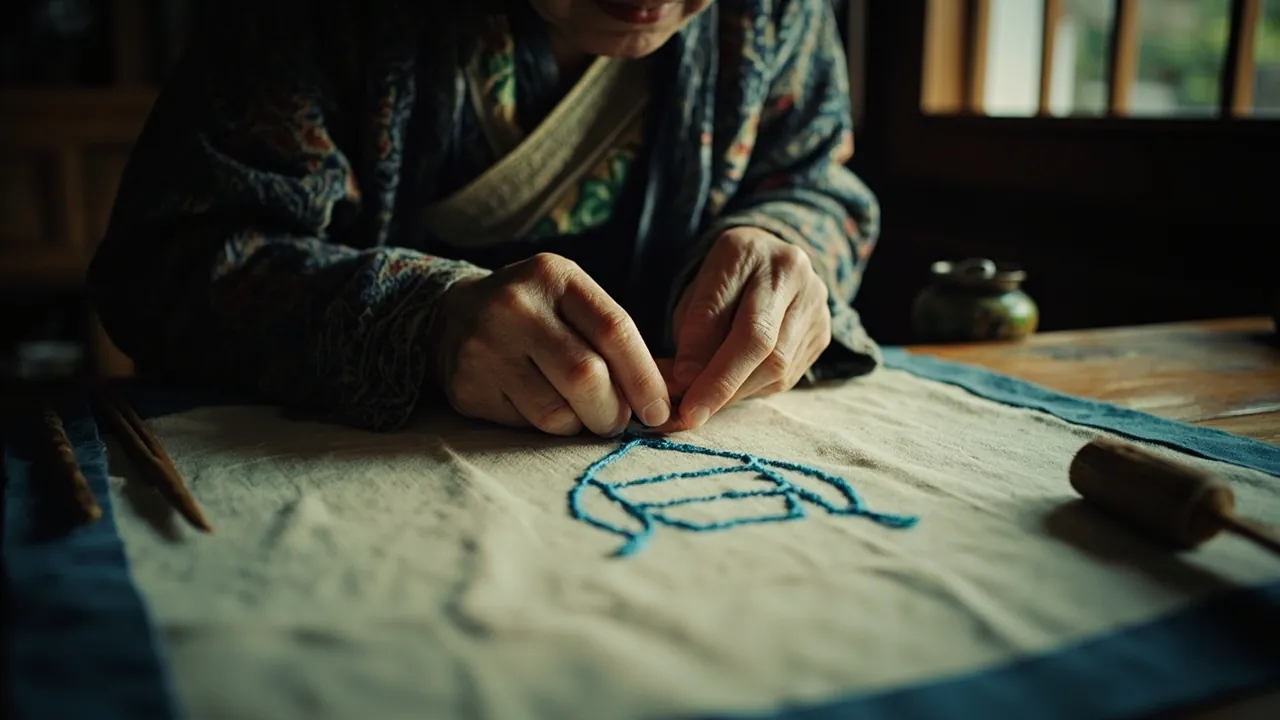
So when those women needed a way to put their feelings into writing, embroidery was the natural medium. They wrote Nushu by stitching it. They embroidered Nushu onto cloth. They folded Nushu into fans. Most famously, they sang Nushu into the wedding trousseau books known as Sanchaoshu (三朝书), which I’ll get to in a moment.
The female friendships of Jiangyong played a crucial role too. In a society where you might be married off at twelve or thirteen to a man in a different village, sisterhood was often your most stable relationship. Women formed sworn-sister bonds that endured a lifetime, and Nushu became the private language of those bonds. Letters in Nushu could be carried in secret, hidden in the folds of a sash. Songs in Nushu could be sung across a river, understood by no man.
There is something profound about that, if you let it settle in your mind. Women who had been told their whole lives that they had nothing important to say invented a whole new way to say it.
The Forms Nushu Took
Nushu wasn’t just one thing. It came in several formats, each tied to a specific moment in a woman’s life.
The most iconic is the Sanchaoshu — the “third-day letter” — sometimes called a bridal trousseau book. In a Sanchaoshu, a bride on the third day after her wedding received gifts and letters from her sworn sisters back home. Often, these were written in Nushu on paper folded into elaborate, fan-like or accordion shapes, then sealed with embroidery. The book wasn’t just a record. It was an emotional time capsule, containing the bride’s complaints about married life, the longing for her sisters, sometimes coded prayers for better days ahead. Many surviving Sanchaoshu read like an early form of expressive diary literature — one of the only places where a Chinese woman of that era could write about her own feelings in her own language and have it both preserved and understood.
Paper fan songs (纸扇歌) were another form. Women wrote Nushu characters on folding paper fans, then walked together through the village singing the songs aloud. The written Nushu was for the women to keep and read quietly later. The song was for the moment of shared mourning or shared grievance. Some of these fans were treated as heirlooms and passed down through generations of women.
There were also embroidered Nushu — characters literally stitched into cloth in colored silk thread, often on handkerchiefs given as tokens of friendship or love. These are arguably the most visually beautiful surviving Nushu artifacts. They look like delicate beadwork until you realize each “bead” is actually a Nushu character encoding a word or a phrase.
Nushu was also used for letters, for prayers to local goddesses, and for personal journals that women kept in secret. One of the most famous surviving examples is a set of Nushu letters written by a woman to her sworn sister during a period of acute loneliness — letters that read, even in translation, like an early feminist confession.
The Rediscovery Most People Have Never Heard Of
For most of the 20th century, Nushu was largely unknown outside Jiangyong — and even inside Jiangyong, it was vanishing. The first modern outsider to recognize it was a teacher named Gong Zhebing, who in 1954 published a brief academic article in a Hunan journal about a “women’s script” used in Jiangyong. Few people paid attention at the time. Gong himself had spotted the script on placards in a Jiangyong temple and assumed it was decorative writing without knowing what it was.
Serious academic interest came decades later, after the reforms of the 1980s reopened China to outside research. In the late 1980s and 1990s, a small group of Chinese and foreign linguists and ethnographers — most famously Zhao Jingsheng and the American scholar Cathy Silber — began to systematically document Nushu. Silber’s 1998 monograph “A Chinese Characters for ‘Woman’ is not ‘Woman’: Women’s Script and the Position of Women” remains one of the best introductions for English readers.
What they found was both thrilling and heartbreaking. The script was real. The last fluent readers — elderly women who had learned Nushu from their mothers and sworn sisters in the 1920s and 1930s — were real. The traditions of the Sanchaoshu were real. But almost all of those last fluent readers were in their 70s or 80s. Some had already died. The chain of transmission that had run unbroken for perhaps two hundred years was about to break.
In 2004, the last widely-recognized fluent reader of Nushu was generally identified as Yang Huanyi (杨焕宜), who died in 2004 at the age of ninety-eight. After her, the language was effectively extinct as a spoken-by-mothers tongue. Younger women in Jiangyong could read snippets of it, but not fluently, not in the way Yang Huanyi had learned it from her own sister and sworn sisters as a girl.
Why UNESCO Inscribed It, and What That Means
In 2014, UNESCO inscribed Nushu on its Representative List of the Intangible Cultural Heritage of Humanity. The decision recognized Nushu not just as a curious linguistic anomaly, but as a form of cultural expression that captures a whole universe of women’s experience. UNESCO’s own description of Nushu emphasizes that it embodied “the history and emotions of Jiangyong women” — that it was at once a script, a song tradition, an embroidery form, and a vehicle for female solidarity in a patriarchal society.
The listing was also an acknowledgment of how precarious Nushu’s survival is. UNESCO inscriptions don’t save cultural traditions by themselves — they raise awareness, bring funding, and create institutional incentives for preservation, but they cannot resurrect a tradition whose social substrate has collapsed. For Nushu, the substrate that produced it — the all-female networks of sworn sisters, the conventions of early marriage, the culture of embroidery-based trousseaus — has mostly disappeared. Modern Chinese women in Jiangyong have school educations and access to standard written Chinese. There is no longer the same urgent need for a secret women’s script. And so, despite the inscription, the natural transmission of Nushu from generation to generation has not been revived.
What survives is something different — a study-and-revive movement. Researchers document Nushu artifacts and interview the last readers. Local cultural bureaus in Jiangyong teach simplified Nushu classes to young women. Museums display embroidered Nushu pieces, and Jiangyong has opened a small Nushu museum near the village of Shimen (浦尾, sometimes Puwei) where the script was most concentrated. Annual Nushu cultural festivals are held, and tourists can see demonstrations of embroidery and pass their eyes over the delicate slanting script.
But there’s a quiet tragedy woven into this revival. A script revived is not the same as a script living. A script living requires a community of readers and writers for whom it is natural. A script revived requires performers. The difference between the two is the difference between a language and a museum piece.
Nushu and Other Women’s Writing Systems
One of the most common questions readers ask is: how does Nushu compare to other women’s writing systems? It’s worth pausing on this, because the comparison illuminates both what makes Nushu unique and what makes it part of a broader story.
The Cherokee syllabary, developed by Sequoyah in the early 19th century in what is now the southeastern United States, is sometimes compared to Nushu. But the Cherokee syllabary was designed by a man and used by both genders. It was a national writing system for the Cherokee Nation as a whole. So the similarity to Nushu is mainly structural: both are syllabaries created outside the standard Chinese or Western alphabetic traditions.
The script sometimes called N’Ko — designed by the Mande intellectual Solomana Kanté in 1949 — was created by a man and spread across West Africa as a literacy tool for the Mande-speaking world. It, too, differs from Nushu in being a men-led project used broadly by a community.
There are other “secret languages” of women that have been documented around the world — the Nu Shu writing of Mosuo women in Yunnan, the female argots of various African and South Asian communities, the “bilabial” speech styles of some Amazonian groups. But most of these are spoken-only or heavily speech-modified. They are not full writing systems. What makes Nushu remarkable is that it is a complete writing system — one that allowed women to encode any utterance they could say into written form.
In part, this is possible because of the structural openness of syllabic scripts. When you invent a writing system for one spoken language, you basically have to invent a character for each sound of that language, which, for a Chinese dialect with several hundred distinct syllables, is a long but tractable task. It would be considerably harder, though not impossible, to invent an alphabetic script for a previously-unwritten vernacular. The syllabic nature of Nushu made the engineering feasible within a community without formal linguistic training.
What Nushu Teaches Us
Nushu stays in the imagination long after you learn about it because it sits at the intersection of so many things we say we care about: literacy, women’s history, the resilience of folk traditions, the secret inner lives of people we might dismiss as having none.
It is also a reminder that the absence of formal education is not the absence of intellect. The women of Jiangyong, who never went to school, who were forbidden from becoming calligraphers or scholars, who lived in a society where their marriages were arranged and their feet were bound, looked at the writing system used by the men around them and built themselves a different one. That is not just resistance. It is one of the great quiet intellectual achievements of Chinese folk culture.
If you ever travel to Hunan, the small museums and cultural workshops in Jiangyong are worth visiting. Bring a notebook. Bring curiosity. The script is fragile and the readers are almost gone, but the artifacts that remain — the embroidered handkerchiefs, the Sanchaoshu books, the delicate paper fan songs — speak to something that matters more than the words they contain. They speak to the persistent human need to be heard, even when the world has decided you should be silent.
Recommended Products for Nushu Cultural Exploration
1. “The Women’s Script of Hunan and Jiangyong Nushu” (Reference Book) A scholarly but readable introduction to Nushu, covering the script’s history, its structure, the last fluent readers who preserved it, and the cultural context of Jiangyong women’s lives. Includes photographs of surviving Sanchaoshu manuscripts, embroidered Nushu textiles, and modern preservation efforts. Suitable for general readers curious about women’s writing systems, Chinese folk culture, or the UNESCO Intangible Heritage list. Several companion volumes also exist in English translation for readers who want to go deeper into the linguistic or anthropological research.
2. “A Chinese Character for ‘Woman’ Is Not ‘Woman” (Women’s History & Linguistics Book) Cathy Silber’s landmark academic monograph on Nushu, widely regarded as the best English-language study of the script and the lives of its practitioners. Reads more like a long-form cultural history than a dry linguistics text. Includes extensive translations of letters and Sanchaoshu passages. Suitable for readers interested in women’s history, ethnography, and the intersection of literacy and gender.
3. Beginning Chinese Calligraphy Set (Brush, Ink Stone, and Practice Paper) While Nushu itself is no longer used, beginning Chinese calligraphy gives you a feel for the rhythm of writing Chinese-language scripts. A good starter set includes a weasel-hair or wool brush, an ink stick (or pre-mixed ink cake), an ink stone, and practice paper ruled with guide squares. Practicing basic Hanzi strokes doesn’t teach you Nushu, but it teaches you the meditative physical experience of brush-based writing — the same experience the women of Jiangyong would have had when they sat down to embroider a letter in Nushu.
4. “The Cooking of Rural China” Regional Chinese Cuisine Cookbook Not directly about Nushu, but a wonderful companion volume for readers interested in the daily lives of rural Chinese women. The cookbook covers regional cuisines from Hunan, Jiangyong, and surrounding areas, with recipes for the simple, hearty dishes that would have formed the everyday backdrop of Nushu women’s lives. A good reminder that written language is only one of many cultural inheritances passed through generations of women.
5. Hand-Painted Silk Folding Fan (Traditional Chinese Craft) The paper fan (折扇) is one of the traditional vessels in which Nushu was historically written and sung. A hand-painted silk folding fan — even one without Nushu characters on it — is a way to hold the physical object that carried so much of this secret women’s writing. Look for fans made in traditional Jiangnan or Hunan workshops, with bamboo ribs and silk panels painted with floral or landscape scenes. A beautiful decorative object and a quiet gesture toward the women who used such fans to whisper to each other.