Nuwa Creates Humans: The Mother Goddess Who Shaped Mankind
The World Before People
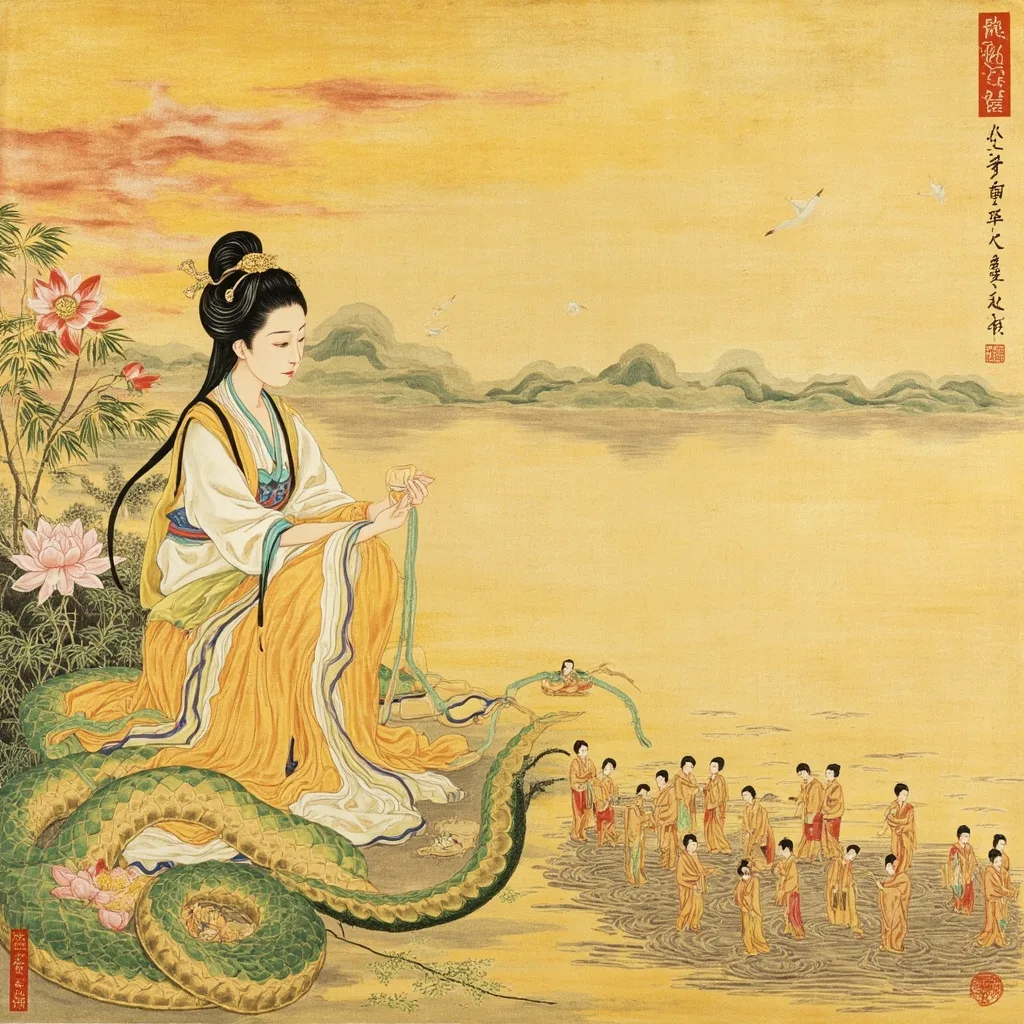
Before there were people, before there was history, there was only Nuwa — the goddess who existed at the beginning of time. Ancient Chinese texts describe her as having the head of a woman and the body of a snake, her form coiling through the empty universe like a living question mark in the darkness.
The world she inherited was a mess. According to legend, the sky had cracked and the earth had fractured. The four corners of the world had collapsed. Floods roared across the land. Fire raged unchecked. And worst of all — there was no one to witness it, no one to care, no one to mend what had broken.
Nuwa looked at this broken world and felt something that ancient Chinese texts describe as “sorrow.” Not anger, not fear — sorrow. A mother’s sorrow for something that has been damaged and cannot repair itself.
And so she began to work.
The Lady Who Mended the Sky
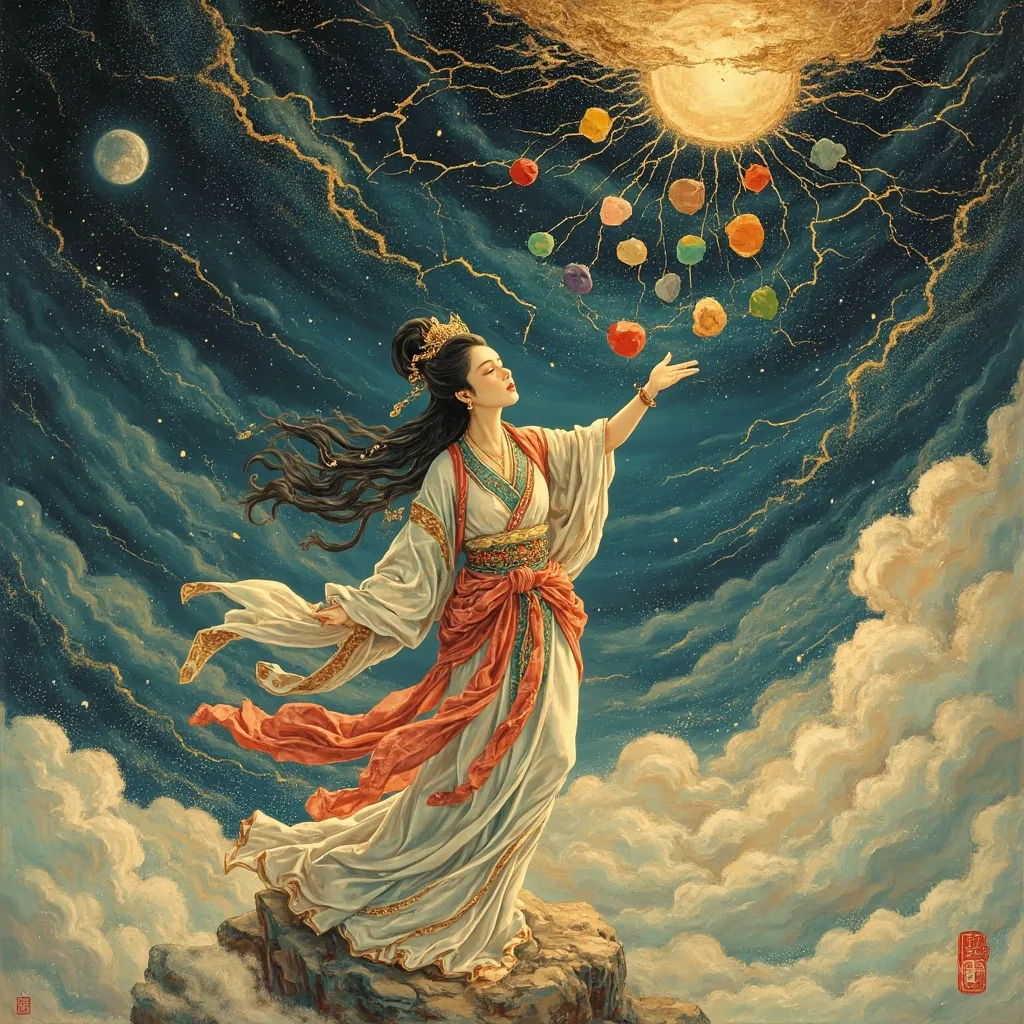
The most famous story about Nuwa is her repair of the heavens. The sky, according to Chinese mythology, had been supported by four pillars — but these pillars had broken, and the sky was falling. Without the sky, there could be no earth. Without the earth, there could be no life.
Nuwa set about rebuilding what was broken. She gathered five colored stones — black, white, red, green, and yellow — and melted them down in a great furnace. With this molten stone, she patched the cracks in the sky, one by one. She cut off the legs of a giant turtle and used them as new pillars to support the heavens. She killed a black dragon to stop the floods and caged the fire that was devouring the land.
It took her years. Maybe centuries. The mythology isn’t clear on the timeline, because time itself hadn’t quite settled into its proper shape yet. But eventually, the world was whole again. The sky held. The floods receded. The fires burned low.
And when she was finished, Nuwa sat down on the shore of a great lake and looked at what she had made. The world was stable. But it was also empty. There were mountains and rivers and clouds and storms, but there was no one to appreciate any of it. No one to walk through the forests she had preserved. No one to name the animals she had saved from extinction.
So she decided to make people.
The First Humans and the Invention of Society
There are two versions of how Nuwa created humanity, and both are beautiful in different ways.
In the first version, Nuwa was walking by a river and paused to scoop up some yellow mud. She shaped it into a small figure — the shape of a human, with a head and arms and legs. She breathed on it, and it came alive. The little mud person laughed, danced, and ran off into the world.
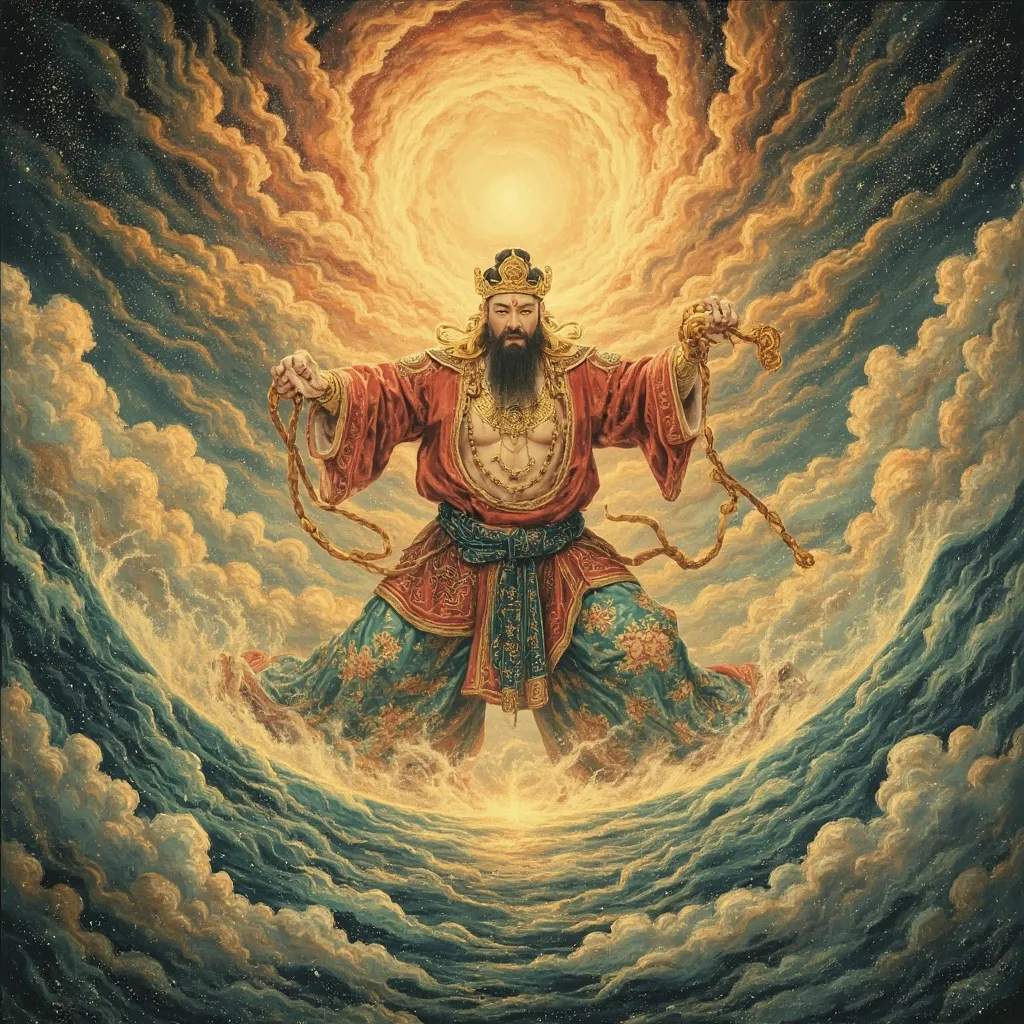
Nuwa was delighted. But she also realized she didn’t have forever to make each person by hand. The world was vast, and she had only two hands and so much time. So she devised a shortcut: she dipped a rope into the river of mud and flicked it from side to side. Each drop of mud that splashed off became a new human being.
The people made directly by her hands became the wealthy and the noble — people who would never have to labor, because they were created with such care and attention. The people made by the splashing rope became the common folk — ordinary people who would have to work for their living, but who were just as human, just as valid, just as much children of the goddess.
In the second version of the story, Nuwa created humans not from mud but from her own experiences. She saw that the world needed balance — that there were forces of chaos and forces of order, and they needed to be held in tension. So she created humans as beings who would embody both: rational enough to bring order, emotional enough to embrace chaos. Neither fully divine nor fully mortal, but something in between.
Both versions circulated in ancient China, and both were taken seriously. They represent two different visions of what it means to be human: one emphasizes our diversity (rich and poor, noble and common), the other emphasizes our fundamental nature as beings who stand between competing forces.
Nuwa and the Social Order
In the centuries after these myths first emerged, Chinese scholars and rulers found in Nuwa’s story a powerful tool for explaining and justifying the social order. If the goddess had created some people by hand and others by rope, then perhaps inequality was natural — built into the very fabric of existence.
This reading became politically convenient. The aristocracy, the scholars, the ruling families — they could trace their origins to Nuwa’s careful handiwork. The farmers, the artisans, the merchants — they were the children of the flicking rope. The hierarchy of Chinese society seemed not just reasonable but cosmic.
But this interpretation was always contested. Other thinkers pointed out that the myth also emphasized what all humans had in common: we all came from the same mud, the same riverbank, the same goddess. Whether we landed close to Nuwa’s hands or far from them, we were all equally her children. The diversity of social roles didn’t imply the inequality of human worth.
This debate — about whether the myth of Nuwa justifies hierarchy or emphasizes common humanity — has never been fully resolved in Chinese thought. It’s one of those questions that each generation has to answer for itself.
The Mother Goddess in a Patriarchal World
Here’s something that strikes modern readers as odd: Nuwa, one of the most powerful deities in Chinese mythology, is female. In a mythological tradition often criticized for its patriarchal leanings, the goddess who created humanity and saved the world is a woman.
Some scholars have argued that this is a remnant of an older, more matriarchal religious tradition in China — a time before the rise of the patriarchal clan systems and the dominance of male deities like the Jade Emperor. According to this theory, Nuwa was originally the supreme deity, and her status was gradually diminished as male-dominated religious and political systems took hold.
By the time of the Han Dynasty (206 BCE – 220 CE), Nuwa had been absorbed into the broader Taoist pantheon, but she retained her special status as one of the three great creator deities. Alongside Fuxi (her brother and, in some versions, her husband) and Shennong (the divine farmer), she forms a trinity of cultural heroes who established the foundations of Chinese civilization.
What makes this particularly interesting is that Nuwa’s femininity was never used to diminish her power. She was not a mother-goddess in the passive sense — not a fertile earth figure who simply gives birth. She was an active creator, a fierce warrior against chaos, a craftsman who mixed colors and built structures. The Chinese did not associate her femaleness with weakness or submission. She was female and she was also the most powerful being in the cosmos.
How Americans Can Understand This Myth
The story of Nuwa has echoes in several American cultural traditions. Consider the story of Genesis, where God creates the first man from dust and the first woman from the man’s rib. Or the Greek myth of Prometheus, who shapes the first humans from clay and gives them fire. Or the Navajo creation story, where the First Woman gives birth to the different peoples of the world.
What Nuwa shares with these traditions is the sense that humans are special — that we are not just another animal species but something created with intention, even with love. The goddess looked at the empty world and felt sorrow. She didn’t create humans because she had to, but because she wanted someone to share it with.
But Nuwa also offers something distinct. In many Western traditions, humans are created to serve — to till the garden, to multiply and fill the earth, to offer praise to the creator. In the Chinese tradition, Nuwa creates humans partly because the world is empty and broken and she wants it to be whole. We are created not just to serve but to be companions, witnesses, and caretakers.
This gives the human condition a different flavor. We are not here primarily to work or to worship, but to be present — to see the world, to appreciate it, to care for it the way Nuwa did when she saw it broken and felt sorrow.
Nuwa’s Legacy in Modern China
Today, Nuwa is remembered in many ways across China. There are temples dedicated to her in various provinces, particularly in the north where her mythology originated. The five-colored stones she used to repair the sky have become a symbol of balance and harmony — the five elements working together to maintain cosmic order.
In recent years, there’s been a revival of interest in Nuwa as a symbol of femininity and maternal power. Chinese feminist scholars have highlighted her as an example of female creative agency in ancient mythology — a counterweight to the male-dominated divine bureaucracies of later Taoism and Buddhism.
She’s also become a popular figure in Chinese fantasy literature and video games, where she’s often depicted as a serene but powerful figure — a mother-goddess who watches over humanity with a mixture of love and detachment. The image of her sitting by the river, shaping mud into human figures, has become iconic.
What Nuwa Teaches Us
If there’s a lesson in the myth of Nuwa, it’s probably this: the world matters, and so do the beings who inhabit it. Nuwa could have lived happily alone in the empty universe — she was a goddess, after all, and gods don’t need company the way mortals do. But she chose to create, not from loneliness but from a sense that creation itself was valuable.
She teaches us that care is creative. That when we see something broken — a relationship, a community, an ecosystem — our response should be to mend it, not to accept the damage or walk away. And she teaches us that humans, whatever our origins, are fundamentally made for connection: to the world, to each other, and to the creative force that brought us into being.
The next time you see a sunset and feel that strange mixture of beauty and sadness — the sense that something lovely is also fleeting — you might think of Nuwa. She felt that too, when she looked at the broken sky. And she did something about it.
That’s the kind of goddess worth remembering.