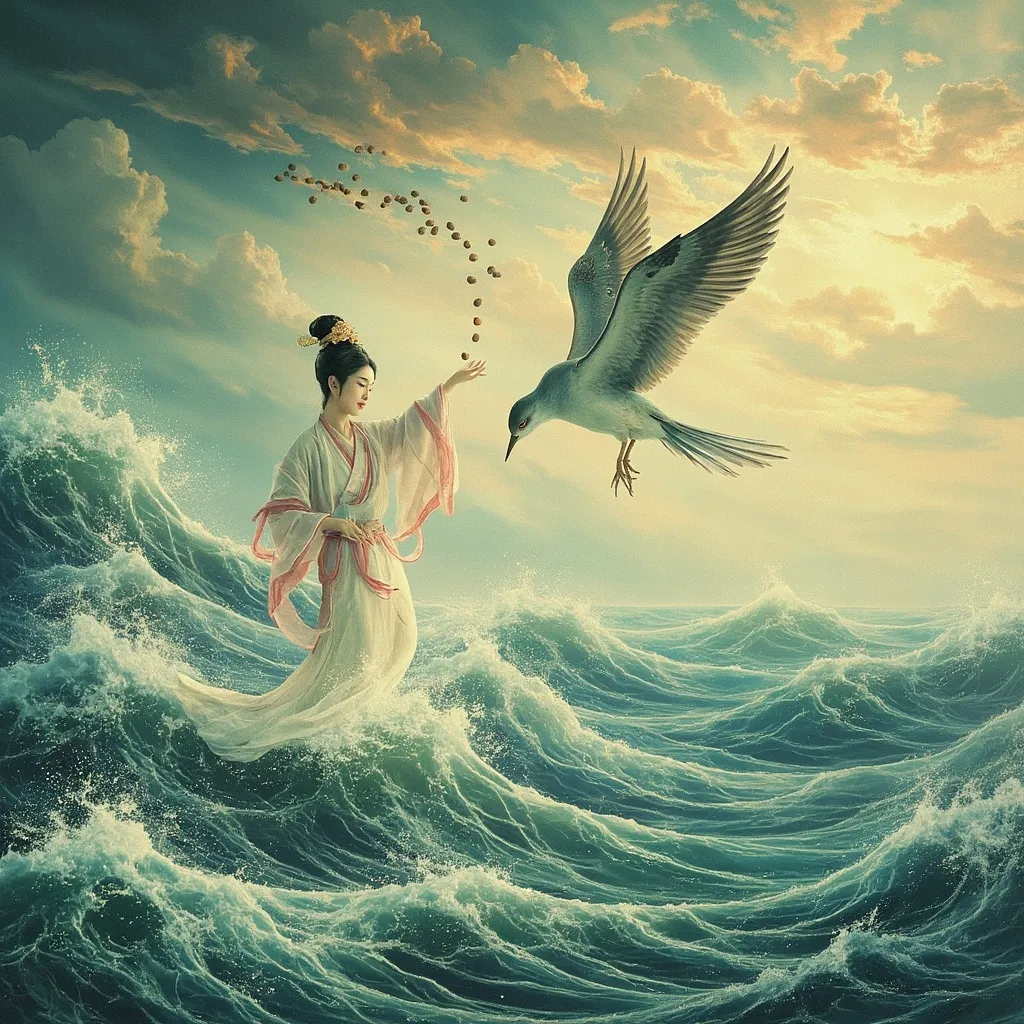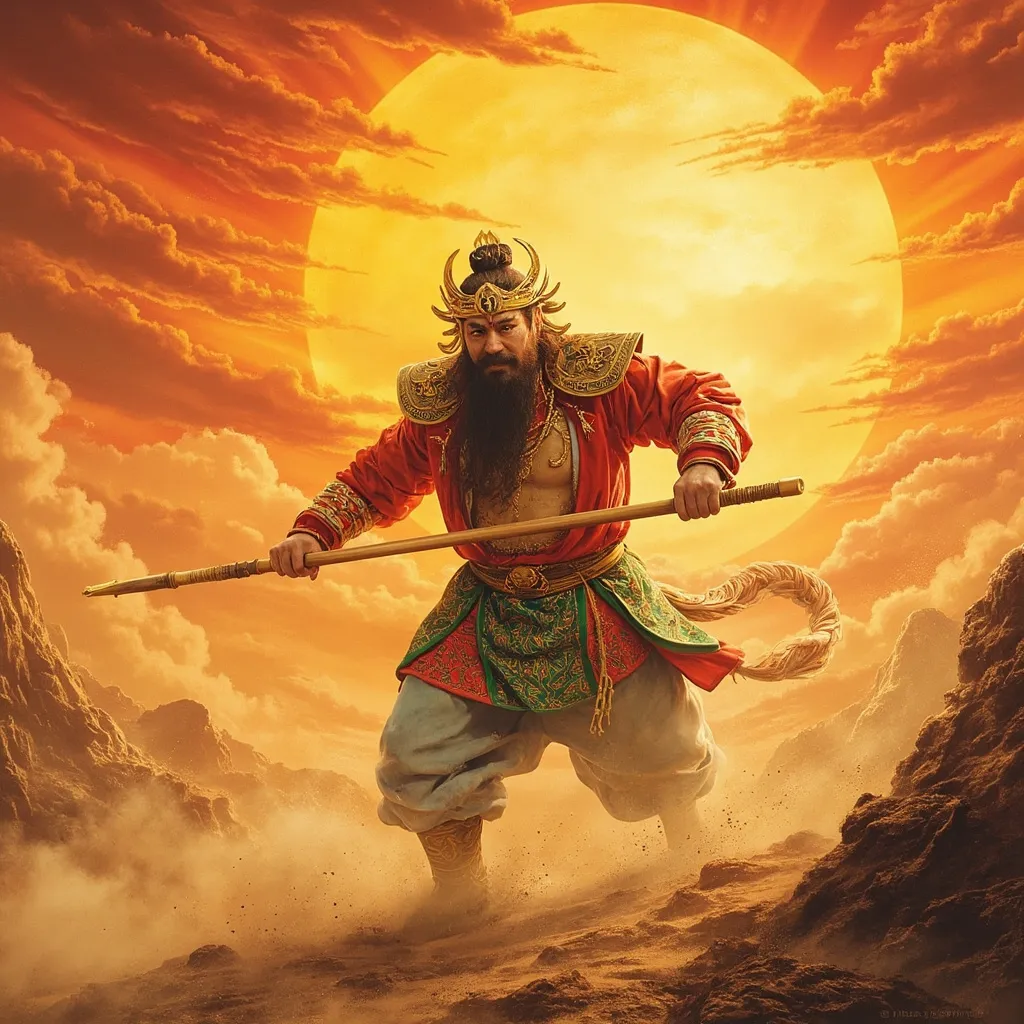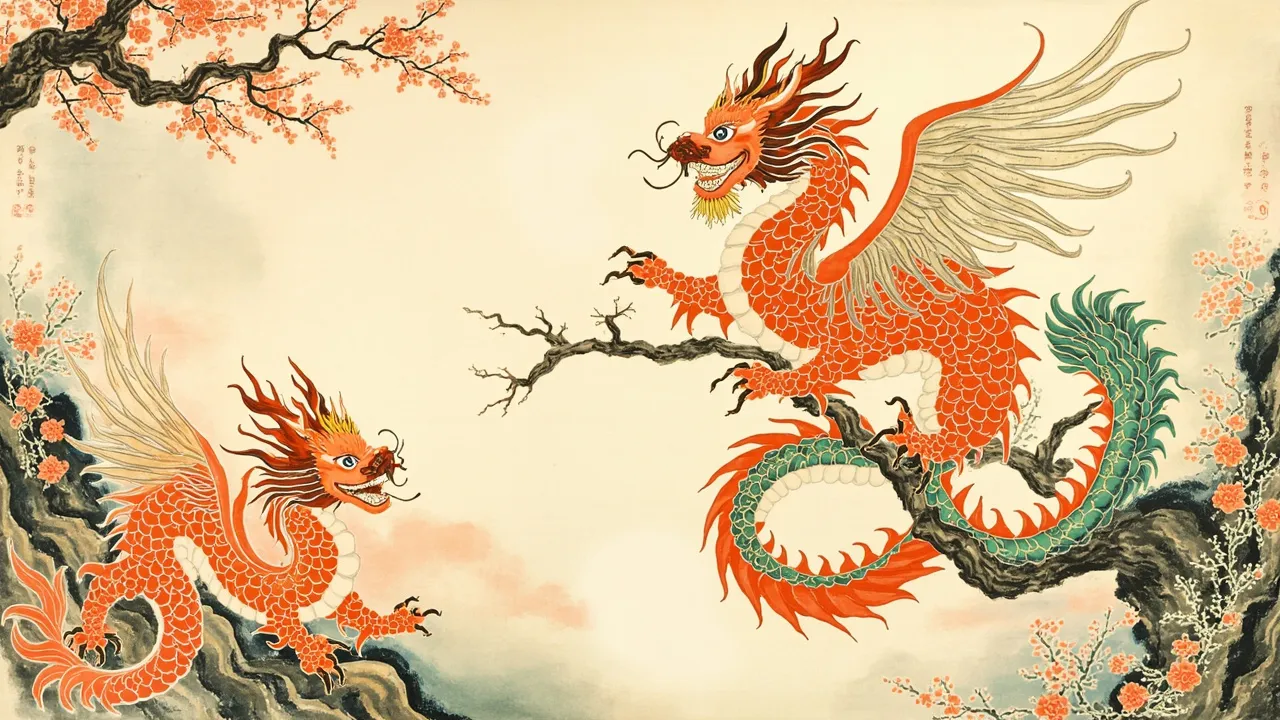
Every mythology has its cataclysm story. The Greeks have Deucalion’s flood. The Mesopotamians have Gilgamesh’s great inundation. The Norse have Ragnarok, the world-eating fire. In Chinese mythology, the great disaster is the breaking of the sky itself — and the solution was not a flood survivor building a boat, not a god retreating to wait it out, but a goddess getting her hands dirty with the raw materials of creation.
Nuwa (女娲) is one of the most ancient figures in Chinese religious tradition, predating the major philosophical schools by at least a millennium. She appears in texts from the Warring States period and earlier, usually associated with creation or with the founding of human society. The most famous story about her, though, is the one where everything went wrong and she put it back together.
The standard version goes like this. In the earliest age, after the world had formed but before it had settled into its current pattern, the sky and the earth were not securely separated. The支柱 — the cosmic pillars that held them apart — were unstable. At some point, this system failed catastrophically. The sky cracked. Parts of it collapsed. The earth itself fractured in places, tilting, splitting, opening up into chasms. The result was not just environmental chaos but existential threat: if the sky kept breaking, everything living would be destroyed.
The Nature of the Crisis
What caused the initial failure is interpreted differently depending on the source. Some texts suggest it was simply the instability of the primordial state — the world was new, things hadn’t settled yet, and structural failures were inevitable. Others blame a war between cosmic beings, or the death of a major deity whose body parts became the failing supports. One version, from the Huainanzi, describes the four pillars of heaven being broken, leading to floods, fires, and predators emerging from their hiding places to attack humans who were already struggling to survive.
This was not a problem you could outrun. The sky was everywhere. If it collapsed entirely, there would be nowhere to go.
Into this situation comes Nuwa. The texts describe her surveying the damage with something like horror, then making a decision. She would fix it. Not abandon humanity to find their own solution. Not delegate to lesser spirits. She would do it herself, using whatever means were available.
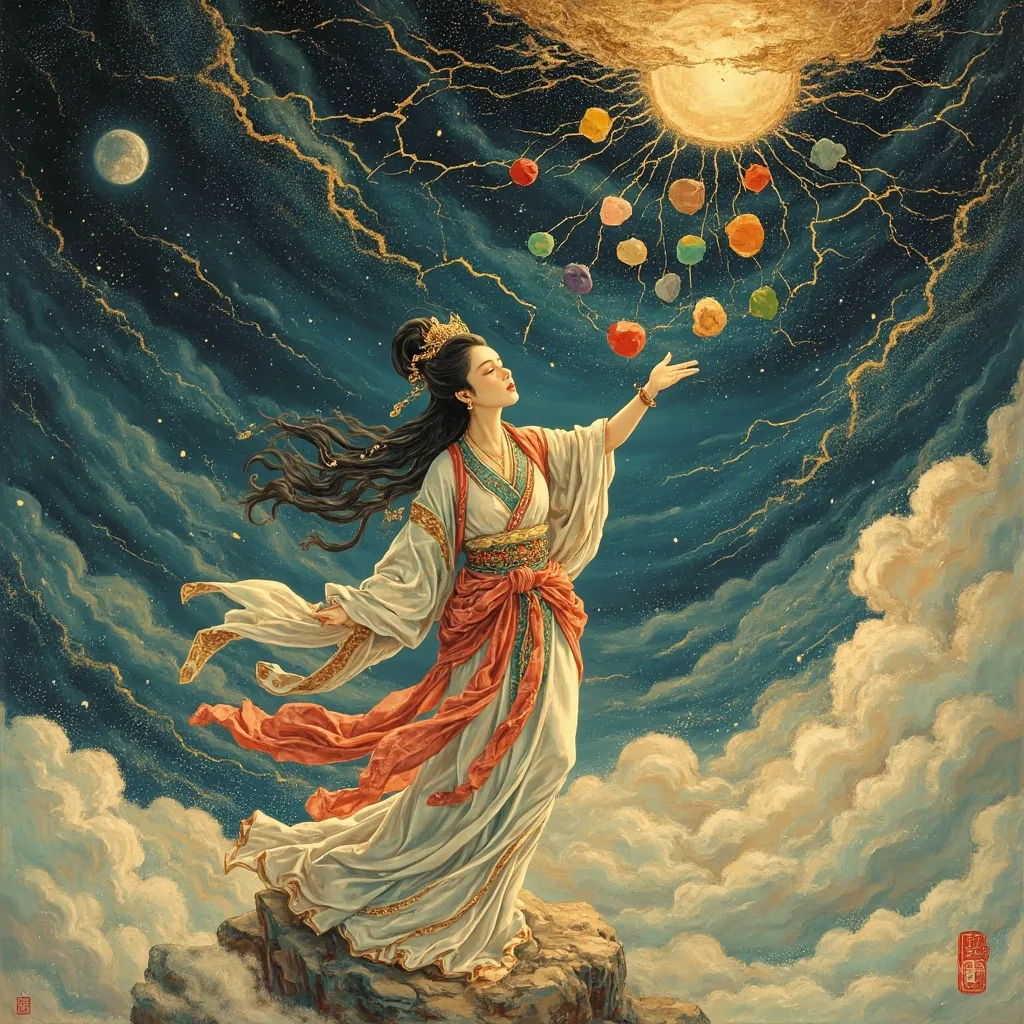
The means, as it turned out, were stones — specifically, stones of five colors that she found at the base of Mount Gong (sometimes identified with mountains in modern Jiangxi or Hunan provinces). The classical account says she melted these stones down and used the resulting substance to fill the cracks in the sky. The five colors corresponded to the five elements, and the logic was essentially alchemical: by using the primordial material of the world itself, she could restore the integrity of the cosmic structure.
The Work of Repair
The scale of what Nuwa did is hard to overstate. She wasn’t patching a leak in a roof. She was rebuilding the boundary between existence and void, the membrane that kept the atmosphere from draining away and the cosmos from collapsing back into undifferentiated chaos. The work took her years — some versions say she worked without rest for what amounted to multiple human generations, her attention fixed entirely on the task.
To stabilize the sky further, she killed a giant turtle (or in some versions, a dragon-turtle) and used its four legs to replace the broken pillars that held heaven and earth apart. This was a cosmically significant act — the turtle was a sacred creature associated with the north star and with the axis of the world. Using its body parts to hold up the sky was a kind of substitution, replacing cosmic supports that had failed with living materials that could bear the weight.
The imagery is visceral. Nuwa didn’t just speak words or think solutions into existence. She sourced materials, processed them, climbed to dangerous heights, descended into unstable places, and physically rebuilt what had broken. If there is a theme in this story, it is that some problems require hands-on work from someone willing to get messy.
I think about that when I encounter organizations in crisis — companies, governments, communities — where the people in charge keep wanting to delegate the hard parts or wait for the problem to solve itself. Nuwa didn’t have that option, and she didn’t take it. The sky was falling. She went up and fixed it.
The Cost of Saving Everything
The story does not pretend that Nuwa’s work was without sacrifice. Some versions describe her exhausting herself in the effort, depleting her own vital energy to complete the repairs. Others describe her eventually ascending to heaven and taking her place among the gods, but only after the work was done and stable. She did not get to rest until the job was finished.
The aftermath is also part of the story. Once the sky was stabilized, Nuwa turned her attention to other problems — specifically, creating human beings in a more systematic way. Different texts give different accounts of this. Some say she originally molded humans from yellow earth, which is why Chinese people are sometimes described as “the children of dust.” Others say she established marriage and family structures to ensure humanity could perpetuate itself. The common thread is that Nuwa was not just a crisis responder but a culture-founder, someone who thought about the long-term stability of the society she had saved.
The idiom nuwa bu tian (女娲补天) entered Chinese vocabulary to describe someone who fixes an apparently irreparable problem, who steps into a disaster and somehow makes things whole. It is a phrase used with genuine respect, not irony. To “mend the heavens” is to do the biggest possible job, the one that seemed to exceed all reasonable capacity. It is both an acknowledgment of the crisis and a tribute to the fixer.
Why This Story Matters
There is something unusual about Nuwa compared to comparable figures in other mythological traditions. She is female, which is itself notable in a pan-Asian mythological context where major creative and destructive forces are usually male. But more than that, she is not a warrior. She does not defeat an enemy. She does not win a battle. She sees that something is broken and she fixes it, using craft and persistence and materials at hand.
This is, in a sense, a very different model of heroism than the one we get from most mythologies. The hero who fights and wins is intuitive. The hero who sees a structural failure and builds a solution is less dramatic but arguably more useful. Nuwa did not kill the thing that broke the sky. She repaired what it had damaged, which required understanding the system well enough to know what each piece was supposed to do.
I find myself thinking about this in contexts where infrastructure fails — where a bridge collapses, where a power grid goes down, where a system that millions of people depend on simply stops working. The instinct is to blame someone, to find the villain, to identify a cause that fits a narrative. But often the real story is more like Nuwa’s: things broke because systems are complex and eventually fail, and what matters is whether someone shows up who is willing and able to rebuild them.
Nuwa and the Question of Female Divinity
It is worth pausing on the gender dynamics of this story, because they are unusual in ways that matter. In most ancient mythological traditions, the major creative and destructive forces are male — Zeus, Odin, Ra, Enlil. The god who makes the world, who unmakes it, who wields the thunderbolts and commands the floods: these figures are almost always men. Nuwa breaks that pattern. She is female, and she is not a minor deity or a helper figure — she is the one who fixes the fundamental structure of reality when it fails.
This did not go unnoticed by ancient Chinese commentators. The Huainanzi, one of the texts that preserves the fullest version of the mending-the-heavens story, presents Nuwa as part of a cosmological trinity that includes Fuxi and Shennong, but it is her action that receives the most detailed description. The passage about her repair work is longer and more vivid than anything written about her male counterparts. Whoever wrote or compiled this material found her deeds worth dwelling on.
There are scholarly debates about what this means. Some argue that Nuwa represents an older, pre-patriarchal layer of Chinese religious practice, a remnant of a time when the major deities were female and the cosmos was understood through feminine rather than masculine metaphors. Others suggest that her gender is incidental — that the story is about competence and problem-solving, and the gender of the solver is not the point. Both interpretations probably contain some truth. The text itself does not comment on her gender as noteworthy; it simply presents a goddess doing what needed to be done.
What I find interesting is that the story does not feminize the repair work. Nuwa does not use empathy or intuition or any of the qualities that patriarchal cultures have traditionally assigned to women. She uses technical skill — she assesses structural damage, sources the right materials, executes a complex repair process that requires climbing to dangerous heights and descending into unstable places. She is, in the most literal sense, an engineer. The story presents this without irony, without suggesting that her approach is unusual for a woman, without framing her competence as exceptional specifically because of her gender. The texts treat her as competent, period. That is itself notable.
The Five-Colored Stones in Chinese Culture
There’s a fascinating coda to the Nuwa story involving the five-colored stones. The tradition that she used stones of five colors to repair the sky became the origin myth for a particular type of jade — specifically, a material that showed multiple colors in a single piece, associated with the goddess and with cosmic修复. In later periods, this material became one of the most valued substances in Chinese ritual and decorative arts.
The word for this kind of stone, yushi (玉石), is related to the broader Chinese vocabulary for jade, and the association with Nuwa gave it religious significance. Pieces that showed five colors were considered especially powerful, representing the harmony of the five elements restored after chaos. Museums that hold ancient Chinese jade collections often have pieces whose coloration matches the described “five colors” — green, red, yellow, white, and black — and these are sometimes presented to visitors with the Nuwa story as their mythological context.
The story also influenced Chinese views on the nature of catastrophe and repair more broadly. When disasters struck — floods, earthquakes, fires — the response was often framed in Nuwa’s terms: the cosmic order had been temporarily disrupted, and the role of rulers and communities was to restore it. This is one reason why flood control and infrastructure maintenance were considered sacred duties in ancient China, not merely engineering projects. To build dikes and channels was to participate in the ongoing work of keeping the world stable that Nuwa had begun.
She is, in this reading, not just a mythological figure but a model for how to be when things fall apart. You assess the damage. You find the right materials. You do the work. You don’t stop until it’s fixed. And when it’s done, you make sure the pillars are strong enough that it won’t break again.
That’s a story worth remembering, whether you believe in goddesses or not.
Recommended Reading and Products
Disclosure: This article contains affiliate links. We earn a commission on qualifying purchases, at no extra cost to you.