Imagine you’re living in a world where the sky is falling.
Not metaphorically — literally falling. The dome of heaven that separates the world of humans from the realm of gods has cracked, broken, collapsed in sections. Water is pouring through. Fire is roaring through other sections. The foundations of the earth are shaking. Mountains are crumbling into the sea. Rivers are reversing course. The world, as it was known, is ending.
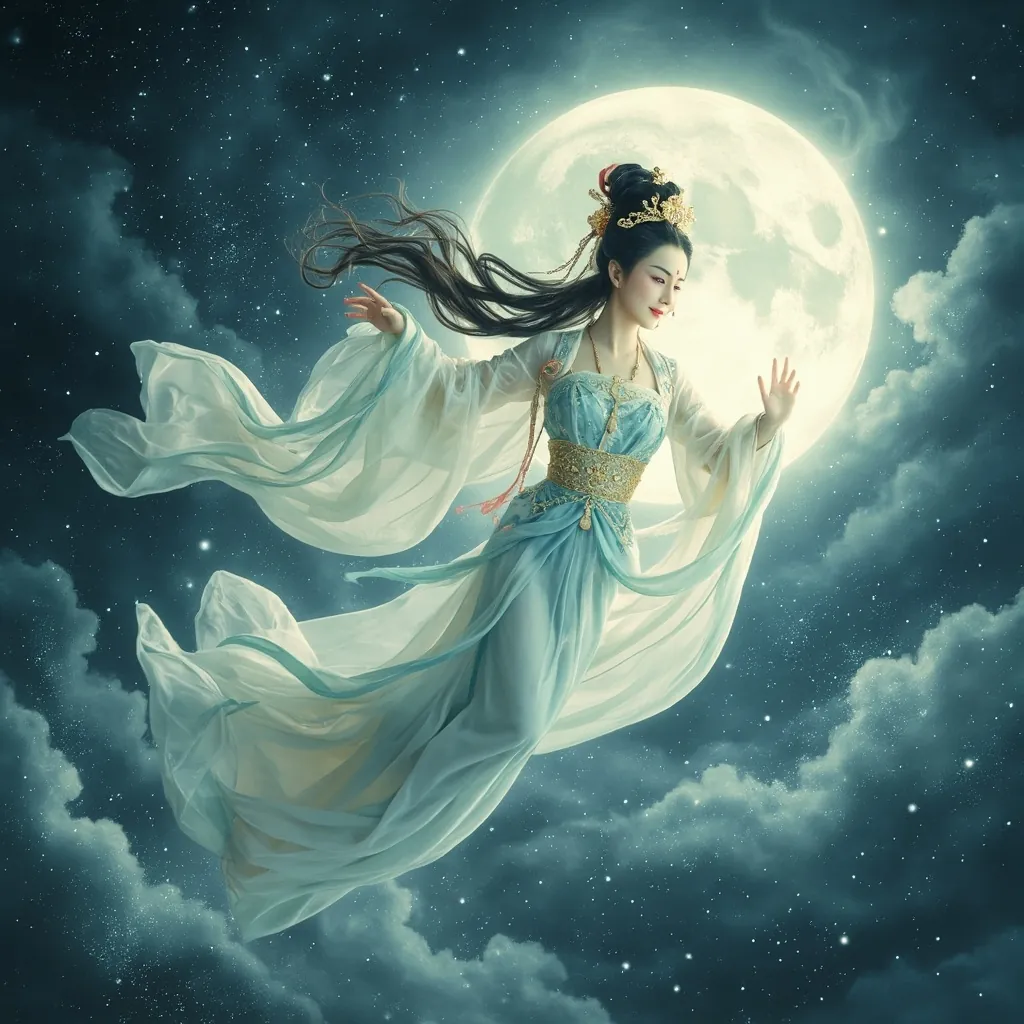
This is the situation that faces the goddess 女娲 — Nuwa — in one of the most dramatic myths in Chinese history. The world was created, but it broke. And Nuwa had to figure out how to fix it before everything was destroyed.
What she does next is one of the great acts of cosmic engineering in any mythology, and the story of how she accomplished it has been told in China for over two thousand years.
The World Before Nuwa Fixed It
To understand why Nuwa had to fix the sky, you need to understand how the world was created in the first place. In Chinese mythology, the universe wasn’t always organized the way it is now. In the earliest age, there was no separation between sky and earth — everything was a formless chaos, a cosmic egg that had existed since the beginning of time.
Inside this egg, a being named 盘古 — Pangu — was born (and we’ll talk about him in detail in another article, but for now, just know that he comes before Nuwa in the creation sequence). Pangu separated the sky from the earth using his own body as the lever, holding them apart for thousands of years until they were permanently separated. After Pangu died, his body became the various features of the natural world — his breath became the wind, his eyes became the sun and moon, and so on.
The world was created, but it was raw. It was new. And like anything newly made, it had weaknesses. The sky — this newly separated dome above the earth — was held in place by pillars. The earth below was supported by foundations. And these pillars and foundations were not infinitely strong. They could, under certain circumstances, break.
The mythology says that a great catastrophe occurred — sometimes described as a war between gods, sometimes as a cosmic instability — that shattered the pillars supporting the sky. The sky cracked. The foundations of the earth shifted. Fire erupted from below; floodwaters poured from above. Stars fell from their positions. The world that Pangu had spent millennia separating was collapsing back into chaos.
And into this broken world, Nuwa was born. Or rather, she had existed all along, but this is when her story becomes urgent.
The Goddess Gets to Work
Nuwa looked at the broken world and did not panic. This is one of the qualities that makes her stand out among mythological heroes — she assesses the situation, calculates what’s needed, and starts working. No drama. No despair. Just the calm, methodical work of repairing a cosmos.
First, she addressed the fire. She gathered stones of a special quality — stones that could withstand extreme heat — and built enormous furnaces at the cardinal directions. These became the four pillars of the sky, replacing the broken ones. She used the refined stone to seal the cracks in the dome of heaven, building it back up section by section. She stabilized the foundations of the earth. She stopped the flooding by redirecting the waters into natural channels.
The work was beyond immense. Imagine repairing a house, but the house is the size of the universe, and you have to hold it together with your bare hands while it’s actively collapsing around you. That’s what Nuwa did.
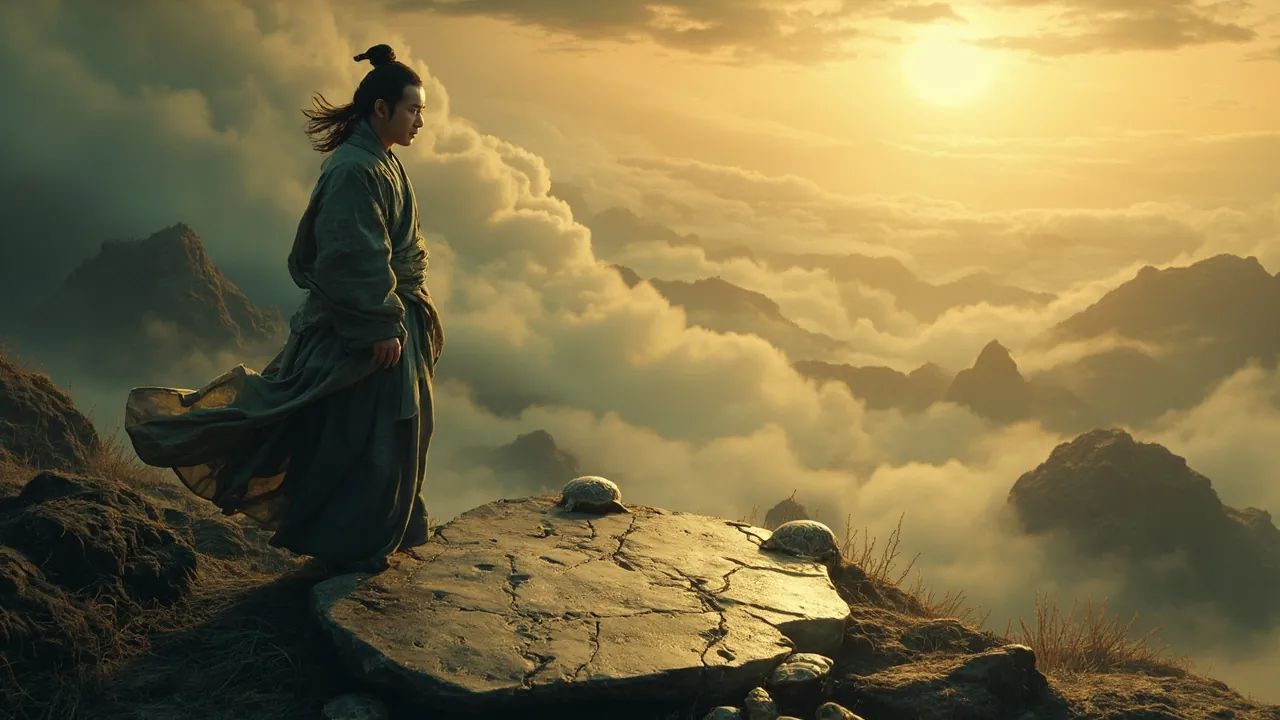
In some versions of the story, she also had to kill a giant turtle — 玄龟 — Xuan Gui — that was responsible for destabilizing one of the sky pillars. She cut off the turtle’s legs and used them as replacement pillars. She also killed a dragon — 黑龙 — Black Dragon — that was causing floods. Every element of the repair involved her directly confronting and defeating the forces that had caused the damage.
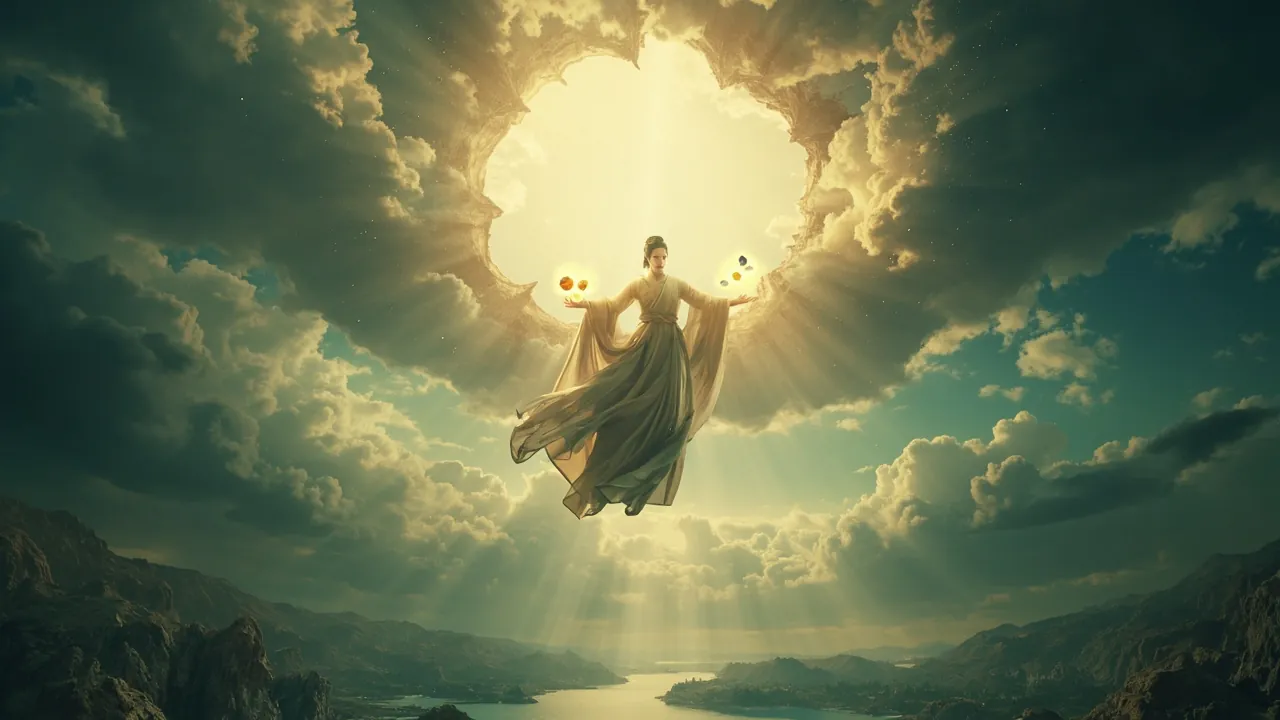
And then, to make sure the sky would never crack again, she gathered a special type of stone — 五彩石 — five-colored stones — that had the property of being able to glow with a divine light that reinforced the sky’s structure. She melted these stones down and used the molten material to seal the remaining cracks, creating a sky that was not just repaired but reinforced. The five-colored stones, in some tellings, created the aurora borealis — the colorful light in the northern sky that Chinese people historically saw as a sign of the mended heavens.
The world was saved. The sky held. Life could continue.
The Cost of Repair
But here’s what the story doesn’t always emphasize in the brief tellings: Nuwa paid a price for saving the world. She gave everything she had to the repair.
In some versions of the myth, she had to cut off her own feet to use as the new pillars when the turtle legs weren’t enough. In others, she melted her own body down to provide enough material to fill the final cracks — essentially sacrificing herself to create the divine stone that would hold the sky together forever.
The sacrifice matters. This isn’t a story where a powerful being snaps their fingers and fixes everything with no cost. Nuwa saved the world, but it cost her. She gave pieces of herself — literally — to make the repair work.
In the version where she uses her own body to create the five-colored stone, she doesn’t die exactly, but she does diminish. The goddess who was whole becomes something less, something that has given of itself to repair what was broken. The sky is saved, but at a price paid in her own substance.
This is why Nuwa is often invoked not just as a creator goddess but as a protector — the mother goddess who saved her children when the world was ending. She’s associated with marriage and childbirth in Chinese folk religion, partly because she’s seen as the原型 — the original — of maternal protection. She created humans (in some versions of the creation myth, she molded them from yellow earth), and then she saved them when the world fell apart.
What the Mending Actually Looked Like
It’s worth slowing down and picturing this, because most retellings move past the work itself in a sentence or two. Imagine a sky that is collapsing in slow slabs. The stars are out of position. Rain is falling up in some places where the broken dome has inverted, and a sulfurous orange glow is pouring out of the cracks from below. The world is loud in a way the world has never been loud before — the groan of stone, the hiss of steam where river meets fire, the deep percussion of a mountain giving way somewhere far away.
And somewhere in this mess, a goddess is building furnaces.
The five-colored stones had to be smelted. You can’t just scoop multicolored gravel out of a riverbed and stick it into a hole in the sky — the material has to be heated past the point of melting, fused into a liquid that will pour into a crack and harden into something the size of a continent can lean on. So she needed fuel, and heat, and bellows, and a steady hand over molten stone in a world that was actively shaking. In the older versions of the myth — particularly the ones that come down through the Shanhaijing, the Classic of Mountains and Seas, compiled sometime around the fourth century BCE but reaching much further back — the stones are gathered from specific named mountains, and the furnaces are built at specific named places. It’s not abstract. It’s engineering with a place attached to every step. She has a quarry. She has a forge. She has a pour site.
The aurora that closes the section above isn’t a metaphor in those older accounts. It’s the afterimage of the pour — the moment the last crack sealed and the sky, which had been flickering with raw heat and broken light, finally settled into one continuous glow. Northern peoples, the Chinese knew, lived under a brighter sky than the rest of the world. The reason, in this telling, is that Nüwa’s repair sealed brightest in the north.
And here is where an American reader might recognize something familiar, even if the names are different. The gesture of a single figure stepping into a catastrophe they did not cause and deciding, against every reasonable instinct, to fix it instead of flee from it — that’s not unique to Chinese myth. It’s the structure of John Henry driving steel until his heart gives out. It’s the figure of Noah, less divine and more desperate, building the ark in a country full of people who think he’s lost his mind. It’s the quieter version that any tradesperson knows: the call at two in the morning when the basement is filling with water and someone has to wade in with a wrench. The work is always the same shape. Something is broken. Someone who knows how shows up. The world stays.
It’s interesting, too, how lightly the myth wears its age. The Shanhaijing version is terse — almost a work order. Nuwa smelted five-colored stones to patch the azure. She cut a turtle’s legs to prop up the four corners. She burned reeds to dredge the floods. Four sentences, more or less. Two thousand years of Chinese painting, poetry, opera, and folk religion has poured itself into those four sentences, filling them with the texture the original compilers left out. What we hear today, the rich version, is mostly the accumulated weight of centuries of people deciding the story deserved more detail than it had been given — and adding it themselves, every generation, the way every generation adds detail to the myths it can’t afford to lose.
What Mending Means
The story of Nuwa mending the heavens resonates so strongly in Chinese culture that it has become one of the most referenced mythological events in Chinese literature and art. When something is catastrophically broken — a dynasty falling, a civilization in crisis, a society that has lost its way — writers invoke Nuwa. The call for someone to “mend the heavens” becomes shorthand for the need to restore cosmic order.
There’s something profound in the specificity of the metaphor. Nuwa doesn’t destroy the broken sky and create a new one. She doesn’t throw away the damaged structure and start from scratch. She repairs it. She finds what can be saved, reinforces it, and fills in the cracks with something stronger than what was there before. The sky she creates is not the original sky — it’s better, reinforced, held together with divine five-colored stone that glows with protective light.
This is a different model of crisis response than “burn it all down and start over.” Nuwa’s approach is conservative in the best sense — she preserves what can be preserved, fixes what can be fixed, and only replaces what’s truly beyond repair. She works with the existing structure, not against it.
And she does it herself. There’s no committee, no divine board meeting. The world is falling and Nuwa fixes it. That sense of individual responsibility for cosmic-scale problems is deeply embedded in how Chinese mythology approaches heroism.
The Mender in All of Us
Here’s the question the Nuwa myth asks of anyone who hears it: when something is broken, what do you do?
You could walk away. The sky was already broken when Nuwa arrived. She didn’t break it. She inherited a catastrophe. She could have said “not my problem” and watched the world collapse. She didn’t.
You could try to replace rather than repair. Starting from scratch is sometimes necessary, and it’s always easier to justify than careful repair work. You can always argue that what existed before was fundamentally flawed and needed to be destroyed. Nuwa didn’t do that either. She looked at what was there and asked what could be saved.
Or you could do what Nuwa did: assess the damage, gather your resources, build what you need to fix it, and give everything you have to the repair. Accept the cost. Pay it without complaint. And in the end, you’ve saved not just the world but something of yourself in the act of saving it.
The five-colored stones glow in the northern sky to this day, if you know how to look at them. That’s the story, anyway. The aurora borealis as a permanent reminder that the world was once broken and was once mended — and that the mending held.
Nuwa saved the world. And she paid in pieces of herself to do it. The world she saved is still here, still turning, still under a sky that glows faintly in the north with the light of the stones she melted to hold everything together.
That’s a legacy worth remembering.