slug: “offering-apologies-thorns-fujingqingzui” description: “Discover 负荆请罪 (fù jīng qǐng zuì) - the powerful Chinese idiom about Lian Po carrying brambles to apologize to Lin Xiangru, showing that true strength means admitting when you’re wrong.” keywords: “负荆请罪, Chinese idiom, Lian Po, Lin Xiangru, apology, ancient China, Chinese idiom story, national unity, military generals” author: “Cultural Tales Studio” category: “Chinese Idioms” tags: [“Chinese idioms”, “Warring States”, “humility”, “national unity”, “idiom stories”, “forgiveness”] image: “/images/offering-apologies-thorns.jpg” affiliate_products:
- “Classic Chinese Wisdom on Leadership”
- “Warring States Generals Biography Collection”
- “Traditional Chinese Calligraphy Set”
- “Historical Drama DVD Collection - Ancient Warriors”
- “Chinese Philosophy of Harmony Book” categories: [Chinese Culture] alt_text: “Illustration depicting offering apologies with thorns, in a traditional Chinese cultural setting”—
Offering Apologies with Thorns: The Humble Act That Healed a Kingdom
Every culture has its stories about pride going before a fall. But there’s something uniquely powerful about a story where the fall is followed not by humiliation, but by reconciliation. That’s what makes 负荆请罪 — fù jīng qǐng zuì — one of the most beloved idioms in Chinese culture.
You’ve probably heard versions of this story without even knowing it. It’s the tale of two great men, one older and one younger, who had every reason to hate each other but chose something harder: they chose to put their country’s interests above their own wounded pride. And in doing so, they gave the world a phrase that still means seeking forgiveness with genuine humility.
Two Men, Two Reasons for Pride
To understand why this story resonates so deeply, you need to understand who these two men were.
Lian Po was old. Really old, by the standards of his time — he’d been serving the Zhao kingdom for decades as one of its most trusted generals. He’d won battles, commanded respect, and built a reputation on steady competence and unwavering loyalty. When younger officers made reckless plans, Lian Po was the voice of caution. When the court wanted bold action, Lian Po advocated for careful strategy. He had earned his gray hair through years of making fewer mistakes than the next guy.
Lin Xiangru was the opposite — young, brilliant, and acutely aware of it. He’d risen to prominence through his famous diplomatic victory with the Heshibi jade, outwitting the Qin state and returning the treasure to Zhao. That feat alone would have been enough to make anyone insufferable, and Lin Xiangru had other gifts too: eloquence, confidence, and the kind of energy that older officials often find exhausting.
So when these two ended up serving the same court, tensions were inevitable. Lian Po looked at Lin Xiangru and saw a young upstart who had gotten lucky with one clever trick. Lin Xiangru looked at Lian Po and saw an old man whose caution was indistinguishable from cowardice. They weren’t enemies exactly, but they were close enough to make everyone uncomfortable.
The Moment Everything Changed
The breaking point came when King Zhao made a decision that struck many as favoritism toward Lin Xiangru. After the jade incident, Lin Xiangru had been elevated to a position that put him on par with — or above — generals who had served for decades. Lian Po’s allies were furious. They whispered that the young diplomat was receiving honors he hadn’t earned, that the old guard was being pushed aside for flash and charm.
Lian Po himself said nothing publicly. But his silence spoke volumes. And everyone in the court could feel the tension building like a storm waiting to break.
Here’s where history gives us one of its most unexpectedly beautiful moments.
Lin Xiangru, watching Lian Po’s coldness, realized something that changed him. He had been so focused on his own achievements, so certain of his own value, that he had failed to see something obvious: Lian Po’s resentment wasn’t just about jealousy. It was about a genuine imbalance in how things worked. Lin Xiangru had indeed risen very fast. He had received honors and positions that others with longer records hadn’t gotten. And the only reason he could accept this without discomfort was because he was too caught up in his own success to consider how it looked from the outside.
More importantly, Lin Xiangru understood that this tension — if it continued — would damage Zhao’s ability to defend itself against Qin. Division in the command structure, resentment between key figures, these were luxuries a small state caught between powerful enemies couldn’t afford.
So Lin Xiangru did something remarkable. He sought out Lian Po.
The Meeting That Wasn’t About Winning
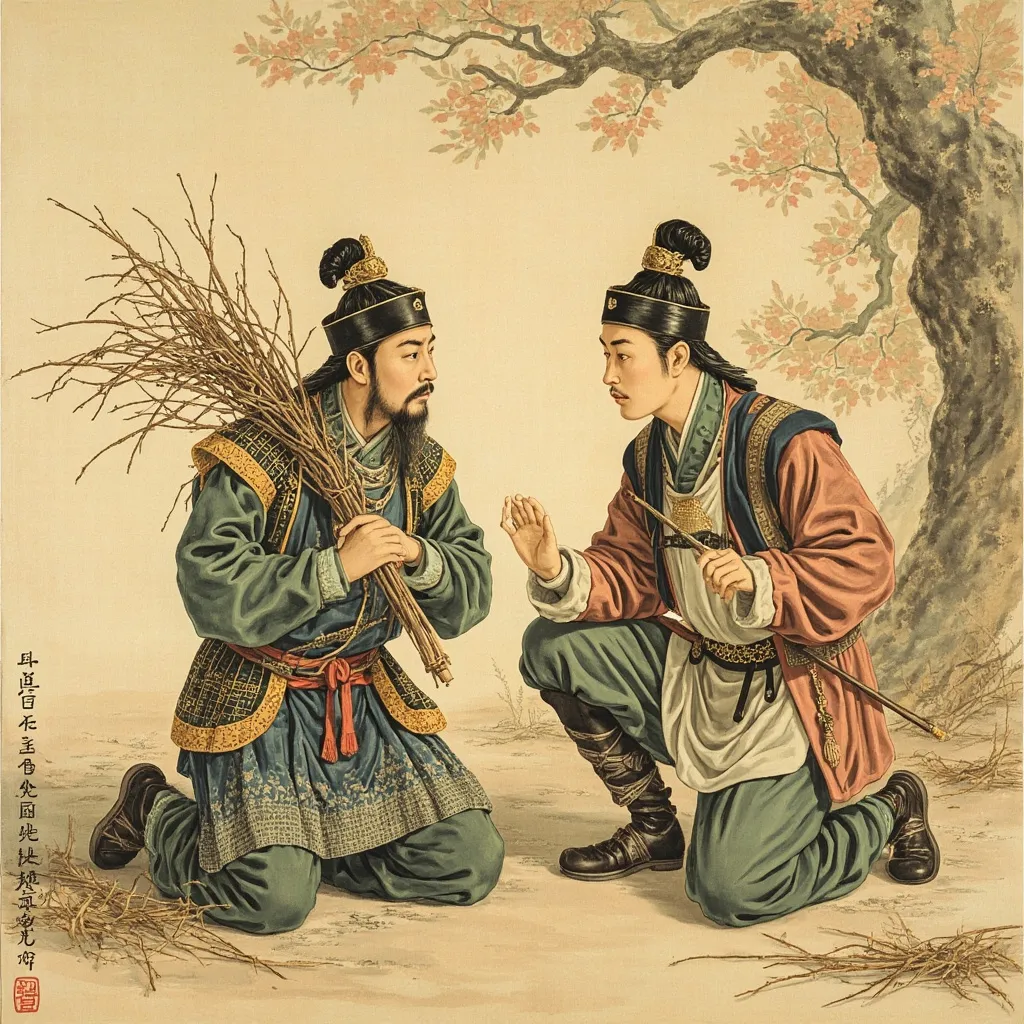
History doesn’t record the exact words exchanged between these two men. What we know is the outcome: Lian Po appeared at Lin Xiangru’s door — and he was carrying a bundle of thorns on his back.
In ancient Chinese custom, carrying thorns was an act of extreme penance. It symbolized that you were prepared to suffer, that you acknowledged your wrongs and accepted whatever punishment the other person deemed appropriate. By appearing at Lin Xiangru’s door with thorns on his back, Lian Po was saying the most humbling thing a proud man could say: I know I was wrong, and I’m here to ask your forgiveness.
But wait — what had Lian Po actually done wrong? He’d been cold, yes. He’d allowed resentment to build. But he hadn’t attacked Lin Xiangru or sabotaged his work. Why should he be the one asking forgiveness?
That’s what makes this story so powerful. Lin Xiangru didn’t make Lian Po grovel because he had more power. He made Lian Po understand something: their conflict was destroying Zhao’s ability to survive. Someone had to break the cycle, and that someone had to be the one with the greater position — the one who could afford to be wrong without losing everything.
Lian Po, seeing Lin Xiangru’s genuine willingness to set aside their rivalry for the good of the kingdom, chose humility over pride. He carried the thorns not because he was weak, but because he was strong enough to recognize when holding onto resentment was weaker than letting it go.
When they met, something shifted. Two proud men looked at each other and chose something bigger than their individual dignity: they chose Zhao.
What Real Leadership Looks Like
The phrase 负荆请罪 captures something that modern culture often struggles to articulate: the difference between being right and being effective.
Lian Po could have stayed angry. He could have maintained his dignity, insisted that Lin Xiangru was the one who should apologize, and watched their kingdom slowly tear itself apart over a grudge. That would have been the “right” thing to do, in a narrow sense. He would have been justified.
But it wouldn’t have worked. And effectiveness, in the end, matters more than justification.
This is what makes the idiom so treasured in Chinese culture. It presents a model of leadership that goes against our natural instincts. We want to be right. We want others to acknowledge our grievances. We want justice, or at least validation. Lian Po gave up all of that — not because he was a pushover, but because he understood that sometimes holding onto being right is weaker than letting it go in service of something larger.
Lin Xiangru, for his part, showed another kind of strength: the ability to reach across a divide rather than digging in deeper. He could have used his position to further marginalize Lian Po. He could have built alliances against the old general and secured his own power. Instead, he chose the harder path of genuine reconciliation — reaching out to someone who had resented him, not to win points but to heal a wound that was damaging the whole kingdom.
The Moment of Decision
Historians have puzzled for centuries over what exactly passed between these two men in that private meeting. The records give us the broad strokes — the thorns, the apology, the transformation of enemies into allies — but not the specific words. And maybe that’s appropriate. The most important conversations aren’t the ones that get recorded, but the ones that change everything.
What we can say is that both men had to overcome substantial psychological barriers to get there. Lian Po had to accept that his resentment, however justified, was no longer serving Zhao’s interests. He had to be honest with himself about the damage his pride was causing, not to himself but to the people depending on him to protect them. That’s a harder thing to do than it sounds.
We all carry around resentments that feel justified. We all have grievances that we nurse like precious possessions, convinced that our anger is a sign of integrity rather than a trap. But Lian Po’s story asks us to consider: what is our anger actually costing us? What relationships is it destroying? What opportunities for connection is it closing off? And is the satisfaction of being right really worth all of that?
Lin Xiangru faced a different but equally difficult challenge. He had to resist the temptation to defend himself, to explain why his rapid rise was justified, to point out that Lian Po’s resentment was unfair. In a debate, he would have won. But winning the argument would have lost the war — the war for Zhao’s survival, the war for unity against external threats.
So instead of defending himself, Lin Xiangru chose to acknowledge something deeper than the immediate dispute. He acknowledged that their conflict mattered more than who was right. He acknowledged that the kingdom’s needs had to come before his personal vindication.
The Kingdom That Survived
What happened after this meeting? Zhao became stronger, not immediately, but genuinely. The two men began to work together rather than against each other. Lin Xiangru’s diplomatic brilliance and Lian Po’s military experience combined into something neither could have achieved alone. When Qin eventually threatened Zhao, they faced a unified front rather than a divided court.
Was Zhao saved permanently? No kingdom lasts forever, and eventually Qin did absorb Zhao along with the other Warring States. But the story of 负荆请罪 isn’t really about political outcomes. It’s about what human beings can choose to be, even in difficult circumstances.
The idiom has lived on precisely because it captures a moment of grace that transcends its historical context. We all face situations where our pride conflicts with our goals. We all encounter people we disagree with strongly enough that continuing the relationship feels impossible. The lesson of 负荆请罪 is that sometimes the impossible is only impossible because we haven’t yet found the humility to try.
Learning to Carry Your Own Thorns
So what does this look like in modern life? Maybe it’s admitting you were wrong at work when every instinct tells you to defend your position. Maybe it’s reaching out to a family member you’ve been estranged from because the separation is hurting more than the original conflict. Maybe it’s swallowing your pride in a relationship and choosing connection over being correct.
The thorns in our lives aren’t literal brambles. They’re the discomfort of admitting we might have been wrong, of choosing vulnerability over armor, of trusting someone else with our dignity. And like Lian Po discovered, sometimes carrying those thorns is the strongest thing you can do.
The next time you find yourself locked in a conflict where being right feels more important than being effective, think of two proud men in an ancient court who chose something better. They chose to set aside their wounds so that something larger than either of them could survive.
That’s the living wisdom of 负荆请罪.
Continue Your Journey into Chinese Wisdom
The story of Lin Xiangru and Lian Po offers timeless lessons about leadership, humility, and the courage it takes to heal rather than inflame. The following resources deepen this exploration with additional perspectives on ancient Chinese wisdom, leadership philosophy, and the historical context that gave these idioms their lasting power.
Recommended Reading and Tools:
Classic Chinese Wisdom on Leadership — This collection gathers the most important ancient Chinese texts on leadership, governance, and the balance between strength and humility that Lian Po and Lin Xiangru embodied in their famous reconciliation.
Warring States Generals Biography Collection — Understand the full context of these remarkable figures with in-depth biographical treatments of the military leaders and diplomats who shaped China’s Warring States period.
Traditional Chinese Calligraphy Set — The art of calligraphy has long been connected to Chinese wisdom traditions. Practice writing the characters for 负荆请罪 and other idioms as a meditative way to internalize their meaning.
Historical Drama DVD Collection - Ancient Warriors — Visual storytelling brings these historical figures to life. This collection of dramatized histories lets you see the court dynamics and personal dramas that shaped the Warring States era.
Chinese Philosophy of Harmony Book — The reconciliation between Lian Po and Lin Xiangru reflects deeper Chinese philosophical principles about harmony, relationship, and the balance between individual and collective good.
This idiom story is part of our continuing exploration of Chinese wisdom literature. Each story offers not just historical insight, but practical guidance for navigating the complex relationships and challenges of modern life.