The Old Man Who Moved Mountains: How Persistence Defeats Impossible Obstacles
Some stories get told so many times that they become part of a culture’s DNA. In China, 愚公移山 — pronounced yú gōng yí shān — is exactly that kind of story. You might hear it in a elementary school classroom, see it referenced in a motivational speech, or encounter it as a quiet reminder from an elder family member when you’re ready to quit something hard. The image it paints is remarkably simple: an old man, two enormous mountains, and a stubborn refusal to accept that the world is fixed as it is.
What’s remarkable about this fable isn’t just its message of persistence. It’s the fact that the story was written with a specific philosophical agenda — one that challenges the very idea of whether some obstacles are truly “too big” to overcome. That tension, between what seems impossible and what sheer determination can accomplish, is what has kept 愚公移山 alive for over two thousand years. Let’s explore the full story, its historical context, and what it means for anyone facing a challenge that feels insurmountable.
The Full Story: A Fable from Ancient China
The tale appears in a collection of texts called the Book of Spirits, or Shan Hai Jing (山海经), though it became widely known through the writings of 列子, a Daoist philosopher who lived in the战国 era, roughly between 450 and 375 BC. The story is short, but its details are worth sitting with.
Once upon a time, there lived a man named Yu Gong, which literally means “愚公” or “Foolish Old Man.” He was already very old — ninety, according to some versions — and he had a problem. Two massive mountains, the 太行山 (Taihang Mountains) and 王屋山 (Wangwu Mountains), stood directly between his village and the rest of the world. Every time someone from the village needed to travel to the north — to trade goods, visit family, or simply go to market — they had to walk around these enormous peaks. It added days to every journey and made ordinary life unbearably inconvenient.
Now, most people in the village had simply accepted this as the way things were. Mountains don’t move. That was simply a fact of life, as reliable as the sunrise. But Yu Gong looked at those mountains one day and came to a different conclusion: they were blocking his family’s path, and there was no reason they had to stay there forever.
So he made a decision that everyone around him thought was completely insane. He would move the mountains.
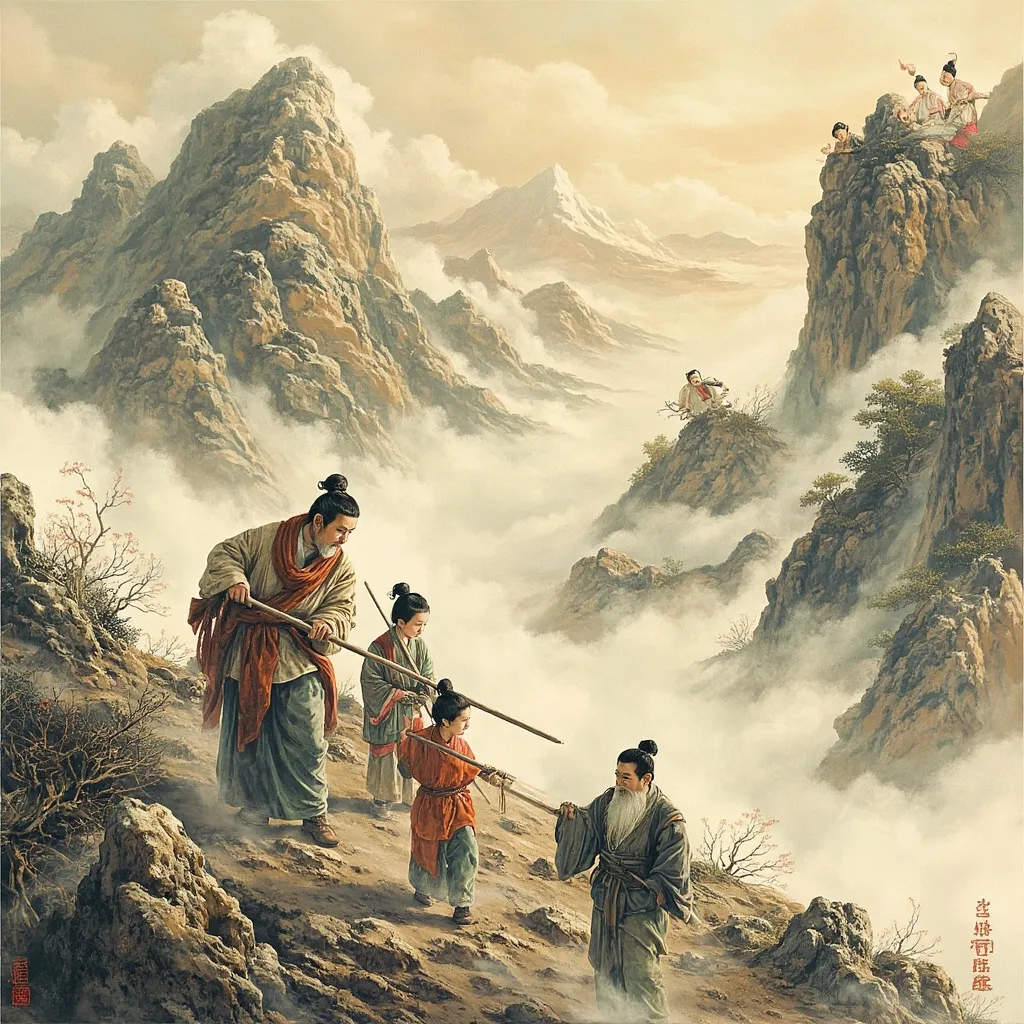
He rounded up his sons and grandsons — the text mentions three generations actively participating — and told them they would start digging. Every day, they would carry baskets of earth and rocks from the mountainside down to the sea, bit by bit, year after year. It was, by any reasonable measure, an absurd plan. The mountains were unimaginably large. The work would take generations. Most people couldn’t even finish the task in a single lifetime.
But Yu Gong wasn’t interested in finishing in his lifetime. He was interested in starting, and in making sure his children and grandchildren kept going after he was gone.
When a local wise man — some versions call him a skeptical neighbor — heard about Yu Gong’s plan, he laughed and tried to discourage him. “You’re so old and weak,” the man said, “you couldn’t even move a single hillock, let alone two mountain ranges. How could you possibly finish such a task?”
Yu Gong reportedly replied with something that has become one of the most famous lines in Chinese philosophy: “我死有子,子又有孙,孙又有子;子子孙孙无穷匮也,而山不加增,何苦而不平?” — “I may die, but I have sons, and my sons have sons, and their sons will have sons. Generation after generation, there will be no end to us. But the mountains won’t grow any larger. So why shouldn’t we eventually succeed?”
The story ends with the gods of the mountains being so impressed — or in some versions, so frightened — by this reasoning that they sent celestial beings to physically move the mountains overnight. The obstacles were removed not because of magic, but because the universe itself recognized that unwavering persistence would eventually accomplish what brute strength alone could not.
The Philosophy Behind the Fable: Why “Foolish” Is Actually Wise
Here’s what makes the story genuinely clever. The protagonist is called “愚公” — Foolish Old Man — and he is surrounded by people who think he’s ridiculous. But the narrative structure is set up so that the reader is meant to realize that the “wise” people are actually the fools, and the “fool” is the one who sees clearly.
This is a classic Daoist paradox: what society calls wisdom often amounts to nothing more than prudent cowardice. The neighbors who discouraged Yu Gong weren’t stupid. They were simply being practical. They measured the size of the problem, calculated the odds, and concluded that no sane person would attempt such a thing. And by the standards of a single human lifetime, they were absolutely right.
Yu Gong’s genius lay in rejecting that framework entirely. He didn’t try to solve the problem within the constraints everyone else accepted. Instead, he asked a different question: not “can I move this mountain?” but “does this mountain have to be here forever?” He understood something that the practical thinkers missed — that obstacles that appear permanent are often only permanent if you accept the premise that they are.
This is why the story resonates so deeply in Chinese culture. It speaks directly to the tension between pragmatism and vision, between knowing your limits and refusing to let those limits define what’s possible. The Daoist philosophers who preserved this story were arguing, in their characteristically indirect way, that the greatest achievements in human history almost always came from people who were too stubborn to accept the conventional wisdom about what was “realistic.”
What “Persistence Over Shortcuts” Really Means
In the modern world, 愚公移山 is often used as a simple motivational story about never giving up. That’s not wrong, exactly, but it undersells the depth of what the original story was getting at. The fable isn’t just about working hard. It’s about a specific relationship between time, generational effort, and the nature of obstacles.
Think about what Yu Gong actually did. He didn’t try to find a clever workaround. He didn’t look for a shortcut or a technological solution. He simply committed to doing the work, day after day, for as long as it took. The mountains weren’t going to evaporate. The task wasn’t going to get easier. There were no guarantees of success. All he had was the willingness to keep going.
This is a profoundly anti-shortcut philosophy. In an age of life hacks, optimization strategies, and get-rich-quick thinking, 愚公移山 pushes back against the idea that success comes from finding the clever approach. Sometimes there is no clever approach. Sometimes the only way through is sheer, patient, sustained effort — not because you’re too stubborn to think of something smarter, but because you’ve correctly assessed that no smarter path exists.
The story also has something important to say about what we owe to future generations. Yu Gong wasn’t just doing this for himself. He explicitly framed his project as something his descendants would continue. He was investing in a future he wouldn’t live to see, trusting that his children and grandchildren would carry the work forward. That’s a surprisingly modern idea — thinking beyond your own lifetime, acting as a link in a chain rather than an isolated individual.
Real-World Examples: People Who “Moved Mountains”
History is full of people who embody the spirit of 愚公移山, even if they’ve never heard the story. These are the individuals who looked at problems everyone else considered unsolvable and simply refused to accept that verdict.
Consider the construction of the Great Wall of China, which took centuries of continuous effort by hundreds of thousands of workers. No single person lived to see it completed in its final form. It was built, rebuilt, extended, and maintained across dozens of dynasties, each generation adding to what the previous one had done. The wall wasn’t a single achievement — it was a multi-generational project, much like Yu Gong’s mountain-moving.
Or look at China’s railway system, particularly the early lines that had to cross terrain everyone said was impossible to build through. Engineers told the builders that certain mountain ranges were simply too rugged, the altitudes too dangerous, the slopes too steep. They built anyway. Generation after generation of railway workers, tunnel by tunnel, bridge by bridge.
In the non-physical realm, think about scientific research. Some of the most important discoveries in medicine, physics, and biology took decades of failed experiments before yielding results. The researchers who finally succeeded didn’t necessarily do anything smarter than those who came before — they just refused to stop trying when others would have moved on to easier problems. Marie Curie, Thomas Edison, Alexander Fleming — all of them worked in the spirit of 愚公移山, grinding away at problems that seemed to have no solution until suddenly, one day, they did.
The common thread in all these examples is that the people involved rejected the premise that the obstacle was permanent. They didn’t always know how they would succeed. They just knew they weren’t going to accept “this is impossible” as a final answer.
How to Apply the Mountain-Moving Mindset Today
The challenge for most of us isn’t finding motivation — it’s maintaining it over the long term. Yu Gong’s advantage was that he had a clear, tangible problem (the mountains blocking his path) and a clear, tangible solution (dig them up and move them). Modern problems are usually more ambiguous, which makes the 愚公移山 mindset harder to apply. But not impossible.
Start by reframing the problem. Ask yourself whether the obstacle in front of you is truly immovable, or whether it only appears that way because everyone has accepted that premise. Yu Gong’s neighbors saw mountains. Yu Gong saw a problem with a solution, even if the solution would take generations to implement. That shift in perspective — from “this is fixed” to “this is hard but not permanent” — is the foundation of the mountain-moving mindset.
Focus on daily incremental progress. Yu Gong didn’t try to move the entire mountain in one day. He and his family filled their baskets, walked to the sea, dumped the rocks, and came back the next morning to do it again. The compound effect of small, consistent actions over years and decades is what made the seemingly impossible achievable. If you’re working toward a long-term goal — learning a language, building a business, paying off debt — the same principle applies. You don’t need to see dramatic results today. You just need to make sure you’re moving the metaphorical rocks from the right side of your life to the wrong side.
Build systems that outlive you. One of Yu Gong’s most underappreciated qualities was his long-term thinking. He knew he wouldn’t finish the job, but he was confident his descendants would. That confidence drove him to establish a pattern of action — a daily practice of showing up and doing the work — that could theoretically continue forever. When you set up your own projects and goals, ask whether the systems you’re creating are sustainable beyond your direct involvement. Are you building something that can be passed down, scaled, or continued by others after you’ve moved on?
Finally, find your gods of the mountains — the external forces that will ultimately validate your persistence. In the story, the celestial beings moved the mountains because they recognized Yu Gong’s unwavering commitment. In real life, those forces might be the people who eventually support your work, the circumstances that shift in your favor, or simply the compounding momentum that builds when you refuse to quit. You can’t always control when or how the breakthrough comes. But you can control whether you’re still there when it arrives.