Before there was sky, there was chaos. Before there was earth, there was formlessness. And before there was light, or dark, or anything at all that we would recognize as a place to exist — there was an egg. Inside that egg, there was a being. He slept for eighteen thousand years, and when he woke up, he began the work of making everything.
This is the story of Pangu (盘古), and if you grew up in a Chinese-speaking household, you almost certainly heard some version of it. It’s the foundational myth, the one that answers the question every culture eventually asks: how did the world begin? The Chinese answer involves a giant, an egg, and eighteen thousand years of continuous transformation — a timescale that puts even the most ambitious geological estimates to shame.
The earliest written versions of the Pangu story appear in texts from the Three Kingdoms period (220-280 CE), though the mythology itself is almost certainly much older, predating written records by centuries or millennia. The Sanwu Liji and the Jinwen tradition preserve fragments that describe Pangu emerging from the cosmic egg and immediately setting to work on the problem of the undifferentiated universe.
The Shape of Nothing
To understand why Pangu’s work mattered, you need to understand what the world looked like before he did it. The old texts describe the primordial state in terms that sound almost like physics, though they predate any scientific understanding of cosmology. There was chaos, which the Chinese called hundun (混沌) — not the chaos of random noise but the chaos of undifferentiated potential. Everything that would later become separate things existed, but not yet separated. It was all one mass, one suspended possibility, one unbroken egg.
Some versions describe the upper part of this egg as clear and the lower part as murky, which is a poetic way of describing what would become sky and earth. But the two hadn’t separated yet. They were stuck together, compressed, like two pages of a book glued back to back with no binding. Pangu existed in the space between them, and for thousands and thousands of years, he slept.
The number eighteen thousand years appears in multiple sources and has the feel of a number that has been symbolically charged — it’s precisely the kind of number that gets assigned mythological significance, the way “forty days” means something in the story of Noah’s flood or “seven years” functions in Egyptian and Hebrew traditions. Whether it meant anything precise to the original storytellers is impossible to know. What matters is the scale: long enough to matter, long enough to mean something, long enough that when Pangu finally woke up, the world was ready to be born.
The Waking and the Separation
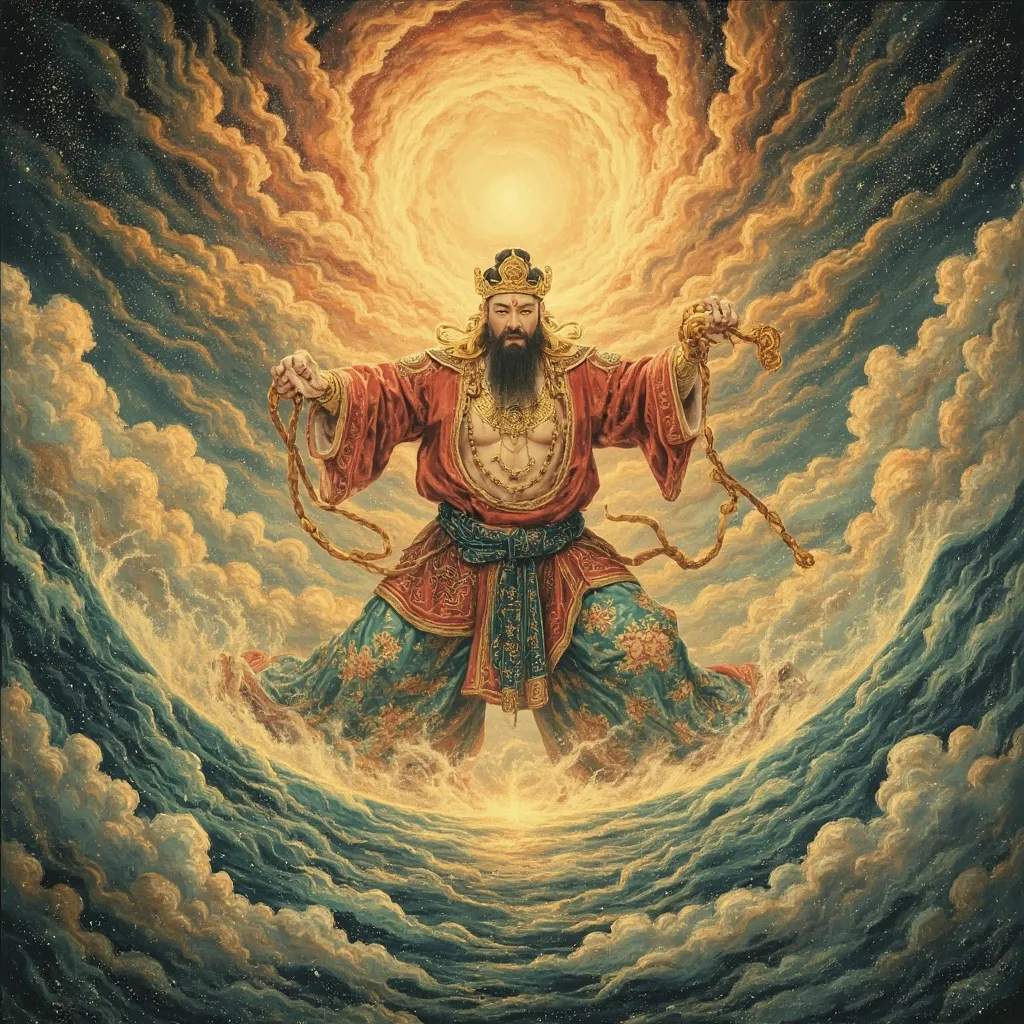
When Pangu opened his eyes, the first thing he saw was darkness. Or rather, he saw the absence of anything else — no light, no form, no boundaries. The chaos surrounded him on all sides, and his first instinct was to change that. He stretched, and in stretching, he began to separate the clear from the murky. The clear elements rose; the heavy ones sank. What had been one thing became two things. What had been formless began to take form.
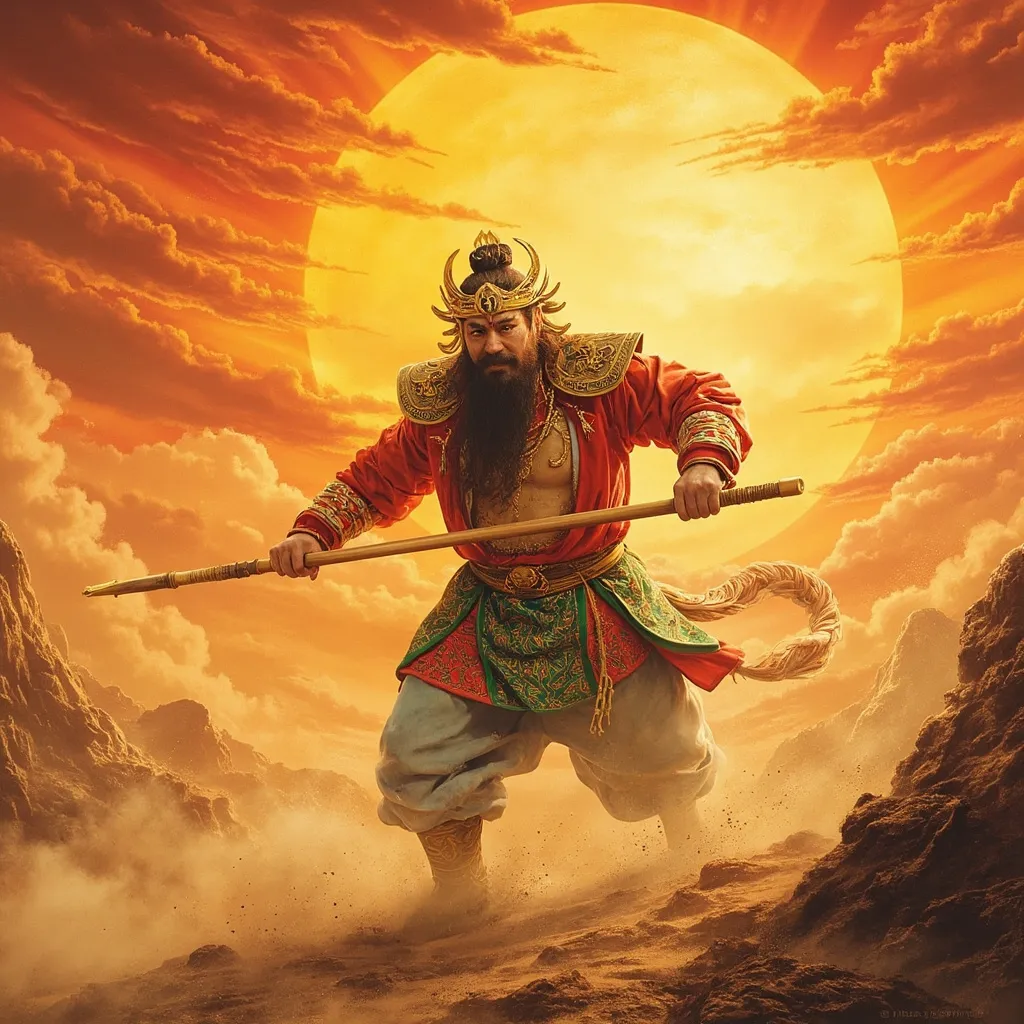
The Sanwu Liji describes this process with a kind of matter-of-factness that makes it feel more real, not less. It doesn’t say the gods commanded it or that magic was involved. It says Pangu grew taller by a small amount each day — some texts say one zhang (roughly three meters) per day, others say the rate accelerated — and as he grew, he pushed the sky further up and the earth further down. Every day, a little more separation. Every day, the world getting bigger because he was making himself bigger.
This is one of the stranger elements of the story. Pangu didn’t create the world by speaking it into existence or by fashioning it from external materials. He created it by being in it, by growing, by using his own body as the instrument of separation. His bones became mountains. His blood became rivers. His breath became wind. His voice became thunder. The sweat that dripped from his body as he labored became rain. When he finally died — and the story always reaches this point — his body continued to transform into the substance of the world itself.
The Body as Cosmos
The death scene is where the myth becomes almost too big to hold in your head. Pangu had been growing for eighteen thousand years. His body was the size of — well, there are no comparisons because nothing else is that size. The texts describe him as thousands of miles tall, or sometimes just say he was “beyond measuring.” When he finally collapsed from exhaustion, the transformation accelerated.
His eyes became the sun and the moon. His head became the mountains at the corners of the world. His躯干 became the central plains. His blood became the great rivers — the Yellow River and the Yangtze appear in some versions. His veins became the roads and paths that humans would later travel. His muscles became the fields. His skin became the grass and the soil. The parasites that had lived in his hair and beard became the stars and constellations, scattered across what had become the sky.
I have read this part of the story many times, and it still strikes me as one of the most ambitious acts of mythological imagination in any tradition. The world did not merely contain Pangu; the world was Pangu, in the most literal possible sense. To walk on the earth was to walk on his body. To drink from a river was to take something from his blood. The boundary between the human world and the divine body that produced it had dissolved entirely.
This is also why the Chinese relationship with nature has often carried religious as well as ecological dimensions. To destroy a mountain or poison a river was not just an environmental crime; it was an injury to something that had once been alive in the same way humans were alive. Pangu’s body was the world, and the world was sacred because it had been alive.
Pangu in the Chinese Imagination
The Pangu story is unusual among creation myths in that it doesn’t involve the creation of humans as a special event. In many traditions — Genesis, for instance — humans are the climax of creation, the beings for whom everything else was made. In the Pangu story, humans appear later, after the world has been shaped, as secondary creations. Some versions say the gods Fuxi and Nuwa (the same goddess from the mending-the-heavens story) created humans, or that humans emerged from the interactions between heaven and earth that Pangu’s separation had made possible. The human story is part of the larger story, not the other way around.
This gives Chinese cosmology a different feel than the Abrahamic tradition, even setting aside the religious differences. The world was not made for humans; humans emerged from the world, which was itself made from sacrifice. Pangu gave everything, and what he got in return was the opposite of rest — his body became the stage on which everything else would eventually play out. There is something almost tragic in that, if you think about it. He worked so hard to make a place for things to exist, and then he became the place.
The idiom pan gu kai tian (盘古开天) — “Pangu opened the sky” — is used in Chinese to describe the beginning of something, the foundational moment, the first act of creation. It’s applied to literal world-creation in religious contexts, but also to any sufficiently fundamental beginning. A company’s founding might be described this way. A new field of study. A relationship. The phrase carries weight precisely because the original act carried so much weight.
Why Beginnings Matter
I think about why cultures need creation stories, and why the specific details of each one tell you something about the people who tell them. The Pangu story says: the world was made by someone who gave everything to make it, and what he made was himself, turned inside out, transformed into the substance of your daily life. When you look at a mountain, you are looking at part of a body. When you drink from a river, you are taking from something that was alive. The world is not separate from you; it is you, extended, repeated, made vast.
This is not a comfortable myth in some ways. It implies that the world is not a resource to be exploited but a body to be respected. It implies that the separation between self and environment is illusory, that the boundary is something Pangu created through effort and that can be undone through neglect or violence. It implies that when the sky is broken (as in the Nuwa story), it is a body that is broken, and someone has to come and fix it because bodies matter.
Many traditional Chinese practices — feng shui, geomancy, the careful siting of graves and temples — reflect this understanding. Where you build matters because the land is not neutral. It has qi, it has history, it has connections to the bodies that became it. This sounds mystical to modern ears, but the underlying intuition is actually quite ecological: everything is connected, everything has a history, and the physical world is not separate from the lives that depend on it.
The Giant Who Became Everything
There is a version of the Pangu story in which he is not alone — in which he shares the cosmic egg with a companion, often described as a sister or a complementary spirit. In some versions, this being is Nuwa, who would later mend the sky and create humans. The two figures together represent the masculine and feminine principles of creation, the active and receptive forces that together produce the world.
This pairing makes the mythology feel less like a solo achievement and more like a collaborative process — Pangu separates, Nuwa completes. Pangu makes the structure; she fills it with beings who can appreciate it. The order of creation matters: first the bones of the world, then the flesh, then the creatures who walk on it. Without Nuwa, Pangu’s sacrifice would have produced an empty stage. Without Pangu, Nuwa would have had nothing to mend when the sky cracked.
The combination also suggests something about the Chinese view of how things get done. It is rarely one hero, one stroke, one moment of individual brilliance. It is usually a process involving multiple actors, multiple stages, multiple transformations. The world was not made in a day; it was made in eighteen thousand years of continuous effort, and then it had to be maintained, and then it had to be repaired when it broke. Creation is not a finished act; it is an ongoing process that requires attention.
Pangu sleeps no more. But the world he made is still here, still turning, still holding sky and earth apart through the structures he established by growing. Every time you see a mountain and feel small in comparison, you are looking at part of something that was once alive. Every time you hear thunder, you are hearing what his voice became. The giant is gone, but the world remains, and in remaining, it testifies to an act of making that has no equivalent in any other mythology I know.
That’s worth remembering. It changes the view, at least a little, to see the mountains as his bones.
Recommended Reading and Products
Disclosure: This article contains affiliate links. We earn a commission on qualifying purchases, at no extra cost to you.