Before the gods had names. Before the earth had shape. Before there was light, or darkness, or anything at all except formless chaos — there was an egg.
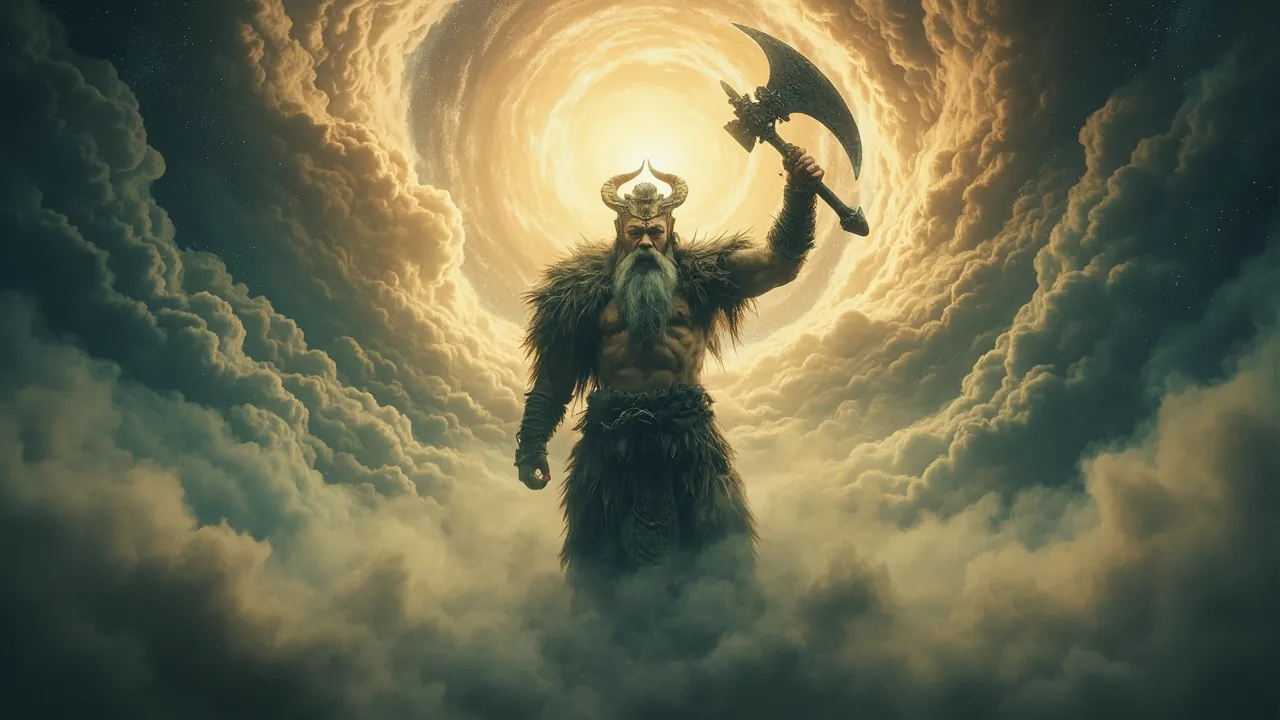
And inside the egg, there was a man. Or something like a man. He had been sleeping in there for so long that no one could remember when he started, and when he finally woke up, the first thing he did was change everything. His name was 盘古 — Pangu — and he is the reason the sky is above us and the earth is below us. Not because a god designed it that way. Because one being, alone in the dark, decided to stand up.
The story of Pangu is one of the oldest in Chinese mythology — its roots go back at least two thousand years, and possibly much longer. It’s a creation story, but it doesn’t start with a god waving a hand and making the universe. It starts with a being inside an egg, in darkness, who has to physically separate the chaos around him using nothing but his own body. The sky and the earth were not given to us. They were made — by one being’s determination and labor over thousands of years.
It’s one of the most physical, almost industrial creation myths you’ll ever encounter. And it’s utterly unlike the creation stories from most other cultures.
The Egg and the Sleeping Man
The oldest versions of the Pangu story describe the universe before his birth as a formless mass — the 混沌 — hundun, sometimes translated as “chaos” or “primordial disorder.” It wasn’t emptiness, exactly. It was fullness without form. Everything was there — the material that would become earth, the material that would become sky — but it was all mixed together, dense and shapeless, like an egg with no inside or outside.
Pangu was born from this egg. How, exactly, varies by telling — some versions say he emerged spontaneously, others say he was conceived within the egg and grew until he broke out. Either way, when he opened his eyes, there was nothing to see. It was dark. It was formless. He was inside the egg, and the egg was inside chaos, and there was no up, no down, no outside.
He stood up.
This is the first recorded action in the Pangu story, and it’s deceptively significant. The moment Pangu stands, he creates the possibility of separation. The chaos that contained him is now being pushed against by something that is not chaos — by a body that occupies space, that moves, that exerts force. The universe, which had been perfectly uniform and undifferentiated, now has a point of difference. Something is different from something else.
The image of a man standing inside a cosmic egg and prying it apart is not, for all its strangeness, unique to China. You can find hauntingly similar scenes in the Norse Ginnungagap, the void between fire and ice that the first gods climbed out of; in the Vedic Hiranyagarbha, the golden embryo floating on the cosmic waters before creation; in the Enuma Elish of Babylon, where Marduk splits the body of the saltwater goddess Tiamat in two and makes one half the sky and the other half the earth. Almost every ancient culture that thought hard about where the world came from arrived at some version of an image: a being, an enclosed space, and a moment of breaking open.
What makes the Chinese version distinct is what the being does with the space after. Pangu doesn’t smash the egg and walk away. He stays inside it, holding the two halves apart, becoming a living pillar between them. In Norse myth, the world is built and the builder steps back. In the Pangu myth, the builder becomes the architecture. That difference — between a god who finishes a project and a god who is the project — runs through every other part of the story.
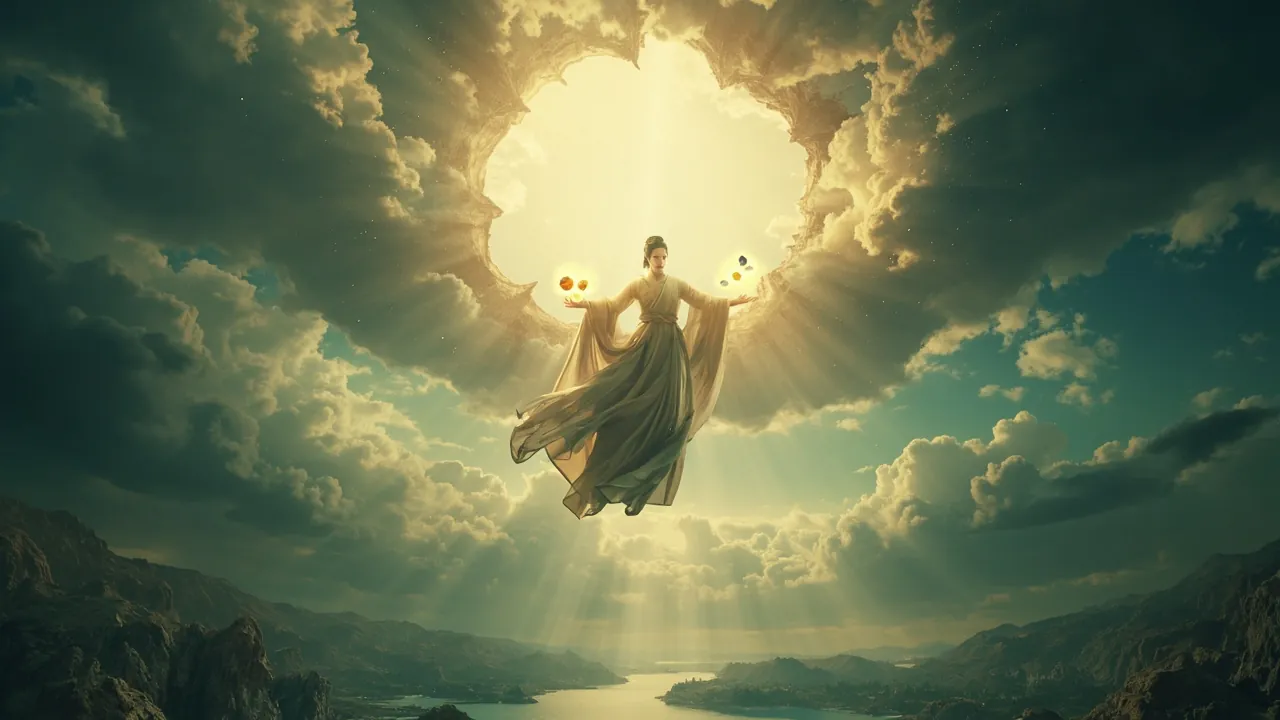
And Pangu, being a being of extraordinary size and patience, began the long slow work of separation. He pushed up. The sky — the lighter, clearer part of the chaos — began to rise. He pushed down. The earth — the heavier, denser part — began to sink. And between them, day by day, century by century, the space that would become the world expanded.
The Work of Ten Thousand Years
Here’s what makes Pangu’s story so unusual compared to other mythological creation accounts: it took a very, very long time. Not six days like the Biblical creation. Not a snap of divine fingers. Pangu spent eighteen thousand years separating the sky from the earth, and he did it through pure physical effort.
He stood. He pushed. Every day, the sky rose a little higher and the earth sank a little lower, and Pangu stood in between, holding them apart. He grew along with the separation — in some versions, he was nine hundred miles tall by the time the work was done. His body expanded as the sky rose. He was literally becoming larger as the world became larger, because his body was the thing keeping them apart.
Imagine standing with your arms raised over your head, holding two surfaces apart, for eighteen thousand years. Imagine never sitting down. Never sleeping, in some versions. Never stopping. That’s what Pangu did. He held the sky and the earth apart through sheer will and physical endurance, and the world took shape around him.
During this time, the mythology says, the world was not fully stable. The sky was not yet firmly separated from the earth. There were floods and fires and disasters as the raw material of the universe continued to sort itself out. Pangu protected the early world from these instabilities, his body shielding the space where life would eventually take root.
And then, one day, after eighteen thousand years of standing and pushing and holding, Pangu looked around and realized: it was done. The sky was high enough. The earth was solid enough. The separation was complete. The job he had been born to do was finished.
He could rest.
He sat down. He lay down. And then he died.
What Pangu Left Behind
In most mythology, when a creator god dies, something happens — they go to a celestial realm, they’re mourned, they become something else. In the Pangu story, the death is almost anticlimactic, and yet what happens afterward is one of the most remarkable images in any creation myth.
When Pangu died, his body became the world.
His breath became the wind. His voice became thunder. His eyes became the sun and the moon — his left eye the sun, his right eye the moon. His blood became rivers and oceans. His veins became mountain ranges. His muscles became the fertile plains. His skin became the grass and flowers. His hair became the stars in the sky. His fleas — yes, his fleas — became the animals that would populate the earth.
The world was not made from nothing. The world was made from one being’s body, one being’s labor, one being’s sacrifice. Every mountain is a piece of Pangu’s skeleton. Every river is a piece of his veins. Every sunset is a glimpse of his eye.
This is not just a story to be remembered. It’s a story that was, for centuries, the way Chinese readers actually saw the world. When a Tang dynasty poet climbed a mountain, the rocks under his hand were Pangu’s bones. When a Song dynasty official looked out at a flooding river and wondered what force could move so much water, the answer was already in the mythology: that is Pangu’s blood, still flowing. The myth gave the Chinese landscape a kind of intimacy with divinity that pure abstraction could not. The land was not a backdrop for human drama. It was the body of the first being, still warm. Even today, when Chinese parents name their children, you can find traces of this ancient pattern — given names that borrow from landscape features, from celestial objects, from the same sun and moon and rivers that were once, in the oldest telling, Pangu’s left eye, his right eye, and the rivers of his blood. The myth has never quite stopped being a working cosmology. It’s been a working poetics for two thousand years.
This is why the Pangu myth is sometimes called the most materialist of all Chinese creation stories — there’s no supernatural creation here, no divine command. The world exists because something worked very hard to make it exist, and then gave everything it had to make it real.
The Lesson Nobody Talks About
The Pangu story is usually told as a creation myth, which makes sense — it’s how the world was made, according to one very old Chinese tradition. But there’s a secondary lesson embedded in it that doesn’t always get mentioned, and it’s this: the world you live in was built by someone else’s sacrifice.
Every mountain you climb, every river you cross, every sunset you watch — you’re seeing pieces of Pangu. The comfort you have, the life you’re living, the very ground beneath your feet — none of it just appeared. It was made. It was made by someone who worked eighteen thousand years and then gave their body to make it real.
This gives the natural world a weight that purely materialist cosmologies don’t provide. These aren’t just rocks and water and gases. These are the remains of a conscious being who chose to create, who chose to labor, who chose to give everything. When you stand on a mountain, you’re standing on something that was once alive and working and pushing the sky away from the earth. That’s not just geology. That’s a story.
Pangu and the Human Condition
There’s something about Pangu that feels deeply relatable, even in his cosmic scale. He didn’t ask to be born in an egg of chaos. He didn’t choose the task of creation. He simply woke up in darkness, assessed the situation, and started working. He didn’t have divine powers or supernatural tools. He had a body and a will, and he used them.
For eighteen thousand years.
Eighteen thousand years is a number so large it’s almost meaningless to human minds. But think about the scale of commitment it implies. Pangu didn’t complete the work in a day. He didn’t complete it in a lifetime, or a hundred lifetimes, or a thousand lifetimes. He completed it in eighteen thousand years of continuous effort, and then he died having done it.
This is not a story about an all-powerful god snapping their fingers. This is a story about someone doing the work — the long, slow, tedious, absolutely necessary work of creation — without stopping.
We live in an age of instant results and viral success and overnight sensations. We celebrate the breakthrough, the disruption, the thing that changes everything in a moment. The Pangu myth offers a different model: the value of sustained, patient, physically-demanding labor over timescales that exceed any single human lifetime.
Pangu didn’t live to see the finished world in his conscious life. The world was finished at the moment of his death. The creation and the creator ended together. But what he made outlived him by — well, by everything. The world he made is still here. His eyes are still watching from the sky. His body is still underfoot.
If you’re the kind of person who struggles with patience, who can’t see the results of your work fast enough, who feels like the effort isn’t worth it because you won’t live to see the payoff — the Pangu story is for you. The work matters even if you don’t see it completed. The sky is higher because of what you did. The earth is solid because of what you gave.
Pangu couldn’t see the finished world while he was alive. But the finished world exists because of him.
That’s not nothing. That’s everything.