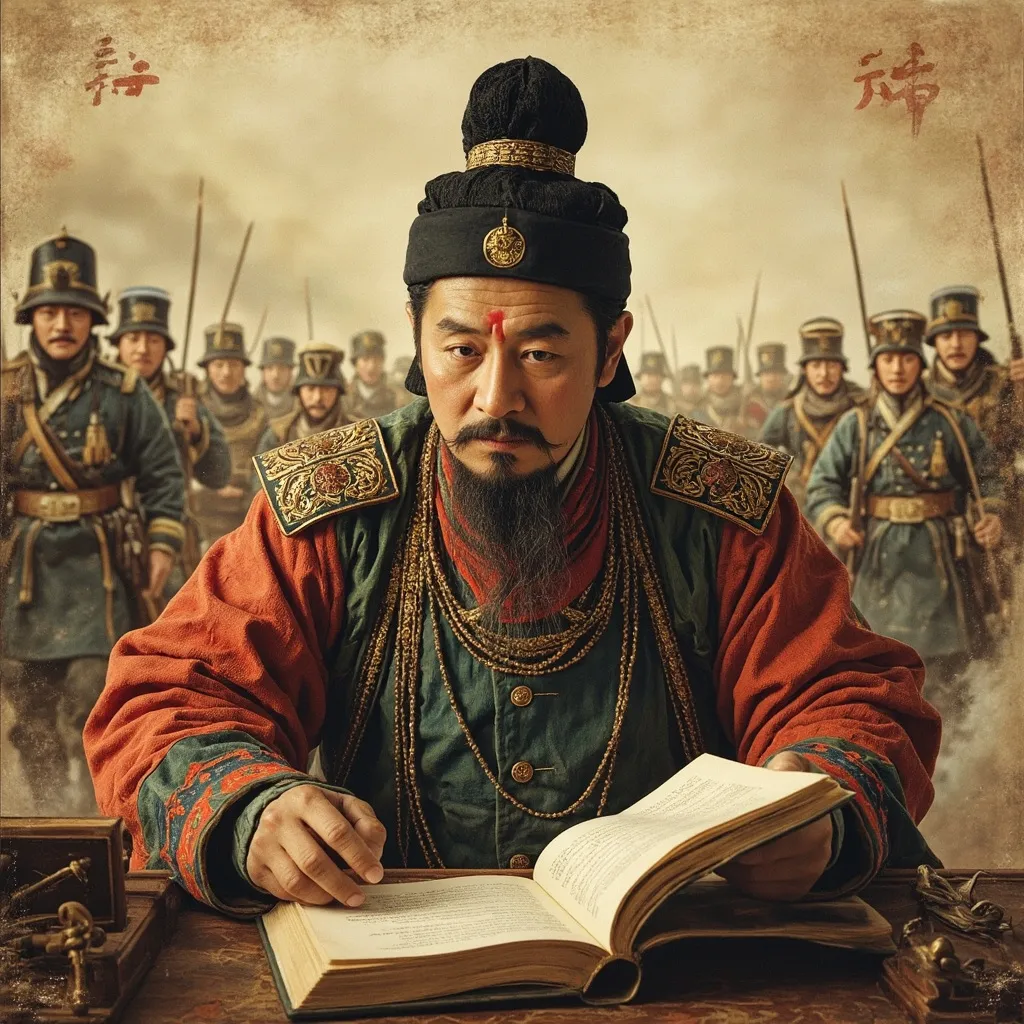
slug: “paper-talking-battle-zhishangtanbing” description: “Discover the fascinating story behind 纸上谈兵 (zhǐshàng tán bīng) - the Chinese idiom about Zhao Kuo, whose book-smart military theories led to catastrophic defeat at the Battle of Changping.” keywords: “纸上谈兵, Chinese idiom, Zhao Kuo, Battle of Changping, Chinese idiom story, ancient China history, military strategy” author: “Cultural Tales Studio” category: “Chinese Idioms” tags: [“Chinese idioms”, “Warring States”, “military history”, “ancient China”, “idiom stories”] image: “/images/paper-talking-battle.jpg” affiliate_products:
- “Classical Chinese Philosophy Collection”
- “Ancient Chinese Warriors Book Set”
- “Bamboo Scroll Journal”
- “Traditional Chinese Ink Stone”
- “Warring States Period History Documentary” categories: [Chinese Idioms] alt_text: “Illustration depicting paper talk about battle, in a traditional Chinese cultural setting”—
Paper Talk About Battle: The Famous Chinese Idiom That Still Stings Today
There’s a phrase Chinese parents love to throw at overconfident students, and it cuts through centuries like a fresh blade. When someone spends all their time reading about something but never actually doing it, when they strut around like they know everything while the real world laughs in the background — that’s when you hear it: 纸上谈兵, pronounced zhǐshàng tán bīng.
Literally it means “talking about battle on paper.” Figuratively, it means empty theoretical talk that falls apart the moment it meets reality. And the story behind this idiom? It’s one of the most devastating military defeats in Chinese history, told and retold for over two thousand years.
The Boy Who Loved Military Books
Let’s travel back to the Warring States period, somewhere around 260 BCE. The Qin state was rising like a thunderstorm, swallowing neighboring kingdoms one by one. Zhao was one of the few states left with enough strength to push back, and at the center of Zhao’s military machine was a general named Zhao She.
Zhao She wasn’t just any general. He was one of the most celebrated military minds of his era, a man who had fought in dozens of battles and understood war the way a master chef understands fire — intimately, respectfully, and with absolute seriousness. He had four sons. The youngest was named Zhao Kuo.
Now, Zhao Kuo grew up in extraordinary circumstances. His father was a living legend, and the boy had access to something precious: all of Zhao She’s personal military writings, battle records, and strategic notes. While other children played with wooden swords, Zhao Kuo buried himself in scrolls. He studied the Art of War attributed to Sun Tzu. He memorized formations. He learned to discuss tactics with the kind of fluency that made adults pause and nod approvingly.
The problem was that Zhao Kuo had never actually been to war.
His father tried to teach him. According to historical records, Zhao She recognized something unsettling in his son’s confidence — a certain brittleness beneath the bravado. Real generalship, Zhao She knew, couldn’t be learned from books alone. It required the ability to read a battlefield in real time, to adapt when plans fell apart, to keep your head when arrows started flying and men started dying.
But Zhao Kuo was young, talented, and absolutely certain of himself. He had studied the greatest military minds in Chinese history. He had memorized campaigns and decoded strategies. In his own mind, he was already a general.
The irony? He wasn’t entirely wrong about his knowledge. He really did know more about military theory than most people alive. The tragedy was that he didn’t understand what he didn’t know.
The Battle That Changed Everything
In 260 BCE, the Qin army marched against Zhao in what would become known as the Battle of Changping — one of the largest and bloodiest battles in pre-modern history. The two armies met in a valley that would soon run red.
The initial Zhao commander was a veteran named Lian Po. Lian Po was old but shrewd. He recognized that the Qin forces were exceptionally strong and that a direct confrontation would be catastrophic. His strategy was simple: defend, wait, let the Qin overextend, then strike. It was the right call. It might have worked.
But the Zhao court had other ideas.
Emperor Zhao’s advisors whispered in his ear. They spoke of Lian Po’s age, his caution, his unwillingness to take risks. And they spoke of Zhao Kuo — young, brilliant, full of energy and theoretical knowledge. Why, they argued, should Zhao rely on an old man守住 while a brilliant young mind could win the war decisively?
Zhao Kuo himself fed this narrative. He met with the Emperor and laid out his strategies with such confidence, such apparent mastery of military science, that the court was seduced. Here was someone who could talk about warfare with the fluency of the greatest scholars. Here was someone who could reference Sun Tzu from memory and draw battle diagrams on the spot.
The Emperor replaced Lian Po with Zhao Kuo.
What followed was a catastrophe that still makes historians wince.
When Theory Collided With Reality
Zhao Kuo took command of forty thousand troops and immediately began implementing his grand strategies. He had studied the classics. He knew what the ancient generals had done. He was going to do even better.
The problem was that the Qin army wasn’t a textbook. They weren’t going to follow the patterns laid out in scrolls. Their commander, Bai Qi, was a tactical genius who had been fighting actual wars for decades. He knew how to read enemy weaknesses, how to bait overconfident commanders into traps, how to exploit the gap between knowing about war and understanding it.
The first signs of disaster came quickly. Zhao Kuo ordered a direct assault, believing that superior positioning and clever formations would carry the day. But the Qin forces didn’t break. They held their ground, adapted, and counter-pressed. Zhao Kuo’s carefully planned formations started to crumble under the reality of combat — the noise, the fear, the chaos that no scroll had ever adequately described.
Within weeks, the Zhao army was encircled. Cut off from supplies, surrounded by a superior enemy force, the soldiers who had trusted their young commander found themselves starving in a valley, waiting for a salvation that wouldn’t come.
The Battle of Changping ended with over four hundred thousand Zhao soldiers dead — either in combat or executed after surrender. The Zhao state never truly recovered. It was a wound that would eventually lead to Zhao’s absorption into Qin territory, part of the empire that would become the first unified Chinese dynasty.
And Zhao Kuo? He died in battle, his body never identified among the carnage. The theoretical genius, the boy who had read every book, was swallowed by the reality he had never understood.
The Lesson That Endures
Here’s what strikes me most about this story: Zhao Kuo wasn’t stupid. He wasn’t lazy. He genuinely studied hard and absorbed enormous amounts of knowledge. The tragedy was that he mistook information for wisdom, book learning for understanding, and confidence for competence.
Every field has its Zhao Kuo moments. The freshly minted MBA who arrives at a startup convinced they understand markets because they’ve read case studies. The medical student who can diagnose from textbooks but freezes in their first real surgery. The finance enthusiast who knows every Warren Buffett strategy but panics when their first investment dips.
We all carry a little Zhao Kuo inside us. The trick is recognizing when we’re reading about life and when we’re actually living it.
Chinese parents use this idiom to gently — or not so gently —提醒 a child who thinks they know better than people with actual experience. It’s not that books are useless. It’s that there’s a difference between knowing the shape of something and knowing its weight, its texture, its sting.
The phrase also carries a warning about confidence without humility. Zhao Kuo’s father saw the problem but couldn’t fix it. The Emperor saw a confident young man and mistook his certainty for ability. In our own lives, we should ask ourselves: when we feel most prepared, are we actually prepared, or have we just read enough to feel that way?
How to Apply This Wisdom Today
The idiom has seeped into modern Chinese life in ways both serious and humorous. You might hear it in a boardroom when someone’s PowerPoint strategy falls apart in execution. You might hear it in a school when a student who aces every practice exam bombs the real test. You might even hear it in your own home when someone insists they know how to fix the plumbing based entirely on YouTube videos.
The wisdom of 纸上谈兵 isn’t just about military defeat. It’s about the gap between knowledge and wisdom, between reading about something and internalizing it through lived experience.
So what can we do differently? First, seek out real experience alongside theoretical learning. Second, remain humble when we feel confident — especially when that confidence comes from having studied more than others. Third, find mentors who have walked the path before us, and actually listen to them instead of just out-arguing them with book quotes.
Most importantly, when we fail — and we will — resist the urge to blame the world for not matching our theories. Sometimes the problem isn’t the world. Sometimes the problem is that we spent too much time talking about battle on paper, and not enough time learning what battle actually feels like.
The next time you catch yourself being very certain about something you’ve only read about, pause. Think of Zhao Kuo, surrounded by his books, so sure he understood war. Then go find a way to get your hands dirty. That’s how you turn knowledge into wisdom.
The Deeper Problem: Why Smart People Fall Into This Trap
There’s something almost tragic about Zhao Kuo’s story when you look at it from a certain angle. He didn’t set out to be reckless. He didn’t ignore advice because he was arrogant in the usual sense. He studied harder than anyone, respected his father’s expertise, and genuinely believed he was prepared.
So where did it go wrong?
The answer lies in a cognitive trap that catches brilliant people more often than we might expect. When you’re good at learning — when you can absorb information quickly, make connections, articulate ideas clearly — it’s easy to confuse that ability with wisdom. You start to believe that understanding the theory automatically translates to understanding the practice.
But theory and practice operate in different domains. Theory deals with idealized scenarios, clean variables, and controllable conditions. Practice deals with chaos, with human fear, with the thousand small decisions that add up to victory or defeat. You can know everything about swimming from books, but that knowledge doesn’t automatically translate to being able to swim when you’re actually in the water.
Zhao Kuo had studied warfare the way a scholar studies anything — by abstracting it, systematizing it, making it fit into a framework he could understand and manipulate. But war doesn’t stay in frameworks. It breaks them. And when his beautiful theories met the ugly reality of Changping, there was nothing left to hold onto.
This is why the idiom remains so relevant. We live in an age of unprecedented access to information, where someone can become “an expert” in almost any field through online courses, video tutorials, and carefully curated reading lists. This is genuinely valuable. But it also creates new opportunities for the Zhao Kuo trap — for believing that consuming information is the same as developing capability.
The real test of knowledge isn’t whether you can explain something beautifully in a controlled environment. It’s whether you can perform when everything is messy and uncertain and people are counting on you to get it right.
What This Means for How We Learn
If Zhao Kuo’s story teaches us anything, it’s that learning requires risk. Real learning — the kind that actually changes how we operate in the world — can’t happen without exposure to real consequences. You have to try things and fail. You have to put yourself in situations where you don’t know all the answers, where the variables are uncontrolled, where your theories will be tested against an indifferent reality.
This doesn’t mean education is worthless. Of course it isn’t. But it does mean that education alone is not sufficient. Every profession, every skill, every domain of competence requires a phase of supervised practice where you’re allowed to make mistakes in a relatively forgiving environment before you’re thrown into situations where mistakes cost dearly.
The ancient Chinese military understood this. In well-run armies, young officers would be paired with experienced commanders and given increasing responsibility as they demonstrated judgment under pressure. The goal wasn’t to teach them theory — theory they could get from books. The goal was to develop their instincts, their ability to read situations, their composure when plans fell apart.
This apprenticeship model has largely been lost in modern education, where we tend to treat learning as something that happens in classrooms and certification exams. We produce people who are very good at passing tests and very unprepared for the actual challenges of their field. Zhao Kuo passed every test his society could devise — and still lost the most important test of all.
The path forward isn’t to abandon theory, but to insist that theory be paired with practice, that knowledge be tested in conditions that mirror reality, and that we maintain enough humility to recognize when our confidence exceeds our actual competence.
Think about your own field. How many people do you know who are brilliant at talking about what they do but struggle when actually doing it? How many “experts” whose expertise seems to dissolve the moment circumstances deviate from the textbook? This is the Zhao Kuo problem, and it’s more common than we’d like to admit.
The antidote is simple to describe but difficult to execute: get in the water. Take on real challenges. Accept that you will make mistakes, and that those mistakes are not signs of failure but essential parts of the learning process. Build relationships with people who have walked the path before you, and let them guide you through the parts that books can’t capture.
That’s how you avoid becoming a cautionary tale. That’s how you turn the pain of Zhao Kuo’s defeat into wisdom you can actually use.
Explore More Chinese Wisdom
Discover the richness of classical Chinese thought with our curated collection of resources that bring ancient stories and philosophies into modern context. These affiliate recommendations complement the themes explored in this article and offer deeper ways to engage with Chinese cultural heritage.
Recommended Reading and Tools:
Classical Chinese Philosophy Collection — A comprehensive anthology featuring translations of Sun Tzu, Confucius, Laozi, and other classical thinkers whose wisdom shaped dynasties. Perfect for readers who want to move beyond surface-level understanding into genuine engagement with ancient Chinese thought.
Ancient Chinese Warriors Book Set — This multi-volume set covers the military history of the Warring States period in depth, including detailed accounts of the Battle of Changping, the strategies that won and lost empires, and the commanders who shaped Chinese military tradition.
Bamboo Scroll Journal — For those inspired to write their own observations and strategic thoughts, this handcrafted journal brings traditional aesthetics to modern note-taking. Write your own reflections on the wisdom you’ve discovered.
Traditional Chinese Ink Stone — Deepen your connection to Chinese scholarly traditions with this authentic ink stone, used for grinding ink the traditional way. There’s something about the physical act of preparing ink by hand that connects you to centuries of scholars and writers.
Warring States Period History Documentary Series — Visual learners will appreciate this documentary series that brings the Warring States period to life through dramatized reenactments, expert commentary, and on-location filming at historical sites mentioned in this article.
This idiom story is part of our ongoing series exploring the wisdom embedded in Chinese idioms. Each expression carries centuries of history, and each reminds us that the past is never really past — it’s simply waiting for us to listen.