- “Peacock Feather Art Supplies”
- “Traditional Chinese Opera DVDs”
- “Chinese Women’s History Books”
- “Ancient Chinese Jewelry & Hairpins”
- “Chinese Classical Poetry Collections”
Peacock Flying Southeast: A Tale of Loyalty, Injustice, and the Spirit That Refused to Die
Among the longest and most emotionally devastating of all Chinese folk ballads, the story of Liu Lanzhi and her husband Luo Gongzi has been told in Chinese villages, performed in opera houses, and passed down through generations for nearly two thousand years. Known as “Peacock Flying Southeast” (孔雀东南飞, Kǒng Què Dōng Nán Fēi), this ancient tale is one of the most celebrated examples of narrative verse in Chinese literature—a story of a young bride who gave everything to her marriage, who served her mother-in-law with tireless devotion, and who was nonetheless cast aside and driven to her death by cruelty and injustice. And it is a story that does not end with death. In death, Liu Lanzhi finds a terrible power—the ability to return, transformed, and to speak the truth that living had forbidden her to say.
The poem that tells this story runs to over three hundred and fifty verses, making it one of the longest and most detailed of all classical Chinese folk narratives. It has been studied by scholars for centuries, analyzed for its portrayal of family dynamics, women’s roles, and the social hierarchies that governed Han Dynasty society. But at its heart, “Peacock Flying Southeast” is simply a story about a woman who loved her husband, who tried to be the perfect wife and daughter-in-law, and who was destroyed anyway by forces beyond her control. Her return as a peacock—a magnificent, iridescent bird that flies southeast toward the home she was forced to leave—gives the story its unforgettable ending and its enduring power.
This is not a story with a happy ending. It is a story about injustice, about the way that rigid social structures crush individual lives beneath their weight, and about the human spirit’s refusal to accept that crushing without protest. Liu Lanzhi dies, but she does not disappear. She transforms, she returns, and she speaks. In the end, the truth comes out, and even the person who destroyed her is forced to confront what she has done.
A Model Marriage and a Cruel Mother-in-Law
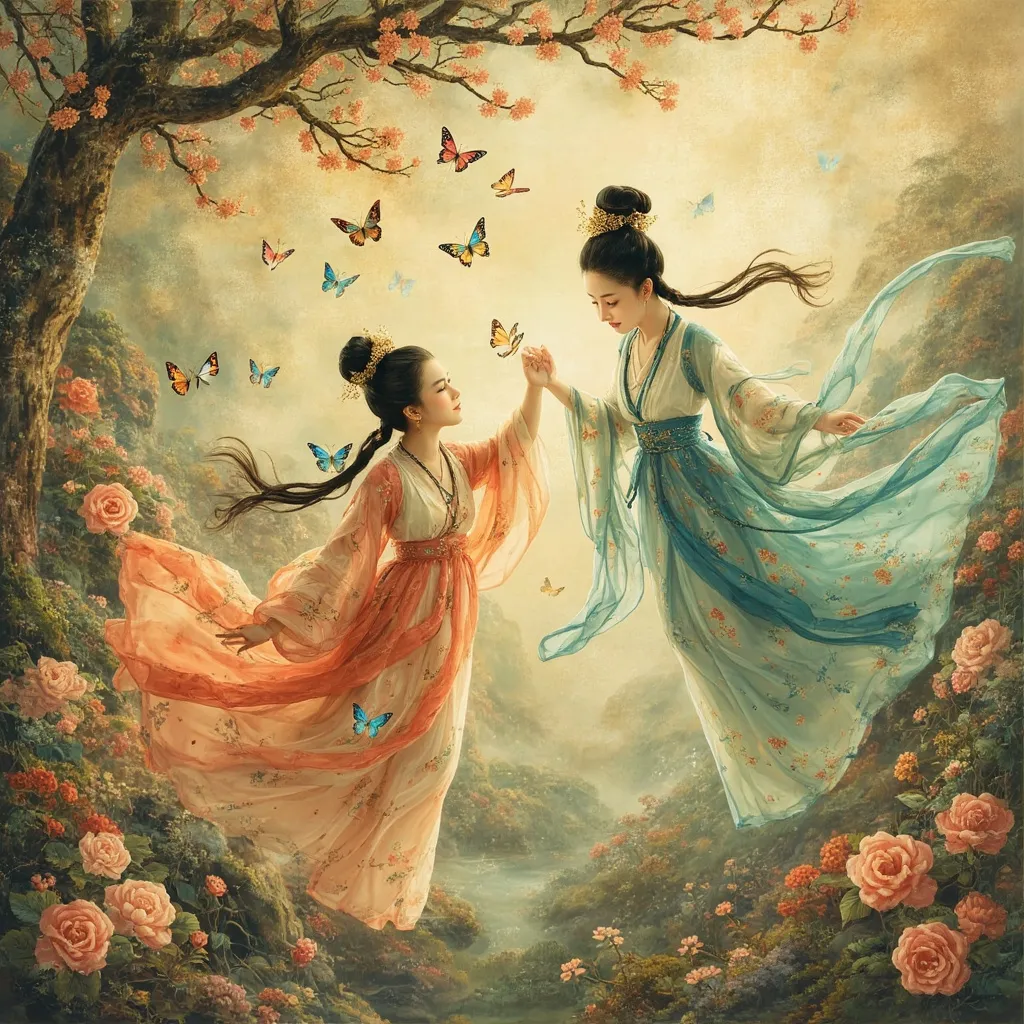
The story begins with the meeting and marriage of Liu Lanzhi and Luo Gongzi, a young couple whose union was, by all appearances, a model of conjugal happiness. Gongzi was a young man of good family and gentle temperament, and Lanzhi was a woman of beauty, virtue, and talent. They married, and from the very beginning, their relationship was marked by deep affection and mutual respect. The two were rarely seen apart—they walked together in the garden, sat together at meals, and spent their evenings in each other’s company, sharing conversation, music, and the quiet pleasures of married life.
In the traditional Chinese household, however, a marriage was not only about the husband and wife. It was also about the relationship between the wife and her mother-in-law, and it was in this relationship that the first signs of trouble appeared. Lanzhi’s mother-in-law, known in the story simply as “Mother Luo,” was a difficult and demanding woman who took an inexplicable dislike to her daughter-in-law. No matter how diligently Lanzhi served, how carefully she managed the household, or how perfectly she fulfilled her domestic duties, Mother Luo found fault with everything. Lanzhi rose before dawn to prepare meals and only slept after midnight, but her mother-in-law complained that she was lazy. Lanzhi dressed simply and wore no jewelry, but her mother-in-law accused her of vanity.
The root of this cruelty is never fully explained in the poem, and this ambiguity is part of what makes the story so psychologically rich. Some scholars have suggested that Mother Luo resented the close bond between her son and his wife, feeling displaced and replaced in her son’s affections. Others have pointed to the rigid expectations of the era—the idea that a mother-in-law’s authority over her daughter-in-law was absolute and unchallengeable, which gave women like Mother Luo a power they might not otherwise possess in a patriarchal society. Whatever the reason, the result was the same: systematic, unrelenting cruelty toward a woman who had done nothing to deserve it.
Gongzi, caught between his duty to his mother and his love for his wife, was in an impossible position. He could not challenge his mother without bringing shame upon the family, yet he could not stand by and watch his wife be mistreated. In the end, he did what many sons in his position did: he defended his wife quietly, speaking to his mother on Lanzhi’s behalf, suggesting that perhaps her complaints were unfounded. But this only made things worse. Mother Luo, enraged that her son would side with his wife against her, became more determined than ever to be rid of the daughter-in-law she had come to hate.
The Unjust Divorce
The breaking point came when Mother Luo made a decision that would destroy everything: she announced that she was sending Lanzhi back to her parents’ home. In Han Dynasty society, a woman who was divorced and sent away in disgrace faced a lifetime of shame and social exclusion. A divorced woman was considered damaged goods, someone who had failed in her most fundamental duty—to maintain a stable household and produce heirs for her husband’s family. That Lanzhi had done nothing wrong, that she had served faithfully and loved her husband deeply, mattered not at all. A mother’s word against her daughter-in-law was enough, and in the rigid social hierarchy of the time, there was no appeal, no court, no authority to which Lanzhi could turn for protection.
Lanzhi was given a choice: she could leave quietly and return to her own family, or she could face a formal divorce and the public shame that accompanied it. She chose to go quietly, asking only that she be allowed to say goodbye to her husband one last time. Mother Luo agreed, perhaps sensing the cruelty of forcing a final separation without farewell, or perhaps simply because she had already won and had no reason to deny this small mercy.
The farewell scene between Lanzhi and Gongzi is the emotional heart of the entire poem. They met in the garden where they had walked together so many times, surrounded by the peacock pond—a detail that will become important in the story’s supernatural ending. Lanzhi begged her husband to reconsider, to speak to his mother, to find some way to keep their marriage intact. But Gongzi, caught in the same social machinery that was destroying his wife, could offer only helpless promises. He gave Lanzhi a casket of cosmetics and jewelry as a parting gift, swore that he would never love another woman, and watched as she walked away toward her parents’ home, taking nothing with her but the clothes on her back and the memory of a love that had been unfulfilled.
In most versions of the story, Lanzhi spent the next few months at her parents’ home, trying to rebuild a life that had been shattered. Her parents were loving and supportive, but the shame of divorce followed her everywhere. And then, just as it seemed that perhaps she might find some measure of peace, word came that Gongzi had been forced by his mother to marry another woman—a young girl from a good family who could give Mother Luo the grandchildren and domestic harmony she demanded. The marriage was a disaster from the start. Gongzi, still deeply in love with Lanzhi, could not bring himself to treat his new wife with affection, and his mother, furious at her son’s continued devotion to his former wife, turned her cruelty toward the new bride as well.
A Death That Was Not the End
Lanzhi learned of Gongzi’s remarriage, and the news broke what little hope she had left. In some versions of the story, she died of grief. In others, she took her own life, unable to bear the weight of a world that had denied her every comfort and every justice. Either way, Lanzhi was dead, and her spirit was said to linger at the edges of the world between the living and the dead—a place where wronged souls were believed to wander, unable to find peace.
But death did not diminish Lanzhi’s spirit. If anything, it sharpened her sense of injustice and her determination to speak the truth about what had been done to her. Her ghost, or spirit, was said to appear to her former husband, telling him of her innocence, of her love, and of the cruelty that had destroyed them both. In some versions, she appeared as a beautiful woman; in others, she appeared as something else entirely—a dark figure at the edge of his bed, a whisper in the night, a presence that could not be explained or denied.
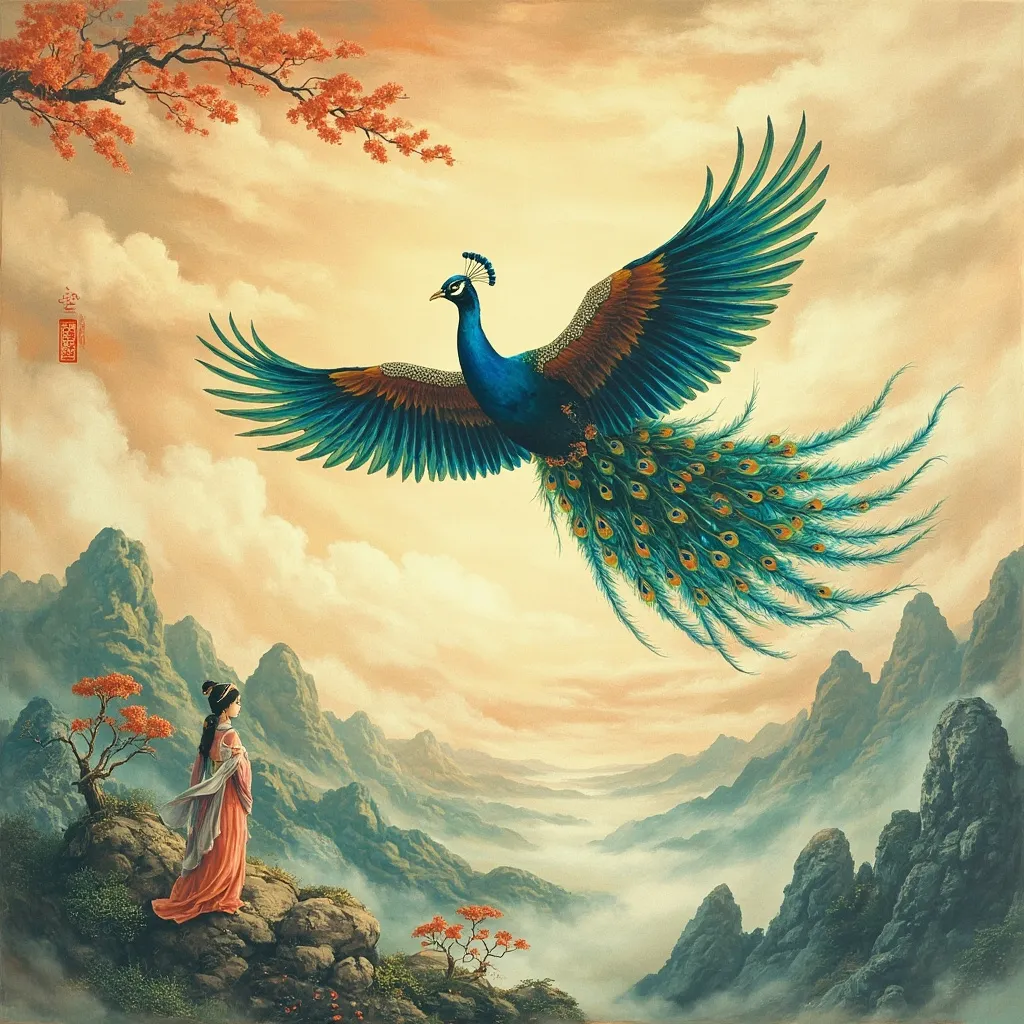
And then, one day, something extraordinary happened. Near the Luo family home, a magnificent peacock appeared—a bird of extraordinary beauty, with iridescent plumage that caught the light and sparkled like precious gems. The peacock flew to the roof of the house and began to cry out, a haunting sound that seemed to carry the weight of all Lanzhi’s unspoken grief and rage. The neighbors gathered to watch, and the bird’s cries seemed to form words that everyone could understand: this was Lanzhi’s spirit, returned to speak the truth.
Mother Luo, confronted with the peacock’s accusations, was unmoved. In a fury, she took a bow and shot the bird down, killing it instantly. But even this did not end the matter. The peacock’s feathers scattered across the countryside, and from each feather, a new peacock emerged, each one crying out the same accusations, each one refusing to be silenced by death or violence. In some versions, the peacocks circled the Luo family home for days before finally flying off toward the southeast—the direction of Lanzhi’s parents’ home, the place she had been forced to leave.
The Truth That Would Not Be Buried
The supernatural elements of “Peacock Flying Southeast” are among the most memorable in all of Chinese folklore, but they serve a purpose beyond mere spectacle. Lanzhi, in life, had no voice. She could not challenge her mother-in-law, could not appeal to authorities, could not defend herself against accusations that had no basis in truth. The social structures of her time gave her no recourse, no power, no agency of any kind. She was a victim, and victims in ancient Chinese society were expected to suffer in silence.
But death changed this. In the supernatural world, the rules that governed the living no longer applied. Lanzhi’s spirit could return, could speak, could accuse—and the very forces that had destroyed her now had to listen. The peacock imagery carries deep symbolic weight in Chinese culture: the bird represents beauty, dignity, and the soul’s journey after death. A peacock that refuses to be silenced, that keeps crying out even after being shot, that multiplies and spreads its truth across the countryside—that is the image of a woman who will not be erased, who will not accept injustice quietly, who insists on being heard even from beyond the grave.
In the end, the story does not offer a neat resolution or a moment of poetic justice. Mother Luo does not repent, does not beg forgiveness, does not suffer any dramatic punishment for what she has done. Instead, the poem ends with the image of the peacocks flying southeast, toward the home that Lanzhi was forced to leave, carrying her truth with them. The cruelty wins, in the end—but so does the spirit of the woman it destroyed. She is remembered, her story is told, and her voice echoes across the centuries.
“Peacock Flying Southeast” endures because it speaks to something universal about the human experience: the desire to be heard, the need for justice, and the refusal to accept that power, authority, or social convention can silence the truth forever. Liu Lanzhi died, but she refused to disappear. In that refusal lies the story’s lasting power and its enduring relevance to readers today.
Recommended Reading & Products
Affiliate products for this article:
Peacock Feather Art Supplies & Home Decor - Amazon US Search - Celebrate the beautiful symbolism of the peacock with art supplies featuring iridescent peacock feathers. Perfect for creating artwork inspired by this legendary tale.
Traditional Chinese Opera DVD Collection - Classic Ballads - Amazon US Search - Experience “Peacock Flying Southeast” as it was meant to be experienced—through the dramatic performances, elaborate costumes, and emotional singing of traditional Chinese opera.
Ancient Chinese Women’s History Books - Amazon US Search - Learn more about the lives of women in Han Dynasty China and the social structures that shaped stories like this one. Scholarly yet accessible histories of women’s experiences in ancient China.
Traditional Chinese Hairpins & Jewelry Sets - Amazon US Search - Inspired by the cosmetics and jewelry Liu Lanzhi received from her husband, these elegant hairpins and jewelry sets capture the beauty of traditional Han Chinese adornment.
Chinese Classical Poetry & Ballads Collection - Amazon US Search - Read “Peacock Flying Southeast” in its original verse form alongside other great Chinese narrative poems. A beautiful anthology of classical Chinese literary masterpieces.
Disclosure: This article contains affiliate links. We earn a commission on qualifying purchases.