There is a creature in the Chinese bestiary that exists for one specific purpose: to bring wealth into your house and to make sure it never leaves.
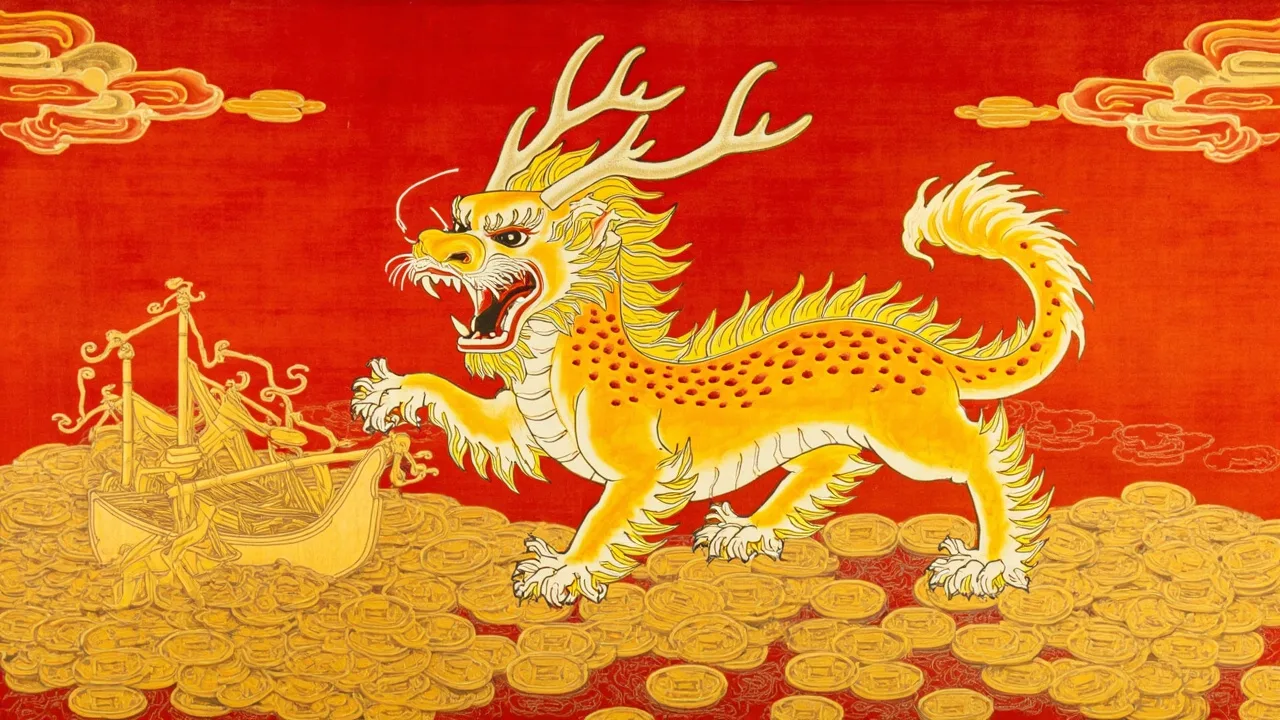
It has the head of a dragon. It has the body of a lion. It has the paws of a tiger and the wings of a phoenix, sometimes, and a single horn on its head in some versions, and no horns in others. And - this is the central, defining, repeatedly emphasized feature of the creature - it has no anus.
It can eat. It cannot excrete.
This is the Pixiu (貔貅), pronounced roughly pee-shee-yo in Mandarin, and it is, by a comfortable margin, the most commercially significant beast in modern Chinese folk religion. You can buy Pixiu statues at airport gift shops in Beijing. You can buy Pixiu bracelets at mall jewelry counters in Singapore, Kuala Lumpur, San Francisco, and Toronto. You can buy Pixiu keychains at convenience stores. You can buy Pixiu phone charms. You can buy Pixiu car ornaments. You can, if you go looking, find Pixiu stickers, Pixiu coffee mugs, Pixiu t-shirts, Pixiu refrigerator magnets, Pixiu embroidered on tea towels, and Pixiu printed on the inside of fortune cookies.
If you have spent any time in a Chinese community, you have seen a Pixiu. You may be wearing one right now and not have known what it was called.
The Pixiu is, in other words, a working myth. It is a creature that has been pulled out of the encyclopedia and put to work, with very specific instructions about how to handle it.
What the Pixiu Actually Looks Like
The Pixiu has one of the more variable visual canons in the Chinese mythological tradition. There are at least three distinct visual families, and they often get mixed together.
The first family - the older one - is more leopard-like. The Pixiu in this family is a winged tiger or leopard with a fierce face, a long tail, and a single horn. It looks more like a heraldic chimera than a beast of burden. This is the Pixiu of the Shanhaijing (山海经, Classic of Mountains and Seas) and the Han dynasty stone reliefs, and it is the version you see on the famous carved stone door guardians of Han tombs.
The second family - the more modern one - is more lion-like. The Pixiu here has the head of a Chinese dragon (more mythical, more canine-toothed, more whiskered than the Western image of a dragon) and the bulky body of a Chinese guardian lion. This is the version you see on shop counters, in jewelry, and on most modern Pixiu merchandise. The dragon-head is unmistakable: rounded forehead, antler-like horns, big nostrils, fangs, sometimes a small ball held in the mouth.
The third family is a hybrid that became popular in the Ming and Qing dynasties. It has the dragon head, the lion body, bat wings (sometimes folded, sometimes spread), and the single horn. It is the most “decorative” of the three families and the most commonly reproduced in modern sculpture.
All three families share the central feature: the Pixiu has no anus. This is mentioned in many classical sources, including the Shanhaijing and the Erya, and it is the feature that drives most of the folk-religious behavior around the creature.
The classical Pixiu is also said to have an unusually fierce appetite for only one thing: gold, silver, and jade. It eats precious metals and gems, and it cannot excrete them, so it accumulates wealth indefinitely. The Pixiu, in other words, is a creature that does for material wealth what compound interest does for money in a bank account.
Where the Pixiu Comes From
The earliest references to the Pixiu are in pre-Qin texts, particularly the Shanhaijing, where it appears as one of several strange creatures of the distant west. The early Pixiu is described as a fierce, leopard-like creature that drives away evil and brings good fortune, with no particular connection to wealth yet. It is a protector-creature, more like a temple guardian than a personal amulet.
The association with wealth is later. It is well established by the Han dynasty (202 BCE to 220 CE), when Pixiu imagery appears on coin molds and on tombs of wealthy merchants. The “no anus” feature is referenced in commentaries on the Shanhaijing by the second-century-CE scholar Guo Pu, who is also the source for the claim that the Pixiu can specifically eat gold and silver but cannot expel them.
By the Tang dynasty (618-907 CE), the Pixiu is firmly established as a wealth-bringing creature, and the no-anus feature is used as the explanation for why it works. The Pixiu’s job is to absorb wealth and hold it. A household with a Pixiu gets the wealth. The Pixiu’s inability to let the wealth out means the household keeps it.
There are two related creatures worth distinguishing from the Pixiu, because they are often confused:
The Tianlu (天禄) is sometimes treated as the male Pixiu, and the Bixie (辟邪) is sometimes treated as the female Pixiu. Some sources reverse the genders, and some treat the Tianlu and Bixie as separate creatures from the Pixiu entirely. The distinctions are unstable across the tradition. For practical purposes, all three names refer to the same general creature-family.
The Piyao (皮姚) is a separate but related creature. The Piyao is sometimes described as a “winged Pixiu” and sometimes as a distinct beast with a different mythology. In modern feng shui, the Piyao is often treated as the same creature as the Pixiu - many sellers and feng shui practitioners use the names interchangeably. The distinction matters mainly in classical art history. For practical purposes in modern folk practice, Pixiu and Piyao are usually the same creature. If a seller at a Chinese gift shop is offering a wealth-creature statue with a dragon head and a lion body, the creature is the Pixiu, regardless of which name is on the label.
The No-Anus Tradition
The no-anus feature of the Pixiu is the single most important element of its folklore. It is also the feature that is most often glossed over or misunderstood in English-language introductions to Chinese mythology.
The tradition goes like this. The Pixiu can eat, but it cannot excrete. The Pixiu is therefore a creature of pure intake. Whatever enters the Pixiu stays inside it.
The folk-religious application of this feature is straightforward. The Pixiu is placed in the home, in the office, or worn on the body. The Pixiu then “eats” the wealth that comes into the household or the wearer’s life. The wealth cannot leave the Pixiu. The wealth stays.
There is also a corollary in the tradition. The Pixiu must be “fed” carefully. If a Pixiu is asked to eat too much wealth, it cannot release the excess, and the excess can block the natural flow of money in the household. This is why feng shui practitioners often recommend “cleansing” the Pixiu periodically by placing it in sunlight, passing it over incense smoke, or leaving it in a quiet place for a day.
The Pixiu should also not be given wealth that is “dirty” in the traditional sense, meaning ill-gotten gains, money from gambling, or money obtained by harming others. The Pixiu is a moral creature. It will not eat what is not rightfully obtained.
How to Place and Wear a Pixiu
The Pixiu, unlike many mythical creatures, has very specific placement and wearing instructions in the folk tradition. The instructions are not uniform across all schools of feng shui, but the most common recommendations are:
For statues (the most common form):
- Place the Pixiu in the entry hall of the home, just inside the front door, facing inward. The Pixiu’s job is to receive wealth that enters and to keep it inside.
- The Pixiu should be slightly elevated, on a small platform or table, never on the floor. The floor is for the Qilin or the tortoise, not for the Pixiu.
- The Pixiu should not be placed in the bedroom (its appetite is too disruptive for a restful room) or in the bathroom (it is incompatible with waste and water).
- The Pixiu should not face outward through the front door. A Pixiu facing outward is said to draw wealth out of the home as fast as it comes in.
- The most auspicious placement is in the corner diagonally opposite the front door. This is the “wealth corner” in many schools of feng shui.
For bracelets (the second most common form):
- The Pixiu bracelet is worn on the left wrist, not the right. This is because the left side of the body is the “receiving” side in feng shui (the right side is the “giving” side).
- The Pixiu’s head on the bracelet should point toward the fingers, not toward the elbow. This is so the Pixiu “eats” wealth as it travels from the wearer’s hand into the body.
- The bracelet should be worn with respect. It should not be removed in public bathrooms, in hospitals, or during funerals.
- The bracelet should not be given to someone who has not been properly introduced to it. A Pixiu bracelet is a personal amulet and is not supposed to be passed around.
For pendants and amulets:
- A Pixiu pendant is typically worn under the shirt, close to the chest. The pendant should not be visible to casual passersby.
- A Pixiu pendant should not be combined with other strong amulets (Buddha pendants, for example) on the same chain. The Pixiu, in this tradition, prefers to work alone.
These instructions are folk-traditional, not religiously mandated. They vary considerably between schools of feng shui, between regions of China, and between individual practitioners. They are, however, the most commonly encountered set of instructions in modern Chinese feng shui practice.
The Pixiu Bracelet Industry
If you have spent any time in a Chinese-owned jewelry store in a Western country, or in a Chinese shopping mall in Singapore, Taipei, or Hong Kong, you have almost certainly seen Pixiu bracelets for sale. They are among the most commercially important pieces of Chinese folk-religious jewelry in the global market today.
The most common materials are:
- Black obsidian - a volcanic glass that is glossy black and is said in Chinese feng shui to absorb negative energy. Black obsidian Pixiu bracelets are the most affordable and the most popular.
- Jade (usually jadeite, the green Burmese jade) - the traditional Chinese precious material for amulets. Jade Pixiu bracelets are typically more expensive, sometimes significantly so.
- Gold and silver - usually as accents around the Pixiu figure, sometimes as the entire bracelet.
- Tiger’s eye - a brown-and-gold stone often used in men’s Pixiu bracelets.
- Red agate or cinnabar - less common, used for the wearer who wants a red-toned amulet.
A Pixiu bracelet typically combines the Pixiu figure (often carved in a single bead or as a focal piece) with a string of beads made of the chosen material. The Pixiu head is at the front of the bracelet; the Pixiu tail is at the back. The bracelet is closed by a Chinese knot, a metal clasp, or a stretch cord.
The bracelets are sold with written instructions for how to wear them, when to take them off, and how to “feed” them. The instructions vary between manufacturers. The most common instruction is to wear the bracelet on the left wrist, with the Pixiu head pointing toward the fingers, and to remove the bracelet before bathing.
The Pixiu bracelet industry has, in the last twenty years, become a substantial commercial sector in the global Chinese jewelry market. A Pixiu bracelet is a common gift for young men starting new jobs, for entrepreneurs opening new businesses, and for family members during the Lunar New Year.
A Few Things That Are Easy to Get Wrong
The Pixiu is a creature that gets described in popular sources with several common errors, mostly stemming from the fact that it is often introduced in the context of jewelry rather than classical mythology. A few clarifications:
The Pixiu is not a Chinese lion. The Chinese guardian lion (石狮, shishi) is a different creature. The shishi looks like a chubby lion with a curly mane; the Pixiu looks like a lion-bodied dragon-headed chimera. The shishi is a guardian of buildings; the Pixiu is a wealth-creature. They are sometimes placed together, but they are not the same.
The Pixiu is not a Foo Dog or a Komainu. The Foo Dog (which is actually a lion, not a dog, in both Chinese and Japanese traditions) and the Japanese Komainu are temple-guardian creatures. They look more like the shishi than like the Pixiu. The Pixiu has a dragon head; the Foo Dog and the Komainu do not.
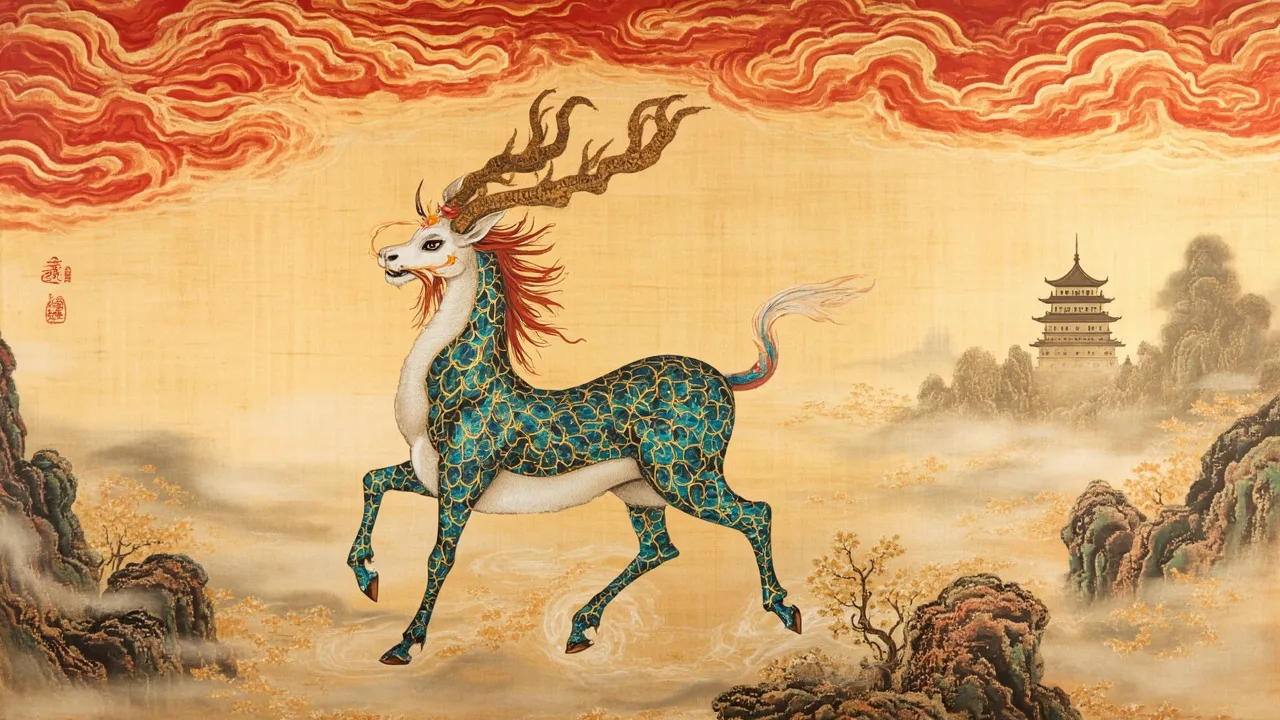
The Pixiu is not the same as the Qilin. The Qilin is a gentle, deer-bodied, dragon-scaled creature associated with sages and moral moments. The Pixiu is a fierce, lion-bodied, wealth-attracting creature. They are placed differently, served differently, and mean different things.
The Pixiu’s “no anus” feature is not metaphorical in the strict sense. It is described in the texts as a literal physical feature of the creature. The metaphorical extension to “wealth that cannot leave the household” is a later folk-religious interpretation, but the literal claim is the starting point.
The Pixiu is not exclusive to Chinese folk religion. It appears in Vietnamese, Korean, and Japanese mythology under related names. The Vietnamese tỳ hưu, the Korean bihyung, and the Japanese byakko (sometimes, more commonly hikyō) are regional relatives of the Chinese Pixiu. The Chinese Pixiu is the most developed and the most commercially significant of these relatives, but the creature-family is pan-East-Asian.
What the Pixiu Is Actually For
The honest answer depends on who you ask. To a traditionalist feng shui practitioner, the Pixiu is a working amulet that interacts with the qi of the household. To a secular consumer, it is a piece of folk art with cultural significance. To a tourist, it is a souvenir that happens to be lucky. To a Chinese grandmother, it is something she gives to her grandson when he goes off to college.
All of these uses are legitimate. The Pixiu is one of the most flexible of Chinese mythical creatures. It works whether the wearer believes in qi or does not. It works whether the placement is performed with full ritual or done casually. The Pixiu, in this sense, is more like a habit than a religion.
The Pixiu is also a good example of how a classical mythological creature can be pulled out of the encyclopedia and put to work in modern commerce. Most of the Chinese mythical creatures - the dragon, the phoenix, the qilin, the tortoise - remain mostly in the realm of art and decoration. The Pixiu has been pulled into the realm of personal amulet, jewelry, and household ornament. It is the most mercantile of the Chinese mythical creatures, and also the most widely worn.
If you walk into a Chinese jewelry store tomorrow and buy a small black obsidian Pixiu bracelet for your left wrist, you will be participating in a tradition that has been continuous for at least two thousand years. The fact that the tradition now also lives on e-commerce platforms, in airport gift shops, and in the windows of San Francisco Chinese jewelry stores does not make it less traditional. It makes the tradition more alive.
Recommended Products for Pixiu Mythology and Feng Shui
If this article has made you curious about owning a Pixiu, here are a few items that are commonly used and that hold up well.
- Black Obsidian Pixiu Bracelet - The most common and most affordable Pixiu bracelet. Black obsidian is glossy, traditional, and pairs well with the Pixiu figure. Look for one with a clear Pixiu head and tail, and a Chinese-knot closure.
- Jade Pixiu Pendant - The classic Pixiu pendant. Jadeite (Burmese green jade) is the most traditional material; nephrite (the other kind of jade) is more affordable. Look for a pendant carved so the Pixiu’s features are clear and the dragon-head detail is visible.
- Pixiu Wealth Figurine (Pair, Resin or Ceramic) - A pair of Pixiu figurines for entry-hall placement. Ceramic versions are heavier and feel more substantial; resin versions are more affordable and easier to ship. Look for figurines where the Pixiu’s features are clearly carved, not blurred.
- Pixiu Car Keychain or Bag Charm - A small Pixiu charm for a keychain or handbag. Jade-look and gold-tone versions are widely available. The Pixiu charm is one of the most common Chinese feng shui accessories.
- Chinese Mythology: A Source Book - The standard English-language sourcebook on Chinese mythological creatures, including the Pixiu, the dragon, the phoenix, and the tortoise. Useful if you want the academic context behind the folklore.
The Pixiu has been working for two thousand years. It has not slowed down. If you take one home with you, treat it well. It is doing its job.