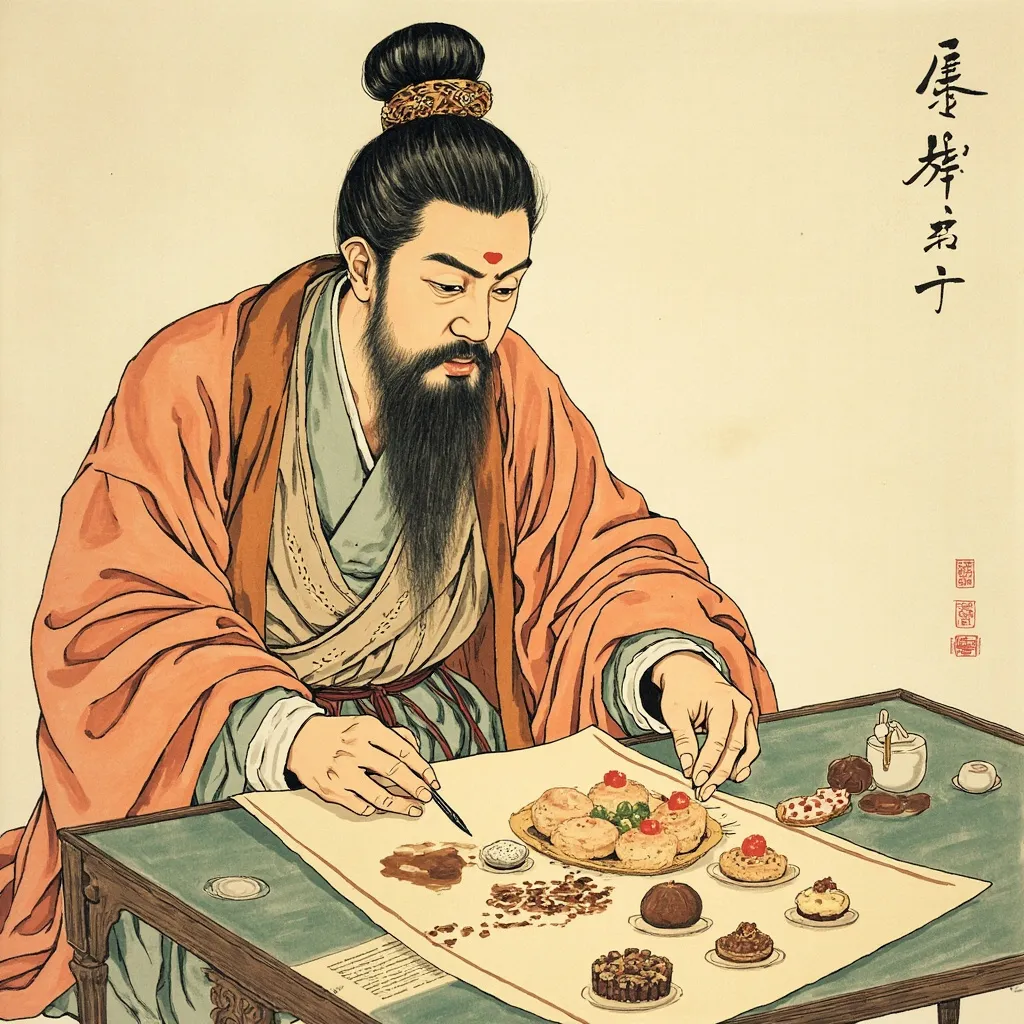
Imagine you’re a soldier in ancient China, marching through a region with no accessible water. The sun is merciless, your throat is parched, your lips are cracked, and every step feels heavier than the last. Your body is demanding rest, demanding water, demanding anything other than continuing this march through what feels like the driest, most waterless hell on earth. And then your general rides up and tells you that up ahead, there’s a grove of plum trees, and the plums are sour, and if you can just hold on a little longer, you’ll be able to eat them and quench your thirst completely.
What happens in your body and mind in that moment? You can almost taste the sourness, can’t you? The sensation is so vivid that you actually produce saliva, and for a few minutes at least, the worst of the desperation fades. You’re not drinking water, but your body responds as if relief is genuinely on the way.
This is the phenomenon at the heart of 望梅止渴 (wàng méi zhǐ kě), which literally means “gazing at plums to quench thirst.” It’s one of the most psychologically sophisticated idioms in the Chinese language, because it captures something that’s simultaneously simple and profound: the mind can do things to the body that seem physically impossible, including producing real physiological responses to imagined stimuli.
The General and the Impossible March
The story comes from the Three Kingdoms period, around 200 CE, during the warlord era that preceded the establishment of the Jin Dynasty. The central figure is Cao Cao, one of the most capable and complex figures in Chinese history — a military commander, statesman, and poet who dominated the political landscape of his era and whose descendants eventually founded the Jin Dynasty. Cao Cao was known for his tactical intelligence, his willingness to use deception, and his ability to inspire loyalty in his followers even through hardship.
The specific incident that gave rise to the idiom is recorded in the Strategies of the Three Kingdoms (三国志), a historical text compiled in the third century. Cao Cao was leading an army through a region in what is now Jiangsu Province when his forces found themselves in a genuinely dangerous situation: there was no water to be found, the summer heat was intense, and the soldiers were suffering from severe dehydration. Men were collapsing. The army was slowing to a crawl. If something didn’t change, many would die.
Cao Cao faced a tactical problem. The army needed to keep moving — there were strategic imperatives that required reaching a certain location quickly. But the soldiers were at the limit of their physical endurance and couldn’t maintain the pace. Ordering them to march faster wouldn’t work. Threatening punishment might create short-term compliance but would also damage morale and potentially trigger mutiny. And there was no water to give them, no immediate physical solution to the problem.
So Cao Cao did something that seems almost too simple to be historically significant: he told his soldiers that there was a plum grove ahead.
The Power of the Suggestion
According to the historical account, Cao Cao told his men that if they could just hold on a little longer, they would reach a place where there were plum trees. The plums were sour — he emphasized this deliberately — but they would quench thirst perfectly. The thought of the sour plums, the anticipation of eating them, would be enough to get them through the next stretch of the march.
The effect was immediate and powerful. The soldiers’ mouths literally watered at the thought. The worst of their desperation faded. They found new strength in their legs, and the army picked up speed. Within a short time, they reached an actual source of water — not a plum grove, but a river or stream that solved the immediate problem — and everyone survived.
The key to understanding why this worked is recognizing that the mind and body are not as separate as we sometimes imagine them to be. When you imagine biting into a sour plum, your salivary glands respond. When you imagine running from danger, your heart rate changes. When you imagine yourself succeeding at something difficult, the confidence shows up in your posture and your actual performance. The body takes cues from the mind, and the mind can be guided through carefully crafted suggestions.
This isn’t mysticism or superstition — it’s well-documented psychology. Modern research on visualization and embodiment shows that mental imagery produces real physiological effects. Athletes who visualize successful performance don’t just feel better — they measurably improve their actual results. People who imagine eating food experience reduced hunger. People who imagine a relaxing scene experience measurable reductions in stress hormones. The boundary between imagination and reality is much more permeable than we typically assume.
Cao Cao, without access to modern psychology, understood this intuitively. He knew that the soldiers’ bodies were failing because their minds had lost hope. Give them something to look forward to — even something as simple as the imagined taste of sour plums — and their bodies would respond accordingly. The plums themselves were a fiction. The relief was real.
Why “Watching Plums” Specifically?
The choice of plums rather than another fruit wasn’t arbitrary. In Chinese culture and cuisine, plums are known primarily for their sourness — they’re rarely eaten raw because they’re too tart, but they’re used extensively in preserved form, as juices, and in cooking precisely because that sourness is so distinctive and penetrating. The word “酸” (sour) is one of the first words associated with plums by Chinese speakers.
This was important for Cao Cao’s purposes. He didn’t tell his soldiers about ripe persimmons or sweet melons. He told them about sour plums, and he emphasized the sourness. The sourness was the key. A sweet fruit would have triggered a different kind of anticipation — the anticipation of pleasure, of satisfaction. But sour plums triggered something more visceral: the immediate, involuntary physical response of salivation. The soldiers didn’t have to imagine pleasure. Their bodies responded automatically to the suggestion.
The idiom preserves this specificity. 望梅止渴 is not about “imagining something pleasant to feel better.” It’s about a particular mechanism: the body’s automatic response to a vivid mental image, the way imagining something sour makes your mouth water. The sophistication of the idiom lies in the precision of the psychological mechanism it describes.
Modern Applications of the Principle
The psychology behind 望梅止渴 has been widely applied in modern contexts, often under different names. Coaches use visualization techniques with athletes, telling them to imagine successful performance before competitions. Therapists use guided imagery to help patients manage pain, reduce anxiety, and recover from trauma. Public speakers use mental preparation to steady their nerves and project confidence. All of these applications rest on the same fundamental insight that Cao Cao was exploiting: the mind influences the body, and vivid imagination can produce real physiological effects.
In the business world, leaders often use techniques that echo Cao Cao’s approach without necessarily naming the idiom. A startup founder who paints a vivid picture of success to motivate an exhausted team is doing something similar. A manager who reminds employees of the goal they’re working toward — making it feel real and present, not just abstract and distant — is channeling the same principle. The “vision” that leaders are supposed to communicate isn’t just abstract strategic direction; it’s a way of making the future feel real enough to pull people forward through present hardship.
Sales professionals have long understood a version of this. The technique of painting a vivid picture of the benefits a customer will experience — making the future state feel real and tangible — is a core part of effective selling. The customer isn’t buying the actual product in the moment; they’re buying the imagined future where the problem is solved. A skilled salesperson knows that this imagination can be guided, and that guiding it skillfully produces real results.
Even in personal relationships, the principle shows up. When someone tells a story about a wonderful future they’re planning with their partner, they’re creating shared imagery that binds them together. Couples who can vividly imagine their shared future tend to be more committed and more resilient through hard times. The imagination creates motivation that reality alone might not generate.
The Limits and Dangers of Imaginary Plums
Of course, there’s a reason the idiom has survived as a story about deception rather than as a pure success story. Cao Cao told his soldiers something that wasn’t true — there was no plum grove ahead. He achieved a real result through a clever fiction, but the technique carries inherent risks that have to be acknowledged.
The most obvious risk is that the technique can be used manipulatively. A leader who learns to paint vivid pictures of imagined futures can inspire people — but can also mislead them. If the “plums” never materialize, if the promise was always a fiction, the backlash can be severe. Trust is damaged when people realize they’ve been guided through hardship by false promises. The short-term motivation produced by the technique creates long-term problems if the technique itself was dishonest.
Cao Cao’s case was different in an important way: the plums were a fiction, but they were a fiction in service of a real goal that actually got achieved. The soldiers were suffering, but they were suffering to reach a real objective. The immediate dehydration was real, but so was the actual water source they eventually found. The fiction created the conditions for survival, not for exploitation. That’s a meaningfully different situation than a leader who uses psychological manipulation to extract effort for goals that will never benefit the people being manipulated.
There’s also a risk in relying on this technique too frequently or too obviously. Soldiers who discover they’ve been deceived once might be harder to motivate the next time. Employees who realize their manager’s “vision” is just empty talk will eventually stop responding to it. The technique depends on trust — on the audience believing, at least implicitly, that the person wielding it has their interests at heart. Violate that trust, and the tool stops working.
The Idiom in Chinese Usage Today
In modern Chinese, 望梅止渴 is typically used with a slightly critical edge — it’s often invoked to describe situations where someone is being satisfied with mere hopes or promises rather than actual results. When a parent tells a child “you can have dessert after dinner” to get them to eat their vegetables, that’s 望梅止渴. When a company tells employees “things will get better next quarter” without any concrete plan, that’s also 望梅止渴. The idiom captures both the effectiveness of the technique and the sense that something slightly unsatisfactory is going on — you’re not actually eating plums, you’re just looking at where plums might be.
At the same time, the idiom doesn’t carry a purely negative connotation. It’s used neutrally in many contexts to describe the use of imagination to bridge a gap between present suffering and future satisfaction. The recognition that this is what’s happening — that someone is essentially being distracted by a mental image — doesn’t negate the legitimacy of the technique when it’s appropriately used.
The phrase also appears in discussions of self-motivation, where individuals are encouraged to use their own imagination deliberately to get through difficult patches. Telling yourself “just imagine how good it will feel when this is over” is a form of 望梅止渴 — using mental imagery to produce real motivational effects. This self-directed application is generally seen as healthy and useful, as long as the imagined future is actually achievable.
The Deeper Wisdom
望梅止渴 captures something essential about the human condition: we don’t live in the present the way we think we do. Our experience of the present moment is always inflected by our expectations of the future, our memories of the past, and our imaginative capacity to construct experiences that aren’t actually happening. Cao Cao’s genius was recognizing this and using it deliberately — he understood that the soldiers’ experience of marching wasn’t just about the physical heat and the physical thirst; it was also about what their minds told them those sensations meant and what they anticipated would happen next.
By changing the anticipated future — by making the future feel like relief rather than continued suffering — he changed the present experience. The heat didn’t become less hot. The thirst didn’t become less urgent. But both became bearable in a way they hadn’t been a moment before, because the mind had something to work with.
This remains one of the most practical insights in all of motivational psychology. The situations we face don’t always change. The hardships don’t disappear. What can change is how we experience them — and that experience is heavily influenced by the stories we tell ourselves about what comes next. The soldiers who heard about the plum grove weren’t in a different situation than they had been a moment before. But they were in a different situation psychologically, and that psychological shift was enough to save them.
The next time you face a difficult stretch — a hard workout, a long meeting, a challenging project — consider the power of what you’re looking forward to. Not as a form of denial, but as a form of fuel. Sometimes the thing that carries you through isn’t the reality of the present moment, but the vivid imagination of what’s on the other side.