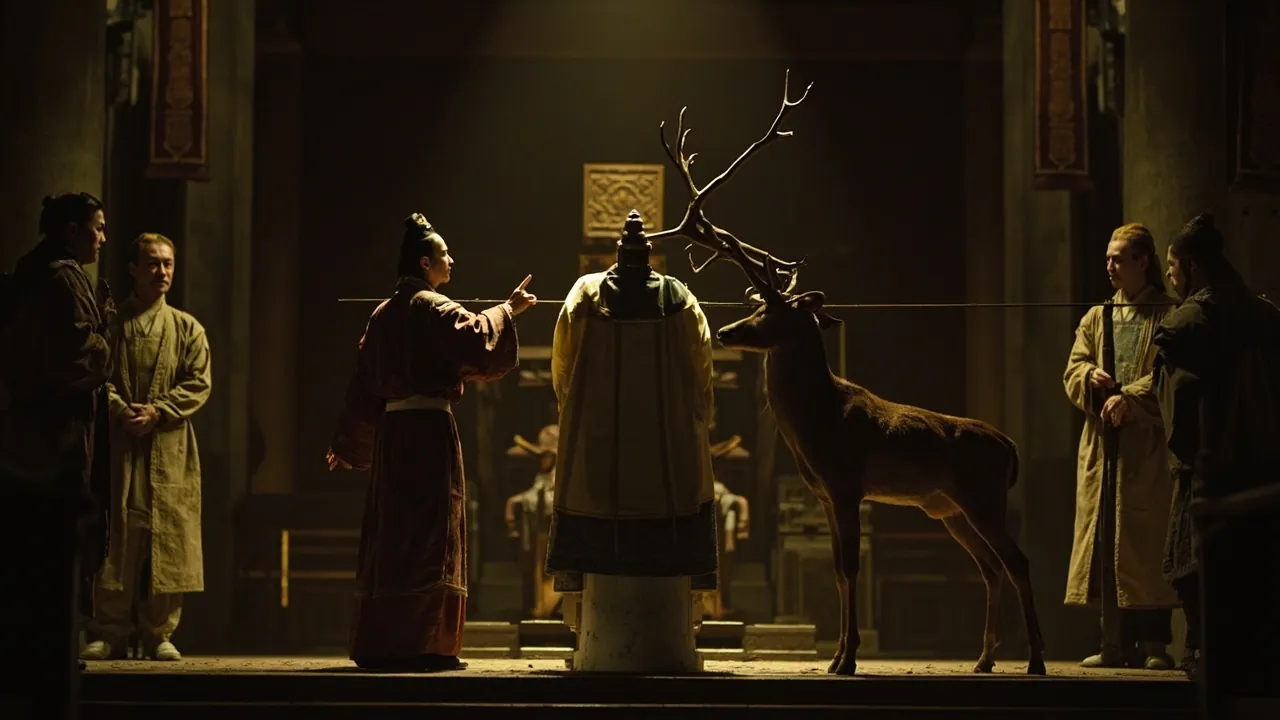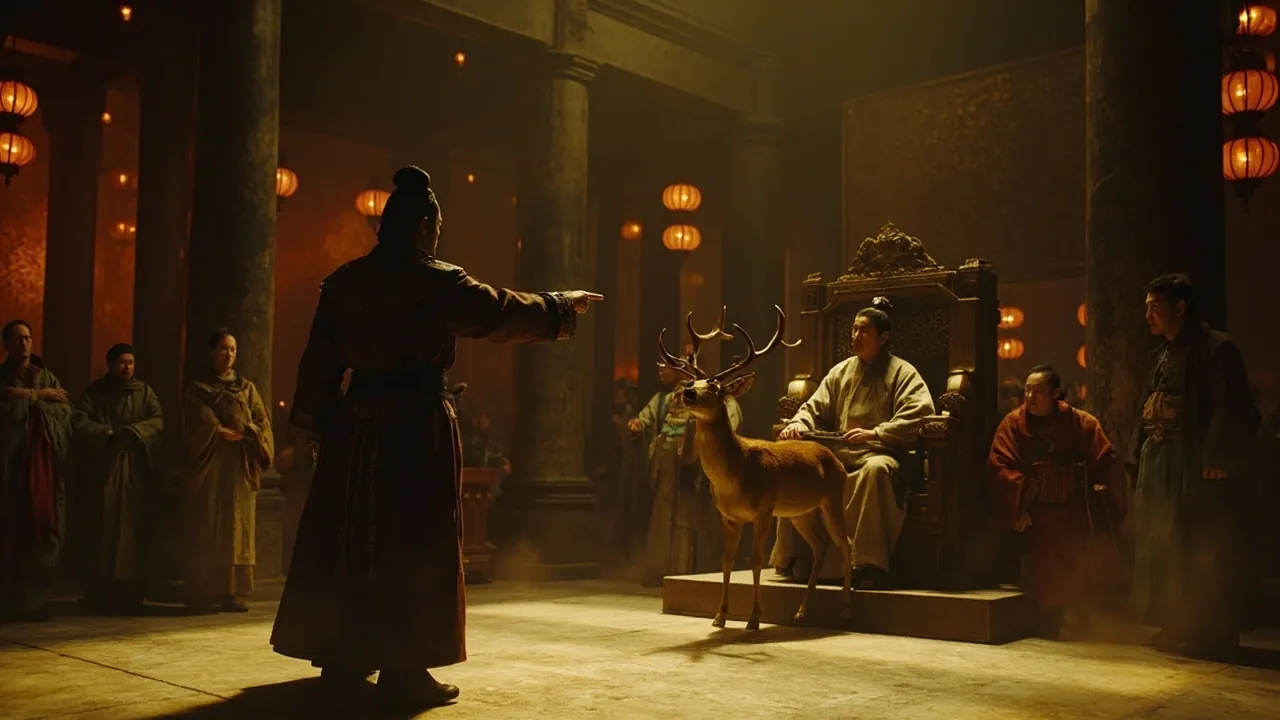
There’s something almost comic about the image at the center of this idiom — a powerful official holding up a deer in front of a crowd and insisting, with complete confidence, that it’s a horse. It’s the kind of scene that would be absurd if it weren’t for the context: everyone in the room knows it’s a deer, the speaker knows they know, and they all know that the speaker knows they know. And yet the speaker is completely unapologetic, daring anyone to correct him.
This is 指鹿为马 (zhǐ lù wéi mǎ), and it’s one of the most politically charged idioms in the Chinese language. Where other idioms capture moments of heroism or wisdom or clever problem-solving, this one captures something darker: the deliberate weaponization of absurdity, the use of obviously false statements to test loyalty and identify enemies. It became a shorthand for corruption so complete that reality itself gets bent to match the powerful person’s preferences.
The Man Behind the Trick
To understand why this incident happened, you need to know something about Zhao Gao, the man who performed it. Zhao Gao was a eunuch official during the final years of the Qin Dynasty, serving as a close advisor to the Second Emperor, Qin Er Shi, who had inherited the throne after the death of his father, Qin Shi Huang — the first emperor who unified China.
Zhao Gao’s rise to power was remarkable given the constraints of the system. As a eunuch, he was part of a group that was generally excluded from the highest reaches of political power, which were dominated by aristocratic families and military leaders. But Zhao Gao had education, intelligence, and what appears to have been an extraordinary talent for navigating court politics. He had also accumulated significant influence as a teacher and mentor to the young heir apparent, who was being groomed to eventually inherit the throne.
When that heir apparent — Fusu — fell out of favor with Qin Er Shi and was forced to commit suicide, Zhao Gao’s position became more complicated. He had been closely associated with Fusu, which should have spelled his downfall. Instead, through a combination of political maneuvering and apparent blackmail of the new emperor, Zhao Gao managed to not only survive but to become one of the most powerful figures in the empire.
By 207 BCE, Zhao Gao was effectively controlling the government. The emperor was weak, the military was stretched thin from campaigns that had overextended Qin’s borders, and the empire was showing serious signs of strain. Zhao Gao’s response to these pressures was to consolidate his personal power, eliminating anyone who might threaten him. This required knowing who his enemies were — and this is where the famous deer-and-horse incident comes in.
The Test: How to Identify Your Enemers
The story as it has come down to us describes a scene in the imperial court. Zhao Gao presented a deer to the Second Emperor and declared that it was a horse — a fine horse, suitable for the emperor’s personal use. The emperor, apparently recognizing this as either a joke or a test, laughed and said that Zhao Gao was mistaken — this was clearly a deer, not a horse.
What followed was either an escalation of a joke gone wrong or, more likely, a deliberate unveiling of the test’s true purpose. Zhao Gao repeated his claim: this was a horse. He then asked various officials present to confirm. Some, apparently understanding the test, agreed that it was indeed a horse. Others, either genuinely not getting it or deliberately refusing to play along, said it was a deer.
Those who said it was a deer, the historical accounts tell us, were later eliminated. Those who agreed with Zhao Gao’s characterization survived and, presumably, were promoted.
The mechanism of the test was elegant in its evil simplicity. Anyone who agreed with Zhao Gao’s obvious falsehood demonstrated that they were willing to subordinate their own perception of reality to his preferences — that they could be trusted to follow his lead even in matters where the truth was plainly visible. Anyone who refused was identified as someone who might, in a more serious situation, oppose Zhao Gao and therefore had to be removed.
This wasn’t about whether someone could correctly identify an animal. It was about whether someone would prioritize their relationship with Zhao Gao over their own eyes, their own judgment, their own integrity. The deer was incidental. The test was about loyalty, and the currency of loyalty was the willingness to call reality whatever Zhao Gao wanted it to be called.
Why This Idiom Endures: The Universal Mechanism
The reason 指鹿为马 has survived as an active part of the Chinese vocabulary for over two thousand years is that the mechanism it describes isn’t unique to ancient China. The deliberate use of absurdity to test loyalty, to normalize corruption, and to identify enemies has appeared in every era and every political system. The specifics vary — the deer and horse are culturally specific, but the underlying dynamic is universal.
Modern workplaces see versions of this. An executive who insists that a project that clearly failed was actually a success, and who watches to see who agrees and who pushes back, is running a version of Zhao Gao’s test. A manager who mischaracterizes a client’s feedback and gauges reactions before correcting the record is identifying who can be relied on to follow the preferred narrative. The people who go along with the mischaracterization are, in that manager’s assessment, safe. The people who object are potential problems.
Political discourse is full of this dynamic. When a leader consistently describes situations in ways that don’t match observable reality — when the economy is actually struggling but is consistently described as thriving, when a policy is clearly failing but is consistently described as succeeding — observers can see the deer being called a horse. The question is always how people respond: who goes along, who stays silent, who speaks up, and what happens to each group.
The idiom has also developed a secondary usage, describing situations where someone deliberately颠倒黑白 (diān dǎo hēi bái) — calls black white and white black — for their own benefit. When a politician claims that evidence of their corruption is actually proof of their innocence, that’s 指鹿为马 in action. When a company tries to rebrand an obvious failure as a learning experience, that’s the same mechanism. The term captures both the act and the awareness that the act is transparent — everyone knows what’s really happening, but the pretense is maintained anyway.
The Broader Context: How Corruption Normalizes
What makes 指鹿为马 truly chilling isn’t just the immediate test — it’s what the test represents about the broader process of normalization. When Zhao Gao got away with calling a deer a horse in open court, something shifted in the political culture. Officials who had been uncertain about where things were headed now had clear evidence: the truth was no longer the operative criterion for statements made in the presence of power. What mattered was what Zhao Gao wanted to be true.
This kind of normalization happens gradually, and the deer-and-horse incident was probably not the beginning of this process in Zhao Gao’s case. He’d been building toward this for years, testing boundaries, rewarding compliance, punishing dissent, until calling a deer a horse became possible. The incident was a crystallization of something that had been developing for some time.
The process is well understood by historians and political scientists. It follows a recognizable pattern: first, small inaccuracies are introduced, and anyone who corrects them is subtly punished. Then larger inaccuracies appear, with the same dynamic. Eventually, the gap between stated reality and actual reality becomes so large that only the most courageous or naive would point it out — and those people have usually already been removed. What’s left is a court full of people who have learned that agreement with power is the path to survival, and that truth is a secondary consideration at best.
This is why 指鹿为马 isn’t just a story about one evil man’s cruelty. It’s a story about what happens to institutions and cultures when this kind of behavior is tolerated. The Qin Dynasty, already stressed by overextension and poor governance, didn’t survive much longer after this incident. The emperor was dead within two years, killed in a coup orchestrated by Zhao Gao himself. The empire fell apart shortly after, giving way to the Chu-Han conflict that eventually produced the Han Dynasty. The corruption that 指鹿为马 represented was a symptom of the regime’s terminal illness, not the cause — but it was a symptom that revealed everything about how sick things had become.
Learning to Recognize the Pattern
For modern readers, the value of understanding 指鹿为马 isn’t just historical — it’s practical. The mechanism the idiom describes shows up in corporate cultures, in political movements, in families and social groups, in any context where power is concentrated and accountability is weak. Recognizing when you’re in a situation where deer are being called horses is the first step toward deciding how to respond.
The responses available generally fall into a few categories. You can go along with the pretense, agree that the deer is a horse, and survive — at least for now. You can stay silent, neither confirming nor denying, and hope that your neutrality is accepted. You can gently push back, suggesting that there might be another perspective without directly contradicting the powerful person. Or you can directly assert that the deer is a deer and accept whatever consequences follow.
None of these responses is universally correct. The people who called the deer a horse in Zhao Gao’s court were sometimes surviving pragmatists — people who recognized that this wasn’t the moment to make a stand, that they could be more useful to their families and their principles if they remained in positions of influence rather than getting themselves killed. The person who called it a deer was making a principled stand, but that stand might accomplish nothing except getting them removed from any position where they could have helped later.
What the idiom teaches is that these choices are real and they have consequences. The person who goes along is complicit in the corruption, even if their reasons are pragmatic. The person who pushes back risks everything. Understanding the nature of the situation — recognizing that you’re in a 指鹿为马 moment — is essential for making the choice that’s right for you.
The Deer in the Room
There’s a related English expression — “the elephant in the room” — that captures a different aspect of the same dynamic. Both expressions point to situations where everyone can see something obvious but no one is willing to address it. The difference is that 指鹿为马 is specifically about power deliberately creating the situation, while “the elephant in the room” can describe situations where everyone is simply uncomfortable.
In the Chinese idiom, the powerful person is actively demanding that you agree to their mischaracterization. The emperor isn’t confused about whether it’s a deer or a horse — he knows perfectly well. The demand is for your complicity, your demonstrated loyalty through agreement. In the English expression, the elephant is typically something that everyone finds awkward or uncomfortable but no one wants to bring up for social reasons. The dynamic is different — passive avoidance rather than active manipulation.
Both situations require choices, though. In both cases, you have to decide whether to acknowledge what’s plainly visible or to participate in the pretense. The Chinese idiom just makes the power dimension explicit, which is why it remains so resonant across so many different contexts.
The Legacy of a Dark Moment
指鹿为马 has been part of the Chinese vocabulary for over two millennia, and shows no signs of fading. It appears in political commentary, in business analysis, in discussions of international relations, and in everyday conversations about the corruption or absurdity someone has witnessed in their own lives. The imagery is vivid enough and the mechanism clear enough that it transfers easily across cultural and temporal boundaries.
The idiom serves as a warning about the nature of corruption and the way it normalizes. When powerful people start calling things by names that don’t match reality, everyone faces a choice about how to respond. Each response shapes the culture further, either enabling the corruption or resisting it. Over time, those small choices accumulate into either a healthy or a toxic environment.
For students of history, the story of Zhao Gao and his deer offers both entertainment and instruction. The entertainment is obvious — it’s genuinely absurd to imagine a powerful man insisting that a deer is a horse. The instruction is subtler but more valuable: the deer-and-horse incident wasn’t an isolated event but part of a pattern of behavior that brought down an empire. Recognizing that pattern when it appears in modern contexts — in workplaces, in politics, in any situation where power is being abused — is a valuable skill. And recognizing that your own choices about how to respond matter, both for yourself and for the culture you help create, is perhaps the most valuable lesson of all.