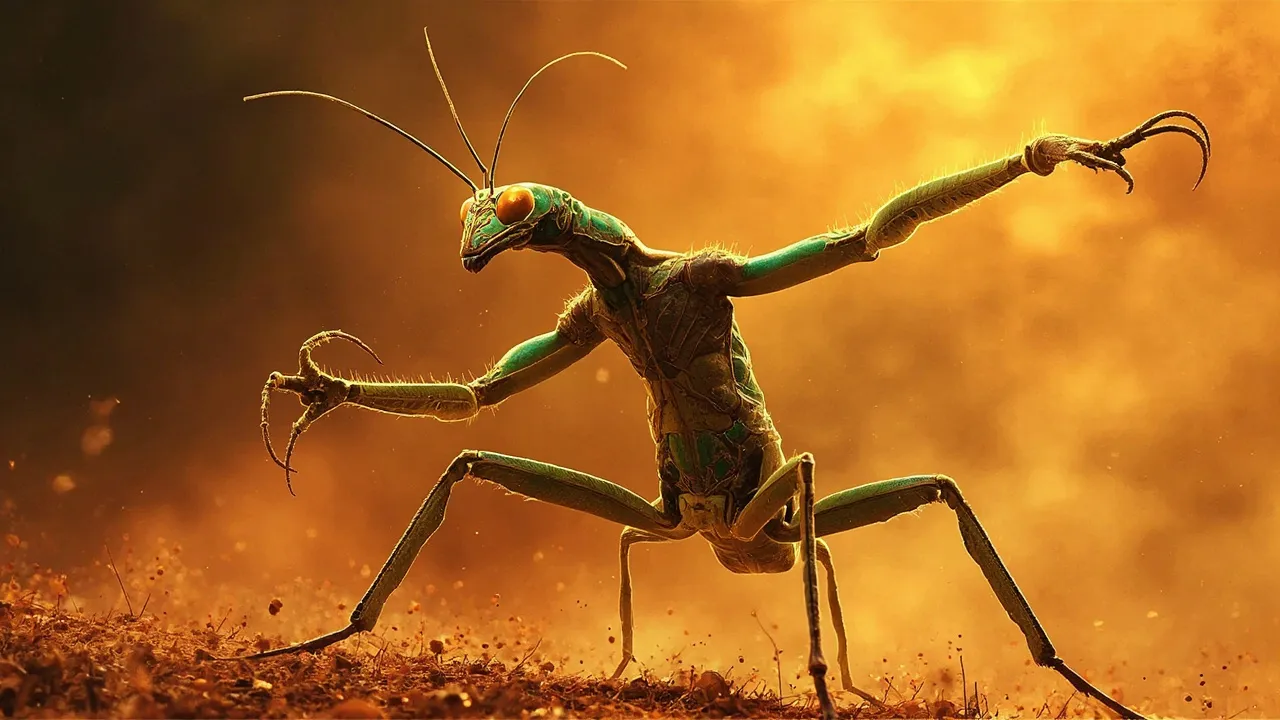
Praying Mantis Kung Fu: The Deadly Art of the Seven Stars
Among the dozens of distinct Chinese martial arts, few are as instantly recognizable as Praying Mantis. The style gets its name from the insect whose movements it emulates — a creature known for its patience, explosive speed, and merciless efficiency. When you watch a skilled Praying Mantis practitioner move, you’re seeing decades of refinement distilled into lightning-fast attacks that seem almost impossible to defend against.
This isn’t a style for the faint of heart. Praying Mantis Kung Fu demands precision, speed, and a willingness to commit fully to techniques that leave no room for hesitation. But for those willing to put in the work, the rewards are extraordinary. The style produces fighters who are notoriously difficult to deal with — fast, precise, and always attacking.
Let’s explore what makes this northern Chinese martial art so special.
The Legend of the Founder
Every great martial art has a good origin story, and Praying Mantis is no exception. According to tradition, the style was created by a monk named Wang Lang in the 17th century during the late Ming Dynasty. While the historical accuracy of this story is debated, it provides valuable insight into the philosophy and approach of the art.
Wang Lang was already a skilled martial artist when he became obsessed with observing the praying mantis in nature. He watched how the insect waited motionless for prey, then struck with incredible speed. He noticed how it used its forelegs to capture and hold struggling victims, how it could move in any direction while maintaining its footing, how its movements were neither purely linear nor purely circular but somewhere in between.
One day, according to legend, Wang Lang saw a mantis successfully attack a large cicada — an insect much bigger than itself. The mantis won not through size or strength, but through superior technique and timing. This was the insight that sparked the creation of the martial art. The mantis had found a way to defeat a larger opponent through speed, precision, and proper positioning.
Wang Lang spent years refining what he’d observed, eventually developing a complete fighting system based on the mantis’s movements. He combined his existing martial knowledge with these new observations, creating something that was both scientifically effective and aesthetically unique. The style he created was not mere imitation of an insect but a translation of biological efficiency into human martial technique.
The style spread throughout northern China, developing into several related systems over the centuries. Today, the two main branches are Seven Star Praying Mantis (七星螳螂拳, Qi Xing Tang Lang Quan) and Plum Blossom Praying Mantis (梅花螳螂拳, Mei Hua Tang Lang Quan), each with slightly different emphases but sharing the core principles that make the art distinctive. Both branches are practiced worldwide, each with its own practitioners and advocates.
What Makes It Different: The Praying Mantis Approach
If you’ve trained in other martial arts, you’ll immediately notice that Praying Mantis feels different. The stances are higher than southern styles, reflecting its northern Chinese origins where mobility was more valued than the deep, rooted stances of southern systems. The movements are faster, more angular, and emphasize continuous motion rather than stationary positions.
The hallmark technique is the “hook fist” (gou quan) — a curved strike that comes up from below, catching the opponent’s attacks and turning them back on themselves. The mantis’s forelegs work this way in nature, and the martial art replicates that motion with devastating effectiveness. The hook can catch punches, deflect strikes, and grab opponents in ways that seem impossible until you’ve experienced them.
But the hook fist is just the beginning. Praying Mantis practitioners learn to strike from any angle, using the hands like the insect’s grasping forelegs. They develop what practitioners call “seven-star” positioning — the coordination of seven key points (two hands, two feet, two elbows, and the head) that creates a constantly shifting, hard-to-target stance. This seven-star concept appears throughout the training and forms the basis of the style’s body mechanics.
The style emphasizes “snapping” strikes — quick, whip-like punches that retract immediately after contact. This is fundamentally different from the pushing power you might see in styles like Shaolin or Wing Chun. The idea is to hit and withdraw before an opponent can counter, using speed and precision rather than raw power. The strikes arrive like the mantis’s strikes — sudden, precise, and gone before the victim can react.
Footwork in Praying Mantis is distinctive as well. Practitioners move in quick, small steps, often crossing their feet in ways that look unusual to outsiders. This creates unpredictable angles and allows practitioners to circle opponents continuously, looking for openings. The crossing footwork confuses opponents and sets up attacks from unexpected directions. It takes significant practice to become proficient, but the benefits are substantial.
The Training: Building the Mantis Body
Training in Praying Mantis develops specific physical qualities that set practitioners apart. The style builds what might be called “explosive flexibility” — the ability to move quickly through large ranges of motion while maintaining control. This combination of speed and flexibility is unusual in martial arts and makes Mantis practitioners particularly difficult to deal with.
Conditioning is intense but different from external styles. Students work extensively on hand flexibility, developing the ability to bend their wrists and fingers in unusual ways that enable the signature hooks and grabs. This takes time and can be uncomfortable initially, but the results are worth the effort. The hand conditioning alone can take months of dedicated stretching before students can perform the techniques properly.
They practice “wall bags” — striking surfaces that develop the hand conditioning needed for the hooks. They work with partners on capturing drills that develop the timing and sensitivity required. They spend hours on forms that teach the body to move in the mantis style.
Forms practice follows patterns that may seem impossibly complex to beginners. The movements are sharp and angular, full of sudden changes in direction. Practitioners learn to coordinate their hand and foot work, developing the “seven-star” body positioning that makes the style so effective. The forms contain the combat knowledge of generations of practitioners, encoded in sequences that must be memorized and then understood through years of practice.
Sparring in Praying Mantis emphasizes the “seven attacks” — a sequence of coordinated strikes that trained practitioners can execute in seconds. Learning to chain these attacks together while maintaining proper form takes years of practice, but when done correctly, the sequence becomes nearly impossible to stop. The attacks flow into each other with minimal hesitation, overwhelming opponents who cannot respond to the rapid succession of techniques.
The training also includes extensive two-person drills. Partner work is essential because so much of Praying Mantis involves capturing and controlling an opponent’s limbs. You can’t develop this skill alone — you need partners who are willing to work through techniques with you. The sensitivity training that these drills develop is one of the most valuable aspects of Mantis training.
Why It Works: The Science of the Mantis
Don’t let the insect inspiration fool you — Praying Mantis Kung Fu is thoroughly practical. The techniques work because they exploit fundamental principles of human biomechanics. The style was developed through centuries of practical testing, refined by generations of fighters who needed techniques that worked in real combat.
The hook fist attacks the wrist and elbow in ways that are difficult to defend. When you try to block a punch, your arm comes across your body — exactly the path a mantis hook takes. A skilled practitioner can capture your wrist and control your entire arm using techniques that leverage your own movement against you. This is not mystical — it is simple mechanics applied skillfully.
The footwork keeps practitioners in constant motion, making them difficult to target. The crossing steps create unexpected angles that confuse opponents and set up strikes from blind spots. This isn’t random movement — it’s calculated positioning that creates advantages. An opponent never knows where the next strike will come from because the mantis practitioner is constantly changing angles.
The snapping strikes generate power through speed rather than commitment. A mantis-style punch doesn’t require you to put your weight behind it, which means you can strike quickly and recover just as fast. Your opponent doesn’t have time to counter because you’re already gone. The technique requires less setup, making it harder to see coming.
The capture and control techniques give practitioners options beyond simply hitting harder. Once you’ve trapped an opponent’s limb, you can throw them, submit them, or strike at leisure. This makes Praying Mantis effective against both standing opponents and those who want to take the fight to the ground. The style transitions smoothly from striking to grappling.
Is Praying Mantis Right for You?
This style isn’t for everyone, and that’s okay. If you’re looking for slow, flowing movements, look elsewhere — Mantis is all about explosive speed and continuous attack. If you want techniques you can learn quickly and use immediately, this probably isn’t your style either. The learning curve is steep, and real proficiency takes years of dedicated practice.
But if you’re willing to invest years in developing genuine skill, if you appreciate precision over power, if you want a martial art that will challenge you physically and mentally for a lifetime, Praying Mantis deserves consideration. The style has a depth that rewards continued study, with layers of technique and principle that keep practitioners learning for decades.
The style has a reputation for being difficult to learn but incredibly rewarding to master. You’ll need patience with yourself during the learning curve. The hand flexibility alone can take months of dedicated stretching. The complex forms demand focused repetition. The footwork requires rebuilding habits you’ve developed over a lifetime. But each of these challenges, once overcome, adds to your capabilities.
But practitioners who stick with it often describe it as the only martial art that truly felt right for them. There’s something about the mantis approach — the patience, the explosive action, the efficiency — that resonates with certain practitioners on a deep level. The style attracts people who appreciate its directness and effectiveness.
Modern schools exist in most major cities, often run by teachers who learned the art from family lineages or made pilgrimages to study with masters in China. The internet has also made videos and instruction more accessible, though nothing replaces training with skilled partners who can help you develop the capture and control skills that define Mantis.