Pu-erh Tea: The Aged Black Tea That Improves with Time
There is something almost paradoxical about pu-erh tea. In most categories of food and drink, freshness is the virtue — you want the bread baked today, the fish caught this morning, the wine from the most recent harvest. Pu-erh defies this entirely. It is a tea that is explicitly, deliberately made to age, and its value increases with time in ways that can feel almost irrational to outsiders. A cake of pu-erh that cost a few hundred yuan when it was pressed might be worth thousands a decade later. The tea itself is actively changing, evolving, becoming something different from what it started as. It is perhaps the only widely consumed food or beverage that genuinely improves with age, sometimes for decades.
My own introduction to pu-erh came through an old merchant in Kunming who kept a cabinet of pu-erh cakes going back forty years. He pulled out a small disc of tea from the early 1980s and brewed it with the casualness of someone opening a tin of everyday biscuits. The taste was unlike anything I’d encountered — earthy, complex, with this incredible depth that seemed to have no bottom. It tasted old in the best possible sense, like a well-seasoned cast-iron pan: accumulated character, layers upon layers of time expressed in liquid form. I understood that evening why people build rooms dedicated to storing this tea, why they argue about provenance and storage conditions with the intensity of wine collectors, why some people spend more on aged pu-erh than they do on their cars.
Ancient Trees of Yunnan: The Birthplace of Pu-erh
Pu-erh’s unique character begins with geography and genetics. The tea comes exclusively from Yunnan province in southwest China, and it is made specifically from the leaves of the Camellia sinensis var. assamica plant — a larger-leafed, hardier variety than the small-leafed sinensis used for most green teas. Yunnan’s climate, altitude (many tea regions sit above 1,000 meters), and soil conditions create a growing environment that produces leaves with distinct chemical compositions: higher in certain amino acids, richer in polysaccharides, with a broader spectrum of polyphenols than tea grown at lower elevations.
What really sets Yunnan pu-erh apart is the existence of ancient tea trees — some of them hundreds, even over a thousand years old — that still produce leaves. These ancient trees (called “gu shu” or “shu shu” in Chinese) grow wild or semi-wild in the forests of Xishuangbanna, Pu’er city, and surrounding areas. Because they’re old and tall (some reach 20+ meters), they grow more slowly, and their leaves accumulate a complexity that younger, cultivated bushes simply cannot match. The root systems go deep, accessing mineral-rich soil layers that shallow-rooted cultivated plants never reach.
Tea made from these ancient trees commands a significant premium. A cake made from pure ancient tree material might cost ten times what an equivalent cake of bush-tea would cost. Whether that premium translates to a proportionate difference in taste is a matter of intense and sometimes contentious debate among pu-erh enthusiasts. Most agree that ancient tree pu-erh has a particular sweetness and depth, a lack of harshness in young pu-erh that can be quite pronounced — but the gap is smaller than the price gap suggests. The reality is more nuanced: good bush pu-erh is excellent; great ancient tree pu-erh is transcendent, but only if you have the palate to detect the differences and the knowledge to identify authentic sourcing.
Raw and Ripened: Understanding the Two Faces of Pu-erh
Pu-erh comes in two fundamentally different styles, and understanding the distinction is essential for anyone getting into this tea. They share a name and a region, but their personalities are so different that a newcomer might not immediately recognize them as related.
Sheng pu-erh (raw pu-erh) is the traditional form. It is made from fresh leaf, processed with minimal oxidation (more like green tea processing), then pressed into cakes, bricks, or other shapes. What makes it “pu-erh” is that it continues to age after pressing. Sheng pu-erh is aged, sometimes for decades, and during that time it undergoes a slow, microbial fermentation that transforms its character dramatically. Young sheng is often rough — bitter, astringent, vegetal, sometimes funky in ways that put newcomers off. Experienced drinkers value young sheng precisely because you can track its transformation over time, tasting the same cake year after year as it evolves. Aged sheng smooths out, develops complex notes of dried fruit, wood, honey, and earth, loses the harsh edges, and becomes something altogether more civilized.
The aging of sheng pu-erh can happen naturally (called “natural aged” or “dry storage”) or can be accelerated through controlled humidity and temperature (called “wet storage,” prevalent in Hong Kong and Southeast Asia). The debate about which approach produces “better” pu-erh is one of the great running arguments in the tea world. Natural storage advocates argue that the slow, gradual aging produces more nuanced, complex teas with cleaner aromatic profiles. Wet storage advocates point to the incredible depth and funkiness that only wet-stored aged pu-erh seems to achieve — that characteristic “aged” character that commands the highest prices. Both produce genuinely excellent teas; both produce duds depending on execution. The key is the specific conditions and the quality of the source material.
Shu pu-erh (ripe or ripened pu-erh) is a modern invention from the 1970s, developed to simulate the aging process of traditional pu-erh in a much shorter timeframe. The process, called “wo Dui” (渥堆, literally “wet piling”), involves spreading freshly processed sheng pu-erh leaves in a thick layer, keeping them moist and warm, and allowing microbial fermentation to occur rapidly — over weeks or months rather than years or decades. The result is a tea that tastes like aged sheng pu-erh: dark, earthy, smooth, with none of the young sheng’s harshness.
Shu pu-erh democratized pu-erh by making its essential character accessible without decades of waiting. You can buy a cake of shu pu-erh today and drink it tonight, and it will taste like pu-erh. This is not a criticism — some shu pu-erh is absolutely delicious, with a rich, dark earthiness, notes of dark chocolate and forest floor, and a smooth, almost oily mouthfeel. The tradeoff is that shu lacks the potential for long-term evolution that makes aged sheng so compelling. A 30-year-old shu pu-erh is essentially at the end of its development; a 30-year-old sheng is in its prime, still improving.
The Microbiology of Aging: How Pu-erh Transforms
The aging process in sheng pu-erh is, at its core, a microbial story. The leaves undergo a process of controlled fermentation driven by naturally occurring bacteria, yeasts, and fungi that colonize the tea during storage. Over time, these microorganisms break down tannins, proteins, and other compounds, producing new aromatic molecules that didn’t exist in the young tea. The microbial community in aged pu-erh is genuinely complex — researchers have identified dozens of species of bacteria and fungi in aged samples, each contributing to the transformation in subtle ways.
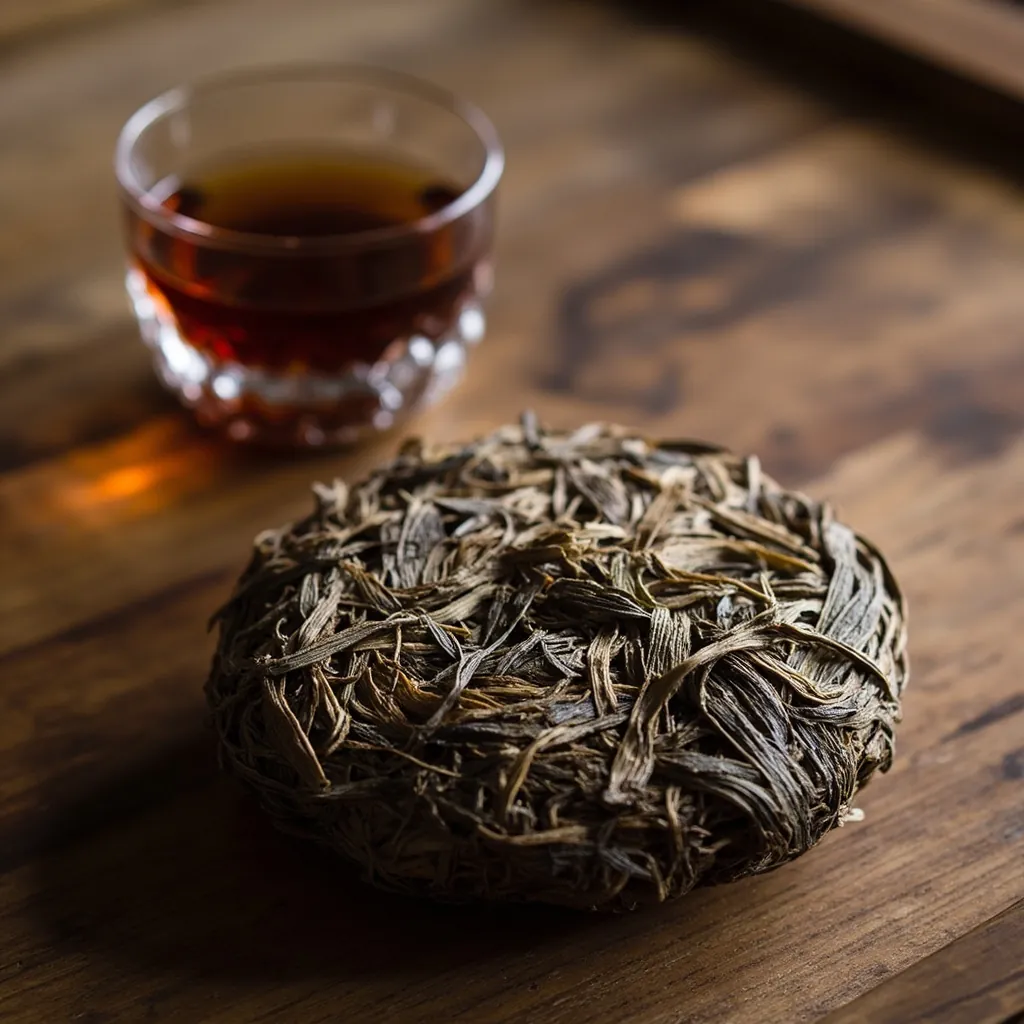
This process is not fast, and it’s not uniform. In the first few years, sheng pu-erh might actually taste worse than when it was fresh — more bitter, more astringent, sometimes showing off-notes that later disappear entirely. The real transformation begins after five to ten years and continues for decades. The tea gradually darkens in color (the liquor moves from pale gold through orange and amber to deep burgundy), the aroma evolves from fresh and vegetal to earthy and complex, and the mouthfeel becomes smoother and more textured.
This is why collectors obsess over provenance and storage history. A cake stored in humid Hong Kong for 20 years will taste completely different from the same cake stored in dry Kunming for the same period. The Hong Kong-stored tea will have developed more of that characteristic “wet stored” funk — leather, mushroom, old wood, fermented notes that some describe as “barnyard” but which devotees experience as beautiful complexity. The Kunming-stored tea will be cleaner, perhaps less dramatically complex, but with brighter fruit notes preserved from youth. Neither is objectively better; they’re different expressions of the same material shaped by different environmental conditions. The best collectors understand this and buy accordingly — matching their taste preferences to storage history.
Storage Tips: Caring for Your Pu-erh Collection
If you’re buying pu-erh to drink now (especially shu), storage is less critical. If you’re buying sheng pu-erh to age, storage becomes the most important factor in determining whether your investment improves or degrades over time. Get this wrong and your tea ages poorly; get it right and it transforms into something remarkable.
The fundamentals of pu-erh storage are not complicated, but they are demanding in their consistency. The tea needs:
- Moderate humidity — typically 60-80% relative humidity. Too dry and the aging slows to a crawl, taking decades to achieve what should take years. Too humid and you risk mold growth, which can ruin a cake quickly and permanently.
- Good airflow — stagnant air breeds mold and funky off-notes that aren’t the good kind of funk. The tea needs some exchange with the outside air, but not direct exposure to outside conditions.
- Consistent temperature — ideally in the 20-30°C (68-86°F) range. High heat accelerates aging but can also dry out the leaves and kill beneficial microorganisms. Temperature swings are particularly damaging.
- Protection from strong odors — pu-erh is extraordinarily absorbent. Anything in the same room with strong smells — paint, cleaning products, spices, cigarettes — will eventually be absorbed by the tea, creating off-notes that no amount of subsequent aging will remove.
The practical setup can be as simple as a dedicated shelf in a climate-controlled room, or as elaborate as a specialized púmǐchá (pu-erh storage) cabinet with humidity and temperature control. Many serious collectors in Yunnan, Hong Kong, and Taiwan have rooms dedicated entirely to aging their pu-erh, with wooden racks, humidifiers, and monitoring equipment that tracks conditions continuously. The investment in proper storage infrastructure reflects how seriously they take the aging process.
For most people, the best approach is to keep your pu-erh in its original packaging (cake wrappers are porous enough to allow some airflow) and store it in a relatively stable environment — not the kitchen (too many odors), not the bathroom (too humid), not near a radiator or air conditioner (temperature fluctuations). A closet in a bedroom, or a spare room if you have one, works fine. If you live in an extremely dry climate, occasional light misting of the room might be necessary. In an extremely humid climate (Southeast Asia, for example), dehumidification is more often the concern.
Why Collectors Treasure Pu-erh Tea
The pu-erh collecting phenomenon — sometimes called “tea investing” — has exploded in the 21st century, particularly in Mainland China, Hong Kong, and Taiwan, but increasingly among enthusiasts worldwide. The appeal is multifaceted, touching on different motivations for different people.
For some, it’s the investment angle: certain limited-production sheng pu-erh cakes from famous mountains or storied producers have appreciated dramatically in value over the past two decades. A 2004 cake from a celebrated producer might have cost $50 when new and be worth $500-1000 today. This appreciation is real, but it’s also speculative, and the market has its bubbles and corrections. Most serious collectors emphasize drinking over pure investment — the tea is meant to be consumed, after all, and the real value lies in experiencing what proper aging can produce.
For others, the appeal is the intellectual challenge of understanding pu-erh — tracing provenance, comparing storage histories, tracking how a specific producer’s tea evolves over decades. This aspect of pu-erh culture rewards deep knowledge and sharp palate memory. The experienced pu-erh drinker can often identify the year, region, and approximate storage conditions of an aged tea from taste alone. This expertise takes years to develop but becomes its own reward.
But the deepest appeal, I think, is something simpler and more profound: pu-erh offers a relationship with time that almost nothing else in the consumable world can match. When you drink a 20-year-old sheng pu-erh, you are tasting something that has been continuously evolving since before you started drinking it. Each cup is a small time capsule — the conditions of that year, the hands that processed the leaf, the specific temperatures and humidity levels of the storage environment — all expressed in liquid form. It connects you to a continuum of human experience, to farmers and collectors and merchants who touched this tea before you, and to the future when your own carefully aged cakes will be opened and drunk by someone who never knew you but shares your appreciation for what time can do.
Recommended Products
2018 Spring Sheng Pu-erh Cake - Yunnan Source — 357g cake from old-growth garden in Pu’er county. Clean, bright sheng with good aging potential. Drink now or age 10+ years. $68
Shu Pu-erh Mini-Cake Set - 3 Varieties — Three 50g mini-cakes from different Yunnan producers. Perfect introduction to shu pu-erh’s range of earthy, dark, smooth styles. $42
Yixing Purple Clay Pu-erh Teapot - 150ml — Unglazed Zisha clay pot specifically selected for pu-erh brewing. The clay’s porosity absorbs tea oils, developing flavor over years of use. $95
Digital Humidity Monitor with Data Logging — Track storage conditions over time. Essential for serious collectors. Records min/max temperature and humidity. $38
Pu-erh Storage Tea Box - Bamboo — Sealed bamboo box with humidity control insert. Holds 2-3 standard 357g cakes. Allows controlled air exchange. $45