There’s a particular kind of frustration that comes from watching someone you love struggle and feeling powerless to help. The urge to step in, to do something — anything — to make things better is almost irresistible. You see a child wrestling with a puzzle they’ve been working on for an hour, and you want to just show them the answer. You watch a friend go through a difficult time and you want to fix it for them, to make the pain disappear. You look at your own progress on a goal and feel the desperate urge to accelerate, to push, to force the outcome you want. We do it with children learning to walk, with friends navigating hard times, with our own projects when results feel too slow in coming. The intention is always good. The outcomes, well, sometimes they’re not.
The Chinese idiom 揠苗助长 (yà miáo zhù zhǎng) captures this dynamic perfectly. It means “pulling seedlings to help them grow,” and it comes from a story that’s been told for over two thousand years because it illustrates something we consistently get wrong: the difference between helping and meddling, between support and interference, between care and control.
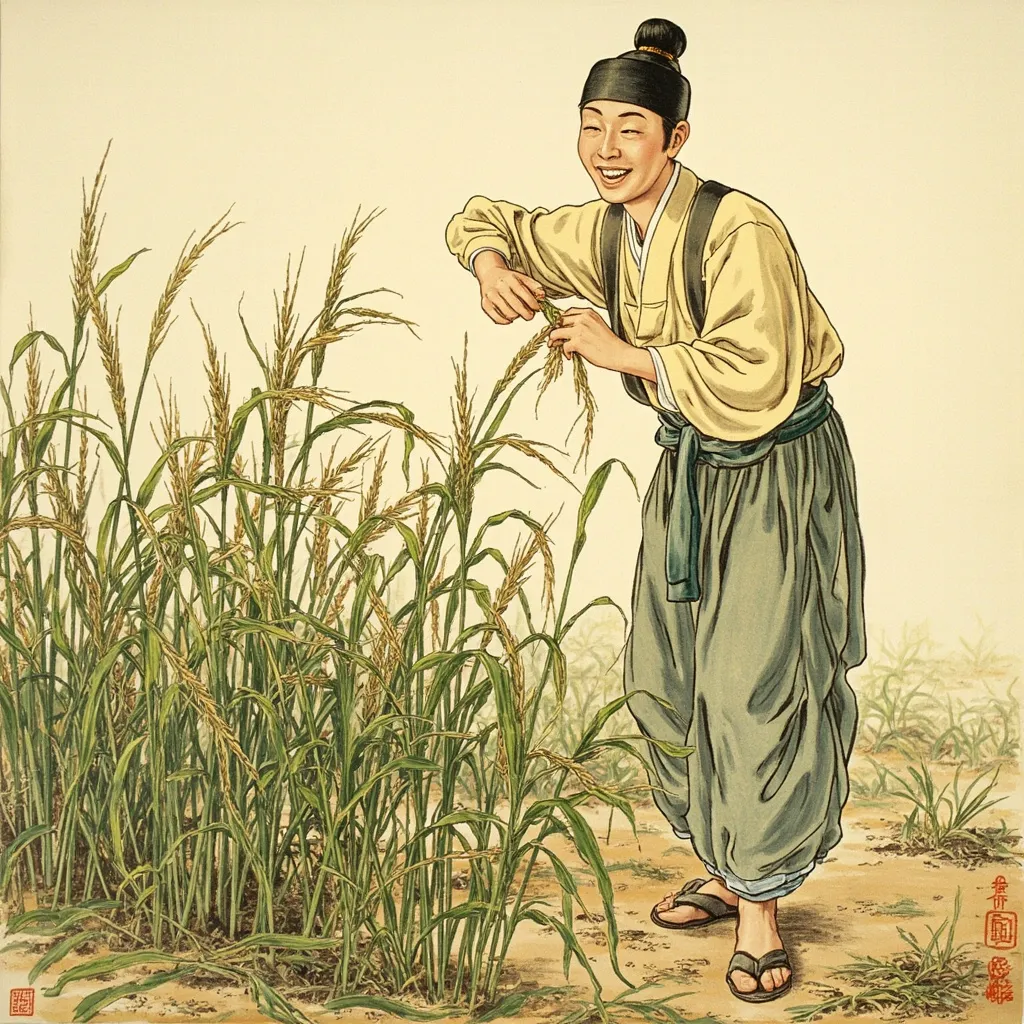
The image the idiom conjures is both comic and tragic: a well-meaning farmer standing in his field, physically pulling upward on each tiny plant, exhausted and proud of his efforts, convinced he’s helping. The plants, of course, are dying. But the farmer can’t see it — or won’t see it — because his intention was so clearly good. That’s the trap this idiom exposes.
The Original Story: An Eager Farmer’s Costly Mistake
The story appears in the Mengzi (孟子), the Book of Mencius, one of the foundational texts of Confucian thought. The philosopher Mencius used it to illustrate a point about patience and natural development in governance and personal cultivation, but the story itself is wonderfully concrete and self-contained — it needs no elaboration to land its lesson.
A farmer in the Song state had planted some rice seedlings in his paddy field. Like all farmers, he wanted a good harvest — needed one, actually, to feed his family through the winter. And like all farmers, he found the waiting hard. The seedlings seemed to grow so slowly, if they grew at all. Each day he would walk the rows and think: come on, grow faster! Why can’t you just be bigger already?
One day, he couldn’t stand it anymore. The waiting, the uncertainty, the slowness — it was too much. He went out to his field and started pulling each seedling upward, one by one, stretching them slightly to make them appear taller. He went up and down every row, giving each plant the same treatment. He did this for the entire day, exhausting himself completely in the process, and returned home believing he’d done something wonderful for his crops. His back ached, his hands were covered in soil, but he felt proud. He’d helped his plants grow. They’d be ready for harvest so much sooner now.
That evening, his son heard what his father had done and went out to check on the field. To his horror, all the seedlings had withered. Not some of them — all of them. The father’s intervention hadn’t accelerated growth; it had killed the plants entirely.
By trying to force them to grow faster, the farmer had actually killed them. The son’s worst fears were confirmed: his father’s impatience had destroyed the very thing he was trying to nurture. The story ends there, but you can imagine the conversation that followed — the farmer’s dawning horror as he understood what his “help” had actually accomplished.
Why the Farmer Was Wrong: The Nature of Real Growth
To understand why the farmer’s intervention backfired so completely, it helps to think about what actually makes seedlings grow. A plant’s roots extend downward into the soil, anchoring the plant and drawing up water and nutrients. The above-ground part grows upward toward sunlight. This process happens naturally when the conditions are right — good soil, adequate water, sufficient light, appropriate temperature. Growth is not something you can force directly; it’s something that emerges from a system working properly.
When the farmer pulled the seedlings upward, he was forcefully extending the above-ground portion while actually severing the underground connection. The roots couldn’t keep up with the artificial elevation. The vascular channels that carry water from roots to leaves were disrupted. The seedlings lost their anchor in the soil. Within hours, unable to transport water properly and no longer firmly rooted, they were dying.
The key insight is that the farmer confused the appearance of growth with actual growth. The seedlings were taller in the moment — visibly, measurably taller than they had been that morning. He could point to the evidence with his own eyes. But they weren’t healthier or more developed. They were simply displaced. They’d been torn loose from where they needed to be. The farmer had optimized for a visible metric (height) while destroying the underlying system that produces genuine, sustainable growth.
This is exactly what happens when we apply yà miáo zhù zhǎng logic to human endeavors. A child who is pushed to read before they’re developmentally ready may appear literate — they can decode words, recite passages, perform the mechanics of reading — but they haven’t built the foundational understanding that would make those skills meaningful and durable. Later, when the material gets more complex, the gaps become apparent. They can read but can’t comprehend. They can decode but can’t engage. The pushed child appears to be ahead but is actually on unstable ground.
An employee who’s given a promotion before they’ve built the necessary skills may fail publicly and lose confidence they might never recover. The visible metric — title, salary, authority — went up. But the underlying capability didn’t develop in step, and the gap between the appearance of competence and actual competence eventually becomes impossible to hide.
A project that’s rushed to meet an arbitrary deadline may produce something that looks finished but collapses under actual use. The launch happened, the announcement was made, the numbers on the dashboard improved. But the foundation was shoddy, and eventually the whole structure shows its cracks.
The Modern Face of Counterproductive Help
You encounter yà miáo zhù zhǎng everywhere once you start looking for it. The pattern is consistent across domains: someone with good intentions takes action that accelerates something at the expense of its foundation. The results look promising for a moment and then collapse, often dramatically and often at the worst possible time.
In education, the phenomenon is sometimes called “push-down curriculum.” Teachers and parents, worried that children aren’t learning fast enough, worried about competitiveness, worried about falling behind some imagined standard, introduce concepts earlier and earlier. What looks like advanced instruction is often just superficial exposure. The children may be able to recite vocabulary or perform calculations that seem impressive for their age, but they haven’t built the cognitive scaffolding that would make those skills durable, transferable, or genuinely understood. Later, when the material gets more complex, the gaps become apparent — sometimes catastrophically so.
In business, you see it when companies prioritize growth metrics over customer satisfaction. New users increase, revenue climbs, engagement numbers look great. But the product experience degrades — corners were cut to ship faster, support is understaffed, technical debt accumulates. Eventually, the metrics reverse, often dramatically, because the underlying value proposition was undermined by the relentless push for visible numbers. The seedlings were pulled upward, and they looked taller for a while.
In personal relationships, parents sometimes “help” their adult children by making decisions for them, solving problems they should solve themselves, removing challenges that would build capability and confidence. The children appear to be thriving — they’re not struggling! everything looks fine! — but they’re also not developing independence. They haven’t built the roots that would let them survive when the parents can no longer intervene — due to illness, death, geographic distance, or simply the natural limits of how much one person can do for another. When the support is removed, the plants wither.
In healthcare, you see it when well-meaning families try to protect frail relatives from all physical activity, all challenge, all risk. The person is safe — no falls, no injuries — but they’re also losing muscle mass, joint flexibility, and cardiovascular capacity. The protection is killing them more slowly than the risks they were protected from, but it’s still killing them. The seedlings weren’t pulled, but they were kept in darkness.
The Temptation We All Face
What’s striking about the original story is that the farmer wasn’t lazy or indifferent. He wasn’t neglecting his responsibilities. He worked incredibly hard. He spent an entire day in the field, physically exerting himself on behalf of his crops. He came home tired, dirty, and believing he’d done right by his family and his land. The story doesn’t suggest he was a bad farmer — just a worried one, an impatient one, a human one.
This is the trap that yà miáo zhù zhǎng exposes so clearly: effort is not the same as helpfulness. Busyness is not the same as progress. Doing something is not the same as doing the right thing. The farmer was active, energetic, devoted — and entirely wrong. His energy was pointed at the wrong target, applied in the wrong direction, informed by a misunderstanding of what growth actually is.
We all face versions of this temptation. When someone we care about is struggling, sitting still feels negligent. We want to offer advice, make calls, create plans, do something visible that demonstrates our care and engagement. We want to show that we’re involved, that we care, that we’re doing our part. The cultural reward system reinforces this — we praise people who “do something,” who “take action,” who “get involved.” We sometimes implicitly criticize those who wait, who observe, who resist the urge to intervene, even when waiting would be the wiser course.
But patience is its own form of care. Sometimes the most helpful thing is to let the process unfold, to trust that the roots are doing their work underground even when nothing visible is happening above. Sometimes the seedling needs time, not tugging. Sometimes the kindest thing you can do for someone you love is to resist the urge to fix their problem and instead simply be present while they find their own way through it.
Learning to Recognize When You’re Pulling
If you want to avoid yà miáo zhù zhǎng in your own life, start by examining your impulse to act. Ask yourself: Am I intervening because something actually needs intervention, or because I can’t tolerate the uncertainty of waiting? Is there a genuine problem I’m solving, or am I soothing my own anxiety by appearing to do something? Am I helping this person, or am I meeting my own need to feel useful?
Watch out for metrics that prioritize visibility over substance. The farmer could see that his seedlings were taller. That’s a measurable, reportable outcome. He could have shown anyone his field and pointed to the evidence of his work. What he couldn’t see was what was happening below the surface — the severed roots, the broken connections, the dying tissue that would show up the next morning. When you’re optimizing for something you can see, ask yourself what’s happening to the parts you can’t see. The visible growth might be coming at the cost of the invisible foundation.
Also notice when your help creates dependency rather than capability. The best help is the kind that makes itself unnecessary — that teaches skills, builds confidence, and creates conditions where the person can eventually thrive without your involvement. If your “help” means the person needs you more rather than less over time, you may be pulling seedlings. Real help should make you less necessary, not more.
Pay attention to the difference between enabling and supporting. Supporting means providing what someone needs to do for themselves. Enabling means doing for them what they could do for themselves if they were pushed to. The distinction is not always obvious in the moment, but it’s crucial.
What the Story Teaches About Trust and Natural Process
At its deepest level, yà miáo zhù zhǎng is about the limits of control. The farmer believed he could force growth through direct intervention. He was wrong because growth isn’t something you can force — it’s something you enable. The farmer’s role should have been to maintain good conditions — water the field, ensure the soil was healthy, protect the seedlings from pests — and then step back, trusting that the natural process would produce results in its own time.
This applies to parenting, leadership, friendship, and self-management. You can create conditions for growth. You can remove obstacles. You can offer resources and encouragement. You can model behavior and create safe spaces for practice. But you can’t do the growing for someone else, and trying to usually makes things worse. The roots have to grow themselves. The plant has to do its own work.
Mencius, who told this story nearly twenty-five hundred years ago, was making a point about governance — about how rulers who try to force moral development through harsh laws and punishments often achieve the opposite, creating resentment and dishonesty rather than virtue. But the lesson generalizes to any context where we try to shortcut natural development. The temptation to pull is strong, but the results are always worse than letting the natural process take its course.
The next time you’re tempted to pull something upward because it seems too slow, remember the farmer’s son walking out to the field at dawn and finding nothing but withered stalks. Sometimes the most loving, patient, courageous thing is to stop pulling and start trusting. The seedlings know what to do. Your job is to make sure they have what they need — and then get out of the way.