If you have ever walked past a Chinese New Year parade and noticed a strange horned creature with a deer body, dragon scales, and the gentle eyes of a saint, you have met the qilin. It is, by most reckonings, the single most beloved mythical creature in the Chinese imagination - more often painted than the dragon, more often carved than the phoenix, more often invoked in blessings than either.
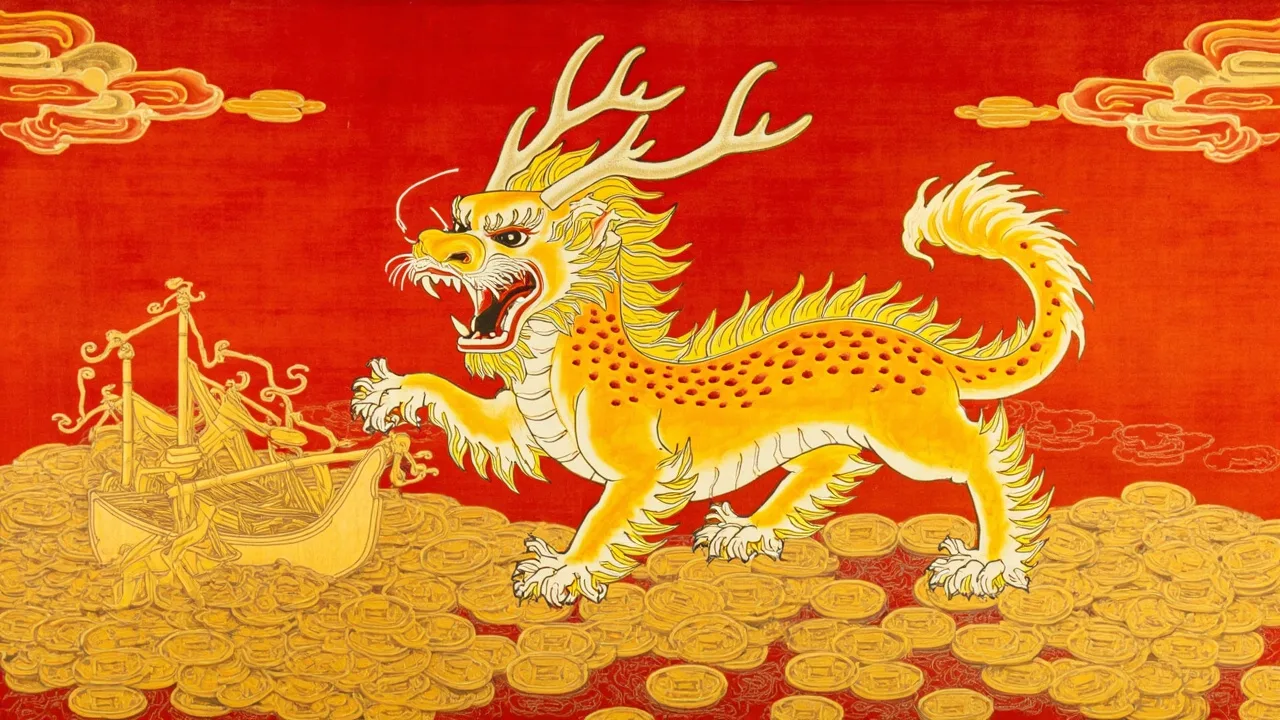
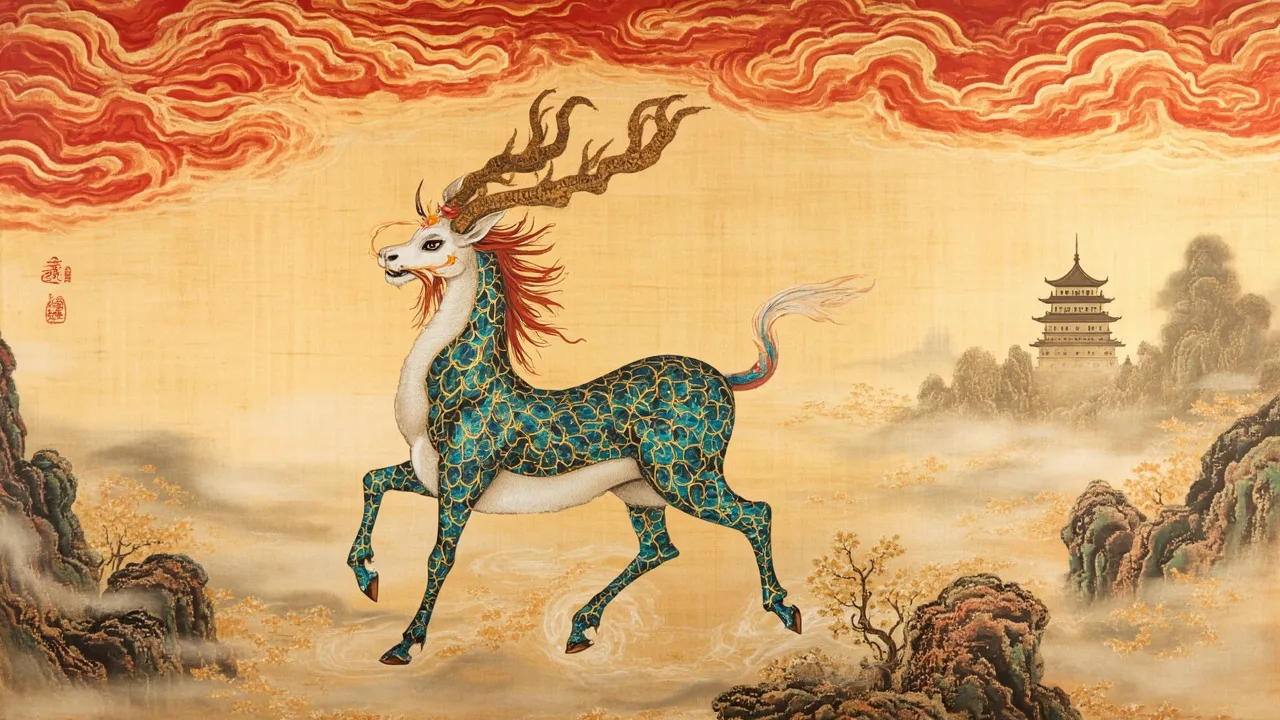
Western readers who know the word usually translate it as “Chinese unicorn,” and the translation is not wrong, exactly, but it is misleading. The Western unicorn is a horse with one horn, often white, often virginal, often weaponized in medieval hunts. The qilin is none of these things. It has a deer’s body. It has a dragon’s scales running along its back. It has an ox’s tail, sometimes a bear’s paws, and a head that combines features from half a dozen animals into something no naturalist has ever classified. Its single horn - when the tradition gives it one horn, which not all versions do - is the horn of a young dragon, not the horn of a horse. And its temperament is not aloof purity. The qilin is gentle, slow-moving, and almost pathologically reluctant to step on living things. When it walks, grass folds beneath its hooves without breaking and then springs back up after it has passed.
That gentleness is the whole point. The qilin is not a creature of war. It is a creature of omen.
What the Qilin Actually Looks Like
The earliest surviving description of the qilin is in the Shanhaijing (山海经), the Classic of Mountains and Seas - a strange, vast, geographically incoherent Chinese encyclopedia probably compiled between the fourth and second centuries BCE, full of mountains that do not exist and rivers that no one can find, populated by creatures that have never been alive. The Shanhaijing does not use the word qilin everywhere, but where it does, it describes the animal in terms that have set the template for two thousand years of Chinese art:
- A body like a deer.
- A tail like an ox.
- A back covered in fish scales or dragon scales.
- A single horn on the head, sometimes described as fleshy rather than bony.
Later texts fill in details. The Erya, a third-century-BCE dictionary, distinguishes the male (called qi) from the female (called lin); the two characters together form the word qilin. The male is sometimes given a slightly darker, more draconic appearance; the female a softer, more cervine one. By the Han dynasty, the qilin was also being described as having “the body of a deer, the tail of an ox, the hooves of a horse, the forehead of a wolf, the horns of a deer, the eyes of a demon, and the claws of a tiger” - that is from a poem attributed to the Han dynasty figure Kong Jia, and it is essentially the canonical list.
The coloration varies. Some paintings show the qilin in deep imperial yellow, others in green, others in pale blue or pearl gray. The single most common color in Ming and Qing dynasty art is a warm, mottled tawny, with the scales picked out in gold leaf or mineral pigment. In Japanese-derived depictions - the qilin traveled to Japan as the kirin and to Korea as the girin - the animal often becomes more horse-like and more brightly colored, sometimes golden, sometimes flame-red.
What almost never changes is the eye. The qilin always has a soft, melancholy, human-aware gaze. This is the visual signal that the qilin is not just another strange beast; it is a moral witness.
The Confucius Birth Omen
The single most famous qilin story in the Chinese tradition concerns Confucius. It happened, according to the legend, in 551 BCE, the year the great sage was born.
The story is told most fully in a third-century-CE text called the Kongzi Jiayu (孔子家语, Family Sayings of Confucius), which is of doubtful historical reliability but enormous cultural influence. As the story goes, the qilin appeared in the courtyard of the Confucius family home in the night before the child’s birth. It brought with it a piece of jade tablet, on which was inscribed a prophecy: “The son of the water-throne shall succeed to a ruined dynasty, and shall end its rule without a crown.” The qilin knelt in the courtyard, breathed on the mother (Confucius’s mother, named Yan Zhengzai 颜徵在), and then vanished.
The prophecy has been read many ways. The most common interpretation is that Confucius would be born into a world in disorder (the Spring and Autumn period was already underway, and the Zhou dynasty was visibly falling apart), that he would attempt to restore moral order, and that he would fail politically but win culturally. Confucius did, indeed, fail politically. He did, indeed, become the dominant cultural authority of the next two thousand years. The qilin’s prophecy, in retrospect, reads less like prediction than like diagnosis.
There is a sad epilogue. Confucius is said to have wept when, late in his life, he encountered a wounded qilin while hunting. A peasant had caught the animal and injured it trying to defend his crops. Confucius recognized the creature, mourned it as a sign that Heaven had sent it to him in vain - that he had failed in his mission, that the moral order he had spent his life advocating would not come - and wrote the Chunqiu (春秋, Spring and Autumn Annals), his short, terse chronicle of the decaying Zhou polity, before dying himself about two years later. The story is almost certainly legend, but it is the legend that sealed the qilin’s place as a creature whose comings and goings mark the rise and fall of human virtue.
The qilin is, in other words, not just a beautiful animal. It is the animal that registers moral weather. When a sage is born, the qilin appears. When a sage dies, the qilin mourns.
The Qilin in Chinese Art and Symbolism
Across Chinese art history, the qilin shows up with surprising consistency in three places: imperial iconography, wedding iconography, and baby-and-child iconography.
In imperial iconography, the qilin appears alongside the dragon, the phoenix, the tortoise, and the tiger as one of the canonical “auspicious creatures” of state. The Ming and Qing courts had official qilin motifs embroidered on court robes, used on official seals, and depicted on imperial gifts to foreign envoys. The Qianlong Emperor in particular was fond of qilin imagery - one famous 18th-century diplomatic gift to the British court depicted a qilin alongside other auspicious beasts, and the recipient, depending on which scholar you ask, may have read it as a giraffe (which is the most famous theory for the origin of the English word giraffe, possibly from zaraffa, possibly from the Chinese word for qilin, possibly from both).
In wedding iconography, the qilin is a fertility and good-marriage symbol. Qilin motifs appear on wedding beds, on bridal headdresses, on wedding fans, and on the gift boxes of wedding tea. The phrase qilin songzi (麒麟送子, “the qilin delivers a son”) is one of the most common visual themes in Chinese decorative art - a qilin carrying a baby boy on its back, often accompanied by a congratulatory inscription. You can see this motif on screens, on porcelain, on paper cuts, and on embroidered hangings in any major museum of Chinese art.
In baby-and-child iconography, qilin motifs appear on caps, bibs, lockets, pillows, and toys for children. A child wearing a qilin hat or sleeping under a qilin blanket is a child whose parents are wishing them long life, good fortune, and gentle character. The qilin in this context is not so much a mythological creature as a kind of blessing in animal form.
The qilin also shows up - and this is less well known in the West - in the martial and protective iconography of Buddhism. In some Buddhist temples, particularly those connected to the bodhisattva Samantabhadra, the qilin appears as a mount or attendant. It is also sometimes associated with the Diamond Sutra and other Mahayana texts as one of the protective creatures of the Dharma. This is a much later overlay on the original Chinese myth, and probably reflects Indian influence via the Silk Road, where the qilin’s character was retrofitted to function as a guardian of Buddhist truth.
The Qilin in Modern Feng Shui
If you walk into a Chinese feng shui supply shop - the kind of shop that sells coins with holes in the middle, brass compasses, bamboo flutes, and small ceramic frogs with coins in their mouths - you will find qilin statues in several sizes. The biggest ones are the size of a small armchair. The smallest ones are the size of a fist. The shopkeeper will tell you they come from the southern Chinese tradition of placing a qilin in the entry hall to ward off negative energy.
The folk tradition here is older than the word feng shui as we use it today, but it works the same way. The qilin in the entry hall is supposed to:
- Absorb bad chi before it enters the home.
- Attract wealth and good fortune.
- Protect children and elders.
- Discourage arguments among the household.
The most common placement, in the tradition I have seen practiced, is just inside the front door, facing inward, slightly elevated on a small platform or table. Some practitioners insist on a pair, one male and one female. Others recommend a single qilin for a small home. The direction it faces matters: traditionally a qilin should not be placed facing the kitchen (which it reads as fire and disorder) or the bathroom (which it reads as waste and impurity). The living room, the office, and the family room are all acceptable.
There is a small but interesting counter-tradition that argues the qilin should never face outward - that is, it should not be placed looking out the front door at passersby, because the qilin, being gentle, will try to bring all the strangers into the home, which is bad. The qilin is supposed to receive the chi of those who come in, not broadcast invitations to those passing by.
You will also find qilin motifs on jewelry, particularly jade and gold pendants, where the qilin is worn as a personal protective amulet. This is more common in southern Chinese and Southeast Asian Chinese communities than in northern ones. A jade qilin pendant is a common gift to a child or a young person starting a new venture, with the unspoken wish that the gentle watcher will keep them from harm.
A Few Things I Find Worth Saying Out Loud
A few things about the qilin that are worth saying plainly, because they tend to get confused in the pop-culture version:
The qilin is not the same as the Chinese dragon. The dragon is yang, celestial, weather-controlling, often imperial. The qilin is gentler, more terrestrial, more associated with specific human moments (birth, marriage, death of sages) than with cosmic forces.
The qilin is not the same as the Chinese unicorn. The Western unicorn is a horse with one horn and a virgin-testing myth. The qilin is a deer-dragon hybrid that has no virgin-testing myth and is itself, in some versions, considered chaste rather than chaste-testing. The Western unicorn is also largely medieval European; the qilin is ancient Chinese and has been continuously imagined for at least two thousand years.
The qilin is also not the same as the kirin of Japanese folklore, although they are related. The Japanese kirin became more horse-like, more chimerical, and more closely associated with good governance (it appears as the emblem of the Kirin Brewery Company, named after the auspicious beast). The Chinese qilin kept its deer-dragon character more consistently.
And the qilin is not, despite what you will read in some English-language pop-mythology books, the same creature as the komainu or the foo dog. Those are guardian lion-dogs; the qilin is a different beast entirely.
What the qilin is, more than anything else, is a moral instrument. It walks the world looking for moments when human goodness is appearing or disappearing, and it marks those moments by showing up. The Chinese tradition has, for two millennia, used the qilin as the kind of animal whose appearance you can take as a sign that something important is happening - a sage is born, a dynasty is rising, a wedding is blessed, a child is granted long life, a just ruler has taken the throne.
It is, when you think about it, a much more interesting beast than the Western unicorn. The unicorn is a creature of the hunt. The qilin is a creature of attention. It does not need to be caught or killed or tamed. It only needs to be noticed.
Recommended Products for Qilin Mythology
If this article has made you want a small piece of the qilin tradition for your own home or library, here are a few items that hold up.
- Chinese Mythology: A Source Book (Wen Xin Publishing) - The standard English-language source book on Chinese mythological creatures, including the qilin, the dragon, the phoenix, and the tortoise. Useful if you want the academic context behind the folklore.
- Bronze Qilin Sculpture (Asian import retailers) - Small bronze qilin sculptures, typically 15-25 centimeters tall, are widely available from Chinese antique-reproduction shops. Look for one that shows the canonical dragon scales along the back and the deer body, rather than the more abstract “dragon-horse” form.
- Jade Qilin Pendant - Jade and jade-look pendants carved as qilin are common gifts in Chinese communities. The traditional meaning is protective amulet for the wearer; a smaller pendant is appropriate for everyday wear.
- Feng Shui Qilin Statue (Pair, Ceramic or Resin) - Pair statues for entry-hall placement, in ceramic or resin, are widely available. Look for a pair where the male and female are distinguishable, rather than two identical statues.
- Chinese Calligraphy Brush and Ink Set - Qilin motifs are among the most common subjects for Chinese brush painting practice. A basic brush-and-ink kit is the entry point; the qilin is a forgiving subject for beginners because its silhouette is forgiving of imperfect lines.
The qilin has been walking quietly through Chinese art for two thousand years. There is no rush. You can take your time getting to know it.