The Qilin: China’s Celestial Unicorn and Omen of Sagely Rulers
A Complete Guide to the Qilin for Americans
In 141 BCE, Emperor Wu of Han — one of China’s greatest rulers — woke to astonishing news. A qilin had appeared in the suburbs of Chang’an, the imperial capital. This was no ordinary animal. The qilin was a creature that had not shown itself since the Zhou Dynasty, more than a thousand years prior. Emperor Wu did not celebrate immediately. Instead, he dispatched his most learned scholars to verify the sighting. Only when they confirmed it did he issue a formal edict declaring the reign blessed by heaven.
This is how seriously Chinese emperors took the qilin. It was not merely a beautiful myth — it was a political instrument, a cosmic report card on whether a ruler deserved the Mandate of Heaven. When the qilin appeared, it meant the ruler was doing something right.
For Americans discovering Chinese mythology, the qilin is one of the most rewarding creatures to understand. It combines the unicorn’s elegance, a deer’s grace, a dragon’s mysticism, and an entirely Chinese philosophy of cosmic justice. This guide will walk you through everything you need to know about this extraordinary creature.
What Does a Qilin Look Like?
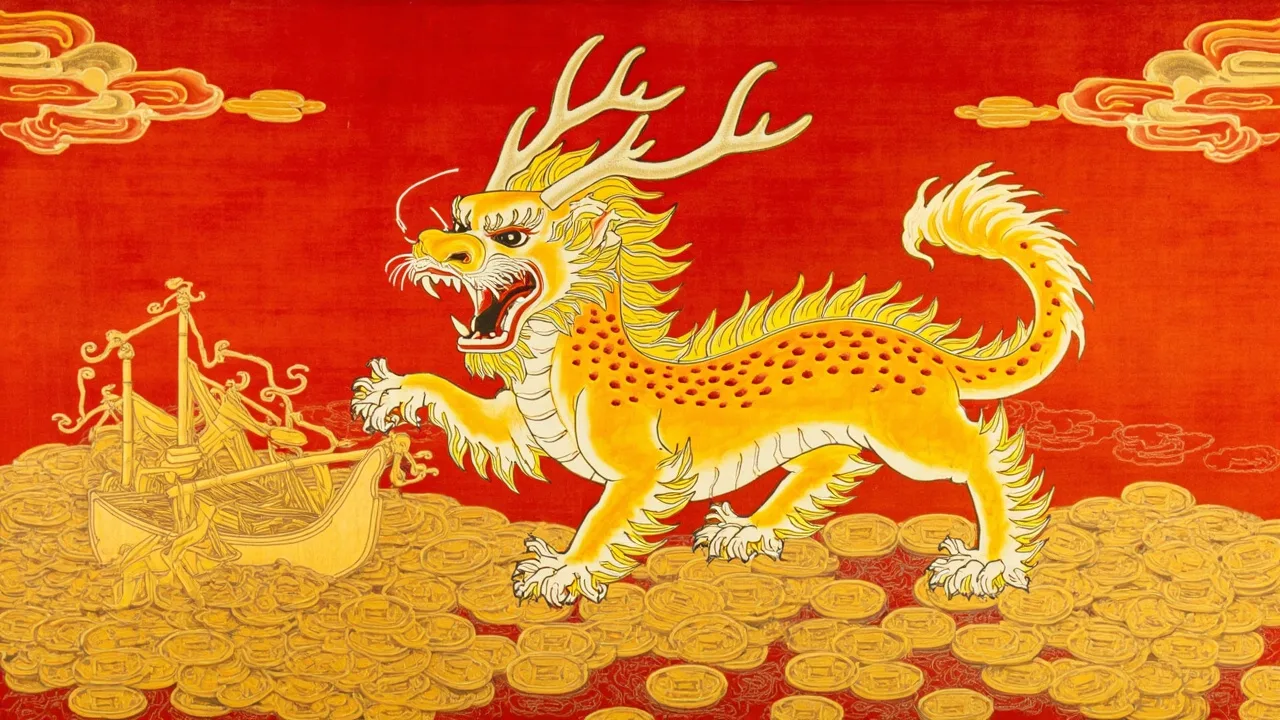
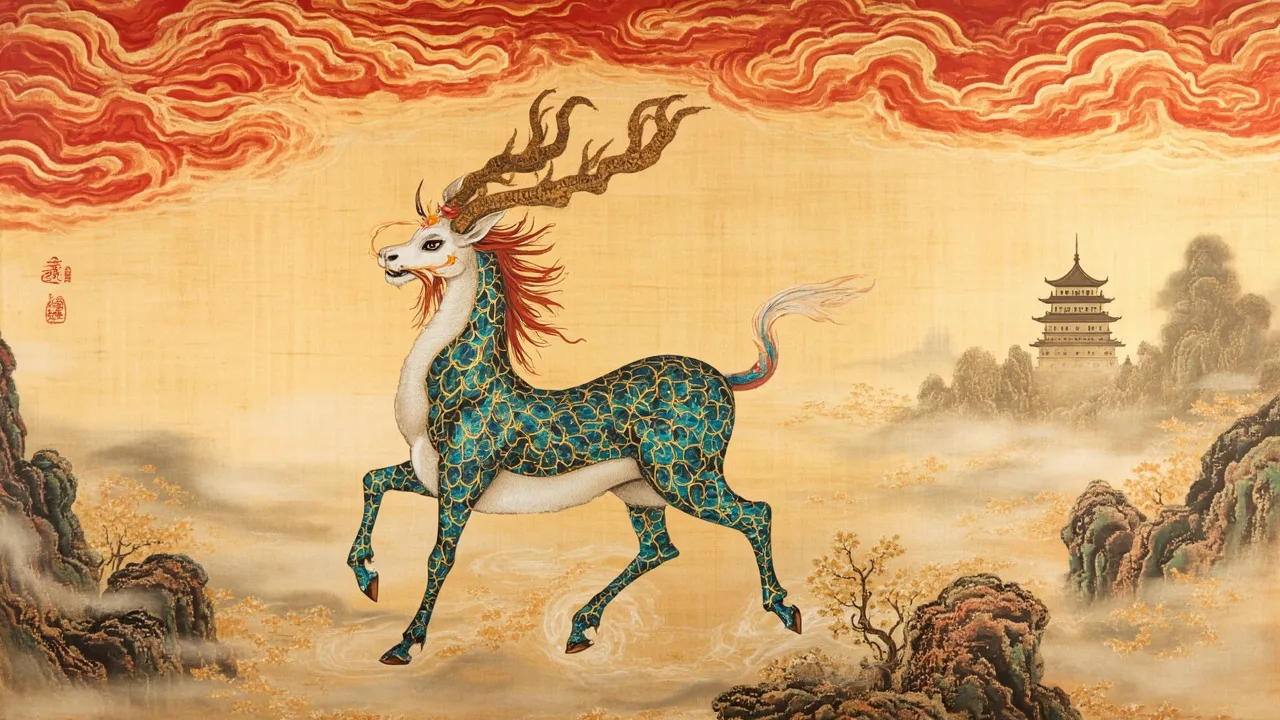
Imagine an animal that belongs to no single species but borrows the best qualities from several. The qilin has the body of a deer, covered in scales like a dragon or carp. It walks on cloven hooves but with the dignified bearing of a sacred ox. Its head is dragon-like, with a single horn protruding from its forehead — not a sharp lance like a narwhal’s, but a gentle, fleshy horn sometimes described as flesh-like or tufted.
Its tail is the tufted tail of an ox. Its hooves never make a sound as it walks. And crucially, the qilin never — ever —steps on a living creature. It walks around insects, around sprouting plants, around everything. This is not an accident of anatomy. It is a moral quality given physical form.
In color, most qilin are described as green, though golden and white qilin also appear in the historical records. A pure white qilin — called a “rulinshen” — was the rarest and most auspicious of all, reserved only for the most saintly rulers.
The Qilin as Cosmic Report Card
Chinese cosmology operated on a principle that sounds almost modern: the natural world responds to human behavior. When rulers governed well, the heavens sent positive signs. When they governed badly, disasters followed. The qilin was among the highest of these positive signs — a creature that appeared only when an emperor governed with virtue.
The historical record is full of qilin sightings, most of them politically convenient. Emperor Wu’s qilin appeared during his glorious reign. The famous Han Dynasty historian Sima Qian recorded several appearances. Tang Dynasty emperors received qilin “gifts” from vassal states. Korean and Japanese courts sent emissaries with qilin as tribute animals, usually meaning giraffes, which look remarkably qilin-like to excited observers who have never seen either.
But there is something genuinely touching about the philosophy behind this. The idea that a mythical animal could hold a ruler accountable — that even the most powerful emperor in the world could be judged by a gentle, hoofed creature that refuses to step on a caterpillar — is a profound piece of political symbolism.
The Book of Rites, one of the Confucian classics, specifically mentions the qilin alongside the phoenix as appearing only when the ruler is “complete in virtue.” Confucius himself reportedly wept when he learned that a qilin had been captured and killed by hunters during his lifetime — seeing it as an omen that the age of sage rulers was truly over. He spent his later years compiling texts that he hoped would restore that age.
The Lin Xiangru Story: The Qilin and the Magnificent Jade Disc
One of the most famous qilin stories actually stars a human — Lin Xiangru, a diplomat of the Zhao state during the Warring States period (roughly 250 BCE).
Lin Xiangru was born into modest circumstances, but his intelligence and fearlessness elevated him to become prime minister of Zhao. His most legendary moment came when the powerful Qin state attempted to deceive Zhao’s king. The Qin claimed they wanted to trade a magnificent jade disc — one of the most precious heirlooms in Chinese history — for the kingdom of Zhao. The king of Zhao was torn. Refuse, and give Qin an excuse for war. Agree, and lose the disc.
Lin Xiangru volunteered for the mission. He took the jade to Qin and immediately saw through the ruse — the Qin had no intention of handing over any territory. They simply wanted the jade for free. In a moment of brilliant improvisation, Lin Xiangru threatened to dash the disc against a stone pillar, making it worthless to both sides. The Qin backed down. Lin Xiangru returned the disc to Zhao intact.
The story gave us the Chinese idiom “to return jade to Zhao intact” — a phrase still used today when someone faithfully returns something entrusted to them. And because of Lin Xiangru’s virtuous character and his role as a “qilin among men” — a person of extraordinary virtue — the qilin and this story became intertwined in Chinese culture. Lin Xiangru was so respected that he became known as the “qilin hero,” a man whose personal integrity was as unstepped-upon as the mythical creature itself.
The Qilin and the Chinese Zodiac
Here’s something that surprises many Americans: the qilin appears in the Chinese zodiac, but not as one of the twelve animals. It is the “celestial guardian” of the northeast, associated with the year of the Dragon in some regional traditions.
More importantly, the qilin is one of the four great celestial beasts of Chinese astrology, appearing as a constellation in the eastern sky. The Qilin Star sits in the Azure Dragon asterism, representing literary achievement, spiritual insight, and the birth of sage children. Families who wanted scholarly sons would pray to the Qilin Star.
In Feng Shui, qilin figurines placed in the home are believed to bring harmony, protect children, and attract virtuous opportunities. Unlike some Feng Shui creatures that are aggressive (like the pixiu, which we’ll cover next), the qilin brings peace. It is the gentle protector.
The Qilin in Art, Architecture, and Modern China
You have almost certainly seen qilin imagery without knowing it. The qilin appears prominently in:
- Palace architecture: The Forbidden City in Beijing features qilin guardians at important gates.
- Temple carvings: Buddhist and Taoist temples across China display qilin as protectors of the dharma.
- Chinese New Year imagery: Qilin processions are part of festival celebrations in southern China.
- Imperial costumes: The qilin was embroidered on the robes of high-ranking officials.
In modern China, the qilin lives on in popular culture. The creature appears in video games (Genshin Impact features a qilin-inspired character), animated films, and children’s books. Qilin toys and figurines are popular gifts for new babies and students, reflecting the belief that the creature brings wisdom and virtue.
The Qilin and the Western Unicorn: Key Differences
The qilin is often called “the Chinese unicorn,” and the comparison is understandable. Both are single-horned creatures. But the philosophy behind them is strikingly different.
The Western unicorn was associated with purity, wildness, and untameable nature — a symbol of Christ in medieval bestiaries, or of primal power in modern fantasy. To capture a unicorn, you had to use a virgin as bait.
The Chinese qilin is the opposite. It is not wild or dangerous. It is tame, gentle, virtuous, and drawn to good rulers. It appears not to be captured but to arrive voluntarily, as a gift from heaven to a deserving ruler. Where the unicorn is about untameable power, the qilin is about harmonized virtue.
This difference reveals something fundamental about how Chinese and Western cultures think about power and authority. Western mythology tends to emphasize domination — taming the wild beast. Chinese mythology tends to emphasize virtue — the beast appears when you deserve it.
The Nian-Qilin Festival
In some parts of China, particularly in rural Shandong and Fujian provinces, there is a tradition called the Nian-Qilin Festival that takes place during the Chinese New Year period. Participants create elaborate qilin costumes from bamboo, silk, and paper, then perform in street processions accompanied by drumming and fireworks.
The qilin in these festivals is always painted green, representing nature and growth. The procession passes through every household in the village, and the qilin “eats” the bad luck that has accumulated over the past year, replacing it with blessings for the new year. It is essentially a giant, community-wide ritual of renewal.
Practical Tips: Experiencing the Qilin Today
If you want to encounter the qilin in real life, here are some ways to do it:
Visit the Palace Museum in Beijing: The Forbidden City has several qilin sculptures guarding the gates. Look for them at the entrances to important halls. They are impossible to miss — the sculptures feature a lion-like body with dragon scales, deer hooves, and a single horn.
Attend a Chinese New Year parade: If you are in Chinatown in San Francisco, New York, or Los Angeles during Lunar New Year, look for qilin processions in the parade. The costumes are breathtaking.
Watch qilin-inspired films: The animated film “The Legend of Qilin” (various titles exist) explores the mythology. The Chinese TV drama “The Legend of Mi Yue” features qilin symbolism prominently.
Read Zhuangzi: The Daoist philosopher Zhuangzi wrote about the qilin in several of his parables. His work is surprisingly readable and endlessly funny. The “Qilin and the Rat” story from Zhuangzi is a particular gem about how apparent size has nothing to do with true virtue.