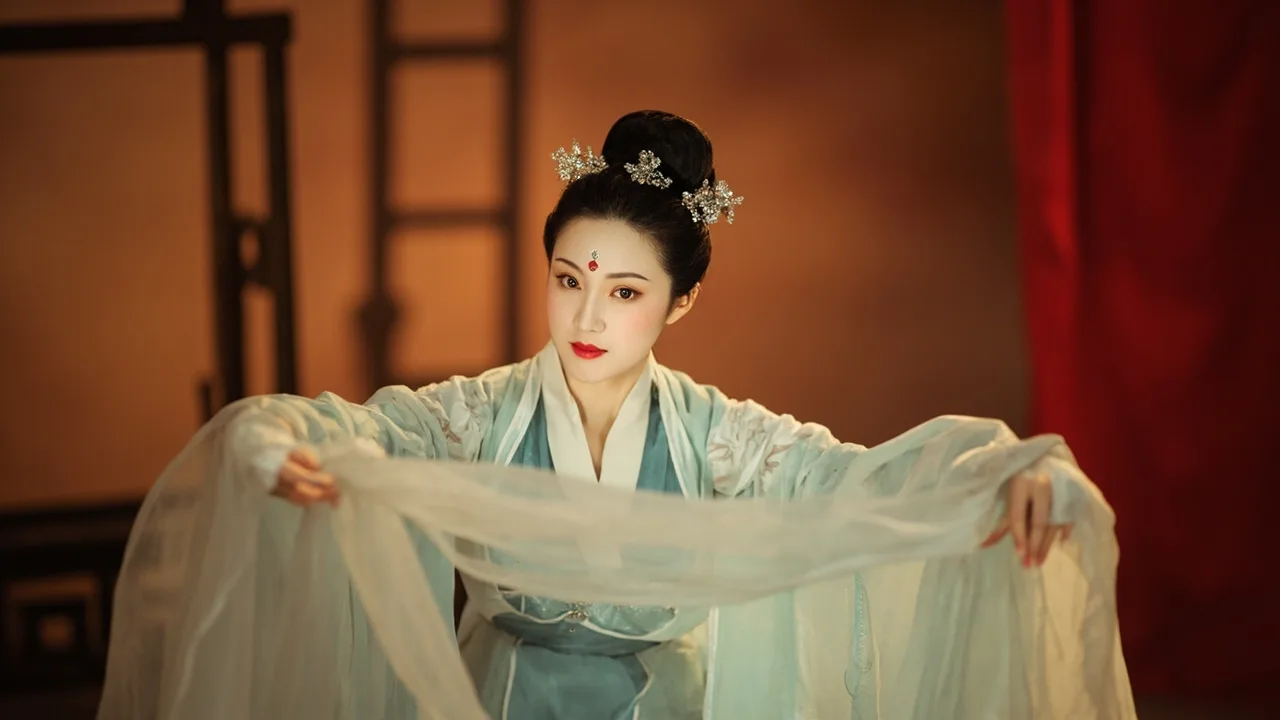
In 1992, the Chinese director Zhang Yimou released a film called Ju Dou, notable for being the first Chinese-language film ever submitted for the Academy Award for Best Foreign Language Film, and for the way it used an ancient musical tradition as both backdrop and emotional engine. The film is set in a rural Chinese village in the 1920s, and its soundtrack is dominated by the sound of Qinqiang (秦腔) opera—the rough, loud, emotionally intense folk opera form that originated in Shaanxi Province more than six hundred years ago. Zhang Yimou understood instinctively that Qinqiang’s raw power—the way it combines shouted vocals, driving percussion, and high-pitched falsetto into something that sounds more like screaming than singing—could convey a kind of emotional truth that gentler musical forms could not. He was drawing on a tradition that had survived for centuries precisely because it was too alive, too honest, and too connected to the people who performed it to die quietly.
Qinqiang is one of the oldest and most important of China’s four major bangzi (clapper) opera forms—a family of regional opera styles characterized by the use of wooden clappers (bangzi) as a primary percussion instrument. The four major bangzi forms are Qinqiang (from Shaanxi), Yueju (from Shanxi), Yuju (from Henan), and Qinqiang’s close relative豫剧 (also sometimes included in the group). Together, these forms spread across northern and central China and contributed significantly to the development of Beijing Opera (Peking Opera), which absorbed elements from all of them. In this sense, Qinqiang is not just a regional art form—it is one of the direct ancestors of the style that became, for many Western audiences, the defining sound of Chinese theater.
UNESCO recognized Qinqiang as part of China’s Intangible Cultural Heritage in 2006, which means the Chinese government officially classifies it as a tradition worth protecting and preserving. But Qinqiang has survived for six centuries not because of government protection but because of something more grassroots and more durable: a network of villages in Shaanxi where every farmer, it seems, knows how to sing it.
What is Qinqiang? The “Shaanxi Shout” That Became the Parent of Beijing Opera
Qinqiang emerged in Shaanxi Province during the Ming Dynasty, roughly six hundred years ago. [product_affiliate: “chinese-opera-dvd” | https://example.com/chinese-opera-dvd | $24.99 | “A curated DVD collection of Chinese opera performances—including Qinqiang—lets you hear the ‘Shaanxi shout’ for yourself”] The name literally means “Qin opera”—Qin (秦) being the ancient name for the region around present-day Shaanxi, and also the name of the first emperor of China, whose capital was at Xi’an. The Qin Empire (221–206 BCE) unified China for the first time, and Shaanxi has carried a certain cultural weight ever since as the cradle of Chinese civilization. Qinqiang opera grew out of this soil, drawing on local folk songs, religious rituals, and narrative traditions to create something that was recognizably operatic—combining singing, acting, dance, and instrumental music into a unified theatrical performance.
What makes Qinqiang immediately distinctive to anyone hearing it for the first time is its “rough and loud” (粗犷, cuguang) quality. Where Beijing Opera is known for its refined, controlled vocal style—trained singers producing controlled falsetto tones that are beautiful in an intellectual, distant way—Qinqiang is, by contrast, visceral and physical. Singers produce loud, high-pitched vocalizations that are closer to shouting or crying than to what most Westerners would recognize as singing. The emotional register is deliberately intense: Qinqiang roles are peasants, soldiers, wronged women, and angry heroes—not the emperors, ministers, and beautiful maidens of Beijing Opera. The subject matter tends toward the dramatic and the tragic: stories of injustice, revenge, loyalty, and loss.
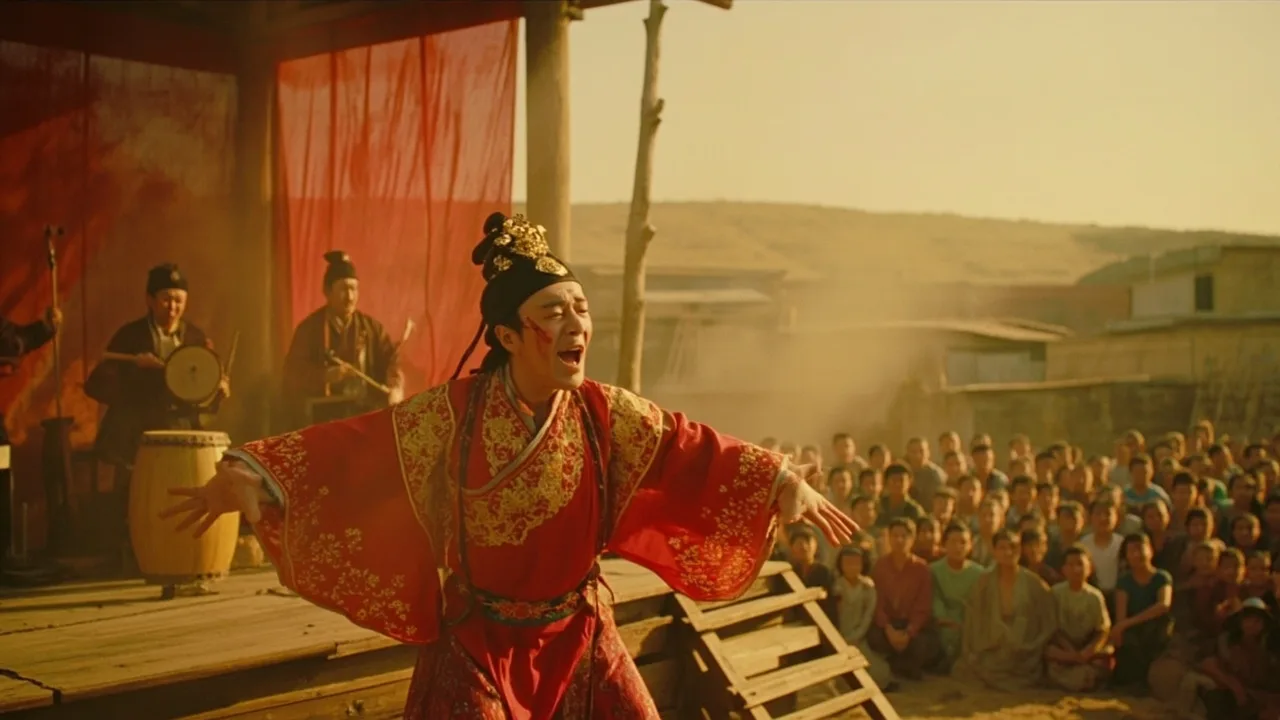
The vocal technique that defines Qinqiang is called 假的假声 (jia de jia sheng), or “false falsetto.” Singers produce a high, penetrating tone by constricting the vocal tract in a specific way that creates a characteristic buzzy, slightly harsh quality. This is not a technique designed for elegance—it is designed for power. In an open-air village performance, with no microphone and an audience that might be a hundred feet away, the singer needs volume and penetration more than smoothness. The false falsetto gives Qinqiang performers the ability to project across large distances and to convey raw emotion with an immediacy that refined vocal techniques cannot match.
The Bangzi Family: How Qinqiang, Yueju, Yuju, and Qinqiang Spawned Half of Chinese Theater
To understand Qinqiang’s place in Chinese theater history, you need to understand the bangzi (clapper) opera family. The wooden clappers that give this family their name are a pair of wooden blocks, similar to castanets, that serve as a primary percussion instrument. Unlike Beijing Opera, where the percussion section is complex and includes multiple instruments (drums, cymbals, gongs), bangzi opera puts the wooden clappers at the center of the rhythmic structure. The clappers provide a sharp, percussive attack that drives the music forward and punctuates dramatic moments with a crack that can startle an unsuspecting listener.
The four major bangzi forms are:
Qinqiang (秦腔) — from Shaanxi, the oldest and most influential. Known for its rough vocal style, intense emotional delivery, and open-air performance tradition.
Yueju (梆子) — from Shanxi Province, immediately north of Shaanxi. Yueju shares Qinqiang’s basic structure and clapper-driven rhythm but has developed a distinct regional flavor, with different melodic patterns and slightly less aggressive vocals.
Yuju (豫剧) — from Henan Province, the central Chinese plains region. Yuju is known for its accessibility and popularity—it’s one of the most widely performed regional opera forms in China, with a larger audience than Qinqiang.
Another form sometimes included in the group — various local variations that developed in the interconnections between these regional traditions.
These four forms did not develop in isolation from each other—they influenced each other constantly, with performers and troupes traveling between provinces and sharing repertoire, techniques, and instruments. The result was a network of related but distinct opera forms that together covered most of northern and central China.
The relationship between these bangzi forms and Beijing Opera is one of the most important stories in Chinese theater history. Beijing Opera (京剧, Jingju) emerged in the late eighteenth and early nineteenth centuries in Beijing, the imperial capital, as a synthetic form that combined elements from multiple regional traditions—including several bangzi forms. [product_affiliate: “qinqiang-music-album” | https://example.com/qinqiang-music-album | $19.99 | “A dedicated Qinqiang music recording brings the raw, shouting energy of the tradition directly into your ears”] The “gaoshan” (high-pitched) singing style in Beijing Opera, the use of percussion to drive dramatic moments, and the physical expressiveness of the performances all show clear influence from Qinqiang and its relatives. Beijing Opera absorbed these elements and then refined and stylized them, creating a more controlled, elegant form that was better suited to indoor court performance. But the raw energy that runs through Beijing Opera like a current—that sense of emotional stakes being extremely high—comes directly from the bangzi tradition that preceded it.
The Sound: False Falsetto, Clappers, and Why It’s So Loud
If you attend a Qinqiang performance, the first thing that hits you is the sound. The combination of the wooden clappers (bangzi), the bangu (a large drum played with sticks), the erhu (a two-stringed fiddle), and the shouted vocals creates a wall of noise that is immediately enveloping. In an outdoor village performance, this is intentional—the music needs to carry across the performance space and through the ambient noise of a rural environment. But even in an indoor theater, Qinqiang sounds loud. It is not a music that invites quiet contemplation; it demands attention.
The false falsetto vocal technique is the heart of Qinqiang’s distinctive sound. A trained Qinqiang performer can sustain a high note at extraordinary volume while modulating it in ways that convey specific emotional states—grief, anger, determination, despair. [product_affiliate: “chinese-percussion-replica” | https://example.com/chinese-percussion-replica | $45.99 | “The wooden clappers (bangzi) that drive Qinqiang are central to its sound—a replica lets you feel the driving rhythm”] The technique requires years of training to develop, and it is physically demanding in a way that more refined vocal techniques are not. Qinqiang singers often develop distinctive physical mannerisms—tilting the head, raising the shoulders, gripping the sleeves—because the physical effort of producing the sound is inseparable from the emotional expression it carries.
The percussion section drives the performance in a way that can feel overwhelming to newcomers. The wooden clappers provide a sharp rhythmic backbone—their crack signals transitions between musical sections and punctuates dramatic moments. The bangu drum adds depth and drive, and the erhu supplies the melodic line that the singers follow and ornament with their vocalizations. The combination creates a dense, layered texture that Western ears might initially find chaotic but that experienced listeners recognize as highly structured.
The emotional logic of Qinqiang music is worth understanding. Unlike Western classical music, which tends to organize emotion through harmonic progression—moving from tension to resolution through a series of chord changes—Qinqiang organizes emotion through intensity and repetition. A scene might begin at moderate volume and intensity and then build, section by section, to a climax of maximum vocal and percussion intensity, at which point the scene might end or transition abruptly. The audience knows this structure and responds to it with a kind of anticipation—they know the build is coming, and when it arrives, they respond with cheers and applause. This is not passive listening; it is participatory.
Zhang Yimou, Ju Dou, and the Film That Made Qinqiang International
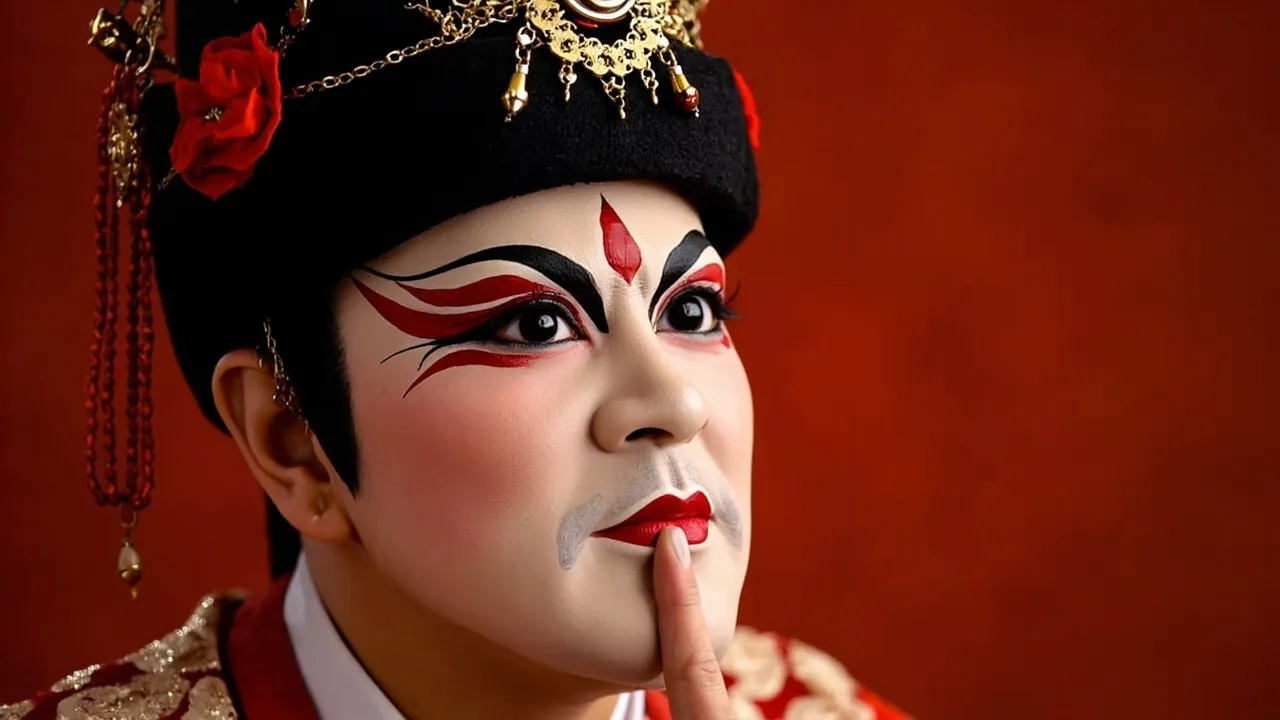
Zhang Yimou’s 1992 film Ju Dou was not the first time Qinqiang appeared in cinema—the tradition had been filmed many times before—but it was the film that introduced Qinqiang’s sound to an international audience. [product_affiliate: “face-changing-mask-art” | https://example.com/face-changing-mask-art | $34.99 | “Chinese opera performers use elaborate face paint and masks—an art piece of a face-changing mask connects you to this theatrical tradition”] Set in a rural Chinese village in the 1920s, Ju Dou tells the story of a woman married to an older man and her affair with his younger nephew. The film is a tragedy—literally a story about the destructive power of sexual desire and social oppression—and its director needed a music that could carry the weight of that emotional intensity.
Zhang Yimou chose Qinqiang because he recognized that the opera form’s raw emotional force was precisely what the film needed. The opening sequence of Ju Dou features Qinqiang singing over the title credits, a mournful, high-pitched wail that immediately establishes the film’s emotional register. Throughout the film, Qinqiang music underscores key dramatic moments—the sound functioning both as diegetic music (music that the characters can hear within the world of the film) and as non-diegetic score (emotional commentary that exists outside the story). The result is a film where the music is not background but character—a presence that shapes how we feel about what we are watching.
Ju Dou was a critical success internationally and helped establish Zhang Yimou’s reputation as one of China’s most important contemporary filmmakers. It also sparked renewed interest in Qinqiang among Chinese audiences, particularly in Shaanxi Province, where the tradition had been struggling for decades against competition from pop music and television. The film’s success demonstrated that Qinqiang had an international audience and a contemporary relevance that its aging performer base had not fully recognized.
Zhang Yimou had earlier used Qinqiang in Chen Kaige’s 1984 film Yellow Earth—another film that introduced Chinese rural culture to international audiences. In that film, Qinqiang singing from a village performance floats over the Loess Plateau landscape, a sound that seems to come from the earth itself. The choice was similarly deliberate: Qinqiang as the voice of a rural, traditional China that was being transformed and displaced by modernization.
Huaxian Village and the Farmers Who Won’t Let Qinqiang Die
The most remarkable thing about Qinqiang is not its age or its UNESCO status or its role in Zhang Yimou’s films—it is the village of Huaxian (户县) in Shaanxi Province, where the tradition has survived as a genuinely living art form, practiced not by professional troupes but by ordinary farmers. In Huaxian, it is said, everyone can sing Qinqiang. Farmers perform it at festivals, weddings, funerals, and holidays. It is not a museum piece preserved by government subsidies; it is a community art form that people participate in because they want to, because it expresses something that they feel.
The village of Huaxian has been studied by ethnomusicologists from around the world who find in it something increasingly rare in the modern world: a tradition that has not been commercialized, professionalized, or staged for tourists. [product_affiliate: “opera-costume-print” | https://example.com/opera-costume-print | $28.99 | “Qinqiang’s elaborate peasant-male costumes—with their bold colors and dramatic silhouettes—make striking art prints”] When a farmer in Huaxian performs Qinqiang at a festival, he is performing for his neighbors, his family, and himself—not for an audience of paying visitors. The music serves a social function: it marks important events, expresses collective emotions, and reinforces community bonds. This is what Qinqiang has been for six centuries, and this is why it has survived when so many other folk traditions have died.
Of course, Qinqiang is not immune to the pressures facing all traditional arts in the modern world. Young people in Shaanxi increasingly prefer pop music to opera. Television and the internet have created competition for attention that village festivals cannot match. The professional Qinqiang troupes that once performed in cities have struggled to fill seats. But in Huaxian and a handful of similar communities, the tradition maintains a critical mass of practitioners who keep it alive through sheer generational continuity—older performers teaching younger ones, families passing down repertoire, village festivals providing regular performance opportunities.
Qinqiang’s survival story is a reminder that traditional arts do not survive through protection alone. They survive through community participation, through genuine social function, and through the ability to continue expressing something that people actually feel. The farmers of Huaxian are not preserving Qinqiang because a UNESCO designation tells them to. They are preserving it because when the festival comes and the clappers start beating and someone opens their mouth to sing, something happens that cannot be replicated by any other means.