Every year, when
Every year, as summer reaches its height, something magical happens across China. Couples appear in parks holding hands, restaurants fill with reservations for two, and young people nervously prepare confessions of love. No, it’s not Valentine’s Day — at least not the Western version. This is Qixi Festival, China’s own celebration of love, and it’s steeped in a mythology so beautiful it might make you believe in fairy tales again.
What Is Qixi?
Qixi Festival (七夕节), often called the “Chinese Valentine’s Day,” falls on the seventh day of the seventh month in the lunar calendar. In 2026, that lands on August 14th. Unlike our February 14th Valentine’s Day, which has only been widely celebrated in China since the 1990s, Qixi has been around for over 2,000 years. This is the original love festival — the one that inspired poems, paintings, and countless love stories across Chinese history.
The word “Qixi” literally means “Double Seven.” Ancient Chinese scholars noticed that the seventh day of the seventh month coincided with the peak of the summer season, when the Milky Way (the celestial river divide the sky) shone brightest. They also noticed it was the perfect time for lovers to meet — the weather was warm, the stars were clear, and the harvest season offered a brief moment of rest from farm work.
What makes Qixi special is that it celebrates romantic love within a culture that has historically emphasized family arrangements and practical considerations over personal romantic attachment. It’s a day when expressed affection isn’t just tolerated—it’s celebrated.
Today, Qixi has become the most romantic day on the Chinese calendar. It’s the day when millions of people express their love, when datings apps see spikes in new users, and when florists, chocolate shops, and jewelry stores do their best business of the year.
The love story of the Cowherd and Weaver Girl
Every great festival needs a great story, and Qixi has one of the most poignant love tales in all of Chinese mythology. This is the legend of the Cowherd and Weaver Girl — a story so beloved that it’s been told for thousands of years and still brings tears to listeners’ eyes.
Once upon a time, in the mortal world, there lived a poor young man named Niulang (牛郎), which means “Cowherd.” He was a simple, hardworking orphan who spent his days tending his only companion — an old ox. One day, the ox spoke to him, which might surprise you unless you’re used to magical animals in Chinese folklore. The ox told Niulang that seven fairy sisters from heaven were coming to bathe in a nearby lake. If he stole the clothes of the youngest sister, she would have to stay in the mortal world and marry him.
Now, I know what you’re thinking — this sounds like a strange way to start a love story. But in traditional Chinese folklore, this kind of trickery often leads to genuine love, so let’s keep going.
Niulang did as the ox suggested. He hid near the lake and watched as the seven fairies descended from heaven, shed their radiant robes, and dove into the water. The youngest was named Zhinü (织女), which means “Weaver Girl.” She was the most beautiful of the sisters, and when she emerged from the lake to find her clothes missing, she was mortified. Niulang offered to return them, and in that moment, their eyes met. Something sparked between them — a connection that neither could deny.
Zhinü decided to stay. She married Niulang, and for a time, they lived happily in his humble cottage. She was a fairy, after all, and she used her magical weaving skills to make their modest life comfortable. They fell deeply in love and soon had two children. It was the kind of simple, tender happiness that everyone dreams of.
But the Heavenly Queen, ruler of the heavens and Zhinü’s mother, discovered that her daughter had married a mortal. She was furious. In the ancient Chinese worldview, the gap between heaven and earth was absolute — fairies simply weren’t supposed to marry humans. The Heavenly Queen sent celestial soldiers to drag Zhinü back to heaven.
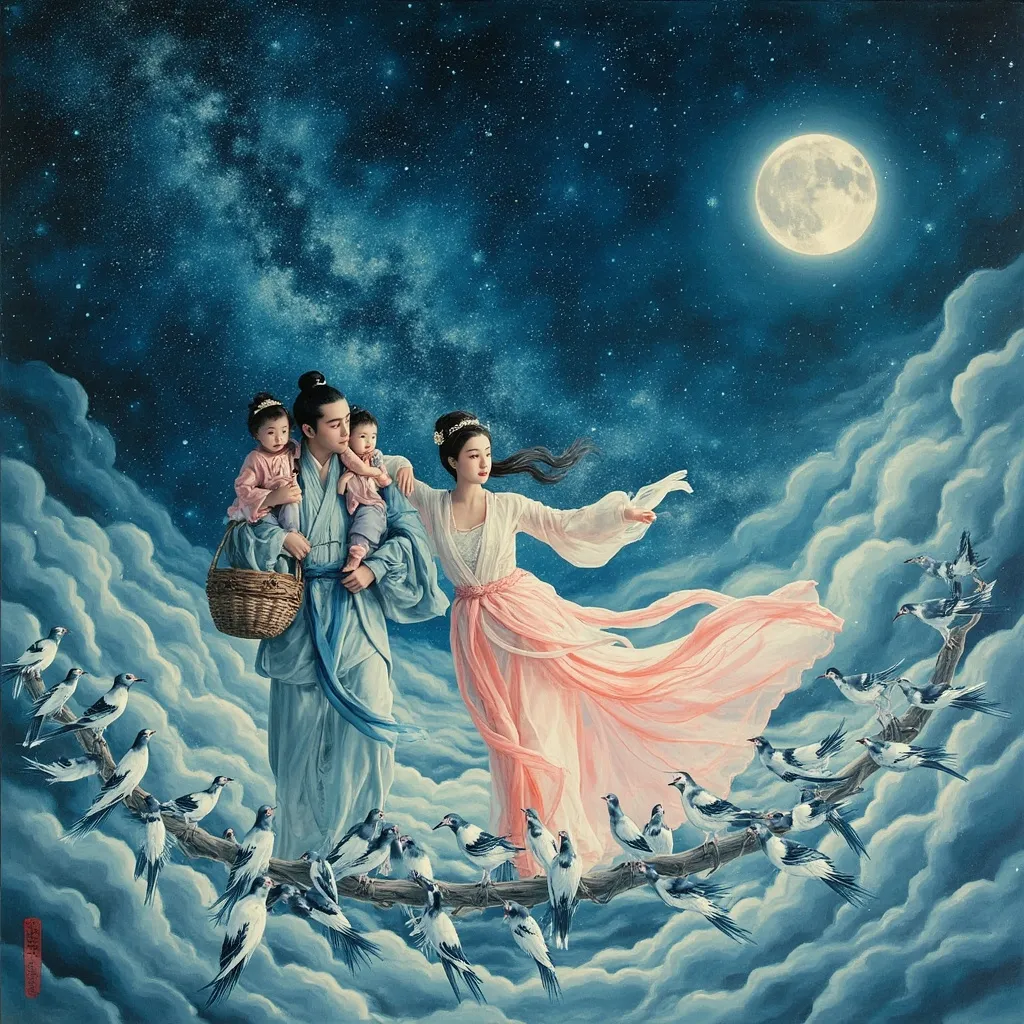
Niulang was devastated. But remember that magical ox? It was dying, and in its final act of loyalty, it told Niulang to kill it and take its hide. When the Heavenly Queen saw Niulang flying toward heaven on the ox hide, clutching their two children, she was even angrier. She took out her hairpin and drew a wide line across the sky — and that line became the Silver River, the Milky Way, separating Zhinü forever from her husband and children.
The story could have ended there, in tragedy. But it doesn’t. The lovers’ devotion touched the magpies of the world. Every year, on the seventh night of the seventh month, thousands of magpies form a living bridge across the Milky Way so that Niulang and Zhinü can meet for one night. This bridge is called the “Magpie Bridge” (鹊桥, què qiáo), and it’s the most romantic image in Chinese culture.
Think about that for a moment. The universe itself recognizes the power of true love. Even the stars and the birds conspire to bring lovers together. It’s the kind of story that makes you believe that love is worth waiting for, worth fighting for, worth enduring any obstacle to preserve.
This is the story that Chinese people recall every Qixi Festival. It’s a reminder that love is rare and precious, that separation makes reunions sweeter, and that true devotion can move even the stars.
How Qixi is celebrated
If you happen to be in China on Qixi, you’ll quickly realize that romance isn’t just for young couples — it’s a national mood. The festival has evolved from solemn religious observances into a joyful celebration that people of all ages enjoy.
For young women, Qixi has traditional roots that go back centuries. Historically, on the night of Qixi, girls would gather to worship the Weaver Girl (Zhinü), offering fruit, flowers, and incense while praying for a good husband or a happy marriage. They would also perform rituals designed to test their needlework skills — after all, Zhinü was famous for her weaving. In some regions, girls would place needles on bowls of water, trying to make them float on the surface without sinking. If the needle floated, it was considered a sign of skill and good luck in love.
These days, most young women skip the formal rituals, but the spirit of the day remains. Qixi is still considered an especially auspicious day for confessions of love. If you’ve been nervous about telling someone how you feel, Qixi gives you the perfect excuse. The festival carries an ancient blessing — if your love is true, even the stars will smile upon you.
Couples celebrate in ways that will feel familiar to anyone who’s experienced Valentine’s Day. Restaurants book up fast, with special “Qixi menus” featuring romantic dinners for two. Flowers, especially red roses and lotus blossoms, fly off the shelves. Jewelry stores promote Qixi sales, and many couples exchange gifts like necklaces, rings, or watches. In recent years, giving expensive gifts like designer bags or the latest smartphones has become popular — Qixi has become almost like a combination of Valentine’s Day and an excuse for high-end gift-giving.
But Qixi isn’t just about couples. It’s also a day for celebrating love in all its forms. Families might go out for dinner together. Friends might exchange small gifts or send heartfelt messages. Some people take the opportunity to express gratitude to parents, spouses, or close friends who have shown them love throughout the year.
In many cities, you’ll find special events on Qixi night. Some parks host “star-gazing” gatherings where couples (and hopeful singles) lie on blankets and try to spot the Cowherd and Weaver Girl stars on opposite sides of the Milky Way. Traditional performances re-enact the love story through opera, dance, or theatrical productions. In some places, people release lanterns into the night sky, each one carrying a wish for love and happiness.
One of the most touching traditions involves writing wishes on small pieces of paper and hanging them on trees or walls. These wishes might be for a romantic partner, for a happy marriage, or for the health and happiness of a current lover. Walking through a park on Qixi night and seeing all those colorful notes fluttering in the breeze is a genuinely moving experience.
Qixi in modern China
China has changed dramatically over the past few decades, and so has Qixi. What was once a quiet, folkloric observance has become one of the country’s biggest commercial events — a kind of Chinese Valentine’s Day that rivals (and in some ways surpasses) the Western version.
The transformation began in the 1990s, as China opened up to global influences and Valentine’s Day became popular among young urban Chinese. Marketers quickly recognized the potential of Qixi, which fell at roughly the same time of year but carried deeper cultural significance. Rather than replacing Valentine’s Day, Qixi became its Chinese soul—a day to celebrate love while honoring ancient traditions.
Today, Qixi is big business. In 2025, Chinese consumers spent an estimated 50 billion yuan (about $7 billion) on Qixi-related gifts and experiences. Flowers, jewelry, fashion items, and dining experiences drive most of that spending. E-commerce platforms run massive sales, with discounts on everything from cosmetics to electronics. Dating apps report significant spikes in activity around Qixi, with many launching special matching events and promotions.
Social media has added new dimensions to the celebration. Hashtags related to Qixi trend for days on platforms like Weibo and WeChat. Young people share photos of their gifts, their dates, and their heartfelt messages. Some couples stage elaborate public proposals or flash mobs to declare their love. It’s all very public and enthusiastic — a far cry from the more reserved expressions of affection that characterized earlier generations.
But here’s what’s interesting: even as Qixi has become commercialized, the core story hasn’t been forgotten. The legend of the Cowherd and Weaver Girl remains central to the festival. Many couples make a point of learning the story and explaining it to their children. There’s a renewed interest in the romantic and poetic traditions of Qixi — writing love letters in classical style, exchanging poems, or engaging in old-fashioned courtship rituals that feel both ancient and fresh.
There’s also a growing movement among young Chinese to reclaim Qixi’s deeper meaning. Rather than focusing solely on expensive gifts, some couples are choosing to celebrate with meaningful experiences — cooking together, stargazing, or simply spending quality time together. Activists and romantics alike use Qixi as an opportunity to talk about the value of genuine connection in a world of swiping right and superficial dating culture.
Qixi has also spread beyond China. Chinese communities in Taiwan, Hong Kong, Singapore, and Malaysia celebrate the festival with enthusiasm. In recent years, it’s gained attention in Western countries as more people discover the beauty of this ancient love story. International luxury brands have even launched Qixi-themed collections, recognizing the festival’s growing global profile.
Conclusion
Whether you’ve been in love for decades or are still waiting for that special someone, Qixi Festival offers something powerful: the reminder that love is worth believing in. The legend of the Cowherd and Weaver Girl is, at its heart, a story about the impossible odds love can overcome and the cosmic forces that unite lovers across any distance.
In a world that often feels too busy for romance, Qixi invites us to pause and appreciate the people we love. It’s a day to express gratitude, to offer heartfelt words, and to celebrate the connections that make life meaningful. The magpies still fly every year to form their bridge across the stars — a beautiful reminder that no river is too wide, no obstacle too great, for those whose hearts are truly meant to be together.
📚 Recommended Reading & Products
Disclosure: This article contains affiliate links.
So this Qixi, whether you’re in China or anywhere else in the world, take a moment to look up at the summer stars. Think of Niulang and Zhinü, reunited for one precious night. And maybe, just maybe, let someone know how much they mean to you. After all, that’s what this ancient festival has always been about — the belief that love, true love, is the most powerful force in the universe.