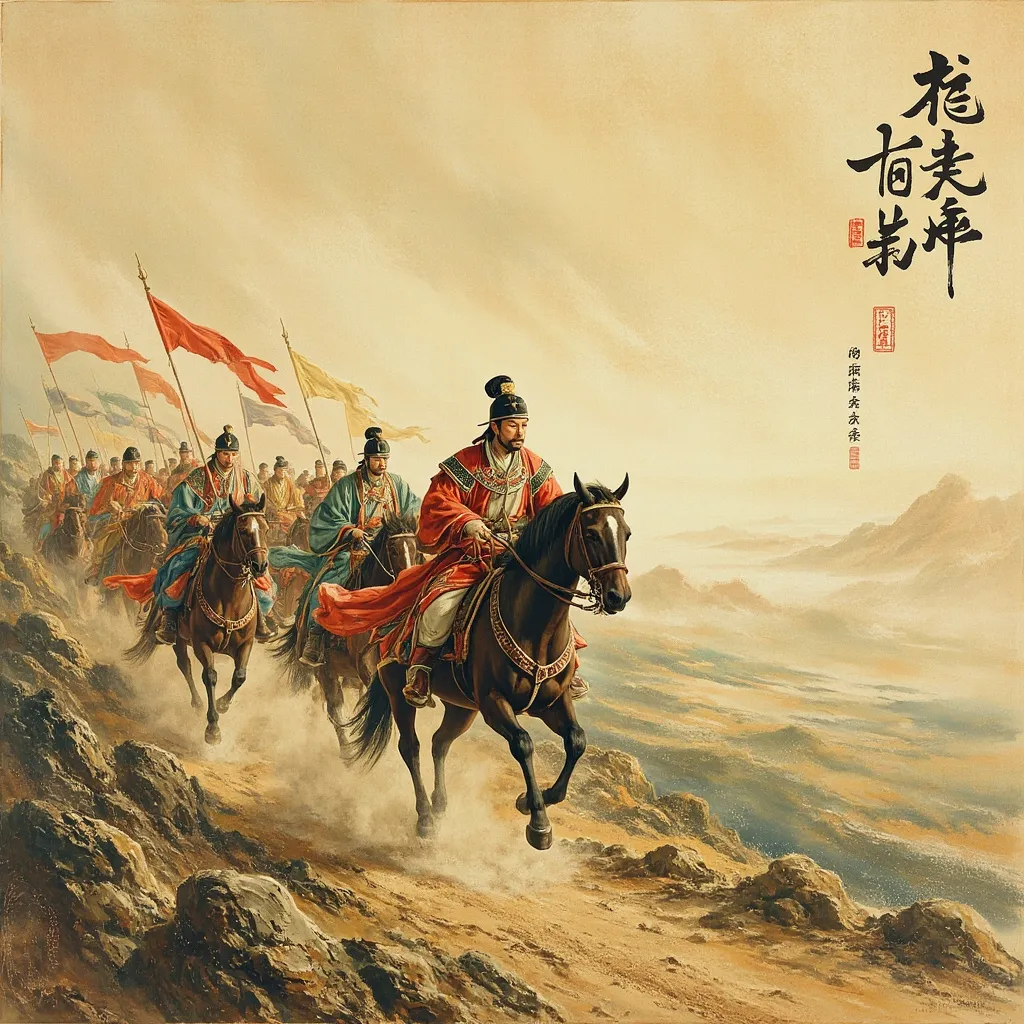
slug: “retreating-three-inns-tuibisanse” description: “Learn about 退避三舍 (tuì bì sān shè) - the legendary Chinese idiom about Prince Wen of Jin retreating three days’ journey to honor a promise, a story about strategic wisdom and keeping your word.” keywords: “退避三舍, Chinese idiom, Prince Wen, Jin kingdom, Chu kingdom, strategic retreat, ancient China, Chinese idiom story, war strategy” author: “Cultural Tales Studio” category: “Chinese Idioms” tags: [“Chinese idioms”, “Warring States”, “strategic thinking”, “integrity”, “idiom stories”, “military wisdom”] image: “/images/retreating-three-zhous.jpg” affiliate_products:
- “Sun Tzu’s Art of War Collection”
- “Ancient Chinese Military Strategies Book”
- “Traditional Chinese Strategy Board Game”
- “Warring States Kingdom Maps Poster”
- “Chinese Military History Documentary Series” categories: [Chinese Culture] alt_text: “Illustration depicting retreating three inns, in a traditional Chinese cultural setting”—
Retreating Three Inns: The Strategic Masterpiece Behind China’s Most Brilliant Withdrawal
Sometimes the smartest move looks like surrender. That’s the paradox at the heart of 退避三舍 — tuì bì sān shè — one of the most respected idioms in Chinese culture. It literally means “retreating three inns,” but don’t let that modest translation fool you. This phrase represents one of the most sophisticated tactical decisions in ancient Chinese military history, a withdrawal that won a war and created a phrase that still means knowing when to step back in order to move forward.
The story involves a prince in exile, a promise made years earlier, a powerful enemy, and one of the most counterintuitive military maneuvers you’ll ever encounter. It’s a story about patience, honor, and the long game — themes that feel just as relevant today as they did two and a half thousand years ago.
A Prince in Exile
Our story begins with Prince Wen of Jin, whose given name was Chong’er. If ever a man was born to privilege but destined for hardship, it was him. He was the son of the Duke of Jin, which should have meant a life of comfort and power. Instead, it meant a childhood marked by political intrigue, assassination attempts, and eventually exile.
When Chong’er was just a young man, his father died and a succession crisis erupted. Rival factions fought for control of Jin, and Chong’er found himself targeted not because of anything he had done, but simply because of who his father had been. He fled into exile, carrying nothing but his life and a handful of loyal followers.
For over a decade, Chong’er wandered from state to state, seeking refuge wherever he could find it. He was a prince without a kingdom, a nobleman treated like a beggar, a man whose future looked bleak beyond all remedy. Some people showed him kindness. Others treated him with barely concealed contempt. And through it all, Chong’er learned something that would define the rest of his life: he learned to understand power from the bottom up.
When you have nothing, you learn to read people. You learn to recognize who is trustworthy and who is merely waiting to use you. You learn patience, because survival depends on it. And you learn that the people who help you when you’re at your lowest are the ones worth keeping forever.
One of those people was the Duke of Chu, who offered Chong’er shelter when he had nowhere else to go.
The Promise That Changed Everything
The Duke of Chu — we’ll call him King Zhuang to keep things clear — was a shrewd ruler of one of the most powerful states of the era. He recognized that hosting a Jin prince in exile gave him potential leverage in future political maneuvering, and he was willing to extend hospitality in exchange for that potential advantage.
But something unexpected happened during Chong’er’s time in Chu. Despite the transactional nature of the arrangement, King Zhuang treated him with genuine respect. He gave Chong’er a place at his court, introduced him to his advisors, and made it clear that while Chong’er was in Chu, he would be protected. It was more than mere diplomacy; there was a personal dimension to the relationship that transcended politics.
Chong’er noticed. And in a moment of genuine connection, he made a promise: if he ever returned to claim his rightful position in Jin and became its ruler, he would repay Chu’s kindness. Specifically, if Jin and Chu ever went to war, Chong’er as ruler of Jin would order his forces to retreat three days’ journey — ninety li — before facing Chu in battle.
It was a strange promise. Military strategists would later scratch their heads at it. A retreating army gives up terrain, morale, and initiative. But Chong’er had learned something in his years of exile that the typical nobleman never understood: honor has strategic value. Relationships built on genuine respect are worth more than tactical advantages that might evaporate.
King Zhuang accepted this promise with whatever mixture of amusement and appreciation a powerful ruler might feel when a homeless prince pledges military deference. The promise was recorded, witnessed, and set aside for future use.
The Road Back to Power
Fate, as it often does, found a way. After more than a decade of wandering, Chong’er received news that the political situation in Jin had shifted. His enemies had weakened each other through their own squabbling, and there was now an opening for him to return and claim the throne. With the help of loyal followers and sympathetic nobles, Chong’er made his move.
What followed was a swift and decisive return. Chong’er became Duke Wen of Jin — Prince Wen — and almost immediately began transforming his fractured state into one of the most powerful kingdoms of the era. His years of exile had taught him about governance, about loyalty, about the dangers of complacency. He rebuilt Jin from the inside out, strengthening its military, stabilizing its politics, and earning the respect of neighboring states.
Word of Jin’s resurgence reached Chu, and King Zhuang must have felt a complicated mix of satisfaction and concern. He had helped a homeless prince become a powerful ruler. That prince now owed him a debt — but that same prince now commanded a state that might become a rival.
The question of what to do about Jin became urgent when conflicts of interest started multiplying. Jin and Chu had different spheres of influence, different ambitions, and eventually their soldiers found themselves on the same battlefield for the first time.
The Battle That Wasn’t
In 632 BCE, the forces of Jin and Chu found themselves positioned for confrontation. King Zhuang, now aging but still formidable, led the Chu army personally. Prince Wen led Jin’s forces. The battlefield waited, and everyone expected one of the decisive clashes that would shape the era.
Prince Wen had a choice to make. His soldiers were ready, his state was strong, and his forces were positioned for battle. A direct engagement might well result in victory — Jin had become genuinely formidable under his leadership. But there was also that old promise, made in a time of desperation, to consider.
Here’s where Prince Wen’s character revealed itself in full. He could have dismissed the promise as the kind of thing said by desperate exiles that no one should feel bound by in retrospect. He could have argued that circumstances had changed, that Jin’s interests now required a different approach. These would have been reasonable arguments, and no one could have forced him to honor a pledge made under such different circumstances.
Instead, Prince Wen ordered a retreat.
Not a tactical withdrawal designed to lure the enemy into a trap. Not a feigned retreat to gain some positional advantage. A genuine, three-day retreat — ninety li — honoring the exact terms of his promise to King Zhuang.
His officers were stunned. His soldiers were confused. A retreating army before a decisive battle looked like cowardice, like giving up, like throwing away victory for no discernible reason.
But Prince Wen understood something his officers didn’t. He understood that his credibility — his ability to make promises that others would believe — was one of his most valuable strategic assets. He had spent his life building relationships based on trust, and he knew that one broken promise could undermine everything he had constructed.
More importantly, he understood that the battle wasn’t really about this particular battle. It was about the kind of ruler he intended to be, and the kind of state Jin intended to become.
When Strategy Met Honor
King Zhuang, watching the Jin forces retreat, felt a complex surge of emotions. He had come to battle expecting a fight, and instead he was seeing something that didn’t fit any of his calculations. Why would a powerful enemy retreat? What trap was being laid?
As the retreat continued — one day, two days, three days — and the Jin forces maintained their disciplined withdrawal without any sign of an ambush, King Zhuang began to understand. The retreating army wasn’t running. It was keeping a promise.
And suddenly, King Zhuang faced his own choice. He could press the retreat, attack a supposedly fleeing enemy, and claim an easy victory. But he also recognized what Prince Wen was doing. This was a man honoring a debt freely given, a ruler placing integrity above tactical advantage. And if Prince Wen was that kind of man, then Chu’s interests might be better served by friendship than by war.
The historical accounts differ on exactly what happened next. Some say battle was eventually joined and Chu was defeated. Others suggest that cooler heads prevailed and the conflict was resolved diplomatically. What everyone agrees on is that the relationship between Jin and Chu shifted after this episode — toward something more respectful, more stable, and more oriented toward long-term peace than immediate conquest.
Prince Wen had won something more valuable than a battle. He had established a reputation for honor that would shape Jin’s diplomatic relationships for generations.
Why This Story Still Resonates
The idiom 退避三舍 has taken on a life far beyond its original military context. Today, Chinese speakers use it to describe anyone who steps back from confrontation not out of weakness, but out of a calculated sense that retreat serves longer-term interests better than immediate conflict.
It shows up in business negotiations, where the smart move might be to concede a point today in order to build a relationship that pays dividends tomorrow. It shows up in personal relationships, where sometimes the strongest thing you can do is decline to engage with provocation. It shows up in geopolitics, where patient statesmanship often looks like weakness to those who don’t understand the long game.
The story also speaks to something deeper about the relationship between honor and strategy. Modern culture tends to treat these as opposites — either you’re an idealist who maintains principles regardless of consequences, or you’re a realist who sacrifices principles for advantages. Prince Wen suggests a third way: a recognition that honor itself can be a strategic asset, that people who keep their word even when it costs them are worth more in alliance than people who calculate every interaction purely on immediate return.
This is wisdom that takes time to internalize. It’s easier to think in terms of immediate wins and losses. It’s harder to see that sometimes giving up a battle can help you win the war, and that the respect you earn by keeping difficult promises is worth more than the tactical advantage you might gain by breaking them.
Living the Lesson
So what does 退避三舍 look like in modern life? Maybe it’s the businessperson who honors a contract even when market conditions make it financially painful. Maybe it’s the leader who keeps a commitment to employees even when keeping it costs something. Maybe it’s the individual who refuses to take the easy shot at a rival because they know that integrity matters more than one moment of advantage.
The challenge is that this kind of behavior often looks like weakness to people who don’t understand what you’re doing. Prince Wen’s officers thought he was making a mistake. King Zhuang initially couldn’t believe what he was seeing. The retreat didn’t make sense unless you understood the bigger picture — and the bigger picture included relationships, reputation, and values that would shape outcomes for decades.
The same is true in our lives. When we choose honor over advantage, we often face confusion or criticism from people who can’t see what we’re building. The key is understanding that the critics don’t have the full picture — and neither do we, most of the time. But Prince Wen’s story suggests that the long game is worth playing, even when the short game looks more attractive.
The next time you face a situation where keeping a promise costs you something, think of Prince Wen. Think of a man who could have won a battle but chose instead to honor a debt. Then ask yourself what kind of reputation you want to build, and whether the short-term cost is actually a long-term investment.
That’s the wisdom of 退避三舍 — knowing when to retreat so you can ultimately advance.
Deepen Your Understanding of Strategic Wisdom
The story of Prince Wen and his famous retreat offers timeless lessons about patience, integrity, and the long game. The following resources explore the broader context of ancient Chinese strategic thought, military history, and the philosophical foundations that shaped decisions like the one Prince Wen made at Chu.
Recommended Reading and Tools:
Sun Tzu’s Art of War Collection — No exploration of ancient Chinese strategy is complete without Sun Tzu. This comprehensive edition includes the classic text plus historical commentary that shows how principles like 退避三舍 fit into the larger strategic tradition.
Ancient Chinese Military Strategies Book — Beyond Sun Tzu, there were many strategic thinkers whose ideas shaped Chinese military history. This book surveys the full landscape of ancient Chinese military philosophy and its applications.
Traditional Chinese Strategy Board Game — The ancient Chinese understood strategy through practice, not just theory. This traditional board game challenges players to think several moves ahead, mirroring the long-game thinking that Prince Wen exemplified.
Warring States Kingdom Maps Poster — Understanding geography is essential to understanding ancient Chinese warfare and diplomacy. This detailed map shows the states, borders, and strategic terrain that shaped decisions like the one Prince Wen made.
Chinese Military History Documentary Series — Visual learners will appreciate this comprehensive documentary series that brings ancient Chinese military campaigns to life, including dramatizations of key moments from the Warring States period.
This idiom story is part of our ongoing series exploring the depth and relevance of Chinese wisdom literature. Each story offers not just historical insight, but practical guidance for navigating complexity, building relationships, and playing the long game in our own lives.