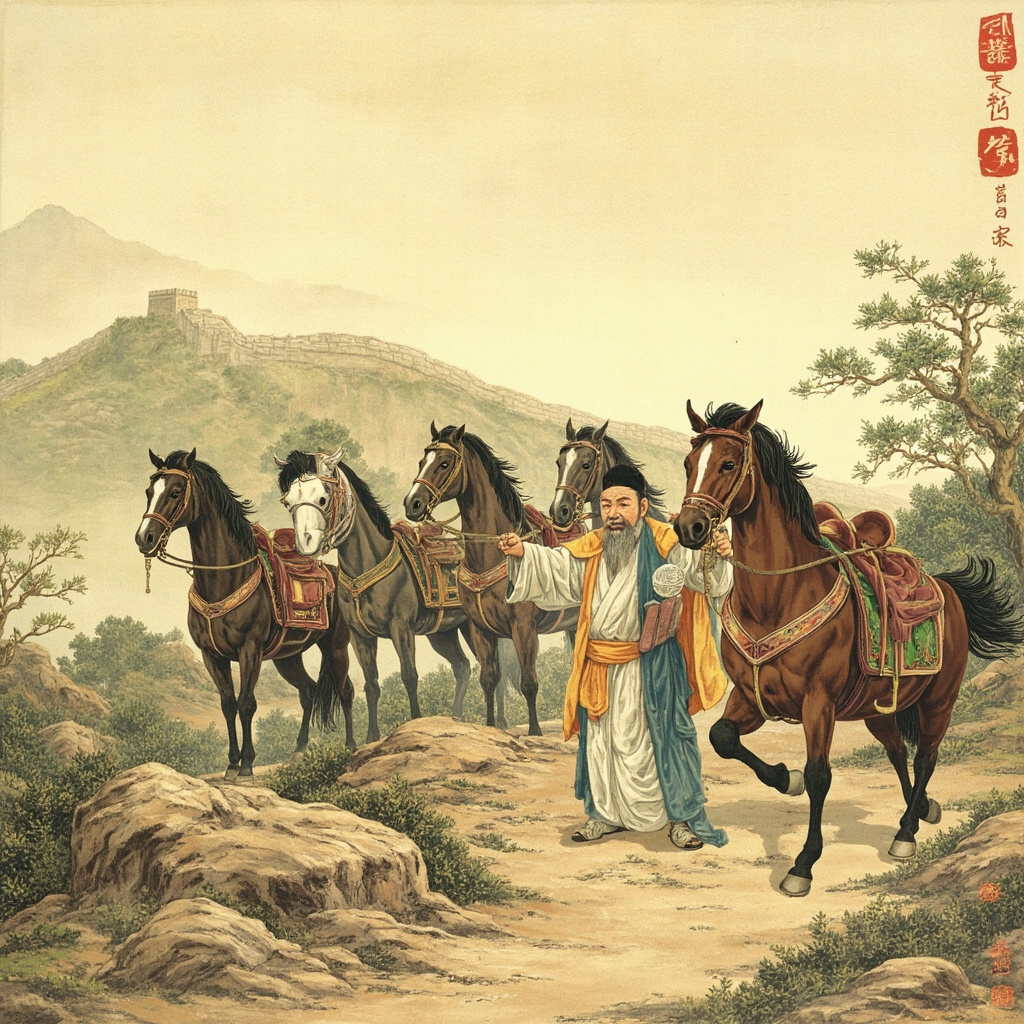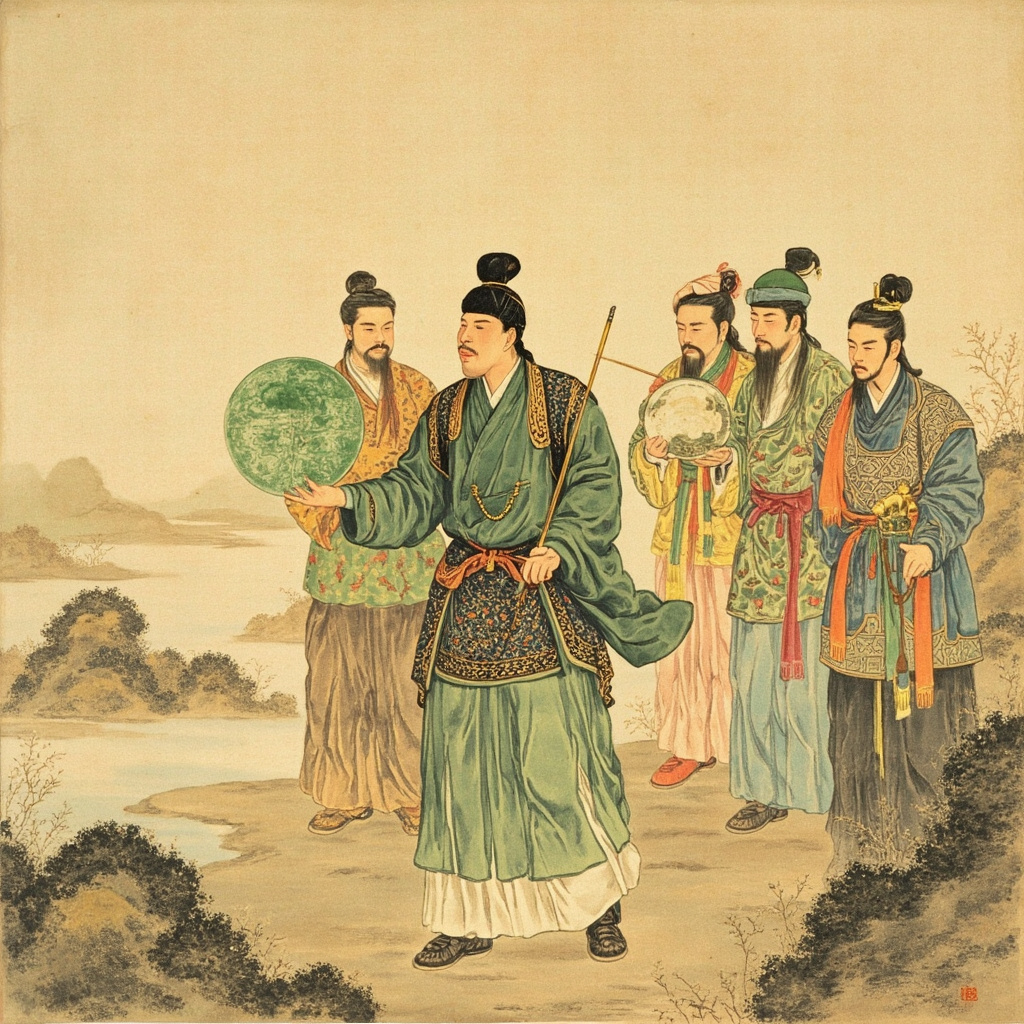
In the third century BC, during the chaotic final centuries of China’s Warring States period, the Kingdom of Zhao acquired something extraordinary: a magnificent jade disc, known as the Heirloom of Zhao, that had been in the royal family for generations. It was not just a beautiful object — it was a symbol of the Zhao royal line’s legitimacy and authority. Owning it mattered politically in ways that went far beyond its material value.
When the King of the neighboring Qin state heard about this treasure, he decided he wanted it. Not legitimately — not through purchase or diplomatic exchange — but through a simple demand backed by the threat of military force. He sent a message to the King of Zhao: give me the jade disc, or I’ll march my army south and take it by force.
The King of Zhao was caught. His state was smaller and weaker than Qin. Refusing meant war. Complying meant surrendering a priceless national treasure. In desperation, he sent a messenger to Qin offering the disc — and the Qin king responded with a proposal that everyone knew was a trap: come to my court in person, the message said, and I’ll give you fifteen cities in exchange for the jade.
The subtext was obvious: give us the disc and we’ll pretend we’re paying for it, but we’ll never actually give you the cities. And if you come to my court, you might not leave alive. This was a no-win situation designed to either humiliate Zhao or provide a pretext for invasion.
It was at this moment that a previously unknown Zhao official named Lin Xiangru stepped forward and volunteered for what everyone assumed was a suicide mission.
The Man Who Would Not Be Intimidated
Lin Xiangru had no family name of distinction and no record of diplomatic accomplishment. He was, by all accounts, a man of exceptional intelligence and nerve who had served in minor positions in the Zhao court. When the crisis arose, he saw what everyone else missed: an opportunity hidden inside what looked like certain defeat.
He asked the King of Zhao to give him the jade disc and send him to Qin. The king looked at him with a mixture of pity and confusion — surely this man understood he was being sent to his death? Lin Xiangru simply asked to be trusted, and the king, with little other choice, agreed.
When Lin Xiangru arrived at the Qin court, he presented the jade disc to the Qin king. The king, delighted, took the precious object and examined it with obvious greed. He handed it to his courtiers and his concubines, showing it off like a trophy. There was no mention of the fifteen cities.
Lin Xiangru watched. And then he did something no one expected: he announced, in front of the entire court, that the jade disc had a flaw, and he needed to point it out to the king. When the king brought the disc back for his inspection, Lin Xiangru snatched it from his hands and retreated, holding the disc over his head in a clear threat to dash it to the ground and destroy it.
“If you don’t honor your agreement,” Lin Xiangru declared, “I will smash this disc on the spot. And I will then fall on my sword. A man of Zhao would rather die than be humiliated.”
The room went silent. The Qin king, confronted with a man who valued honor more than his own life, found himself outmaneuvered. He could have ordered Lin Xiangru killed and taken the disc by force — but the political cost of such crude behavior in front of his own court and visiting dignitaries would have been enormous. And Lin Xiangru’s threat wasn’t idle: he was clearly prepared to destroy the disc rather than let it be taken dishonestly.
The Brilliant Negotiation
Over the following days, Lin Xiangru conducted what can only be described as a masterclass in diplomatic leverage. Each time the Qin king demanded the disc, Lin Xiangru produced it — and then immediately noted that he would need to return to Zhao to prepare the formal ceremony of transfer, which would take time. He was stringing the king along, never quite giving up the disc, never quite making a clean break.
Meanwhile, back in Zhao, Lin Xiangru had apparently arranged for rumors to reach the Qin court through various channels: the King of Zhao was prepared for war. Zhao would rather fight than submit to dishonorable demands. Qin could invade, but it would be a costly and uncertain fight.
The reality was that Zhao was indeed weaker than Qin. But Lin Xiangru had created a perception problem for the Qin king: accepting humiliation by breaking an agreement looked weak; going to war over a jade disc looked petty and disproportionate. The political calculus that had originally favored Qin — pressuring a small state to surrender a treasure — had been completely reversed.
Eventually, the Qin king made the only sensible decision: he formally acknowledged the agreement, gave Lin Xiangru a royal reception honoring Zhao’s honor, and sent him home with the jade disc intact. The fifteen cities never materialized, but neither did the invasion. And the Heirloom of Zhao returned home.
This is the story behind 完璧归赵 — wán bì guī zhào — “returning the jade intact to Zhao.” The idiom now describes any situation where someone successfully returns a borrowed item in perfect condition, or more broadly, any diplomatic or personal success where one manages to preserve dignity and interest against a more powerful adversary.
The Anatomy of Lin Xiangru’s Victory
What made Lin Xiangru’s success possible was not military strength — Zhao could never have defeated Qin in open war. It was something more subtle: he understood that power is not purely a function of military capability, and that negotiation is not simply the art of making threats.
The Qin king had assumed he was dealing with someone who would respond to intimidation the way most people do: by calculating that resistance was futile and compliance was the rational choice. Lin Xiangru refused to make that calculation. He chose instead to make the Qin king face a different set of costs: the cost of appearing as a ruler who broke agreements, the cost of murdering a diplomatic envoy, the cost of seeming greedy and dishonorable in the eyes of other states who might be watching.
This is the fundamental insight behind wán bì guī zhào: in any negotiation or conflict, there are always multiple dimensions of power, not just the most obvious one. The larger army doesn’t always win. The wealthier party doesn’t always get what they want. Sometimes the person who can make the other side’s goals more costly to pursue than to abandon wins.
The Idiom in Modern Context
Today, wán bì guī zhào is used in Chinese to describe any situation where someone successfully navigates a delicate situation involving valuable items or relationships, particularly when dealing with someone more powerful. It’s often applied to diplomats who extract favorable outcomes from unfavorable positions, or to businesspeople who manage to protect their interests when negotiating with much larger partners.
The phrase also carries a strong connotation of integrity — Lin Xiangru didn’t just save the jade disc, he saved Zhao’s honor. He returned exactly what had been entrusted to him, in exactly the same condition, without compromising his principles. In a world where powerful states routinely pressures smaller ones into unfavorable deals, the story of Lin Xiangru remains aspirational: it shows that intelligence and nerve can sometimes accomplish what military strength cannot.
There’s also a literal usage that’s quite common: when you borrow something valuable from a friend and return it in perfect condition, your friend might say wán bì guī zhào — “you returned it intact.” The phrase has become so associated with careful handling of borrowed items that it’s almost a standard expression of gratitude when someone returns something in perfect shape.
The Legacy of the Man Who Saved the Jade
Lin Xiangru’s story didn’t end with the jade disc. He went on to become one of Zhao’s most important officials, eventually serving as prime minister. Later in his career, he was instrumental in another crisis: the famous meeting between the King of Zhao and the King of Qin at Pingxing, where another envoy — the famous general Lian Po — had to physically intimidate the Qin king into honoring an agreement.
Through both incidents, Lin Xiangru demonstrated something that ancient Chinese political philosophy valued highly: the quality of yi (义), often translated as righteousness or moral integrity. He believed that a state — or an individual — should not sacrifice principle for expediency, and that true strength comes from being willing to bear short-term costs to preserve long-term honor.
This is the deeper lesson encoded in wán bì guī zhào: it’s not just about successfully returning a borrowed item. It’s about the particular kind of success that comes from having the courage to act with integrity even when it’s costly and dangerous. Lin Xiangru could have simply handed over the jade disc and hoped for the best. He chose instead to risk everything for what was right. And he won.
The jade disc that he saved — the Heirloom of Zhao — is long gone, destroyed in the chaos of later wars. But the story of the man who saved it remains one of the most celebrated in Chinese history: proof that sometimes the greatest victories are won not by the strongest, but by those who refuse to be intimidated.
Discover more Chinese historical idioms that reveal the wisdom of ancient Chinese diplomacy, strategy, and personal integrity.