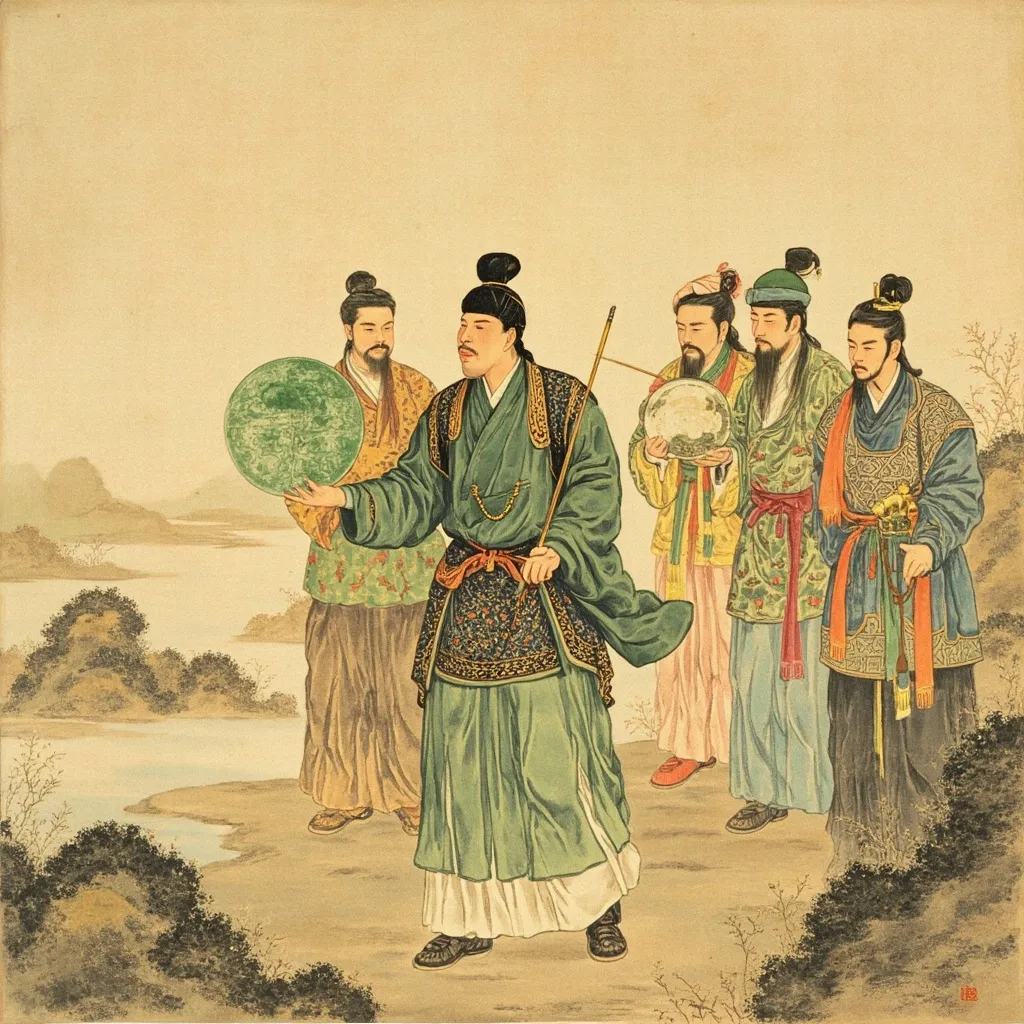
slug: “returning-jade-intact-zhao-wanbi-guizhao” description: “Learn the inspiring story behind 完璧归赵 (wánbì guī zhào) - how Lin Xiangru outwitted the powerful Qin state to protect Zhao’s most precious treasure and national dignity.” keywords: “完璧归赵, Chinese idiom, Lin Xiangru, jade, Zhao kingdom, Qin dynasty, ancient China diplomacy, Chinese idiom story” author: “Cultural Tales Studio” category: “Chinese Idioms” tags: [“Chinese idioms”, “Warring States”, “diplomacy”, “national dignity”, “idiom stories”, “resourcefulness”] image: “/images/returning-jade-zhao.jpg” affiliate_products:
- “Chinese Jade Collection Guide”
- “Warring States Diplomacy History Book”
- “Traditional Chinese Silk Pouch”
- “Ancient Chinese Coins Replica Set”
- “Classic Chinese Diplomatic Strategies” categories: [Traditional Crafts] alt_text: “Illustration depicting returning jade intact to zhao, in a traditional Chinese cultural setting”—
Returning Jade Intact to Zhao: The Clever Mission That Saved a Kingdom’s Honor
There’s something about a precious object that brings out the best and worst in people. Put a stunning gem in front of rulers, and suddenly everyone remembers their honor, their dignity, their ancestral claims. That’s exactly what happened over two thousand years ago, when a piece of jade became the center of an international incident — and gave the world an idiom that still rolls off Chinese tongues whenever something is returned in perfect condition.
完璧归赵 — wánbì guī zhào — means returning something intact to its rightful owner. But peel back those three syllables and you’ll find one of the most nail-biting diplomatic standoffs in ancient Chinese history, a story of quick thinking, genuine courage, and a kingdom that refused to be humiliated.
The Jade That Was Worth a Kingdom
Let’s set the scene. It’s around 283 BCE, and the Zhao state is in a tricky position. Qin is rising aggressively to the west, swallowing smaller states and building toward eventual domination. Zhao isn’t small — it has military strength and cultural prestige — but it’s caught between powers and knows it can’t win a direct confrontation with Qin.
Into this tense atmosphere comes a treasure: the Heshibi, a legendary piece of jadeite considered one of the most beautiful objects in the ancient Chinese world. This wasn’t just a pretty stone. In the political language of the era, holding precious objects of cultural significance conferred legitimacy and prestige. The Heshibi was a symbol of Zhao’s heritage, its refinement, its claim to cultural importance.
King Zhao had acquired the jade through difficult diplomatic maneuvering, and he guarded it carefully. But word travels fast, especially when something valuable is at stake. King Qin — the ruler of that ambitious western state — heard about the Heshibi and immediately sent envoys to Zhao with an offer: he wanted to buy the jade.
Now, everyone understood what this really meant. Qin wasn’t making a commercial transaction. They were testing Zhao’s resolve, and possibly looking for an excuse to start a conflict. If Zhao refused, Qin might use that as justification for military action. If Zhao accepted, they’d be giving up a priceless national treasure and appearing weak in the process.
King Zhao was caught between a rock and a hard place. He needed a solution that would preserve both the jade and the kingdom’s honor.
That’s when someone recommended Lin Xiangru.
The Man Who Stepped Into the Fire
Lin Xiangru wasn’t a famous general or a high-ranking noble. He was a scholar-diplomat with a sharp mind and sharper instincts. What he lacked in political standing he made up for in courage and cunning — qualities that would prove essential in the mission ahead.
When King Zhao explained the situation, Lin Xiangru didn’t hesitate. He would go to Qin, negotiate, and do whatever was necessary to return the jade to Zhao — or destroy it rather than let it fall into Qin’s hands as a trophy of humiliation.
The King’s response? Relief mixed with disbelief. Here was a man volunteering for an almost certainly fatal mission, carrying the most valuable object in the kingdom, walking into the court of its greatest adversary. Lin Xiangru’s eyes were steady. He had studied the situation. He believed he could pull this off.
What followed was a masterclass in strategic improvisation.
Outwitting the Tiger
Lin Xiangru arrived at Qin’s court carrying the Heshibi in a carefully secured case. He presented himself with the formal dignity expected of a diplomatic envoy, and he began what should have been straightforward negotiations: Qin would offer fifteen cities in exchange for the jade.
But King Qin wasn’t planning to honor any agreement. He was playing a game — accepting the jade while never intending to deliver the cities. To him, the Heshibi was already Qin’s, and the “negotiation” was merely theater to legitimize taking it without appearing as an aggressor.
Lin Xiangru watched this performance and understood immediately what was happening. He wasn’t dealing with a genuine negotiator. He was dealing with a thief in royal clothing.
Now, here’s where Lin Xiangru’s brilliance shines. Rather than making accusations that would get him killed, rather than surrendering the jade and hoping for the best, he devised a plan that would become legendary.
He approached King Qin with a complaint — the jade had a flaw, he said. A tiny imperfection that only someone of Qin’s refined taste would notice. He asked permission to show the King exactly where the flaw was, and as he held the jade, he began to describe it in detail.
Then, in a move that must have made every Qin guard in the room reach for their weapon, Lin Xiangru held the jade above the table and announced that if Qin didn’t honor the agreed exchange, he would dash the Heshibi against the stone floor.
The room went silent. King Qin stared at this foreign diplomat holding his kingdom’s most coveted treasure above a hard surface. He saw no bluff in Lin Xiangru’s eyes. This man was genuinely prepared to destroy what he had come to protect rather than surrender it to deception.
For a long moment, no one moved.
The Retreat That Wasn’t a Retreat
King Qin, to his credit, recognized when he’d been outmaneuvered. He couldn’t very well seize the jade by force — that would confirm everything Zhao had suspected about Qin’s bad faith, and it would give Lin Xiangru’s companions (who were waiting nearby with backup plans) the signal to destroy the jade. Qin also couldn’t kill Lin Xiangru on the spot without losing all pretense of diplomatic legitimacy.
So Qin did what powerful people do when they’ve been outsmarted: he pretended he had planned to honor the agreement all along. He ordered his officials to prepare the fifteen cities for transfer — a theatrical performance that Lin Xiangru saw through completely.
But Lin Xiangru wasn’t finished. While Qin’s officials made their show of preparing the cities, Lin Xiangru arranged for the jade to be smuggled back to Zhao under cover of darkness. He sent it ahead with trusted associates, ensuring that even if Qin changed his mind the next morning, the Heshibi would be safely home.
When morning came and Qin realized the jade was gone, Lin Xiangru was already gone too — having used the night to make good his escape with the help of Zhao’s network. Qin was left holding nothing but an empty diplomatic promise and the realization that they had been outplayed by a scholar-diplomat they had underestimated.
Why This Story Still Matters
The phrase 完璧归赵 has stuck around for over two millennia because it captures something universally true: the deep satisfaction of seeing something valuable returned to its rightful place, undamaged and uncompromised.
In modern Chinese usage, you’ll hear this phrase in contexts ranging from the mundane to the profound. A colleague might use it when returning a borrowed book in perfect condition. A businessperson might use it when completing a contract exactly as promised. But beneath these everyday uses lies the original story’s weight — the recognition that what Lin Xiangru did wasn’t just returning an object. It was defending his kingdom’s honor against a much more powerful adversary using nothing but intelligence, preparation, and courage.
The story also speaks to something about the relationship between the small and the mighty. Qin was immeasurably more powerful than Zhao in military terms. But in this encounter, power wasn’t enough. Lin Xiangru won because he understood his opponent, prepared for multiple scenarios, and refused to accept a frame that would have put him at a permanent disadvantage.
There’s a lesson here for anyone who has ever felt outmatched. Lin Xiangru didn’t win because he had more resources. He won because he thought more clearly, prepared more thoroughly, and refused to be intimidated by superior strength. This is the essence of what Chinese strategists called “using the enemy’s force against them” — finding the gap between what your adversary expects and what actually happens, and exploiting that gap with speed and conviction.
The Courage to Walk Into Danger
What strikes me most about Lin Xiangru’s story is that he could have refused the mission. King Zhao didn’t order him to go — he volunteered. He looked at a task that most sensible people would have declined, weighed the risks against the alternatives, and decided that someone had to do it. That kind of moral courage is rarer than we might think.
We often think of courage as physical bravery — the willingness to face physical danger. But Lin Xiangru’s courage was different. He was walking into a court where he could be killed, where the rules of diplomatic immunity might not protect him, where one wrong word could mean his death. And he went anyway, because the alternative — watching his kingdom be humiliated — was unacceptable.
This is what philosophers call “moral courage” — the willingness to accept personal risk for the sake of something larger than yourself. It’s the kind of courage that changes history, because it’s the kind that most people don’t have. Most people, when faced with a dangerous situation, look for ways to avoid it. Lin Xiangru looked for ways to navigate it.
The result was a diplomatic victory that no amount of military force could have achieved. Qin had superior armies, greater resources, and more political leverage. But Lin Xiangru found a way to win that didn’t require any of those advantages — he used his mind, his nerve, and his absolute refusal to be intimidated.
This is why the idiom has endured for over two millennia. It represents the possibility that intelligence and courage can overcome raw power, that the underdog can win if they’re willing to think more clearly than their opponent. That’s a hopeful message in any era.
A Legacy That Endures
King Zhao never forgot what Lin Xiangru had done. The man who had walked into the dragon’s den and walked out with his kingdom’s treasure — and his life — was promoted and honored. Lin Xiangru became one of Zhao’s most trusted advisors, a position he used to advocate for policies that strengthened the state against future threats.
The jade itself? It continued its journey through Chinese history, becoming a symbol of cultural continuity and the belief that some things are worth protecting at any cost. The Heshibi eventually found its way into the imperial collection, where it remained for centuries as a reminder of what a clever diplomat once saved from Qin’s grasp.
Today, visitors to museums in Beijing can still see pieces of jade that carry the weight of stories like this one — stories of resourcefulness, courage, and the refusal to be humiliated even when facing overwhelming power.
The next time you return something borrowed in perfect condition, remember Lin Xiangru. Remember the pressure he was under, the stakes he faced, and the calm brilliance with which he protected what he had been entrusted to defend. That’s the spirit behind 完璧归赵 — not just returning something intact, but doing so in a way that honors the trust placed in you.
Continue Exploring Chinese Cultural Treasures
The story of Lin Xiangru and the Heshibi is just one of many fascinating episodes in Chinese history where wit, courage, and cultural pride shaped the fate of nations. The following resources offer deeper ways to engage with the world of ancient Chinese diplomacy, jade, and the values that defined an era.
Recommended Reading and Tools:
Chinese Jade Collection Guide — Explore the cultural significance of jade in Chinese history, from ritual objects to imperial treasures. This comprehensive guide features detailed photography and historical context for understanding why jade was worth kingdoms.
Warring States Diplomacy History Book — The period when Lin Xiangru lived was one of the most diplomatically complex in Chinese history. This book examines the strategies, alliances, and individual figures who shaped the era’s outcomes.
Traditional Chinese Silk Pouch — Perfect for safely storing precious items the traditional way, these handcrafted silk pouches echo the careful handling that Lin Xiangru would have used when transporting the Heshibi across enemy territory.
Ancient Chinese Coins Replica Set — Currency and precious objects were central to ancient diplomacy. This replica set lets you handle the actual forms of wealth that changed hands in negotiations between states like Zhao and Qin.
Classic Chinese Diplomatic Strategies — Lin Xiangru’s success wasn’t accidental — it was built on generations of strategic thinking. This collection presents the foundational texts on Chinese diplomatic theory and practice.
This idiom story is part of our continuing series on Chinese idioms and the historical moments that created them. Each story offers not just linguistic insight, but genuine wisdom for navigating the complexities of power, honor, and human relationships.