Romance of the Three Kingdoms: China’s Epic Tale of Heroes and Ambition
The Peach Garden Oath has become one of the most famous episodes in Chinese literature. In the spring of 184 CE, three men met in a peach garden,发誓 — swore an oath before heaven and earth — that they would become brothers, devoted to the same cause and willing to die for each other. Their names were Liu Bei, Guan Yu, and Zhang Fei, and their story would eventually become the most beloved historical narrative in Chinese culture, told and retold for over a thousand years in plays, novels, operas, paintings, and video games.
The Romance of the Three Kingdoms, the fourteenth-century novel that transformed this period of chaos and conflict into epic art, isn’t merely a war story. It’s a meditation on loyalty, ambition, betrayal, and the gap between ideals and reality. Readers encounter characters who embody virtues and flaws in larger-than-life proportions, situations that test those qualities to the breaking point, and a narrative arc that spans decades and generations. The novel has shaped Chinese conceptions of leadership, friendship, and honor in ways that still resonate in modern business culture, martial arts films, and everyday conversation.
Understanding the Three Kingdoms story means understanding both the historical events that inspired it and the literary genius that transformed those events into enduring mythology. The real history is fascinating enough — a century of warfare, diplomacy, and shifting alliances involving figures who shaped the future of China. But the novel elevates this material into something that transcends mere history, creating characters who have become cultural archetypes recognizable across East Asia and increasingly, around the world.
The World of the Three Kingdoms: How an Empire Fell
To understand why the Three Kingdoms period arose, you need to understand what came before. The later Han Dynasty, which had ruled China for nearly four centuries, was rotting from within by the second century CE. Emperors came to the throne young and died young, leaving power in the hands of court eunuchs and ambitious officials who fought each other for control while neglecting the empire’s problems.
The situation grew desperate in the 180s when massive rebellions erupted across China. The Yellow Turban Rebellion, led by a Taoist prophet named Zhang Jue, mobilized hundreds of thousands of peasants who believed that the Han Dynasty had lost the “mandate of heaven” to rule. Though the rebellion was eventually suppressed, it demonstrated how fragile imperial control had become. Local governors, given emergency powers to suppress the revolt, found themselves controlling armies and territories that made them effectively independent of central authority.
Into this chaos stepped the figures who would dominate the next half-century. Cao Cao, the most capable military commander of the era, rose from relatively modest origins to become the power behind the Han throne. He was brilliant, ruthless, and utterly pragmatic — a man who famously declared that he would rather betray the world than let the world betray him. His control of the emperor allowed him to legitimize his campaigns against rival warlords, though his ultimate ambition was always a matter of debate among contemporaries and historians alike.
Liu Bei presented a stark contrast. Claiming descent from the imperial Liu family, he had none of Cao Cao’s advantages — no family connections, no trained army, no wealthy territory. Yet he possessed something perhaps more valuable: a reputation for righteousness and a remarkable ability to attract loyal followers. His early career was marked by defeats and exiles, but he never abandoned his cause or his brothers. The novel would portray him as the rightful heir to the Han, a benevolent ruler whose virtue attracted the greatest talents of the age.
The Brotherhood: Liu Bei, Guan Yu, and Zhang Fei
The Peach Garden Oath that opened this article represents the novel’s ideal of sworn brotherhood — complete loyalty, mutual support, and willingness to sacrifice everything for the others. This ideal of brotherhood among warriors became one of the most influential concepts in Chinese culture, shaping expectations about male friendship, martial honor, and the proper relationship between leader and followers.
Guan Yu, whose name would become synonymous with loyalty, emerges from the novel as perhaps its most compelling figure. Tall, with a magnificent beard and wielding the legendary Green Dragon Crescent Blade, he was the ideal of warrior virtue. His capture by the rival warlord Cao Cao presented a test of character that he passed with flying colors. Cao Cao, admiring his talents, offered him wealth, titles, and honors. Guan Yu accepted these things but remained loyal to Liu Bei, eventually making his way back to his sworn brother despite having every reason to stay with his generous captor.
The novel recounts numerous episodes that showcase Guan Yu’s righteousness. When a local official tried to assassinate him by serving poisoned wine at a banquet, Guan Yu reportedly detected the plot and drank the wine anyway, showing that he was not afraid of death and would not suspect a friend. His military achievements were equally legendary — he slew several of Cao Cao’s best generals in single combat and performed such feats as crossing five passes and slaying six generals to rescue his sworn brother from danger.
Zhang Fei, the third brother, presents a different character type. Where Guan Yu was composed and dignified, Zhang Fei was hot-tempered and impulsive. He is famous both for his martial prowess (he reportedly could fight off a hundred enemies with his twin serpent spears) and for his tactical blunders. The novel uses his character to illustrate the importance of wisdom alongside courage — Zhang Fei’s impulsive decisions frequently created problems that required clever solutions from his brothers or their advisors.
Together, the three brothers represent different aspects of the ideal warrior: Liu Bei’s virtue and moral authority, Guan Yu’s loyalty and martial prowess, Zhang Fei’s fierce courage and energy. Their combination, along with their growing circle of followers, would eventually establish the Shu Kingdom in competition with Cao Cao’s Wei and Sun Quan’s Wu.
The Sleeping Dragon: Zhuge Liang and the Art of Strategy
No character in the Romance of the Three Kingdoms has captured the Chinese imagination more completely than Zhuge Liang, known also as Kongming. The novel presents him as the greatest strategic mind of the age — a scholar-recluse who left his mountain retreat to serve Liu Bei and immediately demonstrated his genius in a series of dazzling victories that established the Shu Kingdom.
The famous “Longzhong” meeting, where Zhuge Liang first laid out his strategy for establishing Liu Bei’s power, has become one of the foundational texts of Chinese strategic thinking. In this episode, the sleeping dragon (a reference to his earlier隐居 lifestyle) revealed his understanding of the political landscape: Cao Cao had overwhelming force but lacked popular support; Sun Quan’s Jiangnan territories were strong but limited; only Liu Bei had both the moral claim to restore the Han and access to the strategic resources of Sichuan and Hubei. The plan Zhuge Liang outlined — establish a Shu base in Sichuan, ally with Wu against Wei, and eventually restore the Han by conquering the north — guided Shu policy for decades.
Zhuge Liang’s famous tactics illustrate the novel’s interest in cunning as much as courage. The “empty fort” strategy, in which Zhuge Liang allegedly convinced an enemy general that a city was bristling with soldiers when it was actually defenseless, has entered the global lexicon as an example of psychological warfare at its finest. The story has been told and retold so many times that it has become a kind of archetype — the weak appearing strong through pure audacity and clever misdirection.
Yet Zhuge Liang’s story in the novel is ultimately a tragic one. His loyalty to Liu Bei’s dying request to restore the Han led him to launch a series of campaigns against the numerically superior Wei forces. Though he achieved tactical victories through superior strategy, the cumulative toll was devastating. He exhausted Shu’s resources and his own health in campaigns that could never succeed given the underlying imbalance of strength. The famous “Vegetables of the Ladle” episode, where he reportedly made a fans from ladle-blades for a southern tribe that had submitted, shows both his inventive genius and his attention to the practical needs of his troops.
His death, in 234 CE, reportedly occurred at the battle of Wuzhang Plains after he had manipulated the weather to create an advantageous situation, only to see his health fail at the critical moment. The novel describes his final moments with extraordinary power — a great mind flickering out, leaving behind a legacy of service and sacrifice that would inspire generations of Chinese readers.
Battles and Betrayals: The Novel’s Most Dramatic Moments
The Romance of the Three Kingdoms contains dozens of major battles, sieges, and campaigns, each with its own drama and strategic significance. Yet certain episodes stand out as particularly representative of the novel’s themes and have become cultural reference points in their own right.
The Battle of Red Cliffs, which occurred in 208 CE, represents the novel’s dramatic peak. Cao Cao had unified northern China and possessed overwhelming military superiority as he marched south to destroy the southern kingdoms and reunite the empire. His forces numbered in the hundreds of thousands, while Liu Bei and Sun Quan together could muster perhaps fifty thousand. The novel presents this as a contest between overwhelming force and superior cunning.
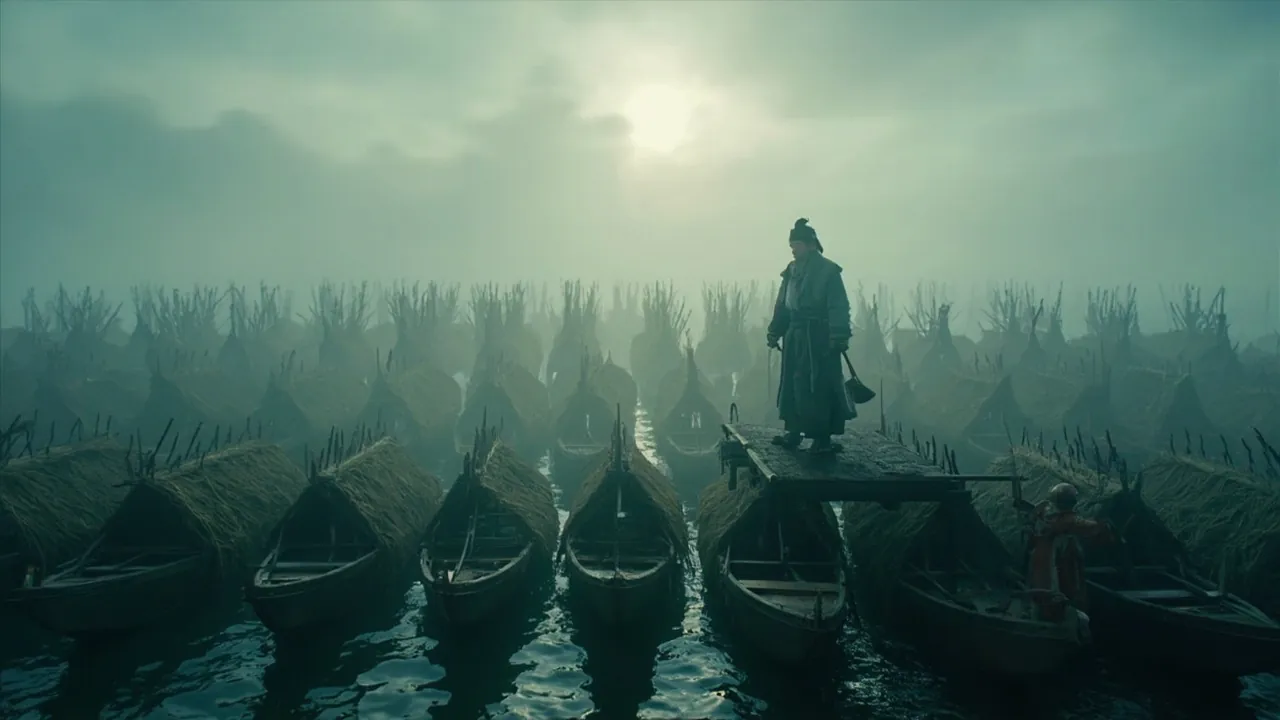
The allied victory at Red Cliffs required cooperation between Liu Bei’s forces and Sun Quan’s navy, despite considerable mutual suspicion. The turning point came when Cao Cao’s forces were devastated by fire attacks launched against ships that had been lashed together — an echo of an ancient naval tactic. The novel tells this story with enormous verve, including romanticized episodes like Zhou Yu’s meeting with Cao Cao (when the latter was disguised) and Huang Gai’s feigned defection to get close enough to launch the fire ships.
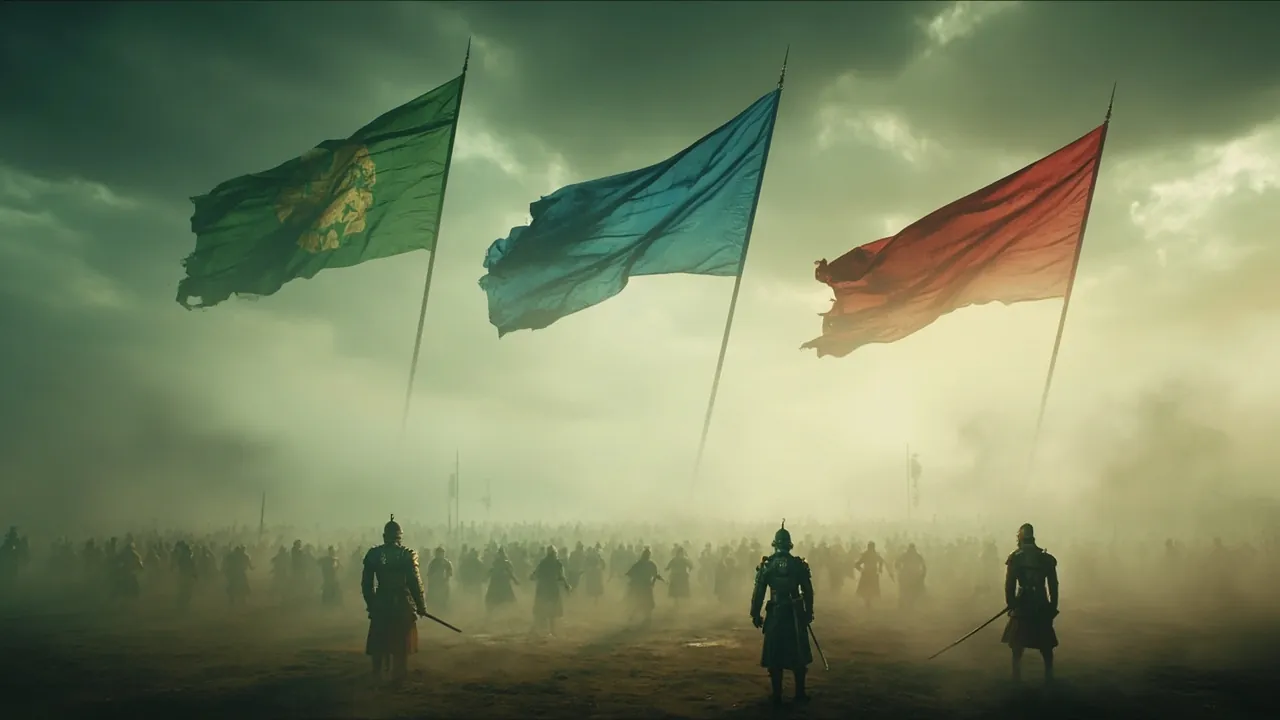
The aftermath of Red Cliffs saw the emergence of three separate kingdoms from the wreckage of Han unity. Cao Cao’s state of Wei controlled the north, Liu Bei’s Shu held Sichuan and parts of Hubei, and Sun Quan’s Wu ruled the southeastern coast and much of the Yangtze River valley. This tripartite division would persist for nearly a century, producing its own dramas of alliance, betrayal, and conflict.
Betrayal runs through the Three Kingdoms narrative like a dark thread. The novel’s moral framework treats betrayal with particular horror, and characters who break oaths or switch sides face condemnation even when their actions prove strategically necessary. Lü Bu, the era’s greatest warrior, is also its most notorious traitor — he served and betrayed multiple masters, eventually earning a reputation that made him unemployable. Cao Cao himself, despite his many crimes in the novel, at least maintains a kind of consistency in his ruthlessness, unlike those who claimed virtue while acting basely.
The Three Kingdoms Legacy: How an Ancient Period Shaped Modern Culture
The Romance of the Three Kingdoms has had a cultural influence in China and East Asia comparable to that of the Iliad and Odyssey in the Western tradition. The novel’s characters have become archetypes — the virtuous but doomed leader, the loyal warrior, the cunning strategist, the ambitious betrayer — whose stories inform everything from business negotiations to martial arts training to video game design.
In Japan, the story is known as Sangokushi and has generated an enormous media franchise, including the long-running Romance of the Three Kingdoms strategy game series that has sold millions of copies worldwide. Korean culture similarly embraces the Three Kingdoms narrative, and Vietnamese literature and art have drawn heavily on the period. The cultural reach extends across Asia and increasingly into Western consciousness as global interest in Asian culture continues to grow.
The novel’s influence on Chinese business culture deserves particular note. The strategic thinking exemplified by Zhuge Liang and other characters has been applied to modern business competition, and the novel is often cited in management literature as a source of insights about leadership, team-building, and competitive strategy. Sun Tzu’s Art of War gets more academic attention, but the Three Kingdoms provides a richer narrative context for understanding strategic principles in action.
Martial arts traditions also claim deep connections to the Three Kingdoms period. The legendary weapons of Guan Yu and other heroes — the Green Dragon Crescent Blade, the twin serpent spears — have become associated with specific martial arts styles. Training halls across China and East Asia display images of Three Kingdoms heroes, and practitioners see themselves as inheritors of their martial tradition.
Perhaps most remarkably, the Romance of the Three Kingdoms continues to generate new adaptations in every medium. Television dramas, films, video games, comic books, and even pop music reference the characters and episodes of this ancient story. Each generation finds new relevance in the old tales — the loyalty of Guan Yu speaks to modern concerns about trustworthiness in business, while the tragic figure of Zhuge Liang resonates with anyone who has worked tirelessly for an impossible cause.
Recommended Reading and Study Resources
If you’re interested in exploring the Romance of the Three Kingdoms further, these resources offer valuable entry points:
“Romance of the Three Kingdoms” translated by C.H. Brewitt-Taylor — The classic English translation of Luo Guanzhong’s fourteenth-century novel, capturing the narrative sweep and character development that have made this work enduringly popular.
“The Three Kingdoms” historical account by Chen Shou — The historical source on which the novel was based, offering a more factual account of the period’s events and figures for readers interested in what actually happened.
“The Art of War for Executives” by Yu M. Zou — An insightful analysis of Three Kingdoms strategy as applied to modern business and leadership challenges.
Affiliate Product Recommendations
Looking to explore the world of Three Kingdoms more deeply? These products can support your journey:
Romance of the Three Kingdoms - Complete Annotated Edition — The full novel with extensive footnotes and historical commentary, making the complex narrative accessible to modern readers while providing context about what historical sources say versus what the novel invented.
Authentic Replica Green Dragon Crescent Blade — Hand-forged replica of Guan Yu’s legendary weapon, crafted using traditional Chinese metallurgy techniques. Each blade comes with a certificate of authenticity and historical information about the weapon’s significance in Three Kingdoms lore.
Three Kingdoms Strategy Board Game Collection — A series of historically themed strategy games based on key battles and campaigns from the Three Kingdoms period. Players experience the strategic challenges faced by Liu Bei, Cao Cao, and Sun Quan as they fought for control of China.
Three Kingdoms Art Collection - Traditional Chinese Paintings — A curated set of high-quality reproductions of traditional Chinese paintings depicting famous scenes from the Three Kingdoms narrative, including the Peach Garden Oath, Red Cliffs, and Zhuge Liang’s bamboo grove retreat.
Historical Documentary: The Three Kingdoms Period — A comprehensive documentary series exploring the real history behind the novel, featuring archaeological evidence, historical analysis, and expert commentary on how history became mythology.
This article is part of our series exploring the foundational narratives and cultural touchstones of Chinese civilization.