The Discovery That Changed Everything
In 1929, a farmer in Sichuan Province was digging a water well. His shovel hit something hard. He thought it was a stone. What he actually found was the edge of one of the most mysterious and visually stunning archaeological discoveries of the 20th century — and most Americans have never heard of it.
The site is called Sanxingdui — Three Star Mounds — named after three earthen hills near the Jinsha River in what is now the city of Guanghan, about 40 kilometers from Chengdu. Over the past ninety years, excavations at Sanxingdui have produced thousands of bronze, jade, gold, and ceramic artifacts that have forced historians to fundamentally reconsider what they thought they knew about ancient China.
The artifacts are unlike anything else in Chinese archaeology. There are bronze masks with enormous exaggerated eyes. There are life-sized bronze human figures with jade hands. There are bronze trees over four meters tall. There are gold scepters and geometrically precise jade tablets. The artistic style is entirely its own — not quite Shang Dynasty, not quite anything else.
The site was first identified in 1929 when a local farmer named Yan Lianhe was digging a well and struck a cache of jade pieces. He sold them to a nearby古董商 (antique dealer), who in turn sold them to dealers in Chengdu and eventually Beijing. For nearly a decade, artifacts from the site circulated on the black market before anyone understood what they were looking at. This is why the first serious academic investigation didn’t begin until 1961, when the Sichuan Provincial Museum conducted a preliminary survey. The Cultural Revolution interrupted all further work — archaeology was not a priority during the political chaos of 1966–1976.
The real breakthrough came in 1986, when local construction workers accidentally discovered two large pits (now designated Pits 1 and 2) while building a factory. The pits contained the first massive bronze sculptures — including the now-iconic Standing Figure and the bronze tree — that shocked the archaeological world. These two pits alone produced over 400 bronze objects, 122 jade pieces, and dozens of gold and ivory artifacts. The 1986 discovery is what put Sanxingdui on the international archaeological map, and the Expressive Bronze Mask became the symbol of the site almost immediately — its 16-centimeter protruding eyes photographed and reproduced countless times.
Then came a long silence. Pits 1 and 2 were excavated and the artifacts went to the museum, but no one could explain who these people were or where they came from. The academic consensus was essentially: “We don’t know.”
The next shock came in 2019, when systematic radar surveys detected anomalies beneath the undisturbed earth between Pits 1 and 2 and the river. Excavation began in 2019 and continued through 2020, producing six new sacrificial pits (numbered 3 through 8). These pits have already yielded thousands of new pieces — including the partial gold mask that created headlines worldwide in 2021 when it was painstakingly cleaned and displayed. More significantly, the new pits have produced organic material (bamboo, wood, textiles, lacquer) that can be radiocarbon dated, giving archaeologists their first reliable absolute dates for the site’s occupation. The current best estimate places Sanxingdui’s primary occupation phase at 1131–2962 BCE — earlier than the mature Shang Dynasty but overlapping with its earlier phases.
For American visitors, there’s an interesting resonance: Sanxingdui existed at roughly the same time as the Mycenaean civilization in Greece, the New Kingdom of Egypt, and the Indus Valley civilization. It was contemporary with the Late Bronze Age in the Mediterranean. The fact that it is so unknown in Western education is a testament to how centered our historical narrative is on the Mediterranean and Near East — not because nothing important was happening in Asia.
The Artifacts — What Was Found
The Bronze Masks
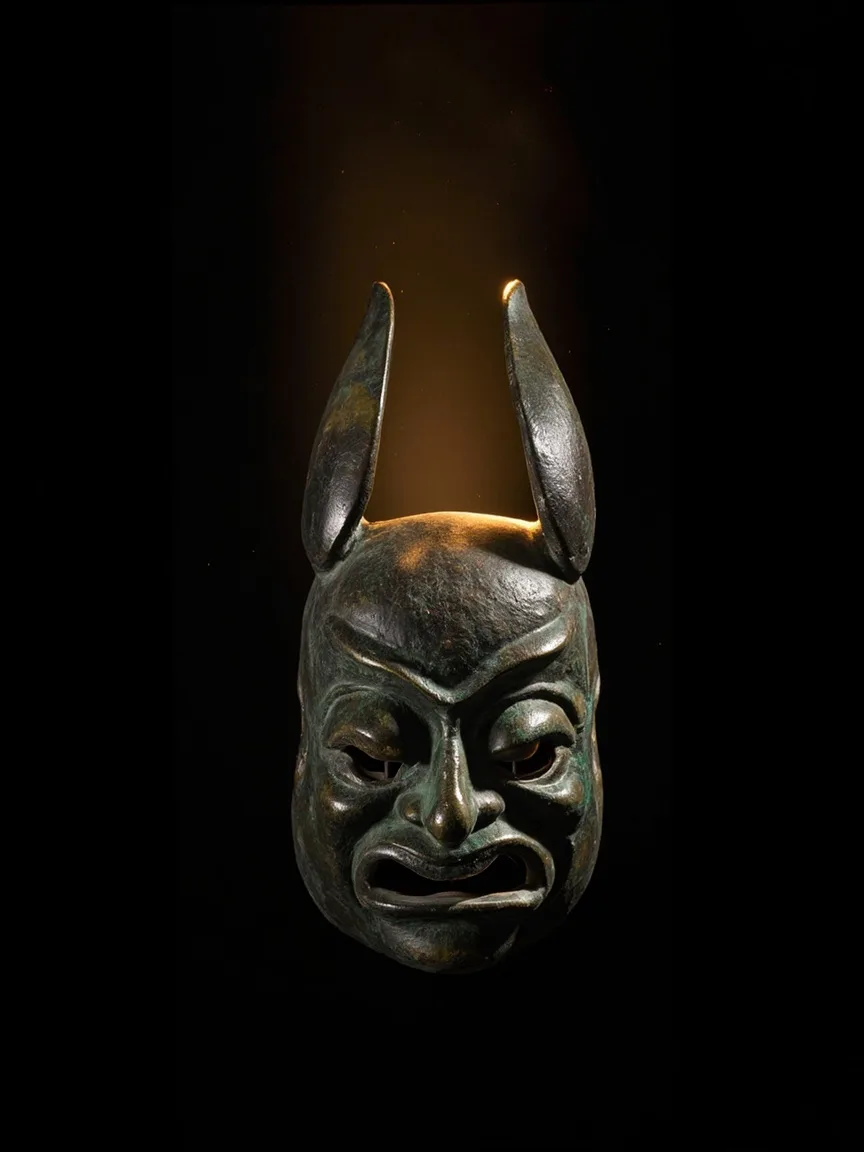
The bronze masks are what put Sanxingdui on the map. They range from the size of a human face to masks over a meter wide. The most iconic have two enormous protruding eyeballs — extending outward as much as 16 centimeters — and pupils that appear to look in different directions. The effect is deeply unsettling in a way that ancient art rarely achieves.
Archaeologists believe these masks were used in ancestor worship rituals. The exaggerated features may represent shamans in trance states, or the faces of deities. The masks were found in two sacred pits — Pits 1 and 2 — along with other ritually “killed” objects (deliberately smashed before burial so the spirits could not be used by the living).
The mask that has become the symbol of Sanxingdui is the “Expressive Bronze Mask” — formally known as Taotie Mask No. 1 — which features the most extreme protrusion of the eyes. It is displayed in a climate-controlled case in the new museum, lit dramatically from below so the eyes seem to follow you across the room. Standing in front of it, you understand immediately why the museum describes it as “the most mysterious face in ancient China.”
The Standing Figures and Sacred Trees
The full-size bronze human figures are equally extraordinary. The largest stands 2.62 meters tall — almost nine feet — and wears an elaborate robe with a dragon motif. It has hollow arms and hands designed to hold objects. This figure was likely a depiction of a king or high priest performing a ritual. The figure’s expression — serene, watchful, with hands frozen mid-gesture — creates an uncanny sense of presence. Standing next to it, you feel like you’re in the presence of someone who is looking back.
What’s remarkable about the bronze casting technique used for these figures is that they were made in sections — the head, torso, arms, and legs were cast separately using a piece-mold technique, then assembled. This is a sophisticated metallurgical process that indicates a highly organized workshop with specialized craftspeople. The precision of the joinery is remarkable — the seams between cast sections are barely visible.
Also extraordinary are the bronze trees — the largest stands 3.96 meters tall with nine birds perched on its branches. The tree may represent a sacred world tree connecting the underworld, the earth, and the heavens — a common motif in ancient cultures across the world, from Norse Yggdrasil to Mesopotamian cosmic trees. The nine birds on the Sanxingdui tree may represent the nine levels of the Chinese underworld, or the nine stars of the Chinese constellation system. No definitive interpretation has been established. The bronze tree was found in fragments — it took archaeologists years to reconstruct it.
The Gold Scepter and Trade Connections
The gold scepter — 1.42 meters long — is one of the longest gold objects from the Bronze Age anywhere in the world. Also found were jade cong — ritual cylinders characteristic of the Liangzhu culture in eastern China, over 1,000 kilometers away. This suggests Sanxingdui was part of a much wider network of trade and cultural exchange than archaeologists initially suspected.
The jade in particular is significant. The Liangzhu culture around modern Shanghai and Hangzhou was famous for its jadeworking — the Liangzhu jade was considered the finest in prehistoric China. Finding Liangzhu jade at Sanxingdui means there was a trade route running roughly 1,200 kilometers from eastern China to Sichuan. That’s not casual exchange — that’s organized long-distance trade in luxury materials. Sanxingdui was not an isolated outpost. It was a sophisticated civilization connected to the wider world.
The Civilization Behind the Artifacts
The artifacts tell us something about the people who made them, but also leave enormous questions unanswered.
What language did they speak? Unknown. Sichuan in this period was not speaking the same language as the Shang court in Henan. Some scholars believe the Sanxingdui people may have been speakers of an early form of Tibeto-Burman language — related to modern Tibetan and Burmese — rather than the Sino-Tibetan languages that dominate China today. We have no texts from Sanxingdui that have been deciphered. The lack of deciphered text is significant — the Shang Dynasty left us tens of thousands of oracle bone inscriptions. Sanxingdui left nothing that we can read. We don’t know their names, their kings, their laws, or their myths in their own words.
What religion did they practice? The artifacts suggest a complex ritual system centered on ancestor worship, shamanic trances (the eye-mask motif), and possibly a sun deity represented by the bird-on-tree motif. But this is inference, not certainty. The masks’ enormous eyes may represent the ability to see between worlds — the living and the dead, the earthly and the divine.
What happened to them? Around 1200 BCE — roughly the same time the Shang Dynasty collapsed in the north — the Sanxingdui settlement was abandoned. The sacred pits were filled. The city was never rebuilt on the same site. No one knows why. Theories include catastrophic flooding (the Jinsha River has changed course multiple times), invasion (possibly from a competing culture to the south), pandemic, or simply migration of the population to integrate with the developing Shu Kingdom in the Chengdu Plain. What we do know is that whatever happened was sudden enough that they didn’t have time to retrieve their sacred objects — they were buried in pits, not stored. This suggests a crisis, not a planned departure.
The most recent theory, advanced by archaeologists working on the 2019-2020 excavations, is that Sanxingdui was not destroyed but rather that the civilization evolved and moved — that the Sanxingdui culture transformed into the Shu Kingdom that appears in later Chinese historical records. If correct, this means the Sanxingdui people didn’t disappear — they became part of the next chapter of Sichuan’s history.
The New Museum and Why It Matters
The Sanxingdui Museum, rebuilt and expanded in 2022, is one of the finest archaeological museums in the world. The original museum was too small to display the full collection — the new facility has 50,000 square meters of exhibition space, including a gallery for the famous “Expressive Bronze Mask” that is genuinely one of the most dramatic individual artifacts in global archaeology.
The museum’s design is extraordinary — the building looks like a series of stacked alien artifacts, and the interior uses dramatic lighting to highlight the bronze surfaces. Visiting is a genuinely awe-inspiring experience, the kind of museum that stays with you for years.
The museum is organized in roughly chronological order, starting with the earliest discoveries from the 1929 well and working up through the 1980s excavations and the most recent 2019-2020 finds. Allow at least 3 hours — the artifacts are so visually arresting that you’ll want to spend more time than you think. The second floor has a restoration laboratory visible through glass windows, where you can watch conservators cleaning and reconstructing newly excavated pieces in real time.
Practical details: Guanghan City, Sichuan Province, 40 km from Chengdu. Take the high-speed train from Chengdu East to Guanghan North (about 25 minutes), then a taxi to the museum (about 20 minutes, ¥30–40). Total journey about 90 minutes from central Chengdu. Tickets about $8–12 USD, bookable online with daily visitor caps. The main exhibition can be absorbed in 2–3 hours. The museum is closed on Mondays (except public holidays). Go early in the day — it gets crowded by midday. Book tickets at least a week in advance during Chinese public holidays.
Where to Stay in Chengdu: For visitors combining Chengdu with a Sanxingdui day trip, base yourself in the Chengdu Chengdu Hotel ($80–120/night) in the city center near Tianfu Square, or for luxury, the The St. Regis Chengdu ($180–250/night) near Chunxi Road shopping district with excellent service and English-speaking staff. The city of Chengdu itself is worth two full days — plan your trip around the city’s famous teahouse culture, the giant panda base, and the Jinli pedestrian street for evening food exploration before or after your Sanxingdui visit.
Why This Matters for Understanding China — and the World
Sanxingdui forces a fundamental rethinking of Chinese civilization’s origin story.
For much of the 20th century, Chinese archaeology focused on the Yellow River Valley — the “cradle of Chinese civilization” — and the Shang Dynasty, which we have written records from in the form of oracle bones. The assumption was that Chinese civilization spread outward from the Yellow River.
Sanxingdui demolishes that assumption. Here is a civilization of comparable sophistication — in bronze casting, in jade working, in religious ritual — that developed entirely independently in the Sichuan Basin, with art forms and religious practices that have no direct parallels in Shang culture.
Modern archaeologists now speak of a “pluralistic origin” for Chinese civilization — multiple regional cultures developing simultaneously across what is now China, all contributing to what eventually became “Chinese” culture. This is a more accurate and more interesting picture than the old “cradle” narrative.
For American visitors, there is a particular resonance in understanding Sanxingdui in a global context. Around 1300 BCE — when Sanxingdui was at its peak — the Eastern Mediterranean was in the Late Bronze Age collapse. Mycenaean Greece was falling. In Sichuan, a sophisticated civilization was making bronze masks with 16-centimeter protruding eyes and burying them in ritual pits along with four-meter-tall sacred trees. The lesson is simple: while European civilization was collapsing in the Bronze Age, China was generating entirely new civilizations in regions we are only beginning to understand.
There’s also something specifically American about the Sanxingdui experience. America loves the idea of frontier archaeology — the discovery that changes everything. The buried cities of the American Southwest, the unexpected findings beneath Manhattan. Sanxingdui is China doing the same thing — and it is happening right now, in front of visitors. The 2019-2020 excavation pits are still being processed. New artifacts are being catalogued. New theories are being published. You are not visiting a closed book — you’re watching the first pages being written.
Sanxingdui is not yet on the radar of most American travelers to China. The crowds that pack the Terracotta Warriors have not yet discovered it in the same numbers. The new museum is magnificent, the artifacts are genuinely world-class, and the site is an hour from Chengdu — one of China’s most comfortable and accessible cities.
Why This Matters for American Visitors: Sanxingdui resonates specifically with American cultural attitudes toward archaeology. The site has strong parallels with major American archaeological discoveries — the discovery of Machu Picchu by Hiram Bingham in 1911, the unearthing of the Pueblo Bonito ruins in New Mexico, the more recent LIDAR mapping discoveries in the jungles of Cambodia. Americans have a deep cultural fascination with the idea of an ancient civilization hiding in plain sight, discovered by accident, rewriting everything historians thought they knew. Sanxingdui is China doing exactly this — and it is happening right now. The 2019–2020 excavation pits are still being processed. New artifacts are being catalogued weekly. New theories are being published. You are not visiting a closed book — you’re watching the first pages being written in real time.
There is also a specific Sichuan-connection to American food culture worth noting. The Sichuan pepper — the tongue-numbing spice that defines Sichuan cuisine — originated in the same region as Sanxingdui. The Sichuan Basin has been cultivating this distinctive spice for at least 2,000 years, based on current archaeological evidence. When you eat mapo tofu or dan dan noodles in an American Sichuan restaurant, you are tasting a flavor that has its deepest roots in the same civilization that created the bronze masks. Food and culture travel together, and the connection between Sanxingdui’s mysterious civilization and the flavors of modern Sichuan is one of those historical threads that makes travel to this region particularly satisfying.
If you have any interest in archaeology, ancient art, or the actual complexity of human civilization’s development, Sanxingdui is not just worth the detour. It is the reason you went to China in the first place — to encounter something that changes the story you thought you knew.