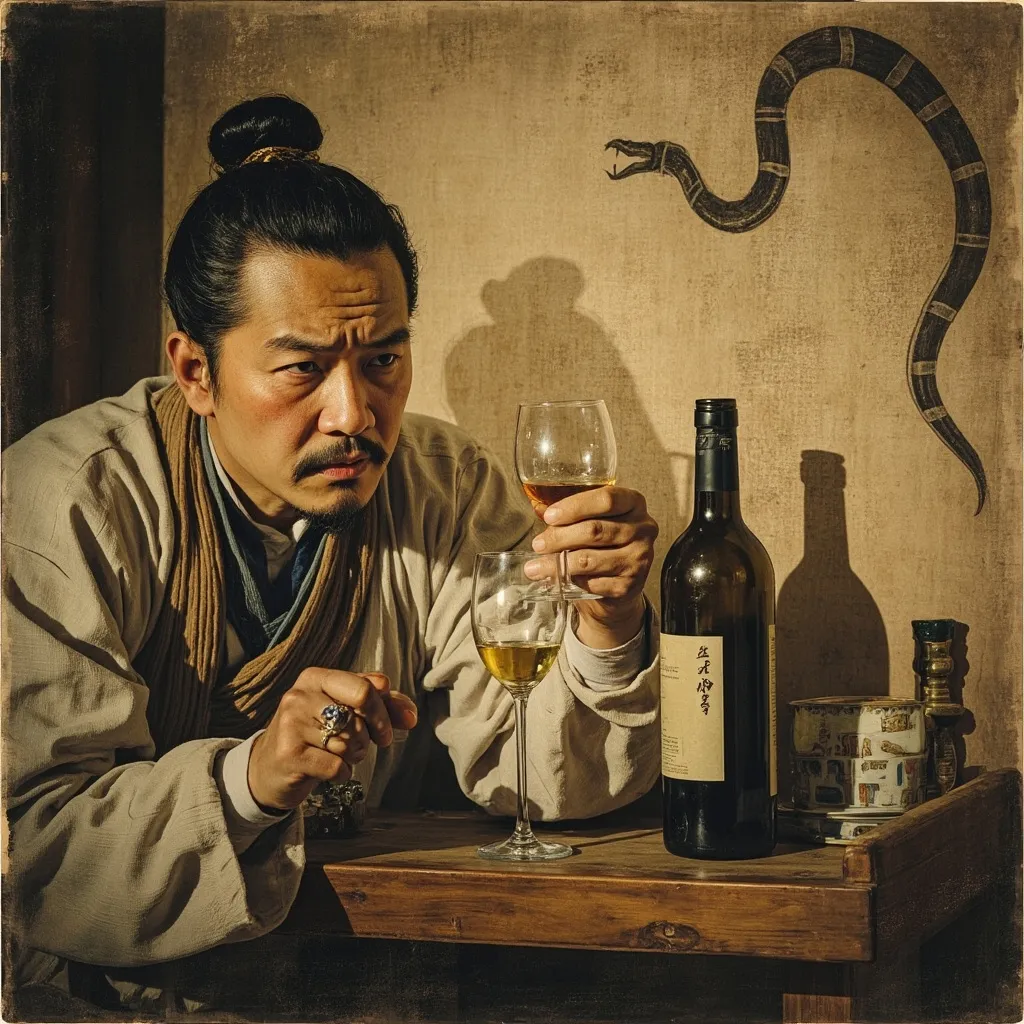
Imagine sitting down for a pleasant evening with friends, raising a cup of wine to your lips, and seeing something horrifying wriggling in your drink. Your stomach lurches. Your hand freezes mid-motion. You put the cup down, maybe spill some wine, and feel your heart racing as you stare at the surface of the liquid where you swear you saw movement. Now imagine being told later that what you saw wasn’t real — that the “snake” was actually just the reflection of a bow hanging on the wall behind you, curved and distorted through the wine in exactly the right way to look serpentine. That’s the situation at the heart of the Chinese idiom 杯弓蛇影 (bēi gōng shé yǐng), which translates to “seeing a bow in a cup as a snake.”
It’s a story that has resonated for nearly two thousand years because it speaks to something we all recognize in our own lives: the way fear can take hold of us even when there’s nothing to be afraid of, and how suspicion, once planted in the mind, is remarkably hard to shake. The snake you think you see doesn’t go away just because someone tells you it was never there. Your body already responded as if it were real. Your heart already raced. The fear is already real, even when the snake wasn’t.
The Original Story: A Dinner Gone Wrong
The tale comes from the Book of Jin (晋书), an official history of the Jin Dynasty compiled in the 7th century during the Tang Dynasty. The story centers on a man named Yue Guang, a prominent official known for his honesty, his fairness, and his level-headedness — exactly the kind of person you’d want making decisions in government. One day, he invited a friend named Du Zhou to his home for dinner. The two men sat across from each other at a low table, sharing wine and conversation in a relaxed setting typical of the era, surrounded by the comfortable furnishings of a scholar-official’s home.
At some point during the meal, Yue Guang noticed that Du Zhou seemed suddenly agitated. The guest’s face had gone pale, his hand trembled slightly as he held his cup, and he was staring at the wine with an expression of genuine horror. When Yue Guang asked what was wrong, Du Zhou pointed at something in his cup and said he’d seen a snake slithering inside the wine. Alarmed, Yue Guang looked at the cup himself and saw nothing unusual — just wine, clear and still. But Du Zhou was already in a state of distress, insisting he’d seen it clearly and demanding to know why his host would serve him wine with a snake in it.
Yue Guang examined the cup more carefully, looked around the room, and couldn’t find any explanation. He apologized, offered Du Zhou fresh wine in a clean cup, and tried to continue the meal, but the atmosphere was ruined. Du Zhou was clearly shaken and didn’t recover his composure for the rest of the evening. The dinner ended awkwardly, and Du Zhou left in a hurry, still looking rattled.
Over the following days, Du Zhou’s condition worsened rather than improved. He became feverish, lost his appetite entirely, and eventually took to his bed, seriously ill. Doctors were summoned but couldn’t identify what was wrong — there was no obvious infection, no visible wound, nothing they could point to and treat. Du Zhou just got sicker and sicker, and no one understood why.
Then one day, Yue Guang was visiting his sick friend and noticed something he’d overlooked before. Hanging on the wall directly behind the place where Du Zhou had been sitting at the dinner was a bow — a real weapon, the kind used for archery, its curved shape visible in the lamplight. Yue Guang looked at the bow, looked at the angle of the light, looked at where Du Zhou’s cup had been positioned, and suddenly understood. The curved bow, when reflected in certain angles through the wine in the cup, could indeed appear snakelike. The reflection moved slightly with the lamp’s flicker, which would explain why Du Zhou thought he saw it slithering.
Realizing what had happened, Yue Guang hurried to Du Zhou’s side with a theory. He asked Du Zhou to come back to his house and sit in the same spot. He placed a cup of wine in the same position, had Du Zhou look into it while the bow hung in the background exactly as it had before. This time, Du Zhou saw it — he watched the reflection appear and recognized it for what it was. The moment he understood the truth, the fear that had been eating at him for days evaporated. He recovered from his mysterious illness almost immediately, as if a switch had been flipped.
The Anatomy of Irrational Fear
What makes 杯弓蛇影 such a precise description of a certain kind of psychological experience? The key is that Du Zhou’s fear was not imaginary in the sense of being made up — he genuinely saw something frightening. His perception was real. The problem was that he misinterpreted what he was seeing. The input was accurate; the interpretation was wildly wrong. He wasn’t hallucinating — there really was a shape in the cup. It just wasn’t a snake.
This distinction matters enormously. We tend to think of fear as a response to real danger, and in most cases that’s true. If you see a snake in your wine, you should be afraid, because snakes in your wine are dangerous. But 杯弓蛇影 describes what happens when the fear response gets triggered by a false alarm — and more importantly, how that fear can become self-sustaining in ways that have nothing to do with the original stimulus.
Du Zhou wasn’t faking his distress. He was genuinely terrified, and that terror made him physically sick. The belief itself became the cause of suffering, independent of whether any actual threat existed. His fear didn’t just feel bad — it created real physiological consequences. He lost his appetite, developed a fever, became too weak to function. The snake in his mind was making him sick even though no snake had ever been there.
Modern psychology has many names for this phenomenon, though no single pithy phrase that captures it the way 杯弓蛇影 does. We talk about anxiety disorders, panic responses, psychosomatic illness, and the way cognitive distortions can create suffering out of thin air. But the Chinese idiom captures something those clinical terms often miss: the specificity of the original trigger, the way the mind can turn innocent shapes into threats, and above all, the remarkable fact that understanding the truth can instantly dissolve the fear. The story suggests that once you see the bow for what it is, you can’t un-see it — the snake interpretation simply becomes impossible going forward.
Why Suspicion Is Hard to Unlearn Once It Takes Root
There’s another layer to the story that often gets overlooked in casual usage of the idiom. When Du Zhou first reported seeing a snake, Yue Guang didn’t dismiss him or laugh at him. He looked in the cup, couldn’t see anything, and presumably wondered if his friend was joking or if he’d had too much wine or if something else was going on. The text doesn’t spell this out explicitly, but the dynamic suggests that Yue Guang took Du Zhou’s concern at least somewhat seriously — enough to investigate, enough to feel genuine concern for his friend’s sudden illness.
The interesting question is why Yue Guang didn’t figure out the bow explanation immediately, right there at the dinner. After all, he had the same view of the room, the same cup, the same lighting. The answer likely has to do with what cognitive scientists call confirmation bias today. Yue Guang wasn’t looking for a snake, so he didn’t see one. He looked at the cup, saw wine, and moved on, assuming his friend had been mistaken or joking. Du Zhou, having already seen something alarming, was primed to interpret ambiguous sensory data through the lens of that alarm. The shape in the cup became evidence of a snake rather than evidence of a reflection.
This is the real danger that 杯弓蛇影 warns us about: once suspicion takes root, it shapes how we perceive everything that follows. Du Zhou’s initial misinterpretation created a filter through which all subsequent information was processed. He wasn’t just scared of the snake he’d seen — he was scared of the possibility of snakes, of poisoned wine, of a world where such things could happen. That generalized fear state is what made him sick, not the specific visual stimulus. Even if there had been no bow, his hypervigilance would have found other threats to fixate on.
The Idiom in Modern Life: When We See Snakes Everywhere
You don’t have to look far to find contemporary examples of 杯弓蛇影 in action. The idiom shows up constantly in discussions about paranoia, anxiety, conspiracy thinking, and the way modern information environments can create and amplify false threats.
Consider social media, where a vague criticism can spiral into the belief that everyone is against you. Someone posts a slightly ambiguous comment about your work, and suddenly you’re convinced there’s a coordinated campaign to undermine you. You start examining everything through the lens of persecution — this person’s like is suspicious, that person’s comment has a hidden meaning, the algorithm is suppressing your posts. The original input may have been real — someone did say something critical — but the interpretation builds an elaborate threat narrative that has no basis in fact.
Workplace dynamics offer another fertile territory for this idiom. A colleague doesn’t respond to your email immediately, and you become convinced they’ve been turned against you, that there’s office politics at play, that your job is in danger. You start looking for evidence — the way they looked at you in the meeting, the project they didn’t invite you to, the lunch they had with your manager without telling you. Each ambiguous data point gets interpreted as confirmation of your suspicion. When you finally talk to them, it turns out they were just on vacation with their phone off. The snake in the cup was just a delayed response, and all your elaborate theories about betrayal were just shadows on the wall.
The idiom also applies powerfully to relationships, where small misunderstandings can compound into lasting suspicion that poisons trust. Your partner comes home late without texting, and you imagine all sorts of scenarios — infidelity, gambling debts, secret meetings with someone else. Some of those scenarios might be innocent: stuck in traffic, lost track of time, phone died. But if the suspicion takes hold before you know the truth, the emotional damage may already be done. You’ve already built a narrative in your head, and that narrative has already changed how you feel about your partner. The snake was never there, but your relationship is already hurting.
Learning to Recognize When You’re Seeing Snakes That Aren’t There
The wisdom of 杯弓蛇影 isn’t just “don’t be paranoid” — it’s a more specific invitation to examine the relationship between what we perceive and what actually exists. The story suggests that when we’re in a heightened emotional state, we should be especially cautious about trusting our interpretations of ambiguous situations.
This doesn’t mean dismissing your perceptions outright. Du Zhou genuinely saw something; he wasn’t making things up or seeking attention. But it means developing the habit of asking: Am I seeing reality clearly, or am I seeing my fears reflected back at me? Is this snake actually a snake, or is it a bow? Is the evidence I’m gathering real evidence, or am I just finding patterns that confirm what I already believe?
In practical terms, this might mean pausing before reacting to something alarming, especially if you’re already in a state of anxiety or stress. It might mean seeking a second opinion from someone not caught up in the same emotional weather — someone who can look at the cup without a snake already in their mind. It might mean simply waiting — giving the situation time to reveal its actual shape rather than projecting the worst interpretation onto ambiguous signals.
The other lesson is about the extraordinary power of disconfirmation. When Du Zhou finally understood what had really been in his cup, the fear didn’t linger, didn’t require therapy, didn’t need medication, didn’t take months to recover from. The snake vanished the moment the bow was revealed. This suggests that sometimes we’re more fragile than we realize — we can be made sick by shadows — but also more resilient than we know. The thing we feared turns out to have never been real, and we’re capable of recovering quickly once we see clearly. The question is whether we can give ourselves the chance to see clearly, or whether we’re too committed to the snake to consider the bow.
The Idiom’s Deeper Message About Trust and Community
Beyond the psychology of individual fear, 杯弓蛇影 carries a quiet but important message about trust — specifically, about the cost of letting suspicion corrode relationships and community bonds. Yue Guang was a genuine friend who wanted to help, who had invited Du Zhou to share a pleasant evening, who felt real concern when his friend fell ill. But Du Zhou’s fear created distance between them. The dinner that should have been a comfortable gathering of friends became a source of illness and estrangement.
When we let our fears run ahead of our understanding, we don’t just suffer personally — we damage our connections with others. We become difficult to reassure, impossible to reason with, trapped in our own interpretive loops. The people who care about us may try to show us the bow on the wall, may offer perfectly reasonable explanations for what we thought we saw, but if we’re too consumed by the snake in the cup, we can’t hear them. We push away the very people who could help us see the truth.
This is perhaps why the idiom has endured as a teaching tool in Chinese culture for so many centuries. It’s not just about individual psychology; it’s about the social fabric. A community where people see snakes everywhere is a community where trust breaks down, where people withdraw from each other, where the 弓 (bow) of genuine connection gets replaced by the 蛇 (snake) of mutual suspicion. The idiom reminds us that fear is contagious and that communities can be poisoned by false alarms as easily as individuals can.
The next time you find yourself seeing a snake where there might only be a bow, take a moment. Look again. Ask someone you trust to look with you. The snake might be real — sometimes there really are snakes. But it also might not be. And the difference between a real threat and an illusory one matters enormously, both for your own wellbeing and for the health of the relationships you care about.