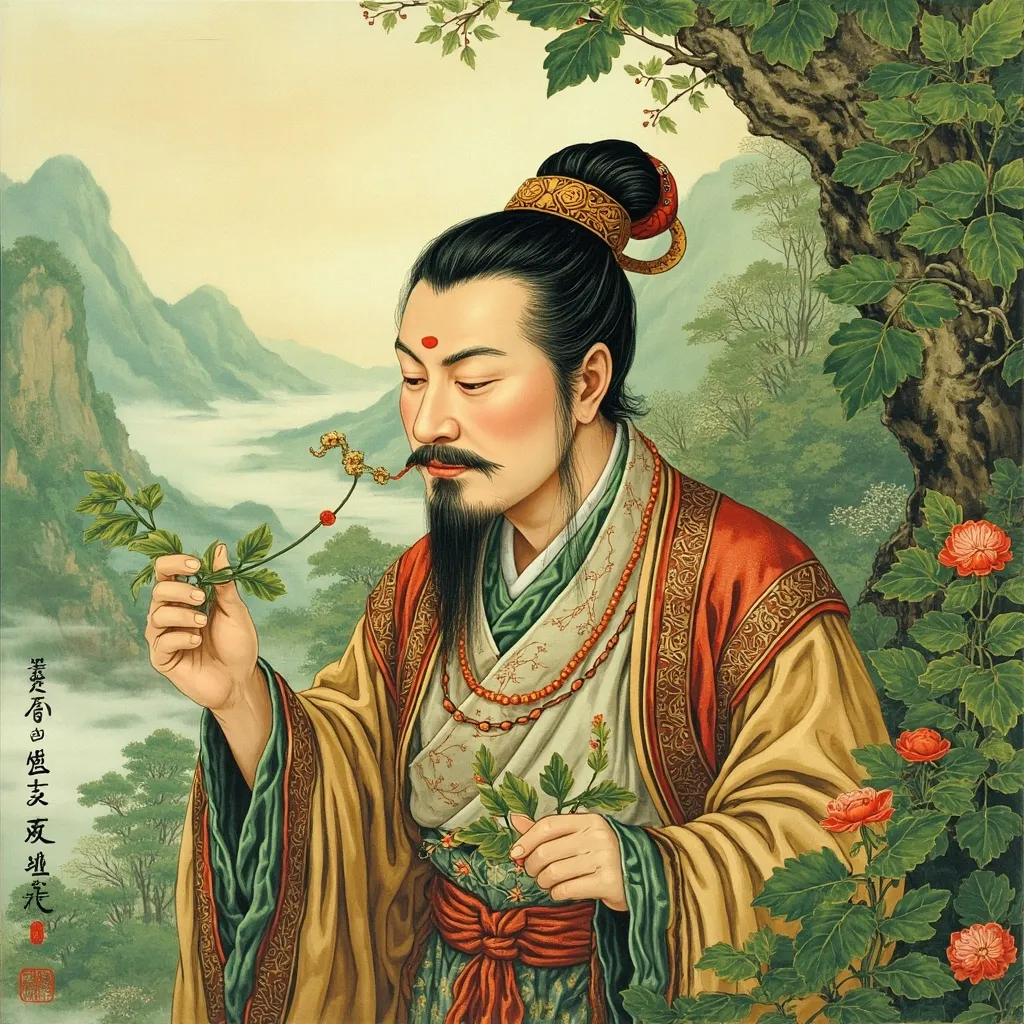
slug: “shennong-tasting-hundred-herbs” description: “Discover the legendary story of Shennong, the Divine Farmer who tasted hundreds of herbs to discover medicine, sacrificing his own safety to save humanity from disease and hunger.” keywords: “Shennong, Chinese mythology, Hundred Herbs, divine farmer, traditional Chinese medicine, Shennong tasting herbs, ancient Chinese medicine, mythological figures” affiliate_products:
- “Traditional Chinese Medicine herbal tea sets”
- “Bamboo medicinal herb storage boxes”
- “Ancient Chinese mythology history books”
- “Chinese farming culture and agriculture documentaries”
- “Handcrafted ceramic tea sets inspired by ancient healing traditions” image: “/images/shennong-herbs.jpg” categories: [Chinese Mythology] alt_text: “Illustration depicting shennong tasting hundred herbs, in a traditional Chinese cultural setting”—
Shennong Tasting Hundred Herbs: The Divine Farmer Who Gave His Life for Humanity
Long before there were doctors with their carefully catalogued remedies and pharmacies with their rows of neatly organized bottles, there was a man who walked through forests and meadows with nothing but his own body as a testing ground. His name was Shennong, and he is remembered as one of the most selfless figures in all of Chinese mythology. The story of Shennong tasting hundred herbs is not merely a tale about the origins of traditional Chinese medicine—it is a profound meditation on sacrifice, curiosity, and the unbreakable bond between human beings and the natural world.
The Legendary Origins of the Divine Farmer
According to ancient Chinese legend, Shennong was born around 2737 BCE during the reign of the Flame Emperor. What made him extraordinary from the very beginning was his unusual appearance—he had a transparent belly, allowing people to see his internal organs working in real time. Some accounts say this was a divine gift that marked him as special; others suggest it was simply how the mythology chose to emphasize his role as someone who understood the inner workings of the body better than anyone else.
Shennong became known as the Divine Farmer because of his revolutionary contributions to agriculture. While other people during his era were still hunting and gathering whatever nature provided, Shennong taught them how to cultivate crops. He introduced the plow and instructed farmers on how to till the land systematically. He showed people which plants could be grown as food and which should be avoided. His agricultural innovations laid the foundation for Chinese civilization’s relationship with farming, making him one of the most respected cultural heroes in Chinese history.
But it was his next venture that would cement his legacy forever. Shennong noticed that people were getting sick from eating the wrong plants, and sometimes dying from what seemed like mysterious illnesses. Determined to find solutions, he made a decision that would ultimately cost him everything—he would taste every plant he could find to determine which ones could heal and which ones could harm.
The Dangerous Journey Through Nature’s Pharmacy
Shennong’s method was remarkably straightforward and unbelievably dangerous. He would venture into forests, mountains, and valleys, collecting plants, fruits, roots, and herbs of every description. Then he would taste them, one by one, carefully noting their effects on his body. If a plant made him feel stronger or cured some ailment, he would classify it as medicinal and share the discovery with his people. If a plant poisoned him, he would document its danger so others would know to avoid it.
The legends say that Shennong created a rudimentary classification system for the substances he encountered. He organized them into categories based on their effects—healing herbs, toxic plants, and neutral substances that could be consumed as food. This system would eventually evolve into the sophisticated framework of traditional Chinese medicine that doctors still use today, thousands of years later.
What makes this story so emotionally powerful is the sheer scope of Shennong’s sacrifice. According to some versions of the legend, he tasted more than a hundred herbs in his lifetime. Each time he consumed something poisonous, he would suffer terrible pain, cramps, or fever. Yet he continued his work, undeterred by his own suffering. The mythology portrays him as someone who genuinely believed that his pain was a small price to pay for the health and wellbeing of future generations.
One of the most famous episodes in the Shennong legend involves his discovery of tea. After tasting a particularly poisonous herb, Shennong collapsed beneath a tea bush. As he lay there, weakened and near death, some tea leaves fell from the bush above and happened to fall into his mouth. The subtle, soothing effect of the leaves helped detoxify his system and eventually restored his health. Whether this story is literally true or simply a charming addition to the mythology, it illustrates something important about Shennong’s relationship with nature—he was not conquering or controlling the natural world, but rather listening to it and learning from it.
The Legacy of Divine Sacrifice
Shennong’s work came at a terrible cost. According to Chinese historical records and mythology, he eventually died from poisoning—some sources say he consumed a plant with such potent toxicity that even his legendary constitution could not save him. He was said to be 168 years old when he passed away, though the mythology being what it is, that number might be symbolic rather than literal. What matters is the manner of his death: he died as he lived, dedicated to the service of humanity through the pursuit of knowledge.
The impact of Shennong’s sacrifice extends far beyond the realm of mythology. Traditional Chinese medicine traces its philosophical roots directly to his experiments and discoveries. The concept of qi, the vital energy that flows through the human body, the principle of balancing yin and yang, the understanding that food and medicine come from the same natural source—all of these ideas have connections to Shennong’s pioneering work. He is often depicted holding a ladle or tasting spoon, surrounded by the plants and herbs he categorized, and he is worshipped as the father of agriculture and the founder of Chinese medical science.
In many Chinese communities, temples called Shennong temples were built in his honor. These sacred spaces served not only as places of worship but also as early medical institutions where people would come to seek healing and guidance. The respect that Chinese culture has traditionally shown to farmers, herbalists, and medical practitioners can be traced back to the reverence afforded to Shennong.
The Philosophy Behind the Sacrifice
There is something deeply moving about the story of Shennong when you consider the philosophical dimensions embedded within it. Chinese mythology does not typically portray its heroes as invincible warriors or flawless beings. Instead, the greatest heroes are often those who suffer the most for the benefit of others. Shennong embodies this principle perfectly—he was not a god who could not be harmed, but a human being who chose to put himself in harm’s way repeatedly so that others would not have to.
This philosophy has influenced Chinese thinking about medicine, healing, and service for millennia. The ideal of the caring physician has always been connected in Chinese culture to the figure of Shennong—the doctor who knows suffering firsthand and who uses that knowledge to alleviate the suffering of others. When Chinese medical students take their oath, they are reminded of Shennong’s example. When herbalists prepare medicines, they often offer a small prayer or moment of gratitude to the Divine Farmer who made their profession possible.
The story also speaks to a particular Chinese approach to knowledge and experimentation. Rather than treating nature as something to be dominated or conquered, Shennong’s methodology was collaborative and observational. He worked with nature, testing its offerings, listening to his body’s responses, and building a cumulative body of knowledge that future generations could draw upon. This empirical approach, though carried out with himself as the sole test subject, represents an early form of scientific inquiry that would eventually develop into the systematic medical traditions we know today.
What is particularly striking about Shennong’s approach is the way it embodied the principle of reciprocity that runs through so much of Chinese philosophy. The land provides plants for food and medicine; in return, humans must understand those plants thoroughly enough to use them wisely. This exchange is not extractive but relational—human beings and the natural world are partners in an ongoing dialogue that requires attention, humility, and care. Shennong’s willingness to suffer the consequences of this dialogue himself suggests that he understood better than most the costs of maintaining the human-natural world relationship.
The mythology also presents Shennong as someone who valued collective welfare over individual safety. This collectivist dimension of his character resonates with broader Chinese cultural values that have historically emphasized community harmony alongside individual achievement. In modern China, this tension between individual desires and collective needs remains a significant theme, and the figure of Shennong serves as an ancient reminder that true heroism often involves sacrificing personal comfort for the greater good.
Modern Reflections on Ancient Wisdom
Today, as we face new health challenges and grapple with questions about how humanity should relate to the natural world, the story of Shennong feels more relevant than ever. The concern that drove him—people suffering from illnesses that could potentially be treated with the right plants—is not so different from modern concerns about disease, healing, and the importance of understanding our biological relationship with the environment. Modern scientists working to discover new medicines still face many of the same challenges Shennong did: identifying which natural substances have healing properties, understanding proper dosages, and recognizing potential toxic effects that might outweigh benefits.
Traditional Chinese medicine, built upon the foundations Shennong helped establish, continues to serve millions of people around the world. Herbal remedies, acupuncture, dietary therapy, and other treatments that trace their lineage back to ancient Chinese medical philosophy are now practiced globally. While modern science continues to evaluate and sometimes validate these traditional approaches, the underlying worldview—that health comes from balance, harmony, and a deep relationship with nature—remains influential.
The figure of Shennong also reminds us that progress often comes at a personal cost. The comfort and knowledge we enjoy today exist because someone, somewhere, made enormous sacrifices to advance human understanding. Shennong’s willingness to risk his own life in pursuit of knowledge for others represents a kind of heroism that transcends cultural boundaries and speaks to something universal in the human experience.
Recommended Reading and Exploration
If the story of Shennong has sparked your interest in Chinese mythology and traditional medicine, there are many ways to continue your journey. Consider exploring books on the history of traditional Chinese medicine that examine how Shennong’s early experiments evolved into the sophisticated medical systems we know today. Look for titles that connect mythology to historical developments, showing how ancient stories often encode practical wisdom about health and healing.
Documentaries about ancient Chinese agriculture and early medical practices can also be illuminating. These visual explorations bring the world Shennong would have known to life, showing the forests, mountains, and valleys where he conducted his dangerous experiments. Seeing the actual plants and landscapes that feature in the mythology helps ground the stories in physical reality.
For those interested in the cultural artifacts connected to Shennong, handmade ceramic pieces featuring traditional medicine motifs make beautiful and meaningful additions to any home. Some collectors seek out antique medicine bottles, herb storage containers, and other objects that reflect the material culture of Chinese healing traditions.
Finally, consider exploring traditional herbal teas that are connected to the philosophy Shennong represented. Tea itself has deep roots in Chinese culture as both a beverage and a form of medicine, and many traditional tea blends are designed to promote health and wellbeing in gentle, natural ways.
The story of Shennong tasting hundred herbs endures because it speaks to something fundamental about human nature—the desire to help others, the willingness to sacrifice for future generations, and the unshakeable belief that knowledge, however costly to acquire, is worth pursuing. In the figure of the Divine Farmer with his transparent belly and his ladle, we see not just a mythological character but a timeless reminder of what it means to live a life of purpose and service.