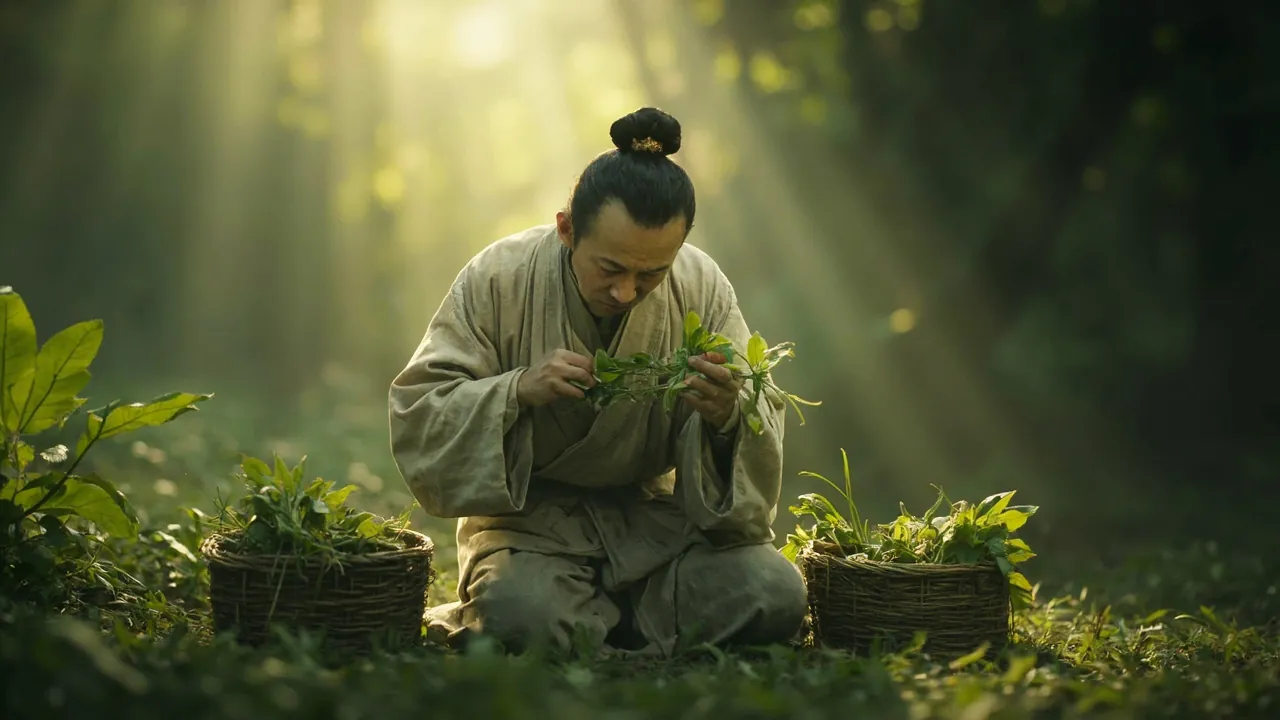
Long before supermarkets, before farming manuals, before anyone knew which berries would kill you and which ones wouldn’t, there was an emperor in China who decided to taste everything. Every root, every leaf, every flower, every strange-looking fungus growing on a tree — he put it in his mouth and swallowed. Day after day, year after year, he did this so that his people would never have to guess.
His name was 神农 — Shennong — which means “Divine Farmer.” And by the time his work was done, he had tasted so many poisonous plants that his body turned the color of grass, permanently stained green from the herbs that nearly killed him. He is remembered as the father of Chinese medicine, the inventor of agriculture, and the first person in history to systematically test the boundary between food and poison — a boundary he found by crossing it, over and over, at the cost of his own body.
If you’ve ever boiled water to make it safe to drink, or chewed ginger for an upset stomach, or understood that ginseng is good for your energy — you’re benefiting from Shennong’s suffering. And Chinese people have known this for nearly five thousand years.
The Emperor Who Came Down from Heaven
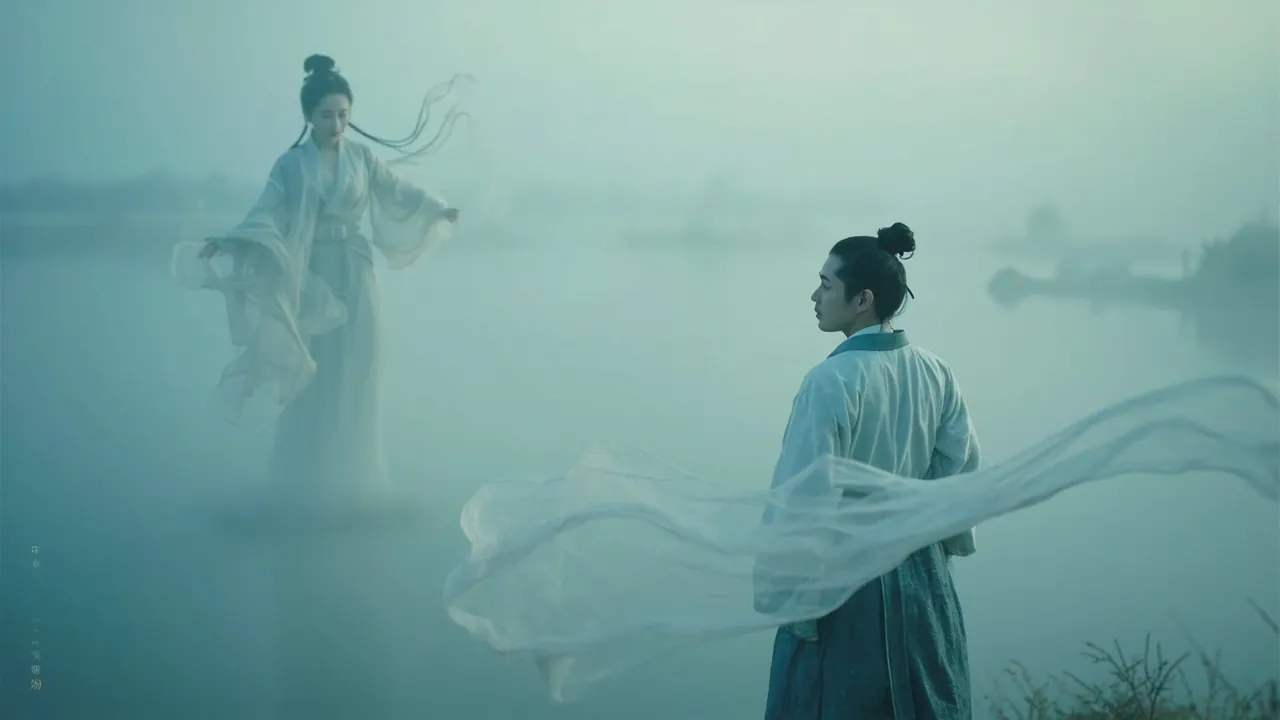
The story of Shennong belongs to a time called the 三皇 — Three Sovereigns — an age so ancient that historians can’t say with certainty what was legend and what was fact. In the oldest versions of the story, Shennong was literally sent from heaven to earth to help humanity. He found a world where people were slowly starving to death, eating whatever they could find raw — roots, leaves, the occasional bird or fish — with no idea what was safe and what would make them terribly, horribly sick.
The problem wasn’t just that people were hungry. The problem was that they had no way of knowing which plants would nourish them and which would kill them. A root that looked perfectly ordinary might tear apart your stomach from the inside. A mushroom that seemed harmless might stop your heart. People died not from famine, but from ignorance — from eating the wrong thing at the wrong time.
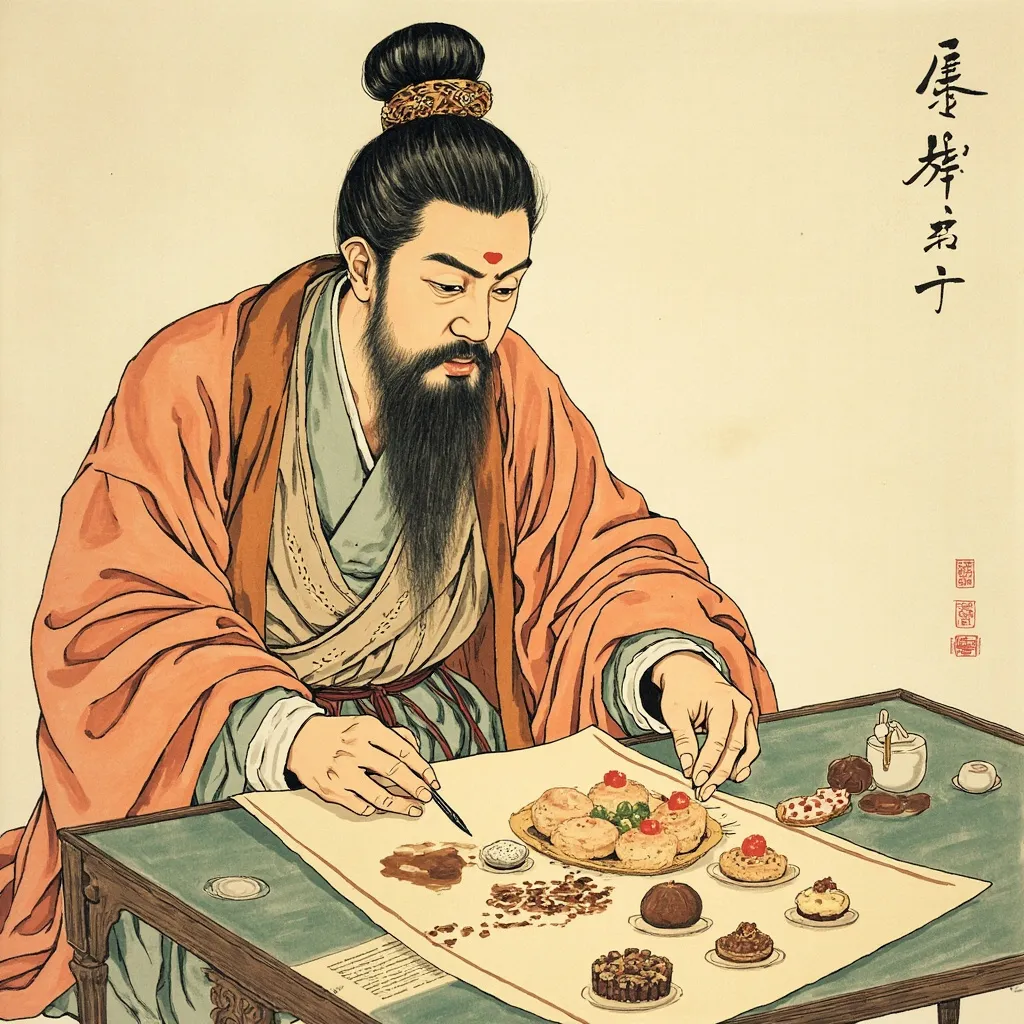
Shennong looked at this situation and did what any good emperor would do: he decided to solve it himself. He would taste every plant in the kingdom — systematically, carefully, recording what he found — so that his people would know what was safe. He built a simple structure of walls and a thatched roof, with no doors, so that anyone could come and see what he was doing. His theory was simple: if a plant was good for you, he’d teach people to grow it. If it was bad for you, he’d teach people to avoid it. And if it was somewhere in between — medicinal — he’d figure out the right dose.
What he didn’t account for was how many times “somewhere in between” would mean “this will make you very sick before it helps you.”
Tasting Poison After Poison
The old stories say that Shennong tasted a new plant every day, and that his body was so pure and his constitution so strong that poisons had a delayed effect on him — giving him time to observe the symptoms, record them, and find antidotes before the poison finished its work. This is a generous interpretation of events. The less generous interpretation is simply that he kept poisoning himself and kept surviving, through a combination of divine resilience, luck, and the desperate hope that the next plant would be the one that finally helped rather than hurt.
He developed a system as he went. Plants that made him feel warm and energized, he classified as yang — good for increasing energy and activity. Plants that made him feel cool and calm, he classified as yin — good for reducing heat and inflammation. He started to see patterns: bitter plants often seemed to clear infections. Sour plants often seemed to tighten and strengthen tissues. Salty plants often seemed to soften hard accumulations. These weren’t scientific conclusions — not in the way we understand science today — but they were the beginning of a system of knowledge that would eventually become Traditional Chinese Medicine.
The 四气 — Four Natures — and 五味 — Five Tastes — that form the foundation of Chinese herbal medicine trace their origins directly to Shennong’s experiment of tasting everything. He didn’t have laboratories or microscopes or peer review. He had his own body and his own observation, and he put them both at risk thousands of times so that his people wouldn’t have to.
The stories say he was poisoned seventy times in a single day once, after tasting a particularly aggressive combination of plants. He survived all seventy, but the experience left him permanently changed. After that, his skin took on a greenish tint — the color of the herbs that had so thoroughly saturated his body. This is why many depictions of Shennong show him with greenish or blue-green skin: not because he was an alien, but because he had earned those colors through years of poisoning himself for the benefit of everyone else.
The Discovery of Tea
One of the most famous stories about Shennong involves the discovery of 茶 — cha, tea.
The legend goes like this: Shennong was resting under a tea bush one day, having boiled some water in his ceremonial cooking vessel, when a few leaves from the bush above fell into his pot of hot water. The water turned a pale golden-green color, and curious as always, Shennong tasted it.
The effect was remarkable. The hot infusion was simultaneously refreshing and calming, and Shennong found that it had a peculiar property: it seemed to counteract the effects of many of the poisons he’d been ingesting. It wasn’t a cure for everything — but it was a universal antidote of sorts, something that could help the body process and expel toxins more efficiently. Shennong named the plant 茶 — cha — and taught his people to brew it.
This is the origin of the Chinese custom of drinking tea not merely for pleasure, but for health. Long before the Tang Dynasty made tea into an art form, and long before the British made it into an empire-destroying addiction, Shennong was drinking it as medicine. The cup of tea you might have in the morning is, in a very real sense, a direct inheritance from an emperor who poisoned himself so thoroughly that his body turned green, and who found, in a happy accident under a tea bush, the one plant that made the suffering worth it.
The Price of Knowledge
Shennong’s story has a tragic ending, as stories about great sacrifices often do.
The legends say that he eventually tasted a plant called 断肠草 — Duanchang Cao, or “Broken Intestine Grass” — a name that should have been warning enough. The plant was extraordinarily effective at killing parasites and harmful bacteria in the digestive system, which made it seem like a miracle cure. Shennong, characteristically, tasted it without hesitation.
This time, there was no antidote. This time, the poison worked too fast, and Shennong died.
But even in death, the story has a certain dignity to it. Shennong didn’t die because he was careless or reckless. He died because he was doing exactly what he’d always done — testing a plant that might help his people, at the cost of risking his own life. He had lived by tasting, and he died by tasting, and in between he had given China the foundations of its entire medical and agricultural tradition.
Chinese historical texts describe him as having a green face, the horns of an ox, and a body that was partially transparent — you could see his stomach and intestines through his skin, so that he could observe what was happening inside his own body as he was poisoned. Whether this is literal or metaphorical is beside the point. The point is the image it creates: an emperor who made himself into a laboratory, who used his own body as the instrument of discovery, who was so committed to knowing the truth about the natural world that he turned his own flesh into evidence.
The Legacy Beneath Our Feet
If you walk through a Chinese pharmacy today — or even a Chinese grocery store in America — you are walking through Shennong’s legacy. The division of foods and herbs into categories — hot and cold, sweet and bitter, nourishing and cleansing — comes from his original system. The idea that different parts of the same plant might have different effects, that the root of one plant might cure what the leaf of another plant causes, that timing and dose matter as much as the ingredient itself — all of this comes from the age of Shennong, from the systematic experimentation of an emperor who refused to let his people eat blind.
When Chinese mothers feed their children 粥 — zhou, rice porridge — with ginger and scallion when they’re sick, they’re following a tradition Shennong started. When Chinese grandparents brew a pot of chrysanthemum tea in the summer to “clear heat,” they’re drawing on the same Four Natures framework he developed. When someone with a cold is told to eat mung beans or drink bamboo leaf tea because those foods are “cold in nature,” they’re participating in a system of nutritional knowledge that goes back nearly five thousand years to a green-faced emperor who tasted everything so his people wouldn’t have to.
The interesting thing about Shennong’s legacy is how democratic it became. He started as a divine emperor, but the knowledge he created belongs to everyone. It’s in the kitchens and gardens and medicine cabinets of ordinary people, passed down from grandmother to grandchild, written into the daily habits of a civilization. He gave his life to a project of knowledge, and the knowledge grew beyond him, beyond any ruling class, beyond any single era, into something that Chinese people carry with them every day.
That’s the deepest meaning of his story, I think. Not just that he suffered for knowledge, but that the knowledge he suffered for became so embedded in daily life that it no longer feels like knowledge at all. It feels like instinct. Like common sense. Like the natural way things are.
Which is exactly what he would have wanted.