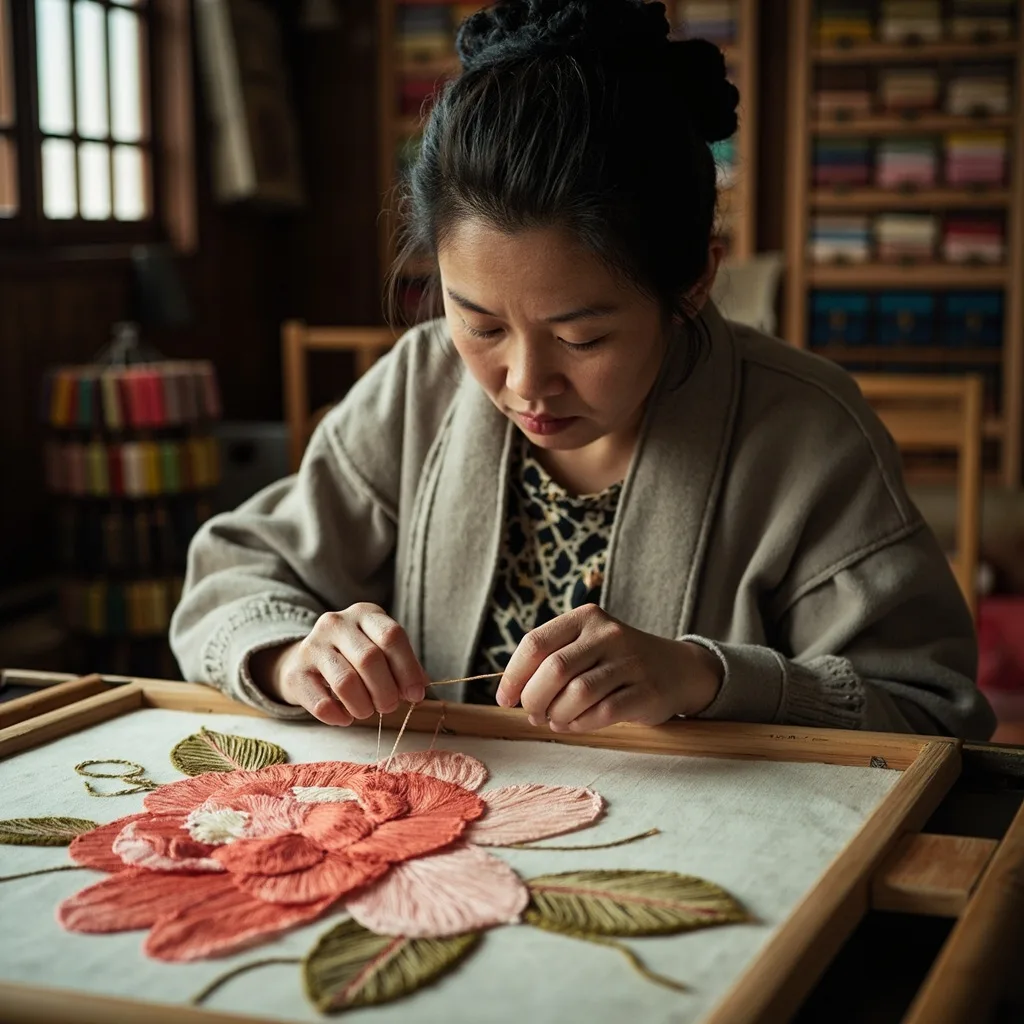
If you walk into a small workshop in Chengdu, the capital of Sichuan province, on a quiet weekday morning, you will probably hear a sound you did not expect: the soft, persistent snick-snick-snick of a needle being pushed through tightly stretched silk, over and over, hundreds of times a minute. The woman at the frame is not in a hurry. Her head is tilted slightly, her eyes narrowed, her fingers guiding a single strand of split silk thread into a design that, when finished, will look less like sewing and more like a painting made of light. That sound — that is Shu embroidery (蜀绣, Shu ci), one of the oldest and most quietly brilliant craft traditions in China.
Shu embroidery is one of the Four Famous Embroideries of China (中国四大名绣) — the elite club of regional needlework traditions that, together, defined what Chinese embroidery meant for most of the last thousand years. The other three are Su embroidery (苏绣) from Suzhou in Jiangsu, Xiang embroidery (湘绣) from Hunan, and Yue embroidery (粤绣, specifically Chaoxiu 潮绣) from the Guangdong coast. Shu embroidery is the oldest of the four with the longest continuous documented history. It is also, in many ways, the most distinctive in technique.
The numbers are not modest. Surviving pieces from the Western Han dynasty (206 BCE – 9 CE) show embroidery done in Sichuan already using techniques essentially identical to those used today. By the Three Kingdoms period (220 – 280 CE), Shu embroidery was a court-sponsored industry. By the Five Dynasties and Song (10th – 13th centuries), it was being exported along the Southern Silk Road to Central Asia and beyond. Modern Shu embroidery studios in Chengdu and surrounding counties still produce pieces that take months to years for a single work, sell internationally, and — like most traditional Chinese crafts — are now protected by a national intangible cultural heritage designation (国家级非物质文化遗产).
Let me walk you through what it actually is, where it comes from, who makes it, and what to look at if you want to see it for yourself.
A Bit of History: Two Thousand Years of Needle and Silk
The Sichuan basin was an extraordinarily fertile place for silk. The Shu state during the Warring States period (roughly the 4th century BCE) was already famous for its silkworm raising, mulberry cultivation, and weaving. Archaeological evidence from Chu tombs in Hubei and Hunan and Shu tombs in Sichuan (most famously the Shu brocade 蜀锦 finds at Chengdu’s Wangcong Tomb, dated to the Western Han) shows that the same people who wove silk into patterned cloth also stitched that cloth into elaborate embroidered panels. Some of these Han-dynasty panels survive in museums in Kyoto, Tokyo, and Ulan Bator — they were traded north and west along the early Silk Road, which is how Sichuan embroidery ended up in Japanese and Mongolian collections more than two thousand years ago.
The Three Kingdoms period is when Shu embroidery really enters the historical record with a name attached. Zhuge Liang (诸葛亮), the chancellor of Shu-Han (221 – 263 CE), is credited in later sources with setting up an official embroidery workshop in Chengdu to supply the court with ceremonial robes and military banners. Whether the attribution to Zhuge Liang is literally true or simply a convenient origin story, the fact is that organized, large-scale Shu embroidery production is documented in Sichuan from this period onward.
The tradition deepened over the Tang (618 – 907 CE) and Song (960 – 1279 CE) dynasties. Tang-era Buddhist embroidery made in Sichuan — religious banners, sutra covers, and monk’s robes — survives in the Shosoin repository in Nara, Japan, and a few of them show techniques (such as the so-called locking stitch 钉线绣, where laid-down threads are tied down at regular intervals) that Shu embroiderers still use today.
The Ming dynasty (1368 – 1644) and especially the Qing dynasty (1644 – 1912) are the high points of the popular decorative tradition. During the Qing, especially under emperors Kangxi, Yongzheng, and Qianlong, court taste shifted heavily toward embroidery as a fine-art medium, and Shu embroidery workshops in Chengdu produced some of the most ambitious works in Chinese decorative history. The most famous surviving Qing-dynasty Shu embroidery piece is the Embroidered Portrait of Emperor Qianlong in His Study, a large hanging that used more than forty shades of silk thread to render the emperor’s face, robes, and the objects on his desk. Several pieces from this period are still in the Palace Museum in Beijing.
In the 20th century, Shu embroidery survived the upheavals of the Republican era, the Long March, the Second Sino-Japanese War (during which many workshops were evacuated into the Sichuan hinterland from eastern China), and the Cultural Revolution. The modern revival dates to the 1980s and 1990s, when state-sponsored cultural-heritage programs re-opened workshops, trained a new generation of master embroiderers, and established the framework that still governs the craft today.
The Distinctive Techniques
What makes Shu embroidery different from Su, Xiang, and Yue embroidery? Several things — and the differences are visible to anyone who looks closely.
1. Loose, layered stitches that build volume. Shu embroidery is famous for what practitioners call the “车马不到” (chemabudao) technique — literally, “carts and horses do not reach,” meaning the stitches are layered so densely and at slightly varying angles that no two adjacent patches of color are identical. The effect is a kind of soft, almost photographic depth, particularly noticeable in animal fur, flower petals, and human faces.
2. Heavy reliance on the “splitting silk” skill. Shu embroidery thread is not ordinary sewing thread. A single filament of silk from a Sichuan silkworm cocoon is so fine that it must be combined into a workable strand. Shu embroiderers traditionally split this combined strand again — a process called 劈丝 (pisi) — into as many as 24 to 48 sub-strands, depending on the detail required. The finest antique pieces used strands split all the way down to one-sixty-fourth of a single thread, almost invisible to the naked eye. This is what gives the work its painted-with-silk quality.
3. The “lucky knot” stitch (晕针, yunzhen). This is a Shu specialty. A short stitch is placed, then a slightly longer one is layered next to it, then a slightly longer one again, with each row shifting in tone. Done correctly, this technique produces smooth gradient shading — from white silk to pink silk to deep crimson, for example — across what looks like a single, seamless sweep of color. Other embroidery schools use similar gradient stitches; Shu embroidery’s version is considered the most refined.
4. Double-sided embroidery (双面绣, shuangmianxiu). Although this is also a specialty of Su embroidery, Shu embroiderers developed their own distinctive version. The same image — usually a panda, a peony, or a pair of fish — appears on both sides of a single piece of silk, with the stitching done so that the two images share the same threads without crossing visibly. The result, when mounted between glass or held up to the light, looks almost holographic.
5. A signature palette. Shu embroidery tends to use slightly warmer, slightly more saturated colors than Su embroidery, which leans toward cool greys and pale blues. The traditional Shu palette favors crimson, ochre, deep green, ivory, and gold, partly because these are the natural colors of Sichuan plant dyes (safflower, gardenia, indigo, sophora flower) and partly because they survived better in the humid Sichuan basin over centuries of storage.
Where to See It, and What to Look For
If you are visiting China, the easiest place to see Shu embroidery is the Chengdu Shu Embroidery Museum (成都蜀绣织绣博物馆), located inside the Huanhuaxi Park in central Chengdu. The permanent collection has more than 2,000 pieces, ranging from Han-dynasty fragments recovered from Sichuan tombs to contemporary works by nationally designated master embroiderers (国家级传承人). The museum also runs a working-studio area where visitors can watch embroiderers at their frames.
Outside Chengdu, the most important workshops are concentrated in Anxian (安, now part of Mianyang), Chongqing’s Rongchang district (荣昌), and the historic city of Guangyuan (广元) in northern Sichuan. The Rongchang area is particularly worth noting because Rongchang embroidery (荣昌折扇绣) developed its own distinctive style on folding fans and silk panels, and is treated as a separate sub-school in modern heritage documentation.
If you cannot get to Sichuan, you can see good examples of Shu embroidery in the China National Silk Museum (中国丝绸博物馆) in Hangzhou, the Shanghai Museum, the Palace Museum in Beijing (故宫博物院), and — for the truly dedicated — the British Museum and the Victoria & Albert Museum, both of which hold Qing-dynasty pieces acquired during the late-19th-century export boom.
A few things to look for if you want to train your eye:
- The reverse side. High-quality Shu embroidery, especially double-sided work, looks almost as clean on the back as on the front. Cheap or tourist-grade pieces have a tangled mess of thread ends on the back. If you are buying, always flip it over.
- The number of colors in a single panel. A decent Shu piece will use 30 to 50 distinct shades of silk thread. A masterwork uses 100+, sometimes approaching 200. The more shades, the longer the piece took, and the higher the price.
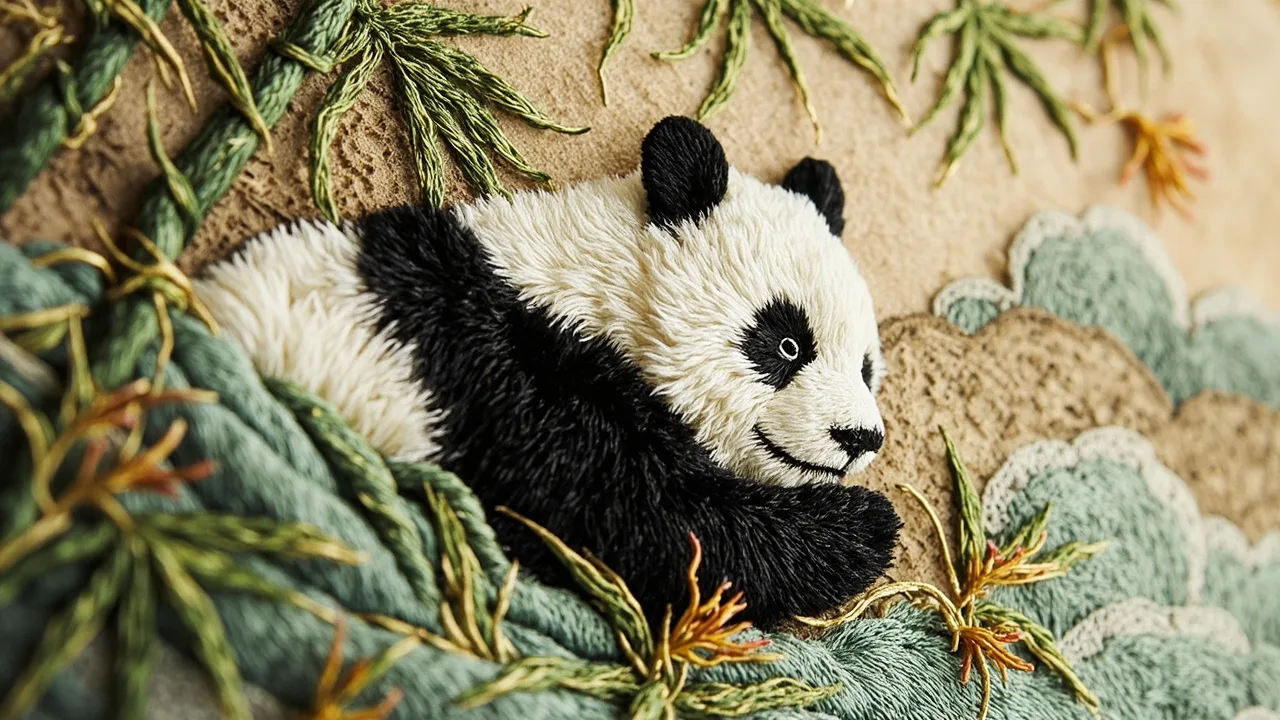
- The panda motif. Since the 1970s, pandas have become one of the most popular Shu embroidery subjects — partly because the panda’s black-and-white coat tests the limits of split-silk technique (rendering true black, true white, and the soft gradient between them is one of the hardest problems in the craft). A well-done panda panel is a fair test of a workshop’s skill.
- The signature stitch on faces and eyes. Look at the eyes of any animal or human figure in the piece. The whites of the eyes are usually built up with several overlapping layers of nearly-invisible stitches, and the dark pupil is a single dense cluster of black silk. This is the area where Shu embroidery masters spend the most time, and where cheaper work shows its weaknesses first.
The People Behind It, and Why It Almost Disappeared
Like most traditional Chinese crafts, Shu embroidery has been under demographic pressure for at least the last century. The work is slow — a moderately complex panel of 30 by 30 cm can take a single embroiderer three to six months; a masterwork can take more than a year. The pay, even at the top end, has historically lagged behind what an embroiderer could earn in manufacturing or service work. Many young Sichuanese women who would have entered the trade in earlier generations have chosen other careers instead.
The Chinese government’s response, beginning in the 2000s, has been a combination of intangible cultural heritage (ICH) designation, regional training programs, and tourism-driven sales. The national-level ICH list (established formally in 2006 and updated regularly since) includes Shu embroidery, with multiple regional sub-designations for Chengdu, Rongchang, and Anxian. Several provinces now run apprenticeship programs that pair a master embroiderer with a small group of younger trainees for three to five years of full-time training. Graduates who reach the level of provincial or national master are given a stipend and a license to teach.
The results so far are mixed. The number of full-time Shu embroiderers in Sichuan is now estimated at around 2,000 to 3,000, depending on how you count part-time workers. The total number of pieces produced annually is in the low tens of thousands, with the bulk being mid-grade decorative work for the domestic tourist market. The share of pieces produced at the masterwork level — works that would qualify for national-level recognition — is much smaller, on the order of a few hundred per year.
That is a small number compared to the scale of the tradition historically, but it is enough to keep the craft alive. The pieces that come out of those workshops are remarkable — quiet, slow, almost obsessively refined. They look, more than anything else, like paintings made of light. If you see one in person, you will understand why the tradition has survived.
If you want to bring a piece of Shu embroidery into your own home — or simply want to learn the basic stitches yourself — here are a few starting points:
- Traditional Chinese Embroidery Starter Kit — A beginner kit with silk thread, hoop, needles, and a printed pattern of a classic motif (panda, peony, or fish). The kit will not give you Shu-quality work — that takes years — but it lets you feel the texture and pacing of the craft.
- 100% Mulberry Silk Embroidery Thread Set — Good embroidery thread makes an enormous difference. A set of properly stranded mulberry silk in 50+ colors is what real Chinese embroiderers work with.
- Round Wooden Embroidery Hoop / Stand Combo — Traditional Chinese embroidery uses a stand (the 绣架, xiujia) rather than a hand-held hoop. The stand holds the silk taut and frees both hands for stitching. A simple roll-up stand is enough to get started.
- Sichuan Herbal Tea Sampler (Jin Hua, Mengding, E Mei) — The right companion while stitching. Sichuan herbal teas — jasmine, bamboo-leaf green, chrysanthemum — are what Chengdu embroiderers traditionally keep in a teapot beside the frame. A cup of tea, a quiet morning, and a slow piece of needlework is a combination that has not changed in two thousand years.
- Gongfu Tea Set with Yixing Clay Teapot — A small Yixing pot and a few porcelain cups are the basic setup for the kind of slow, deliberate tea drinking that pairs well with slow, deliberate handwork. Unglazed zhisha clay will season over years of use.
If you take only one thing from this article, take this: the women (and the occasional man) sitting at the frames in Chengdu are not making souvenirs. They are continuing a tradition that connects them, stitch by stitch, to embroiderers working in the same city more than two thousand years ago. The needles, the silk, the colors, and even the basic motions have changed very little in that time. The next time you see a piece of Shu embroidery — in a museum, in a market, online — give it a long, slow look. You are looking at one of the oldest continuous craft traditions on earth.