category: Chinese Culture tags: [“Sichuan Opera”, “Traditional Performing Arts”, “Face-Changing”, “Chinese Opera”, “Intangible Cultural Heritage”] image: /images/sichuan-opera.jpg categories: [Chinese History] alt_text: “Illustration depicting sichuan opera, in a traditional Chinese cultural setting” affiliate_products: [chinese-history-book, chinese-poetry-collection, chinese-culture-book]
The moment the lights dim in a traditional Sichuan Opera theater, you can feel something electric in the air. The audience settles, conversations trail off, and then — a single drumbeat. The performer strides onto the stage, face alive with color, and within seconds, shifts through a dozen expressions as if flipping through a deck of living portraits. Nobody quite understands how it’s done. Not even the people who study it for a lifetime. This is the magic of Sichuan Opera, and it’s been bewitching audiences for well over three centuries.
Sichuan Opera isn’t just opera in the way the Western world thinks of opera. It’s a full sensory experience — a riotous blend of singing, acrobatics, comedy, puppetry, and the jaw-dropping art of bianlian, which translates literally to “face changing.” It’s China’s most visually spectacular performance tradition, and if you’ve never seen it in person, you haven’t truly experienced Chinese culture at its most theatrical.
The Rich History Behind Sichuan Opera
Sichuan Opera as we know it emerged in the late Ming and early Qing dynasties, roughly around the 17th century, though its roots reach back much further into local folk traditions, temple festivals, and the traveling troupes that crisscrossed the mountainous Sichuan basin. The province of Sichuan — home to the mighty Yangtze River, the sacred Mount Emei, and a people known for their fiery spirit and sharp wit — provided the perfect breeding ground for a performance style unlike anything else in China.
The art form drew from multiple sources. Tea-house culture in Chengdu and other cities meant that folk songs and comedic skits were a daily form of entertainment for working-class audiences. Temple fairs brought in wandering performers who staged acrobatics, puppet shows, and shadow plays. When professional opera troupes from neighboring provinces arrived, they brought their own styles — the kunqu elegance of Jiangsu, the yueju sharpness of Guangdong — and Sichuan’s native performers absorbed, mixed, and transformed all of it into something entirely their own.
By the 18th and 19th centuries, Sichuan Opera had developed its own distinct identity, complete with the five main role types found in Chinese opera generally — male leads, female leads, painted-face characters, comic actors, and acrobatic fighters — but performed in the Sichuanese dialect with a musical sensibility that reflected the region’s辣椒 (làjiāo, “spicy”) personality. Where Beijing Opera was formal and restrained, Sichuan Opera was loud, colorful, and unafraid to make you laugh one moment and gasp in disbelief the next.
The face-changing technique, or bianlian, is what truly set Sichuan Opera apart. While no one can say with absolute certainty when or how it originated, it’s generally believed that bianlian developed sometime in the late 18th century, possibly as a way for actors to quickly portray dramatic shifts in emotion or character during a performance. Over time, it evolved into the meticulously guarded secret it is today — a feat so visually astonishing that audiences sometimes惊呼 (jīnghū, “shout in shock”) mid-performance.
The Mystique of Face-Changing: How Performers Pull Off the Impossible
Let’s talk about the elephant in the room, or rather, the impossible faces that change in the span of a heartbeat. Bianlian is the single most recognizable aspect of Sichuan Opera, and yet it remains one of the most closely protected secrets in all of Chinese performing arts.
The basic technique involves a combination of swift costume movements, muscular control, and specially designed props. Most commonly, performers wear multiple layers of oil-based paints applied to their faces in sequence. A sudden gesture — a wave of a sleeve, a brush of the hand, a sharp turn of the head — triggers a mechanism that reveals a completely different painted face beneath. In some variations, fans are used as props; the fan opens in front of the performer’s face, and when it closes, a new face has materialized.
But here’s where it gets complicated: the exact methods vary from performer to performer, and many masters consider their specific techniques to be family secrets — passed down through generations, never written down, never taught outside the bloodline. What we do know is that the performances require years of training. Young performers begin learning the fundamentals of Sichuan Opera — voice, movement, acrobatics — before they ever touch a face-changing routine. By the time they’re ready to perform bianlian professionally, they’ve spent a decade or more mastering the craft.
The speed at which these faces change is what makes it so extraordinary. In the space of a single second, a performer can cycle through three, four, five different painted faces — each one bold and brightly colored, designed to be read instantly by an audience. Red for anger or loyalty, white for treachery or age, black for honesty or bluntness, gold for divinity. These colors aren’t random; they follow the same symbolic language found throughout Chinese opera and traditional Chinese culture. When you watch a skilled bianlian master at work, you’re watching centuries of accumulated knowledge, physical precision, and showmanship collide in a way that no camera, no matter how slow you set it, fully prepares you for.
It’s worth noting that bianlian isn’t just about visual spectacle. The rapid changes in face color are often used to express intense emotional shifts — the moment a hero realizes he’s been betrayed, the instant a villain’s mask of civility cracks to reveal his true nature. It’s storytelling through makeup, and it’s deeply embedded in the dramatic structure of the performance.
Masks, Costumes, and the Visual Spectacle of the Stage
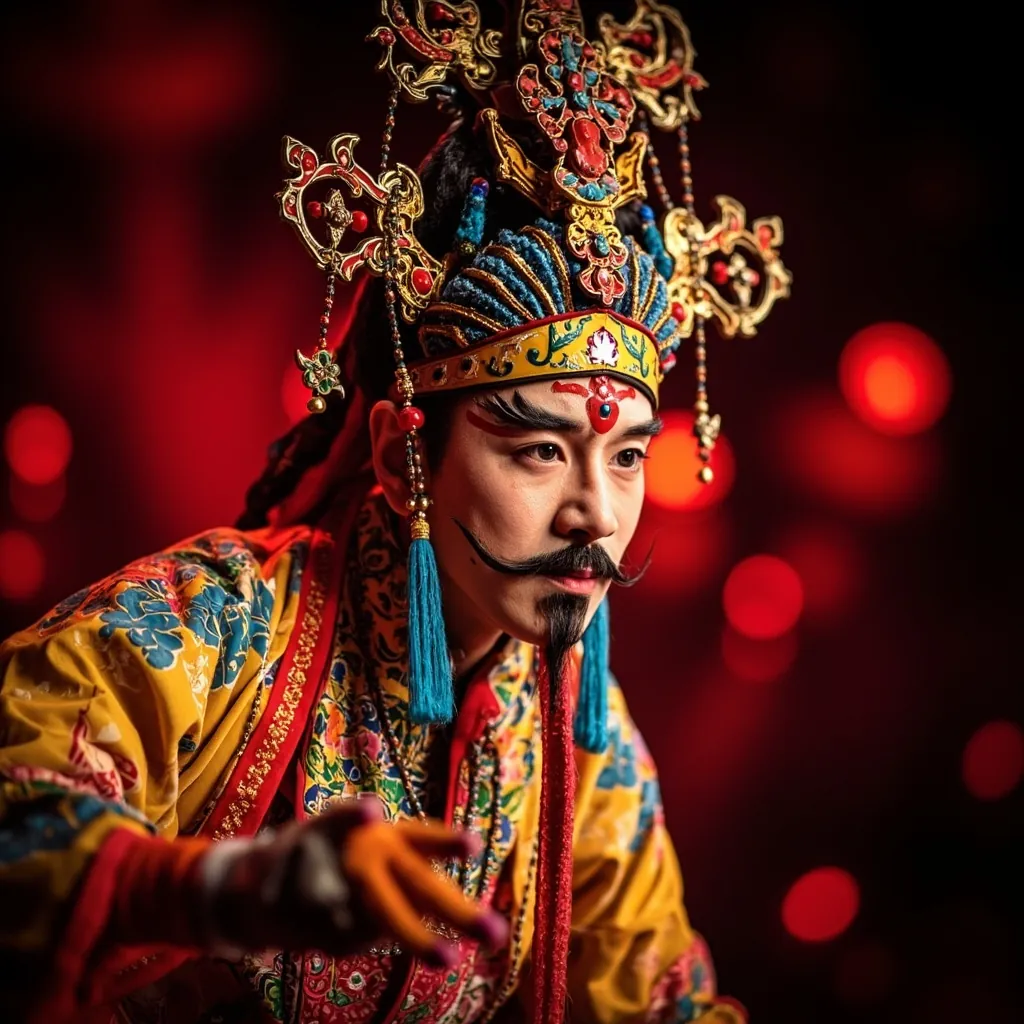
While bianlian draws the headlines, Sichuan Opera is a visual feast from the moment the curtain rises to the final bow. The costumes alone could fill a museum — elaborate silk robes embroidered with dragons, phoenixes, clouds, and waves, each color and pattern carrying its own symbolic weight. Costumes in Sichuan Opera tend to be even more extravagant than in Beijing Opera, reflecting the region’s love of bold, unapologetic showmanship.
The sheng (male lead) might appear in a flowing官袍 (guānpáo, “official robe”) adorned with a five-clawed dragon, while the dan (female lead) floats across the stage in层层叠叠 (céngcéngdiédié, “layer upon layer”) of silk, her costume so elaborate that years of training go into simply moving gracefully while wearing it. The jing (painted-face) characters wear enormous, exaggerated masks that cover most of the face, their expressions carved into porcelain-like surfaces that convey emotion with just a glance.
Sichuan Opera costumes are deeply rooted in tradition, but they also reflect Sichuan’s unique climate and culture. The province’s humid summers and mild winters influenced the choice of fabrics and layers. And because Sichuan Opera developed partly from outdoor temple performances, the costumes were designed to be readable from a distance — bold colors, exaggerated proportions, clear silhouettes.
The makeup is equally important. Beyond the bianlian performances, Sichuan Opera actors spend considerable time applying their日常 (rìcháng, “daily”) makeup, which can take up to two hours to complete. This is especially true for the elaborate painted faces of villain or warrior characters, whose faces tell their moral story before they speak a single line.
Music and Instruments: The Sound of Sichuan Opera
You can’t fully appreciate Sichuan Opera without understanding its music, and this is where the art form diverges dramatically from Beijing Opera. Where Beijing Opera uses a relatively standardized musical palette, Sichuan Opera developed its own distinctive sound, heavily influenced by the folk music of the Sichuan basin.
The primary instruments in a Sichuan Opera orchestra include the pepa (a Sichuanese version of the erhu, a two-stringed bowed instrument), the yunluo (a set of small gongs arranged in a frame), the bangu (a small drum beaten with two bamboo sticks), and the suona — a double-reed instrument with a tremendously loud, piercing sound that signals dramatic moments or the entrance of important characters. The suona in particular is quintessentially Sichuanese; its brash, joyful sound can fill an outdoor theater without any electronic amplification, and it’s used extensively in festive scenes, wedding celebrations, and comic interludes.
The singing style in Sichuan Opera tends to be more conversational and accessible than in Beijing Opera. Lines are often delivered in the Sichuanese dialect, which even many Mandarin speakers from other provinces find challenging to understand, but the emotional directness comes through regardless. The interplay between spoken dialogue, aria, and comedic banter gives Sichuan Opera a theatrical flexibility that allows it to shift from high drama to low comedy within a single scene.
One particularly distinctive feature is the use of闹台 (nàotái, “noise opening”) — a loud, energetic instrumental overture that traditionally opens the performance, designed to announce the show’s beginning and clear the audience’s attention. It sets the tone for the entire evening, announcing that this isn’t a quiet, refined affair. Sichuan Opera wants you to feel something, and it starts pulling you in from the very first note.
Modern Revival and Preserving a National Treasure
Sichuan Opera faced hard times in the 20th century. The political upheavals of the Republic of China era, the Japanese invasion, and the upheavals of the Cultural Revolution all dealt severe blows to traditional performing arts across China, and Sichuan Opera was no exception. Many masters were persecuted, their techniques nearly lost. But the art form proved as resilient as the Sichuanese people themselves.
In the 1980s, as China opened up and rediscovered its cultural heritage, Sichuan Opera underwent a renaissance. Government recognition as a national intangible cultural heritage item gave the art form new institutional support. Training academies reopened, and aging masters were invited back to teach the younger generation. New creative approaches brought Sichuan Opera to international audiences — tours to Europe, North America, and Southeast Asia introduced the bianlian technique to millions who had never heard of it.
Today, you can experience Sichuan Opera in dedicated theaters in Chengdu, the capital of Sichuan Province. The most famous venues include the Shufu Yanyu Teahouse and the Jinjiang Theater, where nightly performances draw both Chinese tourists and international visitors. The best seats in these venues offer proximity to the stage, where you can watch the performers’ movements up close — though the mechanics of bianlian remain as mysterious to most audience members as they were to their ancestors.
For travelers planning a trip to Chengdu, catching a Sichuan Opera performance should be at the top of your itinerary. The experience is like nothing else — equal parts drama, comedy, acrobatics, and genuine, unexplainable magic. And Chengdu itself makes an ideal base, with its legendary sichuanmian (spicy noodles), its tea houses along the Jinjiang River, and the laid-back lifestyle that makes四川 (Sìchuān, “Sichuan”) one of China’s most beloved provinces.
Where to Experience Sichuan Opera
If you’re planning to see Sichuan Opera for yourself, here are a few products that can enhance your experience and help you connect more deeply with this remarkable art form.
Recommended Products:
Sichuan Opera Face Mask Art Print — A high-quality giclée print of a classic Sichuan Opera performer mid-bianlian, perfect for bringing a piece of this theatrical magic into your home.
Traditional Chinese Opera Music Collection - Sichuan Style — A curated compilation of authentic Sichuan Opera instrumental and vocal recordings, ideal for understanding the musical heart of the tradition.
Sichuan Opera Documentary: Masters of Face-Changing — An in-depth documentary following three generations of bianlian masters, offering rare behind-the-scenes access and the personal stories behind the technique.
Handcrafted Sichuan Opera Puppet Set — A set of articulated wooden puppets dressed in miniature Sichuan Opera costumes, great for collectors and families wanting to engage with the art form hands-on.
Silk Embroidered Sichuan Opera Wall Scroll — A museum-quality wall scroll featuring intricate silk embroidery of an opera scene, handcrafted by artisans in Chengdu.
Sichuan Opera is more than a performance — it’s a living window into the soul of a province and a culture that has always known how to laugh, cry, fight, and transform, all within the span of a single evening. The next time you find yourself in Chengdu with an evening free, skip the predictable tourist traps and find your way to a traditional opera house. Turn off your phone, settle into your seat, and let the drums, the laughter, and the impossible faces work their age-old magic on you.