Sima Guang Breaking the Vat: The Boy Who Saved a Life with Quick Thinking
Every culture has those childhood stories that stick with you forever—the ones your grandparents told you, that you later told your own kids, that somehow manage to be both entertaining and genuinely meaningful no matter how many times you hear them. In Chinese culture, one of the most beloved of these is the story of Sima Guang breaking the vat.
I first came across this story when I was researching classical Chinese education and moral tales, and honestly, it stopped me in my tracks. Here you have a young boy—probably no more than seven or eight—who faces a genuine life-or-death moment and responds not with panic, but with a clarity of thought that most adults would struggle to match. That’s worth paying attention to, don’t you think?
The Setting: A Dangerous Game Among Noble Children
The story takes place during the Northern Song Dynasty, a period that spanned from 960 to 1127 CE and is often considered one of China’s golden ages of culture, commerce, and intellectual achievement. Sima Guang was born in 1019 in present-day Luoyang, Henan Province, into a family that would eventually produce one of the most famous historians in Chinese history—Sima Guang himself.
At the time of our story, young Sima Guang was playing with a group of children in the courtyard of a wealthy estate. Among these children was the son of a high-ranking official, and this particular boy was what you might call a bit of a daredevil. While the other children played games that were relatively safe, this boy loved to climb. He would scale walls, shimmy up trees, and do whatever he could to get to higher ground.
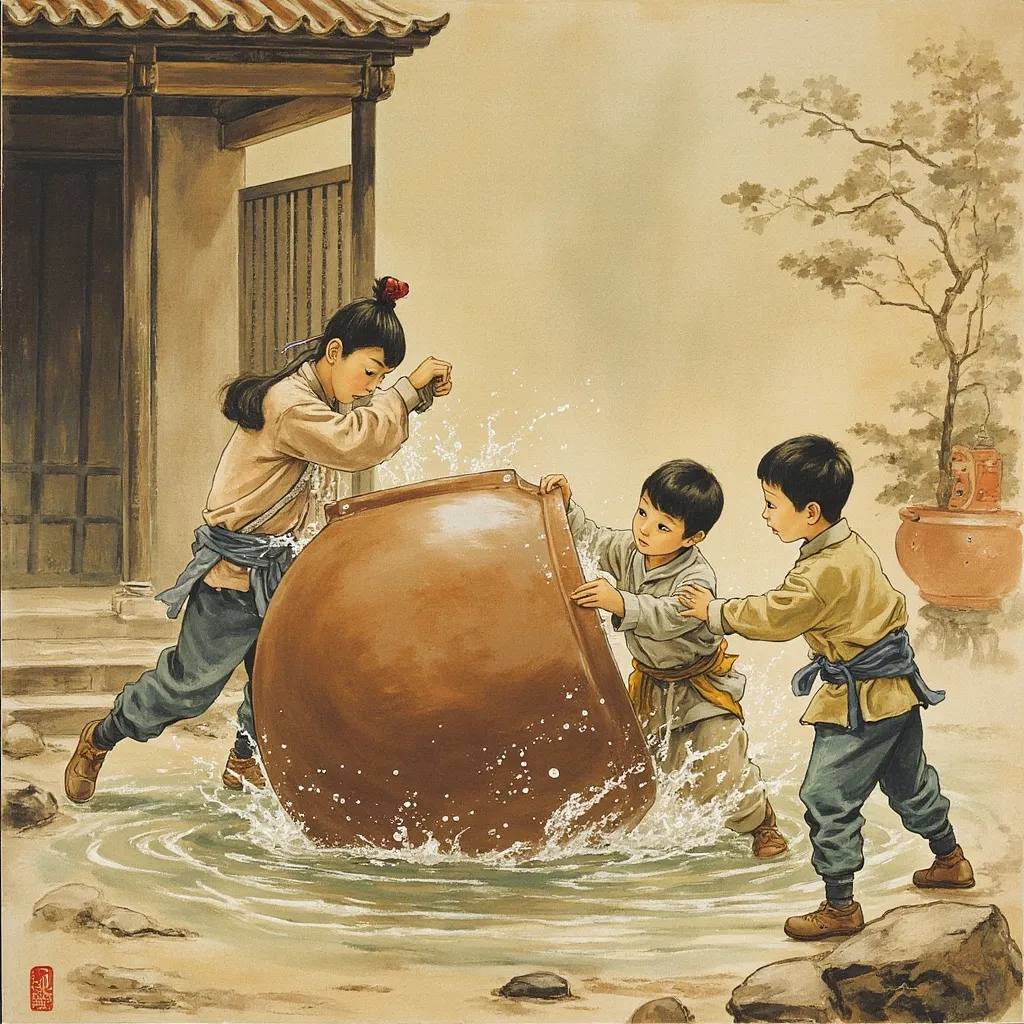
On this fateful day, one of the children had brought a large ceramic water vat to the courtyard. This wasn’t just any container—it was a massive storage vessel, the kind that wealthy households used to keep water cool during the hot summer months. The vat was tall, heavy, and filled to the brim with water. The children, being children, began to play around it, occasionally peering into its depths or touching the water’s surface.
The adventurous boy, eager to show off for his friends, decided to climb onto the rim of the vat. He walked along its edge with the confidence of someone who had done it before. But this time, something was different. Perhaps the rim was wet, perhaps he lost his balance, or perhaps he simply reached too far for something. In an instant, he tumbled over the edge and plunged into the water.
Panic and the Anatomy of a Crisis
What happened next is what makes this story so remarkable. The other children, seeing their friend disappear beneath the water’s surface, immediately panicked. Some screamed. Others ran to find adults. And some just stood there, frozen in shock, watching the water that had suddenly become a death trap.
Think about this for a moment. We’re talking about children here—young children—who had just witnessed their playmate drowning in front of them. Fear is a completely rational response. The brain shuts down, the body freezes, and rational thought becomes nearly impossible. Even adults struggle to think clearly in crisis situations. It’s one of the reasons why emergency response training is so difficult; you have to practice scenarios over and over so that when real danger strikes, your body knows what to do even if your mind hasn’t caught up yet.
But here’s the thing about young Sima Guang: he didn’t panic. Instead, he looked at the situation with an almost cold assessment. He saw the water, he saw the heavy vat, and he saw a nearby pile of rocks that the gardeners used for various tasks around the estate.
Now, you have to understand the physical reality of what Sima Guang did next. Breaking a ceramic vat that size wasn’t easy. These weren’t thin decorative pieces—they were thick, heavy vessels designed to hold enormous amounts of water. A grown man might struggle to break one with a hammer. But Sima Guang, using nothing but a large rock, struck the side of the vat with such force and precision that the vessel cracked and shattered.
The water came rushing out, carrying the drowning boy with it. Within moments, the child was on the ground outside the vat, gasping for air, alive and largely unharmed thanks to Sima Guang’s quick intervention.
The Historical Sima Guang: More Than One Heroic Moment
It’s worth taking a moment to understand who Sima Guang became as an adult, because the child in this story was clearly something special, and that special quality stayed with him throughout his life.
Sima Guang grew up to become one of the most respected scholars, historians, and officials of the Song Dynasty. He served in various high-ranking positions, including chancellor of the imperial court, and is best known for compiling the monumental historical work “Zizhi Tongjian” (Comprehensive Mirror to Aid in Government). This was no small achievement—it was a 294-volume history of China covering from 403 BCE to 959 CE, totaling nearly three million characters in length.
What makes Sima Guang particularly remarkable is his reputation for integrity and moral courage. The Chinese phrase “Sima Guang smashing the vat” (司马光砸缸) has become synonymous with the idea of quick, decisive action in the face of an emergency. But it’s also associated with the broader concept of resourcefulness—using whatever is at hand to solve an unexpected problem.
There’s a famous calligraphic work attributed to Sima Guang that you can still see in various collections today. It shows the young Sima Guang with his rock raised, ready to strike the vat, and it’s become one of those iconic images in Chinese culture. Parents use it as a teaching tool, not just to illustrate quick thinking, but to show children that moral courage can manifest in many forms.
What This Story Teaches Us About Resourcefulness
Now, let’s dig into why this story has resonated with Chinese families for nearly a thousand years. The obvious lesson is about thinking on your feet, about not being paralyzed by fear when someone needs your help. But I think there’s a deeper layer to unpack here.
Resourcefulness isn’t just about being clever with tools. It’s about seeing the world as full of possibilities rather than full of obstacles. When Sima Guang looked at that rock, he didn’t see a gardening implement or a decorative element of the landscape. He saw a solution to a problem. When he looked at the vat, he didn’t see an immovable fixture or a precious piece of property. He saw a container of water, and he understood that water flows downward and that if he could get the water out, the boy would be saved.
This kind of thinking is actually quite rare. Most people, when faced with an unexpected problem, spend too much time trying to solve it the “right” way, the expected way. They look for the proper tools, the proper authority, the proper procedure. But Sima Guang, being a child, hadn’t yet learned all the social conventions that tell us what we’re supposed to do and not do. He just saw a problem and a solution, and he acted.
There’s also something to be said for understanding your constraints. Sima Guang didn’t try to reach into the vat and pull the boy out—he was too small, the vat was too deep, and trying to rescue someone while drowning yourself is a common disaster. Instead, he focused on what he could do with the resources available to him. This is a lesson that applies equally well to modern business, to personal relationships, to everything in between.
Why This Story Still Matters Today
In an age when we’re surrounded by information, when we can look up anything we want in seconds, when we have experts for every conceivable problem, there’s still something powerful about the image of a young boy solving a life-or-death problem with a rock and quick thinking.
Maybe it’s because we all secretly wonder how we would perform under pressure. Would we freeze? Would we panic? Or would we be like Sima Guang, able to see clearly when it matters most?
Or maybe it’s because the story cuts through all the complexity of modern life and reminds us that sometimes, the simplest solution is the right one. You don’t need a complex plan. You don’t need to wait for someone with more authority to tell you what to do. Sometimes you just need to look at what’s in front of you, figure out what needs to happen, and do it.
I think about this story whenever I’m facing a problem that seems overwhelming. I ask myself: if a seven-year-old can break a vat to save a life, what’s my rock? What’s the simple thing I can do right now that will solve this problem or at least move it in the right direction?
The story of Sima Guang breaking the vat has been retold in countless forms over the centuries. It’s been turned into plays, operas, picture books, and animated films. There are traditional Chinese paintings showing the scene, and modern reinterpretations that place the story in contemporary settings. All of this cultural activity is a testament to how deeply this simple story has embedded itself in the Chinese consciousness.
Modern Applications and Learning from the Past
Beyond the purely moral dimension, there are practical lessons here that apply to how we think about education, problem-solving, and even leadership. When we teach children, we often focus on providing them with knowledge—facts, figures, formulas. But Sima Guang’s story reminds us that wisdom is different from knowledge. Wisdom is knowing what to do when the answer isn’t in the textbook.
Some educational psychologists have studied stories like this one and found that they serve an important function in child development. Rather than teaching abstract moral principles, they present scenarios—vivid, memorable scenarios—that children canInternalize and use as reference points throughout their lives. When a child faces a moment of crisis, whether it’s a physical emergency or a social one, the memory of Sima Guang’s calm, decisive action can serve as a template for how to behave.
There’s also an interesting parallel to modern approaches to emergency response training. Military units, emergency services, and even corporate crisis management teams use scenario-based training extensively. They put people in simulated emergencies and train them to react automatically, to bypass the fear response and access that part of the brain that knows what to do. The story of Sima Guang breaking the vat is essentially the ancient Chinese version of this—it’s a mental simulation that prepares children to act when action is needed.
Conclusion: Finding Your Rock
So what should you take away from this thousand-year-old story? I think it comes down to a few key ideas.
First, calmness under pressure is a skill that can be developed. Sima Guang’s ability to stay calm wasn’t magic—it was a product of his character, his upbringing, and probably his natural temperament. But we can all work on our own responses to stress, and we can all try to be the kind of person who thinks clearly when it matters most.
Second, resourcefulness is about seeing possibilities, not obstacles. The next time you’re faced with a problem that seems insurmountable, try asking yourself what tools you have at your disposal. What rocks are lying around that you haven’t noticed? What obvious solutions are you overlooking because you’re too focused on finding the “perfect” solution?
Third, sometimes you just have to act. Sima Guang didn’t have time to organize a committee meeting or write a proposal. Someone’s life was on the line, and he did what needed to be done. In our own lives, we often delay taking action because we want to be certain, because we want more information, because we want approval from others. But sometimes, the bravest thing you can do is just pick up the rock and swing.
The story of Sima Guang breaking the vat has been passed down for nearly a thousand years because it speaks to something fundamental in human nature—the desire to be brave, to be clever, to be the person who saves the day when the moment comes. Whether you’re seven years old or seventy, there’s something in this story for you.