Sima Guang Smashes the Vat: The Boy Who Saved His Friend from Drowning
Imagine you’re seven years old, playing with your friends in a courtyard. One of them climbs onto a giant ceramic vat filled with water — and slips. He falls in. The vat is taller than most adults, and the child is now trapped underwater, drowning in what feels like an instant.
What would you do?
This isn’t a hypothetical. It’s a real moment from Chinese history, and the boy who faced it became one of the most celebrated figures in Chinese culture. His name was Sima Guang (司马光), and he was just seven years old when he smashed the vat with a rock, saving his friend’s life. That moment happened over a thousand years ago, but it still echoes through Chinese art, literature, and the way parents talk to their children today.
The Courtyard That Changed Everything
The year was around 1039 AD, during the reign of Emperor Renzong of the Song Dynasty. Sima Guang was born in 1019 in present-day Shanxi province, into a family that would produce one of the most important historians in Chinese civilization. But at seven, he was just a boy — and like all boys, he spent his afternoons running around with friends in the estate courtyard.
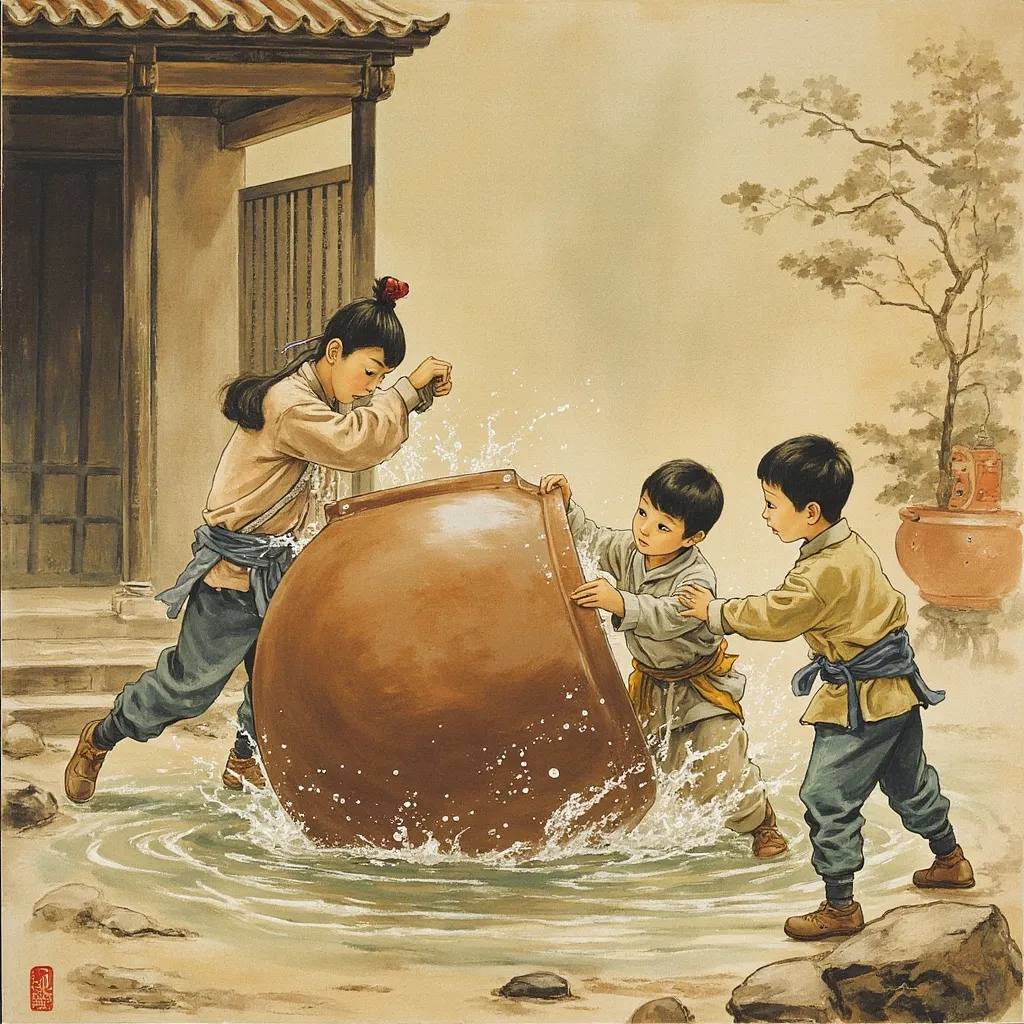
The vat in question was enormous — a great ceramic basin used for storing water, common in wealthy Chinese households of the period. It sat in the courtyard, filled to the brim. The children were playing some kind of game, and one boy — Sima Guang’s friend — climbed onto the rim of the vat to show off. One wrong step, and he went in. The vat was so tall the boy couldn’t reach the top, and he couldn’t swim. He was drowning, and his friends scattered in panic.
Every single one of them ran.
Every single one except Sima Guang.
The Decision That Defined a Lifetime
What made Sima Guang different wasn’t physical strength or superior knowledge. It was something harder to teach: the ability to stay calm when everyone else was panicking, and the creativity to find a solution when the obvious ones weren’t available.
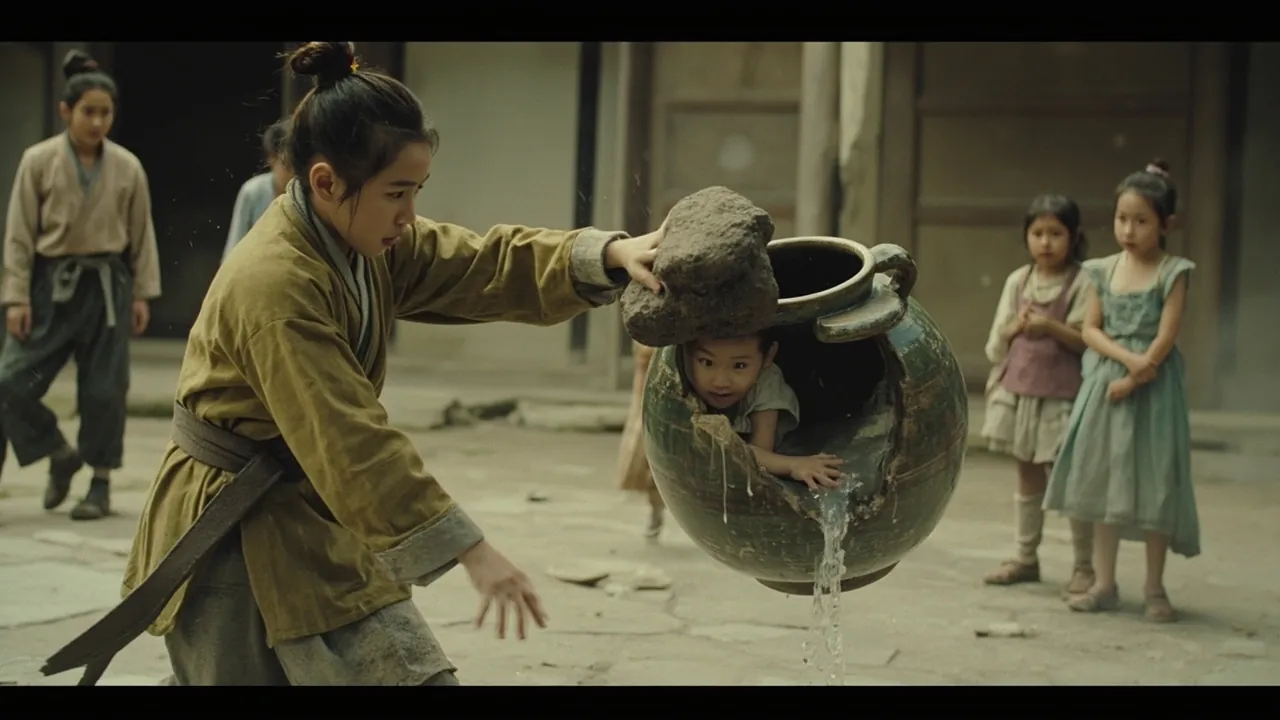
Sima Guang didn’t try to reach into the vat. He didn’t scream for an adult. He scanned the courtyard, spotted a large rock, and did something no one expected. He picked it up and smashed it against the side of the vat.
The ceramic cracked. Water poured out. The water level dropped rapidly — and within moments, his friend was no longer submerged. The boy was rescued from the bottom of the now-drained vat, alive.
It was an act of pure, instant logic: if the water is the problem, remove the water. And it worked.
成年后,司马光成为了一位杰出的政治家和史学家,编撰了《资治通鉴》。但人们记得的首先是这个七岁男孩的瞬间决定。
Why This Story Became a Cultural Touchstone
The tale of Sima Guang smacking the vat spread rapidly through Song Dynasty society. Parents told it to their children. Teachers used it as a moral lesson. Artists painted the scene on scrolls. The story carried several lessons that Chinese culture prized deeply:
资源整合的能力 (zī yuán zhěng hé de néng lì): The ability to use what’s at hand. Sima Guang didn’t wait for a tool to be handed to him or look for the “right” tool. He saw a rock and used it. Resourcefulness was considered a cornerstone of Chinese wisdom.
临危不乱 (lín wēi bù luàn): Remaining calm in a crisis. While other children froze or fled, Sima Guang processed the situation and acted. This quality — not panicking when everything is on the line — was considered the mark of true leadership potential.
见义勇为 (jiàn yì yǒng wéi): Acting righteously despite danger. The story emphasized that true courage isn’t the absence of fear, but action in spite of it.
By the time Sima Guang grew up and became one of the most powerful officials in the Song government, the story of his childhood heroism had already become a fixture of Chinese moral education. He went on to co-author the great historical work the Zizhi Tongjian (资治通鉴), an enormous chronicle of Chinese history spanning sixteen dynasties. But even as a grown man at the pinnacle of political power, people still whispered about the seven-year-old in the courtyard who knew exactly what to do.
What Americans Can Learn From This Story
There’s a reason this story has lasted a thousand years, and it has nothing to do with Chinese borders. It has to do with the universal experience of being a child in a dangerous moment.
Think about the American pioneer stories of children lost in the wilderness, or the tales of young people who pulled their siblings from ponds or高速公路. Every culture has its version of “the child who saved the day.” The Sima Guang story works the same way for Chinese families as stories of young courage work for American ones.
There’s also something genuinely practical here. Sima Guang’s solution was elegant precisely because it was unconventional. When everyone expected him to reach into the vat, he asked a different question: What’s causing the problem? The water. Remove it. It was systems thinking before anyone called it that.
For Americans encountering this story for the first time, it’s worth appreciating that the wisdom here isn’t “be strong” or “be fast.” It’s “be clear.” Clarity under pressure is the rarest commodity in any crisis — and this seven-year-old boy had it.
How This Story Appears in Modern Chinese Life
Walk into almost any Chinese elementary school and ask students about Sima Guang, and you’ll get the story back, often with impressive detail. The tale appears in textbooks. It’s dramatized in television series about Song Dynasty figures. There are museums and historical sites in Shanxi that commemorate the event.
The vat itself — or a replica — has become something of a cultural artifact. Visitors to Luoyang and other historical sites can see recreations of the courtyard, complete with a large ceramic vat, and hear the story told again.
In Chinese internet culture, the phrase “司马光砸缸” has become shorthand for an unconventional solution to an obvious problem. If someone in a discussion suggests an out-of-the-box fix, you might see a comment: “这不就是司马光砸缸吗?” — “Isn’t that just Sima Guang smashing the vat?”
The Broader Legacy of Sima Guang
While the vat story made him a childhood hero, Sima Guang’s adult achievements are what cemented his place in Chinese history. As a historian, he was meticulous and brave — the Zizhi Tongjian took decades to complete and covered over 1,300 years of Chinese history. As a politician, he was known for his integrity and his willingness to stand up to emperors when he believed they were wrong.
But perhaps the most striking thing is that the same qualities he displayed at seven — calm judgment, creative problem-solving, decisive action — are the ones that defined him at seventy. He didn’t outgrow the virtues of childhood. He refined them.
The vat was broken. The boy was saved. And a thousand years later, the lesson remains simple: when everything is going wrong, the clearest thinker in the room is often the one who changes everything.
If you’re interested in other stories of young people who changed history, you might enjoy our article on Cao Chong Weighs the Elephant — another childhood genius story from ancient China. Or explore Kong Rong Yields the Pear to meet another historical figure who showed remarkable character as a child.