There are comeback stories, and then there’s the story of King Goujian of Yue. It’s the kind of tale that sounds almost too dramatic to be real — a king captured, humiliated, forced to serve his enemy as a stable hand, and then somehow clawing his way back to destroy that very enemy years later. The scene changes from a king’s throne room to a horse stable to a humble cottage where a broken man sleeps on firewood and swallows bitter bile — all to keep his purpose alive. But this isn’t mythology. This actually happened, and the Chinese have been telling the story for over two thousand years, using it as both inspiration and warning.
The idiom that came from this history is 卧薪尝胆 — wò xīn cháng dǎn — which translates roughly to “sleeping on firewood and tasting gall.” It sounds cryptic unless you know the story, and once you know the story, you never forget it. The imagery is so visceral, so deliberately unpleasant, that it sears itself into memory. A king who made himself miserable every single day so he would never forget what he had lost. A man who refused comfort because comfort was the enemy of his mission. A conqueror in the making, forged in bitterness rather than strength.
The Fall: How King Goujian Lost Everything
The story begins in the Spring and Autumn period of ancient China, roughly around 494 BCE — a time when the great kingdoms were constantly at war, alliances shifted like sand, and no kingdom could afford complacency. The Kingdom of Yue (roughly modern-day Zhejiang province) had grown powerful under King Goujian’s leadership, expanding its territory and building a navy that gave it dominance over the waterways of eastern China. Their neighbor to the north, the mighty Kingdom of Wu, saw this rising power with alarm.
King Fuchai of Wu was a capable ruler who had inherited a strong kingdom and intended to make it stronger. When it became clear that Yue’s growth threatened Wu’s interests, Fuchai decided to strike first rather than wait for Yue to grow too powerful to contain. He assembled an army and marched south, meeting Goujian’s forces at the Battle of Zhuji. The battle was a disaster for Yue. Goujian’s navy was soundly defeated, and the Wu army pushed deep into Yue territory, spreading terror and destruction as they went.
Facing total collapse, Goujian faced a choice that no leader wants to make: fight to the death and potentially lose everything, including the lives of his people, or surrender and accept whatever terms the victor chose to impose. Goujian made the decision that would haunt him for years to come: he surrendered. Not just surrendered in principle — he submitted himself to King Fuchai as a hostage and servant. This was an act of profound humiliation for a king, an acknowledgment that he was no longer even the equal of his enemy. Fuchai intended to keep it that way, to make sure Goujian understood his new place in the world.
The Degradation: Life as a Captive
The victors didn’t just lock Goujian away in comfortable captivity. That would have been too dignified, too much like respecting an equal. Instead, Fuchai took a particular delight in publicly humiliating his former rival. Goujian was made to serve as a stable hand — caring for horses while the man who had been his enemy sat on the throne. His status as a king meant nothing here. He was reduced to the lowest of servants, expected to perform manual labor that was beneath even commoners, let alone royalty. Every day, he cleaned stalls, fed horses, and performed tasks that his subjects would have considered shameful.
The historical accounts suggest that Fuchai seriously considered simply executing Goujian. A dead enemy king is no threat. But someone talked him out of it — different sources give different reasons. Some say a minister advised that keeping Goujian alive but humiliated would demonstrate Wu’s superiority more effectively than killing him. Others suggest strategic calculation — having a live hostage gave Wu leverage over Yue. Whatever the reason, Fuchai kept Goujian alive but made sure the king knew his place.
But Fuchai, apparently convinced he had broken Goujian’s spirit through years of degradation, made a fateful decision: he let Goujian return to Yue. Perhaps he wanted to demonstrate magnanimity. Perhaps his advisors convinced him that a gracious gesture would earn Yue’s loyalty. Perhaps he simply got careless, distracted by other concerns. Whatever the reason, after several years of captivity, Goujian was sent back to his kingdom — a broken, humiliated man in the eyes of the world.
What Fuchai didn’t realize was that Goujian’s apparent brokenness was entirely performative. Underneath the compliant exterior, underneath the willingness to bow and scrape and serve, was a mind burning with one purpose: revenge. The years of humiliation had not destroyed Goujian. They had focused him. Every indignity, every sneer, every moment of condescension had been filed away in his memory, stored as fuel for the fire he was building. The king had not forgotten who he was. He had simply learned to hide it, to present the face his enemy expected while scheming in the shadows.
The Ascent: How Goujian Rebuilt His Kingdom
Upon returning to Yue, Goujian confronted the wreckage of his former glory. His army was decimated, his treasury depleted by years of tribute to Wu, his people demoralized and traumatized by defeat and occupation. Any sensible observer looking at the situation would have concluded that Yue would never threaten Wu again, that the best the kingdom could hope for was modest survival as a subservient neighbor. Goujian looked at the same situation and saw something else: a starting point.
He didn’t wallow in self-pity or blame his generals for the original defeat. He didn’t make excuses about the overwhelming power of Wu or the inevitability of his defeat. Instead, he did something that most people in his position would never have the discipline to do: he rebuilt, systematically and deliberately, from the ground up. He reformed his government, streamlined his administration, reduced taxes to let his people recover economically, and began the long process of rebuilding his military. But he also did something far more unusual — he committed himself to a regime of self-deprivation that would have broken most men.
The story gains its legendary power from what Goujian did to himself during this rebuilding period. He deliberately made his own life uncomfortable in ways that most people in his position would never consider. He surrounded himself with reminders of his failure, his humiliation, his debt. He refused to let himself forget, even for a moment, what he had lost and what he intended to reclaim.
The Firewood and the Gall: Daily Reminders of Failure
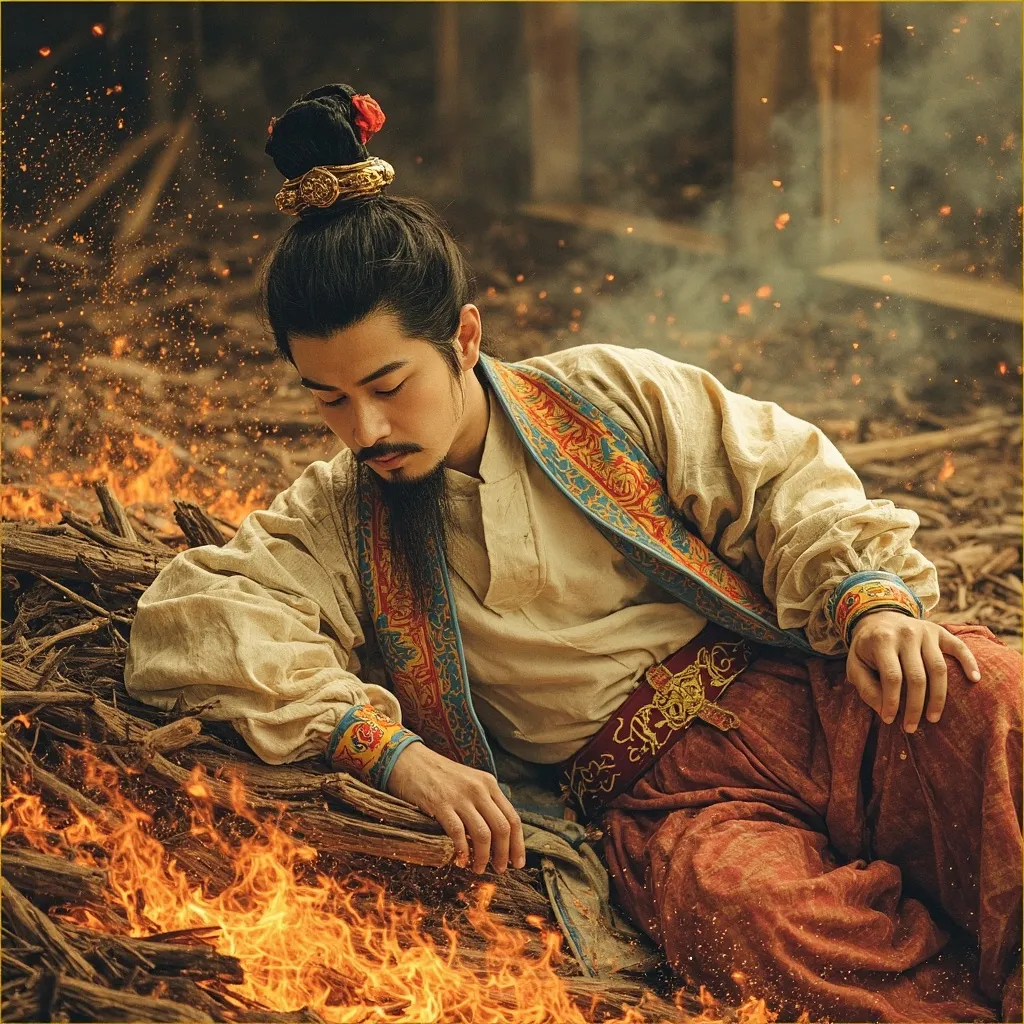
This is where the idiom’s famous imagery comes from, the details that make 卧薪尝胆 such a memorable phrase. Goujian slept not on a comfortable bed but on rough firewood. Every night, the hard, knobby wood pressed against his back, reminding him of the softness of his former life as king — and the softness he had shown in allowing his kingdom to be defeated. He didn’t allow himself the luxuries that his position would normally command. He lived plainly, barely comfortably, as if he were still the captive he had been rather than the monarch he now was again.
But that wasn’t enough. He also kept a gallbladder — the gallbladder of an animal, typically said to be a pig or some other meat source — and he would taste it every day. Every morning, he would put the bitter gallbladder on his tongue and let the taste remind him of the bile he had swallowed, the humiliation he had endured. The bitterness was intentional, a way of making himself physically experience the sourness of his failure every single day. Some versions of the story say he mixed the gallbladder with food; others say he simply chewed on it directly. Either way, the message was clear: this is what defeat tastes like. This is what you will not taste again.
The combination was deliberate and brutal: physical discomfort to keep the body vigilant, and constant bitter taste to keep the spirit sharp. Every comfort that a king might normally enjoy was stripped away. Goujian reportedly also had servants who would wake him if he appeared to be sleeping too peacefully, reminding him of his mission. The message was clear — there would be no rest, no comfort, no peace until the debt was paid. He was not just rebuilding his kingdom. He was forging himself into a weapon of revenge.
Historians debate exactly how much of the traditional account is literal versus symbolic. Some suggest that the “firewood” was actually a symbolic reference to sleeping on a hard floor or practicing archery until his muscles screamed, rather than literally sleeping on logs. Some argue the gallbladder story is exaggerated or purely metaphorical. But the core image endures regardless of historical accuracy: a man deliberately making his own life uncomfortable so that he would never become comfortable with his failure. So that he would never normalize his situation. So that the fire of his purpose would never dim.
The Revenge: An Empire Destroyed from Within
Meanwhile, King Fuchai of Wu had grown complacent. He had won decisively, taken a powerful neighbor out of the equation, and settled into the prosperity that victory brought. But success had made him careless. He expanded militarily in multiple directions, stretching his resources thin. He fought wars on multiple fronts, draining his treasury and depleting his army. He ignored the warnings of his advisors, surrounded himself with yes-men who told him what he wanted to hear, and stopped paying attention to the kingdom he had built.
The very confidence that had led him to defeat Goujian now worked against him. Fuchai stopped being the hungry, strategic ruler who had won at Zhuji and became instead the comfortable king who expected his superiority to be permanent. He stopped questioning his assumptions. He stopped considering the possibility that the humiliated captive he had released might one day return to collect the debt.
Goujian, meanwhile, had been sending a steady stream of gifts and beautiful women to Fuchai — ostensibly tribute, actually poison. The finest silks, the most exquisite wines, the most captivating women from Yue — all presented as gestures of submission and respect. Fuchai, surrounded by luxury and flattery, stopped paying attention to the kingdom he had built. He stopped noticing the subtle weakening of his own state, the growing discontent among his vassals, the slow erosion of his military readiness. The man who had been sharp and strategic became soft and trusting, exactly as Goujian had planned.
For years, Goujian played the long game. He sent spies disguised as servants into Wu’s major cities. He cultivated relationships with Wu’s vassals, making secret alliances that would one day prove useful. He rebuilt Yue’s military in secret, far from Wu’s borders, developing new tactics and new weapons that his enemy knew nothing about. He sent his own ministers to study Wu’s weaknesses. And all the while, he slept on firewood and tasted gall, letting the bitterness fuel him forward, refusing to let comfort steal his edge.
Finally, when the moment was right — when Wu was weakened, overextended, and caught off guard by a crisis on another front — Goujian struck. His forces invaded Wu with everything they had, launching the attack that years of planning had prepared. The result was never really in doubt. Wu, for all its former strength, had been rotting from within for years. Its army was depleted, its alliances frayed, its king distracted by pleasure. Wu fell, and King Fuchai, confronted with the ruin of everything he had built, took his own life rather than face the conqueror he had once humiliated.
Goujian had done the seemingly impossible. He had gone from captive to conqueror, from humiliation to total victory. The man who had stableed his enemy’s horses now controlled the enemy’s throne. The story, as the Chinese tell it, ends with Yue ascending to become one of the dominant powers of the later Spring and Autumn period, while Wu faded into irrelevance. The reversal was complete.
What 卧薪尝胆 Really Means Today
The idiom has become shorthand in Chinese for a particular kind of determined, disciplined recovery from setback. It captures something that most Western narratives about success tend to miss: the importance of staying angry, of not letting yourself forget what was taken from you, of using pain as fuel rather than letting it paralyze you. In Chinese business culture, in particular, 卧薪尝胆 is often invoked when describing a company’s long struggle back from failure or a leader’s patient climb back to prominence after a professional defeat.
Modern interpretations sometimes soften this into “perseverance” or “determination,” and those are certainly part of it. But the original story carries a sharper edge than those vague inspirational words suggest. Goujian didn’t just work hard. He worked hard while deliberately making himself miserable, because he believed comfort was a trap. He refused to allow himself a single moment of peace until the mission was complete. He ate bitterness every day so that bitterness would not catch him unprepared when the time came to fight.
This isn’t an approach that works for everyone, and modern psychologists might well note the psychological risks of such prolonged self-imposed deprivation. The story does not have a “self-care” ending. Goujian becomes a conqueror but also, presumably, a man who has forgotten how to be anything other than a weapon. There’s something tragic in that, something cautionary even as the story is used for inspiration.
But there’s something to be said for the intensity of it — the refusal to let go of the wound, the insistence that the debt must be paid, the commitment to a purpose larger than immediate comfort. In a world that constantly tells us to “move on,” “let go,” and “practice self-care,” the story of 卧薪尝胆 offers a counter-narrative. Sometimes the right response to humiliation isn’t healing — it’s action. Sometimes the appropriate response to being knocked down isn’t to dust yourself off and feel better immediately. It’s to stay on the ground, feel the pain with absolute clarity, and then use that pain to fuel the climb back up. Goujian’s story doesn’t have a clean moral about “winning not mattering” or “revenge being unhealthy.” It simply tells you what happened: a broken man rebuilt himself into a conqueror through an act of will that bordered on the superhuman. Whether that’s inspiring or terrifying probably depends on which side of the story you were on.