程门立雪:尊师重道的千古佳话
Every culture has its foundational stories about the relationship between teachers and students. In the Western tradition, we have accounts of Socrates walking through Athens with his disciples, arguing about virtue until the end. In Indian culture, the guru-shishya parampara — the lineage of teacher to student — stretches back thousands of years. And in China, one of the most enduring images of pedagogical devotion is captured in the idiom 程门立雪 (Chéng mén lì xuě), which literally means “standing in snow at Cheng’s door.”
This isn’t a story about a student who overcame poverty or mastered some great intellectual challenge through sheer force of will. It’s quieter than that, and in many ways more profound. It’s a story about patience, respect, and the recognition that learning requires humility — the willingness to wait, to endure discomfort, and to acknowledge that someone else possesses knowledge you need and don’t yet have.
In an age when we can Google anything, watch tutorial videos on any subject, and learn from AI chatbots at any hour of the day, the story of 程门立雪 asks us to reconsider something we’ve perhaps lost: the understanding that some knowledge can only be transmitted through genuine human relationship, and that receiving that knowledge requires a certain posture — one of respect, patience, and openness.
The Historical Figures: Two Students and Their Teacher
The story of 程门立雪 takes place during the Northern Song Dynasty, around the year 1093 CE. The two students at the center of the story were Yang Shi (杨时) and You Cuo (游酢), both of whom were already accomplished scholars in their own right when this incident occurred.
Yang Shi, born in 1053, was originally from what is now Fujian province. He had studied under several notable teachers and had developed a reputation for both intellectual ability and moral character. You Cuo, similarly, came from a learned family and had already passed the imperial examinations at a young age. These were not novices or children looking for basic instruction. They were grown men with established credentials seeking advanced philosophical guidance.
Their teacher was Cheng Yi (程颐), one of the most important Confucian philosophers of the Song Dynasty. Cheng Yi, along with his brother Cheng Hao, had developed a sophisticated philosophical system that would eventually become known as neo-Confucianism — a comprehensive worldview that sought to reconcile Buddhist and Taoist insights with classical Confucian teachings. Cheng Yi’s interpretations of the Confucian classics were considered authoritative, and students came from across the empire to study under him.
Cheng Yi taught at a private academy near the town of Luo Yang, the capital of the Northern Song Dynasty. His reputation was such that even high-ranking officials would seek his counsel, and the imperial court itself sometimes requested his opinion on matters of state and ritual.
For Yang Shi and You Cuo, studying under Cheng Yi represented the pinnacle of their intellectual ambitions. They had traveled a considerable distance to reach him, leaving behind their families and official positions to dedicate themselves fully to philosophical study. This context matters. They weren’t casual learners or dilettantes playing at philosophy. They were serious scholars who understood exactly what they were seeking and from whom.
The Incident: What Actually Happened
The classic account of 程门立雪 is beautifully simple. Yang Shi and You Cuo arrived at Cheng Yi’s residence seeking to study with him. When they reached his door, they found the master inside, apparently in the middle of a conversation with another visitor — or, in some versions of the story, resting or meditating.
Rather than disturb him by knocking or calling out, Yang Shi and You Cuo decided to wait.
They waited outside the door.
And they kept waiting.
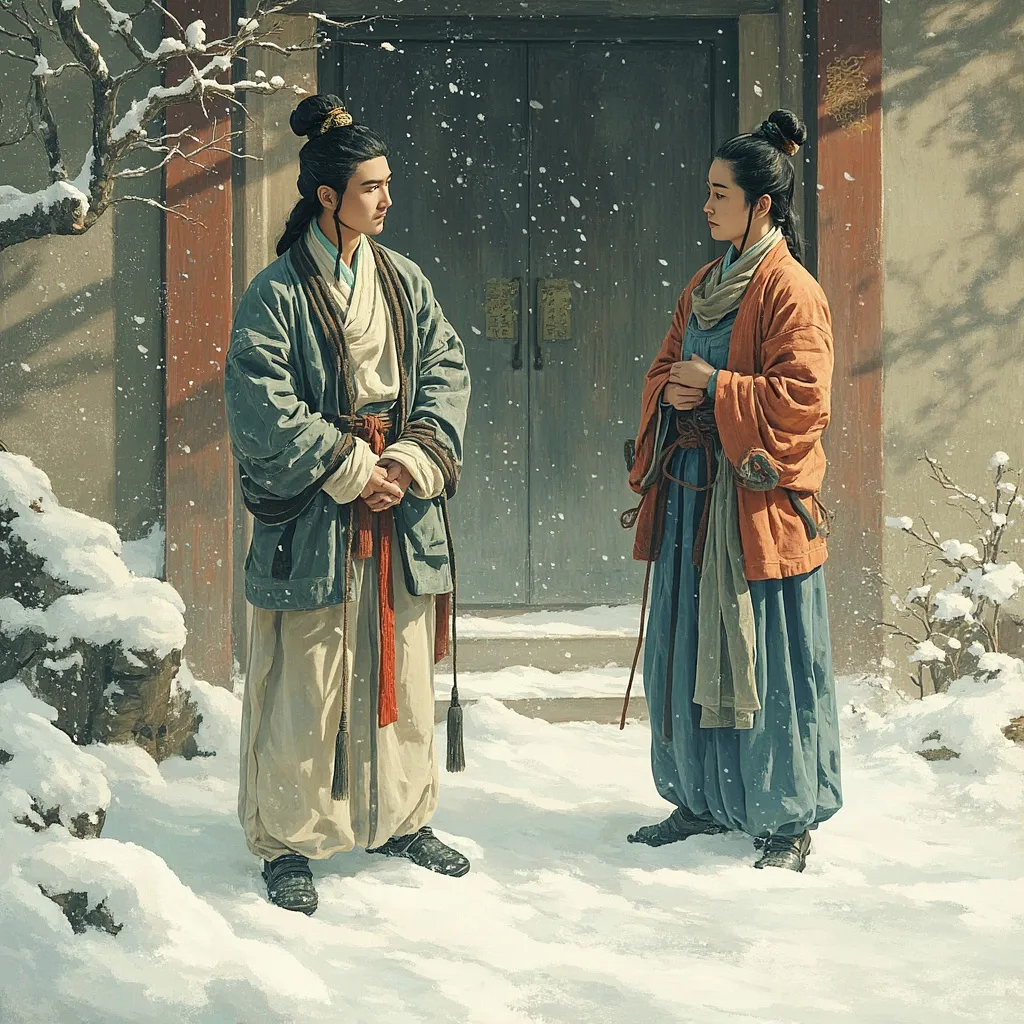
According to the traditional account, a heavy snow began to fall. The two men stood in the courtyard, enduring the cold and the accumulating snow without complaint. They did not seek shelter. They did not attempt to gain entry through any stratagem. They simply stood, respectful and patient, waiting for the teacher to become available.
The snow fell harder. It piled up around their feet and on their shoulders. Still, they waited.
When Cheng Yi finally emerged — some accounts say hours later, others suggest a full day — he found two snow-covered figures standing quietly in his courtyard. The snow around them had accumulated to roughly a foot deep, and both men were visibly cold but showed no sign of impatience or irritation.
The story doesn’t record whether Cheng Yi was moved to tears, angry at himself for keeping them waiting, or simply quietly pleased. What we know is that he accepted them as students, recognized their exceptional character, and gave them the instruction they had traveled so far to receive.
The phrase 程门立雪 entered the Chinese lexicon as a shorthand for this kind of patient, respectful devotion to learning. It became a model for how students should approach teachers — with humility, endurance, and the willingness to subordinate personal comfort to the pursuit of knowledge.
Why This Story Matters More Than Ever
In some ways, the conditions that made 程门立雪 meaningful have changed dramatically. In the 21st century, we have access to more information, more instructional content, and more learning resources than any previous generation. If you want to learn almost anything — from quantum physics to ancient Chinese philosophy to how to bake sourdough bread — you can find high-quality instruction online, often for free.
This is genuinely wonderful. It democratizes knowledge in ways that previous generations couldn’t have imagined. A young person in a rural village in Africa can now access the same introductory courses as a student at Harvard. That’s an extraordinary development, and we should celebrate it.
But here’s what technology hasn’t replicated: the irreplaceable value of a living human relationship between teacher and student. The story of 程门立雪 captures something that no online course, no matter how well-produced, can provide. It captures the experience of waiting for another human being, of recognizing that this person’s time and attention are valuable and finite, of subordinating your immediate desires to the reality of another person’s existence.
There’s also the dimension of embodied knowledge. Cheng Yi wasn’t just transmitting information. He was modeling a way of being — a way of thinking, of questioning, of engaging with ideas that Yang Shi and You Cuo couldn’t have learned from a book or a video. Philosophy isn’t just a body of knowledge; it’s a practice, a discipline, a form of life. And the only way to learn a practice is to watch it being done by someone who has mastered it, to ask questions in real time, to receive feedback and adjust accordingly.
This is why mentorship still matters so much, even in the age of the internet. It’s why the relationship between a doctoral student and their advisor is qualitatively different from reading a textbook. It’s why a young professional can learn more from spending a year watching a skilled colleague work than from a hundred online tutorials.
程门立雪 captures this truth in a single, vivid image. The snow isn’t just weather; it’s the physical manifestation of the student’s willingness to wait, to endure, to make themselves available to learning on the teacher’s terms rather than their own.
The Confucian Context: Why Respect for Teachers Was Paramount
To understand why this story became so celebrated, we need to appreciate the Confucian framework in which it originated. In classical Confucian thought, the relationship between teacher and student is one of the five fundamental human relationships — alongside those between ruler and subject, parent and child, husband and wife, and elder and younger sibling.
The teacher-student relationship was conceived as analogous to the parent-child relationship. Just as children owe their parents filial piety — respect, obedience, and care in old age — students owe their teachers similar reverence. The Chinese character for “to learn” (学) was sometimes analyzed in classical times as consisting of elements meaning “the child receiving the knowledge of the generations.” Learning was framed as an act of intergenerational transmission, a continuation of the wisdom of the past into the present.
This framework had concrete implications. Students were expected to treat their teachers with formal respect, to follow their instructions even when those instructions seemed difficult or arbitrary, and to prioritize the teacher’s comfort and reputation. In turn, teachers were expected to treat their students with genuine care, to passing on not just technical knowledge but moral and philosophical wisdom, and to accept responsibility for their students’ development as human beings.
Cheng Yi himself wrote extensively about the importance of the teacher-student relationship. He argued that without proper guidance, students would inevitably go astray, no matter how intelligent or well-intentioned they might be. The teacher’s role was to correct errors, challenge assumptions, and push students toward genuine understanding rather than mere intellectual performance.
This is the context in which 程门立雪 makes sense. Yang Shi and You Cuo weren’t just being polite by waiting in the snow. They were performing an act of profound respect that signaled their readiness to receive Cheng Yi’s teachings. They were saying, without words: “We understand that you have knowledge we need. We are willing to endure discomfort to gain access to that knowledge. We place your time and your wisdom above our own immediate comfort.”
That kind of posture doesn’t come naturally to most people. And that’s precisely why it became a celebrated virtue.
Modern Applications: Respect and Patience in Contemporary Learning
How do we apply the wisdom of 程门立雪 to our own lives, especially when the dominant culture of the internet encourages the opposite — instant access, immediate answers, and the assumption that knowledge should be free and frictionless?
One approach is to think about the concept of asymmetrical respect in learning relationships. In the Song Dynasty, the respect shown by students to teachers was asymmetrical — students gave more respect than they received in material terms. But the relationship was ultimately reciprocal. The teacher gained something too: the satisfaction of transmitting knowledge, the legacy of seeing students succeed, the continuation of their intellectual lineage.
We can look for modern learning relationships that replicate some of this reciprocity, even in informal contexts. When you ask an expert a question, recognize that you’re asking for something valuable — their time, their attention, their hard-won knowledge. Approach that request with appropriate humility. Don’t demand answers; request them. Don’t assume the expert owes you their time; thank them for giving it.
Another application is more personal: practicing patience with the learning process itself. In an era of 30-second videos and productivity hacks, the slow, patient accumulation of knowledge through years of practice can feel antiquated. But the most valuable kinds of learning — the kind that change how you think, not just what you know — require exactly this kind of patience.
Think of learning a musical instrument, a new language, or a complex professional skill. None of these can be rushed. They require showing up day after day, accepting that you’ll make mistakes, enduring the discomfort of being a beginner, and trusting that the process will eventually produce results. 程门立雪 is a reminder that this kind of patient endurance has value, even when — especially when — it feels like the progress is too slow to measure.
The Story’s Legacy in Chinese Culture
程门立雪 became one of the most frequently cited stories in discussions of education and teacher-student relationships in Chinese culture. It appeared in moral instruction texts for children, in essays by scholars reflecting on the nature of learning, and in the biographies of famous Confucian teachers and their students.
The story was used to illustrate several related virtues: filial piety (the broader Confucian value of respect for those who came before), persistence (the willingness to endure hardship in pursuit of a goal), and intellectual humility (the recognition that even accomplished people still need teachers).
Over the centuries, the story also became a subject for artists. Paintings depicting Yang Shi and You Cuo standing in the snow outside Cheng Yi’s door have been created by numerous artists, each trying to capture the stillness and devotion of the scene. These works typically show two robed figures in a snowy courtyard, their posture erect and respectful, their faces calm despite the winter weather. The door to Cheng Yi’s residence is typically shown as partially open, suggesting the imminent possibility of learning.
The story also gave rise to a related tradition: the idea that prospective students should demonstrate their commitment before being accepted as disciples. Some later accounts of the story emphasize that Cheng Yi was testing his visitors, and that their willingness to wait in the snow was itself a form of examination. This interpretation reinforced the idea that genuine learning requires sacrifice, and that those unwilling to make sacrifices are unworthy of serious instruction.
What We Can Learn From Standing in the Snow
Ultimately, 程门立雪 is a story about what we value and how we show it. Yang Shi and You Cuo valued knowledge. They showed that value through their actions — through their willingness to endure discomfort, to wait without complaint, to signal their readiness through deed rather than word.
This is a challenge to the modern assumption that knowledge should be easily accessible and that asking people to struggle to learn is elitist or unfair. There’s a difference between making education broadly accessible (which is genuinely important) and eliminating all friction from the learning process (which may actually undermine depth and commitment).
The most meaningful learning relationships — the ones that genuinely transform how we think and who we are — rarely come through frictionless digital interfaces. They come through encounter with another person, through the experience of waiting and wanting and eventually receiving. They require us to stand in the snow, at least metaphorically, and demonstrate that we’re willing to endure the discomfort of being beginners.
So the next time you find yourself frustrated by a slow mentorship process, a demanding course, or a teacher who doesn’t immediately give you the answers you want, remember the two scholars standing in the snow outside Cheng Yi’s door. They got exactly what they came for — not because they demanded it, but because they were willing to wait for it.
Recommended Resources for Deepening Your Learning Practice
1. Online Courses in Chinese Philosophy and Confucian Studies — Continue your journey into traditional Chinese thought with structured online courses. Study under expert instructors and join learning communities that value depth over speed.
2. Premium Study Journal for Philosophical Reflection — Like Yang Shi and You Cuo, cultivate the habit of serious reflection on what you learn. A dedicated journal helps you process ideas deeply and track your intellectual development over time.
3. Traditional Chinese Calligraphy Practice Book — Honor the tradition of scholarly discipline passed down through generations of Chinese learners. Practice calligraphy as both a meditative discipline and a connection to classical learning methods.
4. Premium Tea Set for Study Sessions — In the Song Dynasty, scholarly discussions were often accompanied by tea. Create your own atmosphere of mindful learning by preparing tea during your study sessions and approaching them with the same reverence as Yang Shi brought to Cheng Yi’s door.
5. Book: The Analects of Confucius — Complete Translation with Commentary — Go to the source. The teachings that Cheng Yi interpreted and that Yang Shi studied are available in this comprehensive translation. Understanding the classical texts will deepen your appreciation of why stories like 程门立雪 became so central to Chinese culture.