Most of us have had a teacher who changed our life. Maybe it was someone who saw potential in us when we couldn’t see it ourselves, who pushed us past our limits, who opened our eyes to ideas we’d never encountered. Now imagine standing outside that teacher’s door in a blizzard, waiting in the snow for hours — not because they asked you to, but because you simply refused to interrupt them. That’s the scene that gives us 程门立雪 (chéng mén lì xuě), literally “standing in snow at Cheng’s gate.” It’s one of the most beautiful idioms in Chinese for the reverence a dedicated student owes to their teacher.
The idiom originates in the Song Dynasty (960–1279 CE), a period that produced some of China’s greatest philosophers, poets, and painters. Among the most influential thinkers of that era were the Cheng brothers — Cheng Hao and Cheng Yi — who helped shape the school of Neo-Confucianism that would dominate Chinese intellectual life for centuries. It was Cheng Yi, the younger brother, who was the subject of one of the most famous stories about teacher-student devotion in Chinese history.
The Two Cheng Brothers and Their Legacy
Before getting to the story, it helps to understand who Cheng Yi was and why his opinion mattered so much. Cheng Yi (1033–1107 CE) was a philosopher, educator, and one of the most important figures in the development of Neo-Confucian thought. Alongside his older brother Cheng Hao, he worked to synthesize ideas from earlier Confucian traditions, Buddhist philosophy, and Daoist metaphysics into a coherent new system that explained everything from individual ethics to the nature of the universe.
Cheng Yi was known for the rigor of his thinking and the exacting standards he applied to his own work and that of his students. He was not an easy teacher in the sense of being lenient or forgiving of sloppy thinking. He demanded precision, depth, and genuine understanding rather than rote memorization or superficial performance. For a student who wanted to truly learn from him, the bar was high — but the reward was genuine insight.
The story of 程门立雪 involves one of Cheng Yi’s students — Yang Zhu (also spelled Yang Shi), who would go on to become one of the most prominent Neo-Confucian scholars of the next generation. Yang Zhu was a serious student who had traveled from afar to study under Cheng Yi, recognizing that the younger Cheng brother was one of the greatest minds of his era. He had committed himself to learning everything Cheng Yi could teach him.
The Day It Snowed
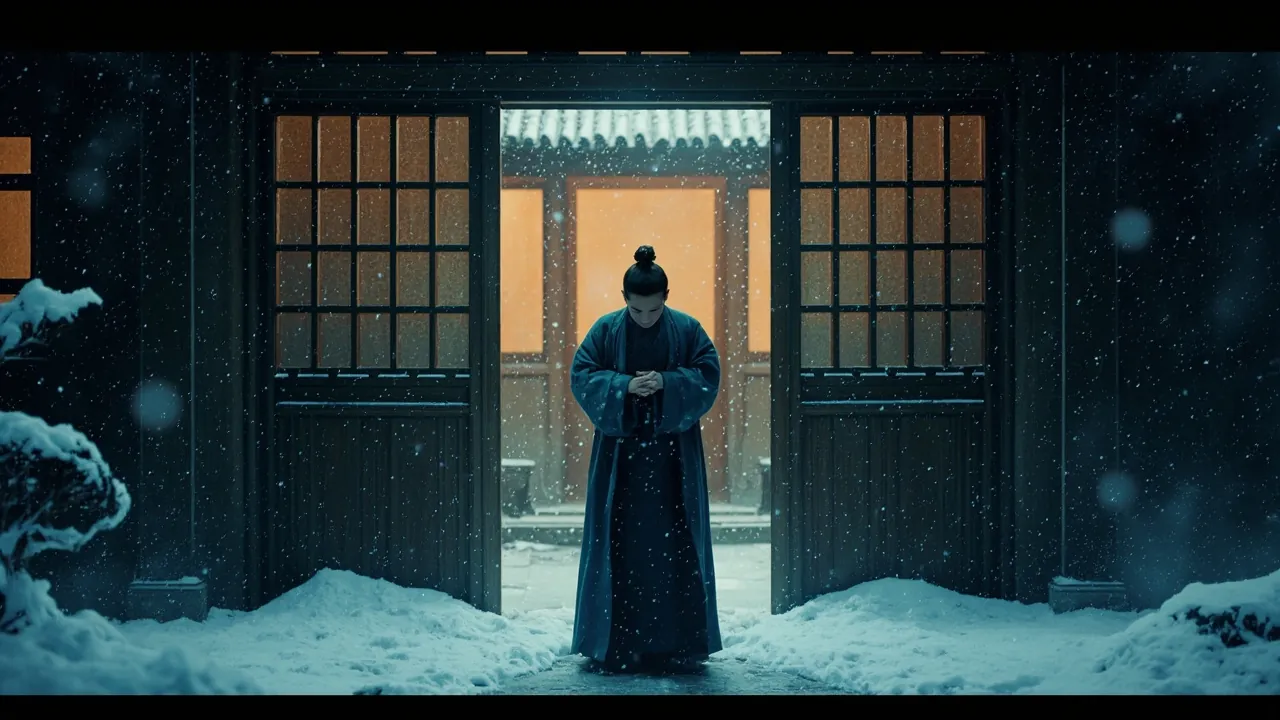
The story takes place on a winter day when Yang Zhu arrived at Cheng Yi’s home seeking instruction. It was the middle of winter, and a heavy snow was falling — the kind of snow that turns pathways into rivers of slush and makes outdoor waiting deeply uncomfortable. Yang Zhu reached Cheng Yi’s gate and found it closed.
What happened next depends a bit on which version of the story you read, but the core details are consistent. Yang Zhu knocked or called out, but received no answer. Cheng Yi was inside, occupied with something — perhaps another student, perhaps deep in his own studies. Yang Zhu faced a choice: make more noise and demand attention, or simply wait.
He chose to wait. And then he kept waiting.
Yang Zhu stood outside the gate in the falling snow, not moving to seek shelter, not calling out again, not taking any action that might disturb whatever Cheng Yi was doing inside. Hours passed. The snow accumulated on his shoulders and head. He must have been cold, wet, uncomfortable — possibly dangerously so. But he waited.
When Cheng Yi finally emerged and saw his student standing in the snow, the story diverges slightly depending on the source. Some versions say Cheng Yi was so moved by Yang Zhu’s patience and respect that he accepted him as a disciple on the spot. Others say Cheng Yi was initially displeased at finding a student who couldn’t manage his time better, but was won over by Yang Zhu’s explanation that he simply could not bring himself to interrupt a teacher’s privacy. Either way, the end result was the same: Yang Zhu became Cheng Yi’s student, and the story became immortal.
What the Snow Represents
The snow in the story is doing heavy symbolic work. Snow is cold, uncomfortable, and potentially dangerous. Standing in snow is not a pleasant experience by any measure. But Yang Zhu didn’t complain about the snow, didn’t try to减轻 his discomfort, didn’t look for ways to make his vigil easier. He simply stood there, enduring, because he believed that the act of waiting — of demonstrating patience and respect — was more important than his immediate comfort.
This is the core of what 程门立雪 communicates: genuine respect for a teacher isn’t about what you say or how much you flatter. It’s about what you’re willing to endure on behalf of that relationship. The snow was a test, and Yang Zhu passed not by saying the right things but by doing the right thing — quietly, without fanfare, without expecting praise.
The idiom also captures something specific about the cultural context in which it emerged. In Song Dynasty China, the relationship between teacher and student was considered one of the most important in society — comparable in some ways to the relationship between parent and child. A student who showed disrespect to their teacher was viewed almost as severely as a child who showed disrespect to their parents. Conversely, a student who showed extraordinary devotion — like Yang Zhu standing in the snow — was celebrated as embodying the ideal of the serious learner.
The Broader Principle: Reverence Creates the Condition for Learning
There’s a deeper insight embedded in this story about the relationship between reverence and learning. Cheng Yi was an exacting teacher who demanded a lot from his students. But he could afford to demand a lot precisely because he knew his students had chosen him deliberately and came to him with genuine respect. A student who has stood in the snow for hours to gain an audience isn’t going to waste that opportunity with superficial work or lazy thinking. The reverence comes first; the learning follows.
This is a pattern that shows up repeatedly in the history of education. The best learning happens when the student approaches the material — or the teacher — with genuine respect and openness. A student who thinks they already know everything, or who views their teacher as an obstacle rather than a resource, learns far less than one who comes with humility and genuine curiosity. The snow that Yang Zhu stood in wasn’t just weather; it was an expression of the internal disposition that made him ready to learn.
Modern education often struggles with this dynamic. The ease of access to information — Google, YouTube, Wikipedia — has created a culture where students can feel like they don’t need teachers in the same way previous generations did. And in some narrow sense, that’s true: facts are more accessible than ever. But the deeper function of a great teacher — the ability to challenge assumptions, to push students past their comfort zones, to model what genuine intellectual rigor looks like — requires a relationship that can’t be replaced by a search engine. The student who approaches that relationship with contempt or indifference will learn far less than the one who approaches it with something like Yang Zhu’s patience.
How 程门立雪 Is Used Today
In modern Chinese, 程门立雪 is most commonly used in contexts involving respect for teachers, mentorship, and the value of education. It’s the kind of phrase that might appear in a graduation speech, an article about educational philosophy, or a conversation about the importance of finding good mentors. It carries connotations of traditional values — filial piety applied to the teacher-student relationship — and is often invoked with a note of nostalgia for an era when that relationship was treated with more solemnity.
The idiom is also used more broadly to describe any situation where someone demonstrates extraordinary patience and respect in pursuing knowledge or guidance. A young professional who persistently but respectfully seeks mentorship from a senior figure might be described as having 程门立雪精神 — the spirit of standing in snow at Cheng’s gate. The phrase suggests both the patience to wait and the humility to recognize that the person you’re seeking wisdom from is worth waiting for.
The Limits of the Metaphor
It’s worth noting that the extreme patience Yang Zhu displayed is not universally praised in Chinese tradition. Some versions of the story include a note of concern: waiting in a blizzard for hours could easily have resulted in frostbite or worse. There are healthier ways to demonstrate respect for a teacher, and modern readers often note that a good teacher would prefer a student who speaks up over one who quietly endangers themselves.
This is the tension that 程门立雪 sits within: the traditional emphasis on absolute reverence for teachers sometimes conflicted with more pragmatic concerns about student wellbeing. The idiom celebrates Yang Zhu’s patience and humility, but it also implicitly raises questions about the boundaries of deference. When does respect become self-destruction? When does devotion become unhealthy obsession?
These questions don’t have clean answers, and the idiom doesn’t pretend to resolve them. It simply holds up Yang Zhu’s example — his willingness to endure discomfort for the sake of learning — as something worthy of admiration. The snow was cold, but the learning was worth it. At least, that’s the calculation Yang Zhu made, and the calculation that Chinese culture has celebrated for nearly a thousand years.
The Legacy of One Student’s Vigil
Yang Zhu went on to become one of Cheng Yi’s most prominent disciples, carrying forward the elder scholar’s ideas and eventually helping to spread Neo-Confucian philosophy throughout China. He was known for his own rigor as a teacher, which suggests that whatever he learned from Cheng Yi in that snowy vigil — and in the years that followed — made a deep and lasting impression.
The idiom that emerged from his moment of patient devotion has outlasted the Song Dynasty, the snow, and the gate itself. Today, 程门立雪 serves as a reminder that learning requires something from the learner — not just time and intelligence, but also humility, patience, and a genuine willingness to wait for the knowledge you need. The student who stands in the snow long enough eventually gets through the gate. The lesson isn’t about the snow itself; it’s about what’s on the other side, and how badly you want to get there.