In the popular imagination, great victories are loud things. They happen in the clash of steel, in the thunder of charging cavalry, in the desperate scramble of soldiers scaled walls at dawn. History books fill with the names of warriors and conquerors, men whose strength on the battlefield became the stuff of legend. But the real turning points of history often happen somewhere very different — in quiet rooms, in hushed conversations, in the minds of people who never threw a punch or swung a sword but whose thinking reshaped the world nonetheless.
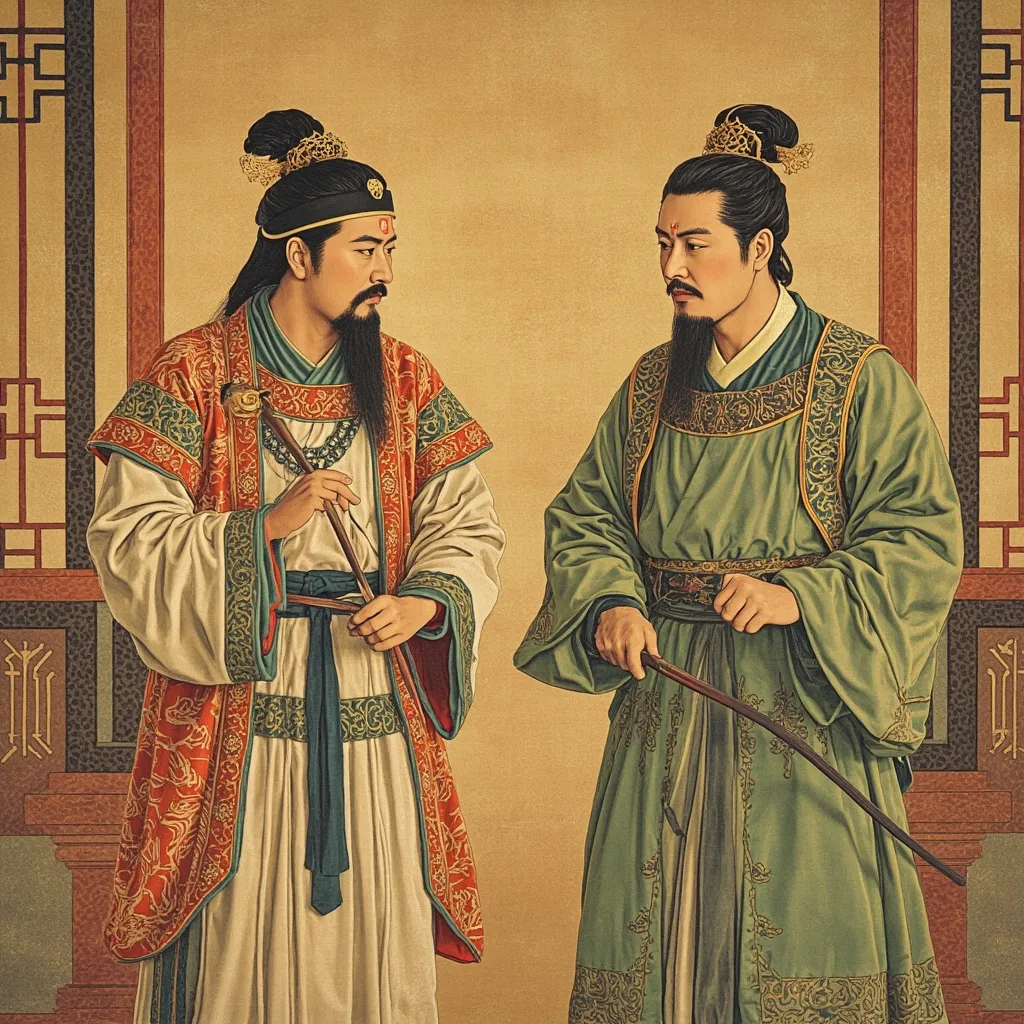
Zhang Liang was one of those people. He never commanded an army in the conventional sense. He never won a duel or held a fortress. What he did was harder, stranger, and ultimately more consequential: he sat in a tent and thought. He analyzed situations with a precision that bordered on the uncanny, developed plans that accounted for every possible variable, and presented his conclusions to Liu Bang at moments of crisis with a calm that made panic seem unnecessary. For this — for the simple act of planning from behind the scenes — he earned a phrase that has been used to describe the finest strategic minds for over two thousand years.
运筹帷幄 (yùn chóu wéi wò). To strategize within the commander-in-chief’s tent. To plan from behind the scenes. To win battles without ever picking up a weapon.
The Disgraced noble Who Refused to Disappear
Zhang Liang’s story begins in tragedy. He was born into one of the great noble families of the Qi kingdom during the混乱 of the late Qin Dynasty, the son of a man who had served as a minister to the king. His family had wealth, status, connections — all the things that made a comfortable life possible in an era of remarkable upheaval. But the Qin Emperor Shihuangdi was systematically destroying the old noble order, and Zhang Liang’s family was not spared. When he was young, his father was assassinated, part of a broader purge of disloyal nobles. Zhang Liang was suddenly alone, orphaned, stripped of rank and inheritance, left to survive in a world that had been deliberately designed to crush everyone his family had once been.
He did what many desperate young men did in that era: he fled. His journey took him across the broken landscape of former kingdoms, through war zones and refugee trails, until he eventually arrived in the kingdom of Qi as a fugitive with a price on his head. There, in a twist of fate that reads like fiction, he was taken in by a man named Huang Shigong — a hermit and rumored sage who recognized something in the young refugee’s eyes that others had missed.
Huang Shigong took Zhang Liang under his wing and began teaching him what would later be called the Art of Unseen Victory (以奇制胜). The core of this teaching was deceptively simple: the most powerful movements are the ones your opponent never sees coming. True strategy is not about matching strength with strength, about confronting your enemy when and where he expects you. It is about understanding the entire field of conflict — political, psychological, economic, geographical — and finding the point where minimal force applied at the right moment produces maximum effect.
Zhang Liang absorbed these lessons with an intensity that impressed even his mentor. Within a few years, he had transformed himself from a desperate refugee into one of the most dangerous strategic minds of his generation. But he had no way to prove it — no army, no patron, no platform from which his ideas could make a difference. The great warlords of the age were busy fighting each other, and none of them were looking for a philosopher-thinker who spoke in terms of systems and patterns rather than swords and shields.
The Meeting That Changed Everything
The opportunity Zhang Liang had been waiting for arrived with Liu Bang.
Liu Bang was not an obvious candidate for conquest. He was a peasant-born commoner with minimal education, a man who had spent much of his early life as a minor official in his home district. He had no noble blood, no family legacy of military leadership, and what seemed like a fundamental inability to take anything seriously for long enough to execute a complex plan. Those who met him for the first time often came away confused — how could this laughing, irreverent man possibly pose a threat to the established order?
Zhang Liang saw something different. He saw a man whose very unpredictability was a kind of strength, a leader who could move through rigid social structures that would have blocked a more conventional figure. More importantly, he saw a man who was capable of recognizing genuine talent when it presented itself, a ruler who would actually listen to advice rather than surrounding himself with yes-men and flatterers. After the fall of the Qin Dynasty, when Liu Bang was establishing his initial power base, Zhang Liang approached him with a proposal.
What happened next became part of the legend. Zhang Liang did not arrive with a army or a wealth of political connections. He came with something more valuable: a detailed plan for conquering the Qin heartland. He had studied the geography of the region, the disposition of forces, the psychology of the Qin court after the death of Shihuangdi. He knew exactly which passes needed to be held, which cities would yield to negotiation, which strategic points would determine the outcome of any campaign. His presentation to Liu Bang was not a vague pitch about grand possibilities — it was a working document, a genuine operational plan that laid out step-by-step how Liu Bang could accomplish something that every other warlord in China was attempting and failing.
Liu Bang was stunned. He had heard presentations before, had listened to ambitious men make promises they couldn’t keep. But Zhang Liang’s plan had the quality of inevitability about it — not a wishful fantasy but a coherent analysis of how specific actions would produce specific results. For the first time in his career, Liu Bang encountered a mind that operated at a level he couldn’t match through raw intuition alone. He hired Zhang Liang immediately, and he never second-guessed that decision for the rest of his life.
Inside the Tent: How Victory Was Planned
The phrase 运筹帷幄 derives from the literal setting of Zhang Liang’s work: the command tent of Liu Bang’s military headquarters, where strategic planning took place away from the front lines. The “tent” (帷幄) was not merely a shelter — it was the nerve center of the entire operation, the place where information from scouts and allies was synthesized into actionable intelligence, where the overall direction of campaigns was determined, where decisions were made that would send thousands of men marching to their deaths or to glory.
Zhang Liang spent more time in that tent than almost anyone else in Liu Bang’s inner circle. While generals discussed tactics and soldiers prepared equipment, Zhang Liang was doing something harder: thinking. He would sit for hours with maps spread before him, moving markers across surfaces, calculating distances and supply lines and probable enemy movements. He would reconstruct the decision-making processes of rival warlords, trying to understand how they would respond to various provocations, what goals were driving their behavior, where their blind spots lay. His ability to model other people’s thinking was legendary — he could predict with remarkable accuracy how a given leader would react to a given situation, a talent that proved invaluable in negotiations and in war.
But Zhang Liang’s genius was not merely analytical. It was also deeply psychological. He understood that military victory was never just about military factors — it was about the perception of legitimacy, the management of alliances, the careful distribution of rewards and punishments to maintain loyalty. He advised Liu Bang on matters that ranged far beyond battlefield tactics: how to treat conquered populations, how to negotiate with potential allies, how to present himself to ordinary people whose support would ultimately determine the outcome of the struggle for empire.
One of his most famous interventions came during the campaign against the Qin heartland itself. Liu Bang’s forces were approaching the capital region, and everyone expected a massive battle — the final confrontation that would determine who inherited the crumbling Qin Empire. Zhang Liang’s analysis said otherwise. He convinced Liu Bang that a direct assault would be unnecessarily costly when a negotiated surrender might be achievable through proper diplomatic signaling. The plan required Liu Bang to restrain his more aggressive commanders and to present himself not as a conqueror but as a righteous reformer who would govern in the interest of the people rather than the dynasty. It was a gamble — Zhang Liang was essentially asking Liu Bang to bet everything on the possibility that the Qin court would prefer survival through accommodation over a heroic last stand.
The gamble paid off. The Qin capital surrendered without a major battle, saving thousands of lives and giving Liu Bang control of the imperial administration. From that moment on, Zhang Liang’s position in Liu Bang’s council was unassailable. The man who had somehow seen a path to victory that nobody else could perceive had earned the right to guide strategy for the foreseeable future.
The Legacy of Invisible Influence
The phrase 运筹帷幄 entered the Chinese language not as a boast but as an acknowledgment of a particular kind of power — the power that comes from thinking clearly when everyone around you is reacting blindly. It speaks to the importance of strategic planning as an activity distinct from the execution of plans, the recognition that the person who thinks through a campaign in advance deserves credit alongside the person who carries it out.
Zhang Liang himself embodied this principle. He never sought glory, never demanded public recognition, never tried to take credit for victories that came from executing his plans. When Liu Bang praised him for his contributions, he consistently deflected attention toward the soldiers and commanders who had implemented his strategies. This was not mere modesty — it was a genuine understanding that the value of strategic thinking lies in its effects rather than in its recognition.
After Liu Bang established the Han Dynasty, Zhang Liang was one of the few advisors who continued to exert significant influence without holding formal administrative positions. He was consulted on matters of state, asked to weigh in on questions of succession and diplomacy, invited to the inner chambers where the most sensitive decisions were made. His counsel was often cryptic, delivered through analogies and historical examples rather than direct recommendations — a teaching style that Huang Shigong had apparently cultivated deliberately, recognizing that people are more likely to accept wisdom they feel they have discovered themselves.
Zhang Liang eventually retired from public life, spending his final years in meditation and study. His departure from the political stage was as quiet as his arrival had been dramatic — he simply faded into the background, declining positions and honors until even the emperor’s messengers stopped coming. He left behind a legacy that has never faded: the recognition that the most powerful victories are won in the mind before they are won on the field, that the person who thinks clearly enough to see the whole picture deserves to be heard alongside those who act most forcefully upon it.
What 运筹帷幄 Teaches Us Today
The phrase remains relevant precisely because the dynamics Zhang Liang navigated are timeless. Every organization, every project, every complex undertaking involves a tension between planning and execution, between the person who sees the whole and the person who acts on the part. We live in a culture that often valorizes action over thought, that rewards visible doing more than invisible thinking. The phrase 运筹帷幄 pushes back against this bias, insisting that the strategist in the tent deserves acknowledgment alongside the soldier in the field.
In modern usage, the phrase describes anyone whose strategic thinking produces results without requiring them to be visible in the implementation. A CEO who designs a business strategy that transforms a company without ever personally closing a deal. A teacher who develops a curriculum that reshapes how students understand a subject. A parent who raises children whose success reflects hidden years of careful guidance. The common thread is always the same: results that flow from thinking rather than doing, influence that operates through patterns rather than direct contact.
Zhang Liang’s life also illustrates a broader truth about how expertise develops. He was not born a genius — he was made one through years of deliberate study under a master who pushed him to see beyond surface appearances. The Art of Unseen Victory that Huang Shigong taught him was not about tricks or manipulation; it was about cultivating a quality of attention that most people never develop, the ability to see systems instead of just events. This kind of expertise cannot be rushed. It can only be earned through patient practice and a willingness to think about difficult problems for as long as it takes to understand them.
The next time you encounter someone whose quiet thinking seems disproportionately valuable, remember Zhang Liang. Remember the tent, the maps, the years of preparation that made one conversation with Liu Bang worth more than a thousand ordinary battle victories. The world is full of people who do. It is much rarer to find people who truly know how to think. Zhang Liang was one of the rarest kinds of people: a genuine thinker whose thoughts changed the world.