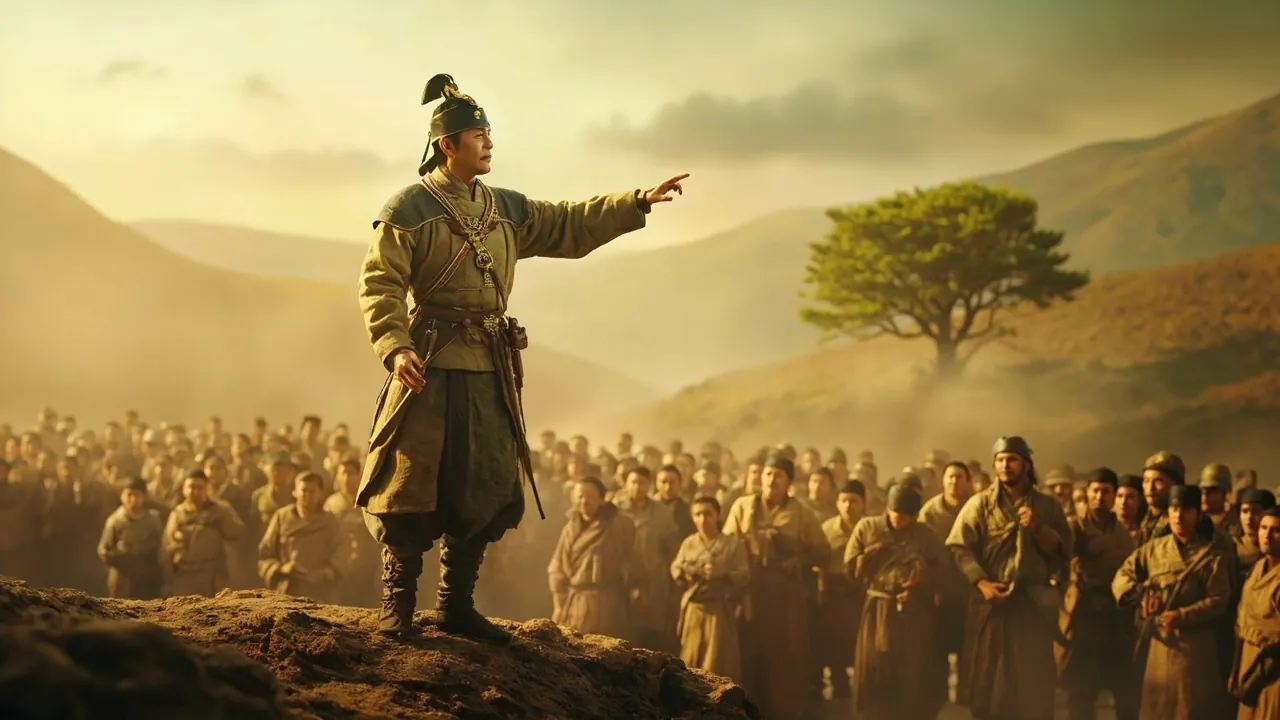
There are war stories about bigger armies and stronger swords, and then there’s the story of a man who won a battle before it even began — using nothing but boats,稻草, and a thick fog. In the winter of 208-209 CE, two of China’s most brilliant military minds faced each other across the Yangtze River near what is now Yichang, Hubei province. On one side stood Zhou Yu, commander of the Wu forces, a fierce and proud general who had never lost a battle. On the other side stood Cao Cao, the self-declared “King of Wei,” leading what was then the largest and best-equipped army in China. Between them, quietly observing everything, was a third figure — a advisor from the Shu kingdom named Zhuge Liang, a man whose mind was sharper than any sword.
The numbers told a grim story. Cao Cao commanded roughly 230,000 soldiers, a force that had conquered every opponent it had faced on its march south. Zhou Yu had only about 50,000 Wu troops, though they had the advantage of controlling the river. Even with naval superiority, fighting Cao Cao head-on seemed like suicide. Zhou Yu knew this. Everyone knew this. And that’s when the fog rolled in — not just across the river, but across the pages of history.
The challenge that sparked it all came from Zhou Yu himself. Legend says he looked at Zhuge Liang one morning and issued a challenge: produce 100,000 arrows within three days, or face consequences. It was meant as a test — perhaps even a trap. Zhuge Liang had a reputation for making impossible promises, and Zhou Yu wanted to see him fail. What Zhou Yu got instead was one of the most legendary feats of ingenuity in Chinese military history. The three-day deadline that was supposed to be Zhuge Liang’s undoing became the timeframe for a plan so audacious it still makes people shake their heads in disbelief two millennia later.
The Fog and the Boats: How Zhuge Liang Read the Weather and the Enemy
The story takes place in the context of the broader Battle of Red Cliffs (赤壁之战, Chìbì Zhī Zhàn), one of the most decisive battles in Chinese history. If Cao Cao had won, he would likely have unified all of China under his rule, and the Three Kingdoms period would never have happened. Instead, the coalition of Wu and Shu defeated him, and China spent the next century divided. But that battle hadn’t been fought yet. First came the buildup, the skirmishes, the war of nerves. And in that period of waiting, Zhuge Liang made his move.
Zhuge Liang was a student of astronomy, geography, and the natural world. He read the sky the way some people read books — with total fluency and complete confidence. On the second night of his three-day deadline, he stepped outside and looked up. The fog was already forming on the river, a thick marine layer that crept in with the evening tide. He studied the wind, checked the humidity, watched the way the mist gathered in the low places between the water and the shore. And he smiled. He had seen exactly what he needed.
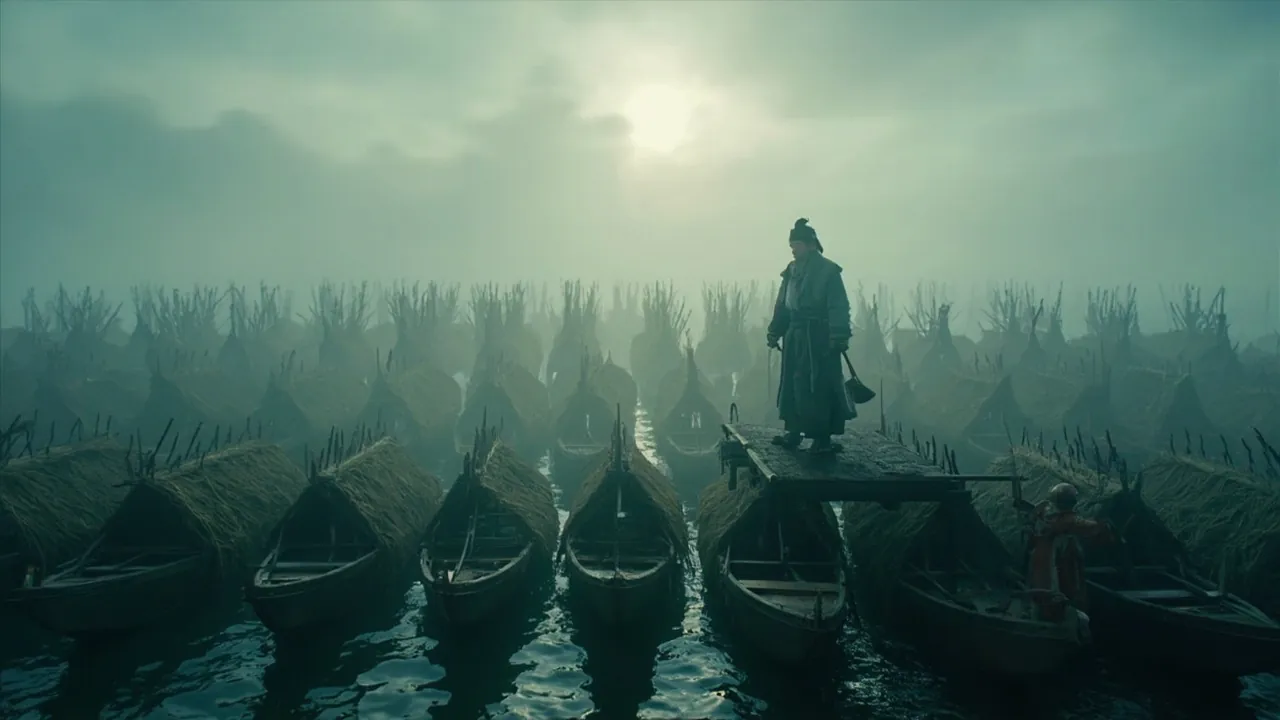
Here is what most people imagine when they picture 草船借箭: a fleet of small boats with稻草人 tied to their rails, drifting lazily into the enemy camp while the fog did all the work. That’s the image Chinese schoolchildren grow up with, the one painted on scrolls and depicted in operas and reproduced in a thousand ink drawings. But the real story, as it usually does, is a little more complicated — and a little more interesting.
Zhuge Liang didn’t just wait for fog. He calculated the precise moment when the fog would be thickest, the exact position where the Wu ships would be invisible to Cao Cao’s sentries until it was too late, and the exact moment to begin making noise — clanging gongs, beating drums, creating enough commotion that the enemy would have to investigate. He calculated that Cao Cao’s soldiers, seeing shadowy shapes approaching through the fog and hearing the sounds of an apparent attack, would respond the way any soldiers would: they would shoot. They would shoot thousands of arrows in a panic, trying to repel a threat they couldn’t clearly see. And those arrows would lodge in the稻草人 — the straw figures — which is where the idiom gets its name.
What the Arrow Harvest Really Looked Like
According to the historical accounts, Zhuge Liang ordered the construction of roughly twenty small boats, each equipped with rows of稻草人 positioned along the gunwales and superstructure. He filled his fleet with around 3,000 soldiers — enough to man the ships but deliberately chosen for their discipline and silence. No talking, no unnecessary movement. The boats had to look like they were full of attacking troops, but they also had to behave like ghost ships, silent and unsettling.
At some point in the pre-dawn darkness, Zhuge Liang gave the order to set out. The boats moved slowly downriver, driven by the northeast wind that Zhuge Liang had correctly predicted would prevail that night. The fog thickened as they approached Cao Cao’s camp on the opposite bank. It was so dense that sentries on shore could barely see the water’s edge. When the first sounds of drums and gongs reached the camp, the reaction was immediate.
Cao Cao’s generals, seeing shapes emerging from the white veil of fog and hearing what sounded like a full assault, did exactly what Zhuge Liang had hoped: they ordered their archers to fire. Volley after volley of arrows arched across the water, slamming into the boats and the稻草人 with heavy thuds. The arrows piled up so densely that the straw men began to lean, their weight suddenly heavy with iron and bamboo. The Wu soldiers stood behind shields, unharmed, collecting the shafts as fast as they could. The fog kept Cao Cao’s forces from seeing exactly what was happening — they kept firing, convinced they were repelling an invasion force.
By the time the fog began to lift, Zhuge Liang’s boats were laden with tens of thousands of arrows. The historical accounts differ slightly on the exact number — some say over 100,000, some say closer to 60,000 — but everyone agrees the haul was enormous. The boats turned around, drifting back with the wind now at their backs, and returned to Zhou Yu’s camp to unload their impossible cargo.
The Real Genius: Knowing What the Enemy Would Do
What makes this story endure isn’t the fog, and it isn’t the boats. It’s the fact that Zhuge Liang understood his enemy so completely that he could predict their behavior in the dark. Cao Cao’s army was powerful but largely composed of northern soldiers who were unfamiliar with river warfare and uncomfortable on boats. When they heard an attack coming through the fog, their instinctive response was to shoot — to use their one overwhelming advantage, their archery, to keep the enemy at bay. They had no idea they were being manipulated into donating their weapons to the other side.
This is the deeper lesson of 草船借箭: the best victories are the ones where your enemy does exactly what you want them to do, and feels good about doing it. Cao Cao’s soldiers went back to their tents that morning thinking they had successfully defended the camp. They were wrong. They had just given away the very weapons that would be used against them in the actual battle, which came just days later and ended in Cao Cao’s catastrophic defeat.
Zhou Yu, when he saw the arrows coming back on the boats, reportedly felt a complicated mix of admiration and unease. He had given Zhuge Liang an impossible task expecting him to fail. Instead, Zhuge Liang had found the one solution that made the task not just possible but inevitable. Zhou Yu reportedly said something along the lines of, “If this man were ever to turn against Wu, we would have no peace.” It was, in retrospect, an accurate assessment. Zhuge Liang would go on to become the most celebrated military strategist of the Three Kingdoms period, serving as the prime minister and de facto ruler of Shu Han.
The Broader Legacy: How an Ancient Battle Plan Became a Daily Saying
Today, 草船借箭 has evolved from a specific military anecdote into a widely-used Chinese idiom meaning “to achieve one’s goal by cleverly exploiting external conditions” or more literally “borrowing arrows with straw boats.” It’s used in business negotiations, in political discussions, in everyday conversation about any situation where someone turned an obstacle into an opportunity. When a startup uses a competitor’s resources to build its own product, that’s 草船借箭. When a smaller company turns a larger rival’s aggressive marketing campaign into free publicity, that’s also 草船借箭. The principle is timeless: don’t fight the enemy’s strength when you can redirect it.
The idiom is also taught in Chinese schools as an example of intelligence defeating brute force, which is part of why it has such cultural resonance. China has a deep appreciation for cleverness and strategic thinking in warfare and in life. The story of Zhuge Liang in particular embodies the ideal of the scholar-warrior — someone who could win with books and ideas before the first sword was drawn. He is one of the most portrayed figures in Chinese opera, literature, and art, and this particular story is one of his most famous adventures.
If you find the Battle of Red Cliffs fascinating, you’ll also enjoy our article on the fire attack at Red Cliffs and the story of Zhou Yu and his relationship with his strategist. Both explore the personalities and events that shaped this pivotal moment in Chinese history.