Su Dongpo: The Soul of Song Dynasty China
Walk through the streets of any Chinese city and mention Su Dongpo, and you’ll see faces light up. He’s the poet who wrote about missing his brother on a moonlit night so beautifully that people still cry when they read it eight centuries later. He’s the calligrapher whose wild, flowing hand looks almost like a painting. He’s the cook who accidentally invented a pork dish so good that an entire cuisine was born. And he’s the man who, despite being exiled twice by emperors who should have known better, never stopped loving his country or writing about it with aching, honest beauty.
Su Dongpo — born Su Shi in 1037 in Meishan, Sichuan — stands as one of the most complete cultural figures in all of Chinese history. Where most scholars mastered one discipline, he seems to have simply refused to be contained by any single one. His life story reads like a novel: meteoric rise, devastating fall, exile to remote swamps, and yet through all of it, an unshakeable creative spirit that produced some of the most beloved poetry, essays, and calligraphy in the Chinese tradition.
The Making of a prodigy
Su Dongpo was born into a family that valued learning above almost everything else. His father, Su Xun, was a scholar in his own right — a man who had struggled for years before finally passing the imperial examinations — and he passed that fierce intellectual ambition down to his son. Su Dongpo’s mother, from the Cheng family, came from a lineage of scholars as well, and she reportedly began teaching her young son classical texts before he was even old enough to understand them fully.
The young Su Shi showed signs of brilliance early. Stories from his childhood often circle back to his extraordinary memory and his ability to compose poetry on demand. By the time he was a teenager, he had already caught the attention of local officials who recognized they were looking at someone special. But what set Su Dongpo apart from other brilliant young scholars wasn’t just raw talent — it was the way he combined intellectual rigor with genuine warmth, and academic ambition with an unconventional streak that would both make his career and nearly destroy it.
When Su Dongpo took the imperial examination in 1057, he did something unusual: he wrote an essay that impressed the chief examiner, the legendary Ouyang Xiu, precisely because it broke from convention in ways that showed deep understanding rather than mere cleverness. Ouyang Xiu, one of the most respected scholars and officials of the era, reportedly said that while Su Dongpo was still young and might be considered a pupil, in ten years he would become a figure that people would talk about endlessly. He wasn’t wrong.
A Friendship That Shaped an Era
One of the most remarkable relationships in Chinese literary history is the friendship between Su Dongpo and Ouyang Xiu. Despite the generation gap — Ouyang Xiu was more than thirty years older — the two men developed a bond that transcended the typical teacher-student relationship. They shared not just literary tastes but also a philosophical approach to governance, a belief that scholarship should serve the people and that officials had a moral obligation to speak honestly, even when honesty was inconvenient for those in power.
Ouyang Xiu was already a towering figure when Su Dongpo came onto the scene. He had survived political persecution, served as a provincial governor, and was in the process of reforming the civil examination system to emphasize practical knowledge over rote memorization of classical texts. Su Dongpo admired him enormously but also challenged him — their letters were filled with literary banter, mutual admiration, and a frankness that both men seems to have treasured.
When Ouyang Xiu died in 1072, Su Dongpo wrote a memorial that revealed how deeply this relationship had shaped him. He described Ouyang Xiu not just as a mentor but as a friend who had shown him what it meant to be both a great scholar and a genuinely good person. This capacity for deep, lasting friendship would become a theme throughout Su Dongpo’s life. He formed intense bonds with many people — some of which sustained him through his exiles, others of which drew him into political troubles he might otherwise have avoided.
Exile to Huangzhou: The Crucible of Creativity
In 1079, Su Dongpo’s career took a catastrophic turn. Having risen to a position as a scholar-official in the Song Dynasty court, he had made enemies through his honest criticism of government policies — particularly the new tax and currency reforms that were causing hardship among common people. A collection of his poems, some satirical, fell into the wrong hands. The authorities decided these poems showed disrespect toward the emperor, and Su Dongpo was arrested, put in chains, and thrown into a prison dungeon in what came to be known as the Crow Terrace Poetry Trial.
The outcome could have been execution. Instead, Su Dongpo was sentenced to exile in Huangzhou, a swampy, impoverished region south of the Yangtze River. For a man who had grown up in the cultured comforts of Sichuan and served in the refined atmosphere of the capital Kaifeng, this was a devastating fall. The climate was unhealthy, the local dialect was nearly unintelligible to outsiders, and the people who lived there were poor farmers and fishermen, not the scholarly company Su Dongpo had kept his whole life.
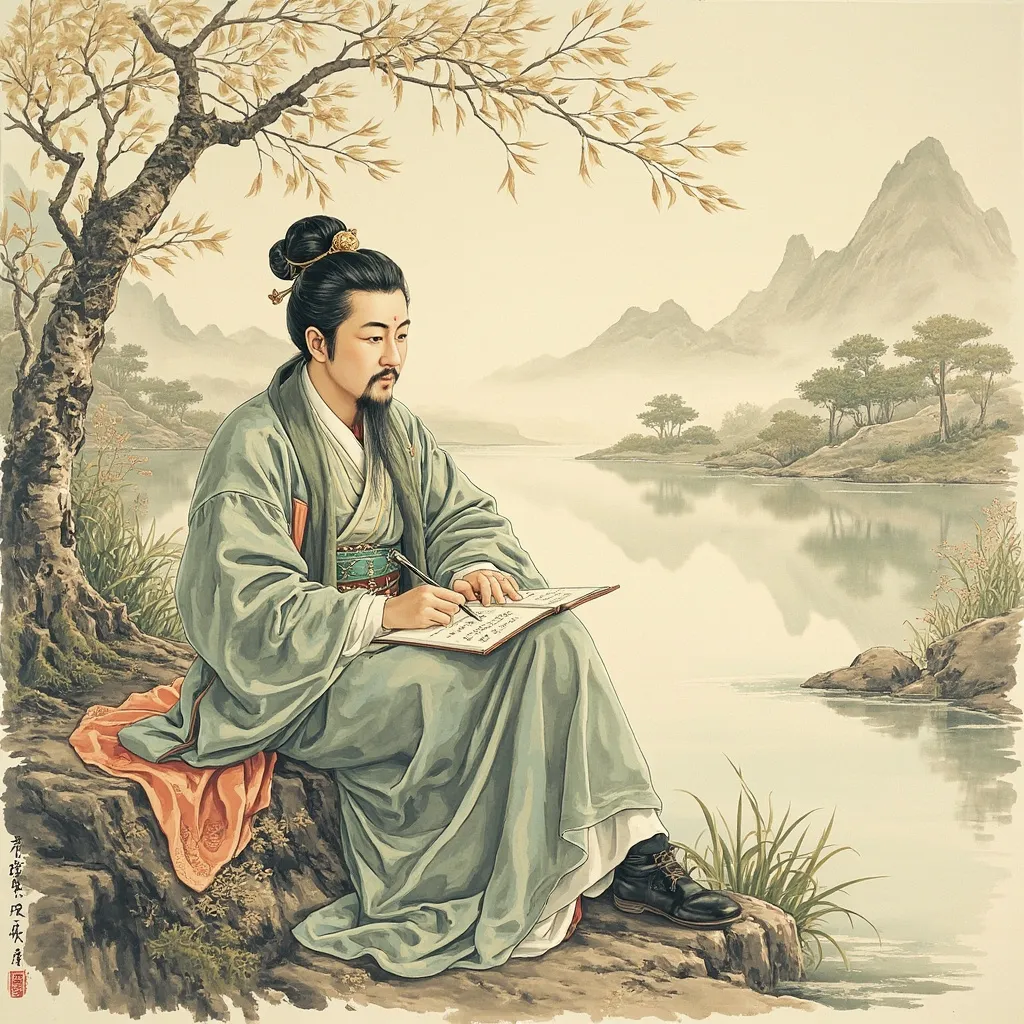
And yet — this exile became one of the most productive periods of his life. Stripped of official status and social pretension, Su Dongpo was forced to confront who he really was. He wore peasant clothes, grew vegetables in a small garden, and spent his days walking through the countryside, talking to farmers, fishermen, and monks. He wrote poems about the moon and the river that showed a new intimacy with nature, a way of seeing the world that felt more immediate and less filtered through literary convention.
It was during his Huangzhou years that Su Dongpo wrote two of the most famous pieces in Chinese literature. The first is the preface to his calligraphy masterpiece “Huangzhou Hanshi Tie,” written after a drunken night when he walked home in a snowstorm and wrote letters to friends on the walls of a temple as the candles burned low. The second is the prose-poem “Former Reckoning of the Red Cliffs,” which reimagines a historical battle as a dream shared between the narrator and two ancient warrior-spirits, weaving together history, philosophy, and a melancholy awareness of life’s fleeting nature.
But Huangzhou gave Su Dongpo something else: time. For the first time in his adult life, he had space to think, to write, and to cook. Yes, to cook. Legend has it that Su Dongpo, left to his own devices in this remote region, began experimenting with the limited ingredients available. The most famous result was dongpo pork — a braised pork belly dish cooked with soy sauce, rice wine, and aromatics until the meat becomes melt-in-your-mouth tender, its rich sweetness balanced by the savory depth of long, slow cooking. The dish spread throughout China and eventually became a staple of Hangzhou cuisine. In some versions, it’s cooked wrapped in lotus leaves; in others, the pork is double-cooked to achieve an even more complex texture. Whatever the method, every bite carries the ghost of a hungry poet making the best of a difficult situation.
“Mid-Autumn River Moon” and the Poem That Moved a Nation
Of all Su Dongpo’s works, none captures the Chinese imagination quite like his poem for the Mid-Autumn Festival, written during his second exile in 1076. He was separated from his brother Su Zhe by hundreds of miles, missing him desperately, and on the night of the full moon — traditionally a time for family reunion — he sat alone with his wine and wrote.
The poem begins with a question that sounds simple but carries the weight of centuries: “How long has the moon been shining?” It moves through images of watching the moon rise over the palace, thinking of loved ones, and ends with one of the most quoted lines in all of Chinese poetry: “May we live long and share this beauty together, even though we are far apart.” This couplet has been repeated at weddings, carved into jewelry, and tattooed on skin. It speaks to something universal — the wish that joy might be shared even when bodies are separated.
The poem works because Su Dongpo was writing from genuine feeling, not performing literary excellence. The Mid-Autumn Festival is still the most important occasion for family reunion in China, even more than the Lunar New Year for many people, and Su Dongpo’s poem has become inseparable from how Chinese speakers experience that night. Every time someone looks up at the full moon in autumn and feels a pang of longing for family, they are channeling the spirit of this ninth-century poet.
Calligraphy and the Art of Letting Go
Su Dongpo’s calligraphy is another dimension of his genius that sometimes gets overshadowed by his poetry, but any serious student of Chinese art will tell you that his contribution to calligraphy was revolutionary. He is considered one of the “Four Masters of the Song Dynasty,” and his style — sometimes called “bold and untrammeled” — broke from the more controlled, regulated traditions that had dominated earlier periods.
Where other calligraphers of his era prized technical perfection and strict adherence to traditional forms, Su Dongpo brought the same spontaneity and emotional directness to his brushwork that he brought to his poetry. His characters sometimes look almost unfinished, as if the brush was moving too fast to be contained, and yet they cohere into something that feels more alive than calligraphy that takes far longer to execute. This was not carelessness but a deliberate philosophical position: Su Dongpo believed that true art could not be forced or planned, that it had to emerge from a state of flow where the artist’s mind and hand worked together without self-consciousness.
This philosophy extended to his teaching. Su Dongpo wrote essays arguing that great calligraphy, like great poetry, came from genuine feeling rather than technical display. He contrasted the “scholar’s calligraphy” — expressive, personal, slightly rough around the edges — with the “craftsman’s calligraphy” — technically proficient but emotionally cold. This distinction shaped Chinese aesthetic thought for centuries afterward and helped legitimize a more personal, expressive approach to art-making that had previously been considered inferior to rigid technical mastery.
Legacy and Enduring Influence
When Su Dongpo died in 1101 at the age of sixty-four, he left behind an enormous body of work: more than two thousand poems, hundreds of essays, and countless letters and memoranda on matters of state. He had served as a governor, a minister, a military commander, and a exile. He had been a Buddhist layman, a Daoist seeker, and a devoted Confucian scholar-official. He had eaten his way across China, invented dishes that still bear his name, and walked through swamps and mountains writing poetry that made people cry.
His legacy is not just literary or artistic, though those alone would be enough to guarantee his place in history. Su Dongpo represents a particular vision of what it means to be educated, what it means to serve the public, and what it means to maintain your humanity when the world is doing its best to crush you. He never stopped speaking his mind, even when doing so cost him everything. He never stopped creating, even in the most adverse circumstances. And he never stopped loving his country, his friends, and his family, even when exiled far from all of them.
Today, you can visit sites associated with Su Dongpo across China: the memorial hall in Huangzhou where he gardened, the Red Cliffs on the Yangtze where he set his most famous prose poem, the West Lake in Hangzhou where he supposedly walked every rainy morning. In Japan and Korea, his works are studied as part of the classical literary canon. And in Chinese communities around the world, his Mid-Autumn poem is still recited at family gatherings, passed down from parents to children as a kind of cultural inheritance that bridges distance and time.
Su Dongpo would probably be embarrassed by all the attention. He once wrote that he hoped people would read his poems and feel less alone in their own suffering, less convinced that happiness was only possible under perfect circumstances. “I have no regrets about the things I’ve done,” he wrote near the end of his life, “only gratitude for the things I’ve seen.” In that spirit, we can read his work today — not as museum pieces from a dead civilization, but as letters from a warm, brilliant, stubborn man who insisted on finding beauty everywhere, even in the swamps.
Recommended Reading and Cultural Products
1. “The Selected Poems of Su Dongpo” (Bilingual Edition) A comprehensive collection of Su Dongpo’s poetry in Chinese with English translations. This edition includes detailed notes on historical context and poetic technique, making it ideal for readers who want to understand both the beauty and the meaning behind his work. Available at major booksellers.
2. Dongpo Pork Cooking Set Everything you need to recreate the legendary braised pork belly dish at home. Includes a traditional clay pot, rice wine, premium soy sauce, and dried tangerine peel. Several artisan food brands now produce authentic versions of this cooking set, with proceeds supporting traditional Chinese cooking schools.
3. Chinese Calligraphy Brush Set for Beginners Su Dongpo’s revolutionary approach to calligraphy started with mastering traditional techniques. A quality brush set — with wolf-hair and羊毫 brushes in multiple sizes, along with aged xuan paper and quality ink sticks — makes an excellent starting point for anyone curious about this art form. Look for sets from established Chinese art supply brands.
4. “The Crow Terrace Poetry Trial: Su Dongpo and the Politics of Persecution in Song China” A deep academic examination of the 1079 political trial that sent Su Dongpo into exile. This book reconstructs the court politics, literary culture, and personal relationships that combined to nearly destroy his career, and provides essential context for understanding his Huangzhou-period works. Published by a university press with strong reviews in Chinese studies journals.
5. West Lake Longjing Tea (Pre-Quality Pick) Su Dongpo was famously a tea lover, and Hangzhou’s West Lake region produces the Longjing (Dragon Well) tea that he would have sipped while composing his famous poems. A tin of authentic pre-qi ming (before the Qingming harvest) Longjing makes a thoughtful gift and a direct connection to the landscape Su Dongpo loved. Purchase from reputable tea merchants specializing in Chinese greens to ensure authenticity.