Su Embroidery: The Delicate Art of Suzhou’s Silk Masters
The City of Silk and Thread
If you visit Suzhou today — a city of twelve million people in Jiangsu Province, about an hour west of Shanghai by high-speed rail — you’ll notice something unusual about the streets. Many of the shop signs feature the character xiu (绣), meaning embroidery. The local government has invested heavily in promoting Su embroidery as a cultural heritage, and it’s not hard to see why. The city has been producing some of the finest embroidered textiles in the world for nearly two thousand years.
The craft is called Su Xiu (苏绣), and it’s one of the four great schools of Chinese embroidery — alongside techniques from Hunan, Sichuan, and Guangdong provinces. But Su embroidery is widely considered the most refined of the four, the one most prized by collectors and the one most associated with the word “embroidery” in the Chinese cultural imagination.
So what makes Suzhou’s embroidery so special? And why has this ancient craft survived into the twenty-first century, when so many other textile traditions have faded?
The Four Great Schools of Chinese Embroidery
Before we go further, let’s put Su embroidery in context. Chinese embroidery is not a single tradition but a family of regional styles, each with its own history, techniques, and aesthetic priorities.
Su embroidery from Jiangsu is known for its delicacy, its subtlety, and its ability to render landscapes and flowers with photographic realism. The colors are soft, the stitches are tiny, and the overall effect is one of dreamlike refinement.
Xiang embroidery from Hunan is bolder, with stronger contrasts and brighter colors. It’s famous for its lion and tiger motifs, and for the way it captures the texture of animal fur through a technique called “pouncing” (cuomian).
Shu embroidery from Sichuan is perhaps the most technically innovative of the four. It uses a technique called “twill tapestry” (jinxiuni) that creates images with extraordinary depth and complexity, almost like pointillist painting in thread.
Yue embroidery from Guangdong is the most colorful, with a palette that runs toward vivid reds, golds, and greens. It’s famous for its dragon and phoenix motifs and for the way it combines embroidery with gold-leaf decoration.
Each of these traditions developed in a different region of China, shaped by local materials, local aesthetics, and local markets. But Su embroidery has always been considered the most prestigious — the school that emperors and aristocrats turned to when they wanted something truly extraordinary.
The Craftsmanship Behind Su Embroidery
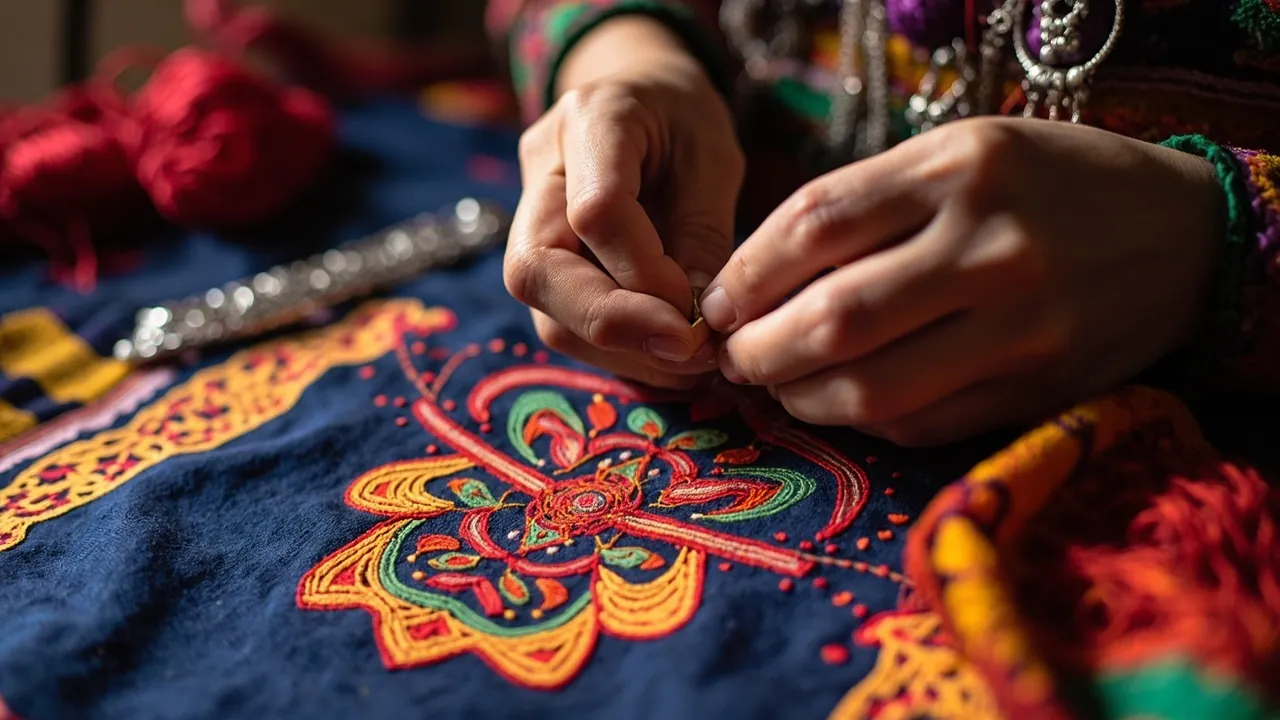
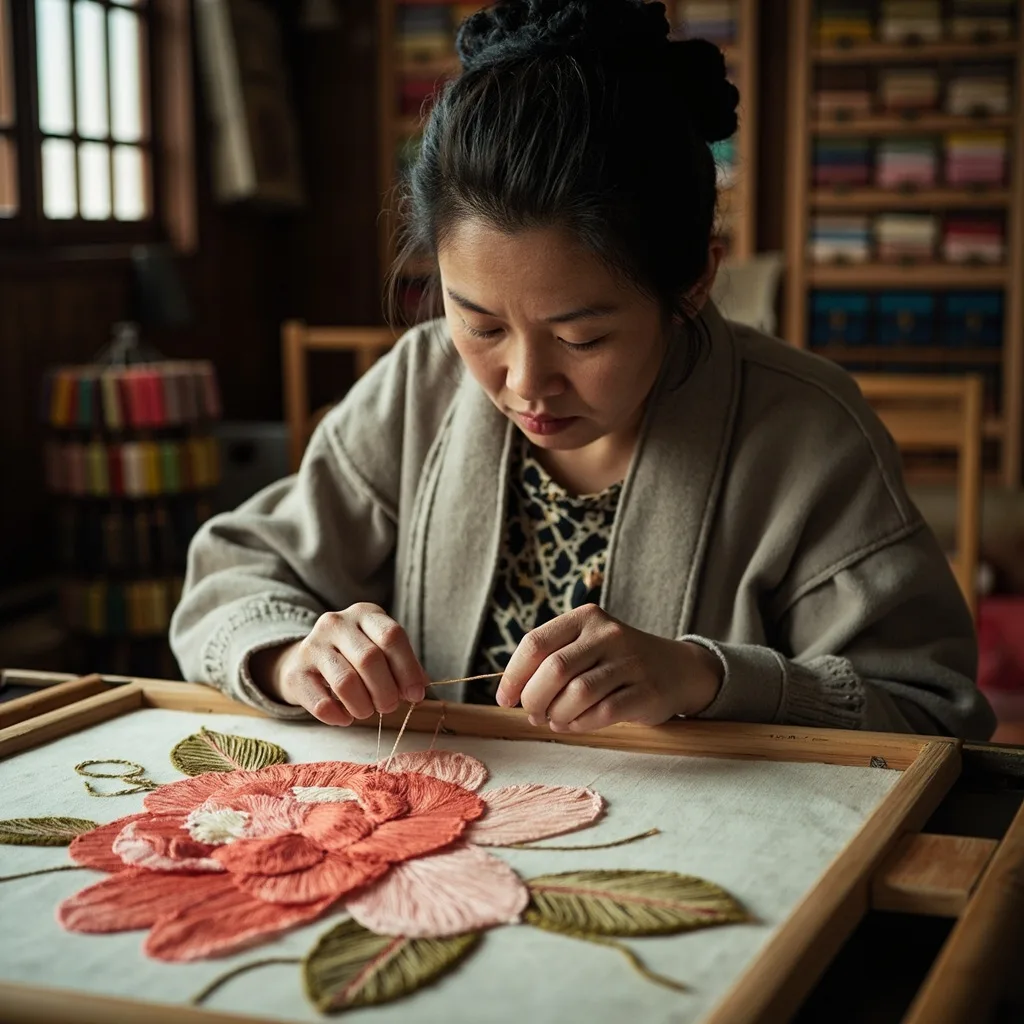
Walking into a Su embroidery workshop in Suzhou is like stepping into another century. The artisans — most of them women, continuing a long tradition — sit at wooden frames, their needles flashing in the light as they work on pieces that can take months or even years to complete.
The basic process hasn’t changed in centuries. First, a design is selected or created — traditionally, these were paintings by famous artists, which were then adapted for the needle. Then, the fabric is stretched onto a wooden frame. The artisan selects threads from a palette that can include hundreds of different shades — Su embroidery uses more colors than almost any other tradition, sometimes employing forty or fifty different shades of a single hue to create natural gradients.
Then comes the actual embroidery. Su embroidery is known for several signature techniques:
Double-sided embroidery (shuangmianxiu) is perhaps the most impressive. The artisan works with multiple needles and threads simultaneously, creating a design that looks different from the front and the back — but both sides are beautiful. In some pieces, one side shows a landscape and the other shows calligraphy, both created with the same threads. This technique requires extraordinary spatial reasoning and manual control.
Simulated stitching (voxian) is used to create the illusion of painted brushstrokes. Instead of using regular stitches, the artisan varies the direction, length, and tension of each stitch to mimic the way a brush moves across paper. The effect can be almost indistinguishable from painting.
Pouncing (dunshang) is a technique for creating texture, especially the texture of fur, feathers, or flower petals. The stitches are arranged in overlapping layers, each slightly offset from the last, to create a sense of depth and softness.
The Cultural Significance of Thread
In traditional Chinese culture, embroidery was not just a craft — it was an art form with deep social and spiritual significance. For women of the scholar-official class, embroidery was one of the “four accomplishments” (qín qíng) that every cultured lady was expected to cultivate, alongside playing the guqin, playing chess, and painting.
But embroidery was also something more: it was a way of expressing values that couldn’t be spoken directly. A daughter might embroider a lotus flower for her mother — the lotus representing purity and spiritual growth — as a way of honoring her without saying so in words. A wife might stitch a pair of mandarin ducks — symbols of marital devotion — into her husband’s traveling robe, a private message that only the two of them would understand.
This language of embroidery operated below the surface of daily life, in the intimate spaces of the household. It was women’s art, created in the inner chambers of the home, carrying meanings that the official culture of men seldom noticed or valued.
Su Embroidery and the Imperial Court
Throughout Chinese history, Su embroidery was a favorite of the imperial court. The finest pieces were reserved for the emperor and his family, and the workshops that produced them were supported by imperial patronage.
The connection dates back to at least the Tang Dynasty (618-907 CE), when Suzhou’s workshops first began producing the elaborate robes, banners, and hangings that decorated the imperial palace. The craft continued to flourish under subsequent dynasties, reaching a peak during the Ming (1368-1644) and Qing (1644-1912) periods.
One of the most famous examples of Su embroidery is the “Twelve Peacocks” screen, created in the Ming Dynasty and now housed in the Palace Museum in Beijing. The screen depicts twelve peacocks in a landscape of rocks, flowers, and water — each bird rendered in thousands of individual stitches, with feathers that seem to shimmer and shift in the light. It took a team of artisans several years to complete.
But Su embroidery wasn’t only for the elite. Middle-class families also prized it, and the workshops produced a wide range of items for the commercial market: fans, handkerchiefs, pillowcases, curtains, and clothing accessories. A well-to-do merchant might buy his wife an embroidered sash for her birthday; a scholar might commission an embroidered portrait of his favorite poet.
The Art in Everyday Life
What strikes modern observers about Su embroidery is the way it permeated every level of Chinese society. It wasn’t a luxury reserved for the wealthy or a high art practiced only in palaces. It was a living tradition that ordinary people encountered every day — in the clothes they wore, the household items they used, the gifts they exchanged.
This integration of art into daily life is one of the things that makes Chinese craft traditions distinctive. In the West, we tend to separate “art” from “craft” and to locate art in museums and galleries. In traditional China, the distinction was less clear. A bowl, a chair, a robe — these could be both functional and beautiful, both everyday objects and carriers of cultural meaning.
Su embroidery embodied this philosophy perfectly. A hand-embroidered pillowcase was still a pillowcase — you could rest your head on it — but it was also a small work of art, a demonstration of skill and care that transformed the ordinary into something special.
How Su Embroidery Survived the Modern Era
The twentieth century was hard on China’s craft traditions. The fall of the Qing Dynasty, the wars, the political upheavals — all of these disrupted the networks of patronage and transmission that had kept crafts like Su embroidery alive for centuries. Many workshops closed. Many artisans gave up their needles. The tradition seemed in danger of dying out.
But Su embroidery survived — partly because of dedicated preservation efforts, and partly because the craft found new markets. In the 1950s, the Chinese government established embroidery factories and training schools, trying to preserve the technique while also making it commercially viable. These efforts had mixed results — the factory system wasn’t always kind to artisanal craftsmanship — but they kept the skills alive.
Today, Su embroidery is experiencing a renaissance. Young artisans are learning the traditional techniques while also experimenting with new styles and new applications. The workshops in Suzhou now produce everything from traditional screens and robes to contemporary art pieces that wouldn’t look out of place in a modern gallery.
There are also efforts to connect Su embroidery with the global market. The craft has been featured in international exhibitions, and high-end collectors around the world prize vintage Su embroidery pieces. A well-preserved Ming Dynasty screen can sell for millions of dollars; even mid-quality antique pieces command significant prices.
Visiting Suzhou’s Embroidery Museums
If you want to see Su embroidery up close, Suzhou is the place to go. The city has several museums and workshops dedicated to the craft.
The Suzhou Embroidery Research Institute is the most prestigious, with a collection that includes pieces from the Ming and Qing dynasties alongside contemporary works. The institute also trains new artisans and conducts research into historical techniques.
The Suzhou Silk Museum is another excellent destination, with exhibits on the broader context of silk production in the region. Suzhou was one of the centers of Chinese silk production, and the museum shows how embroidery fit into the larger world of silk weaving and dyeing.
For a more hands-on experience, several workshops in the old city offer demonstrations and even short courses for visitors. You can watch artisans at work, ask questions about technique and history, and in some cases try your hand at basic stitching under their guidance.
The Patience of the Needle
There’s a Chinese saying: “One day’s work, one day’s embroidery” — meaning that some things simply cannot be rushed. Su embroidery embodies this philosophy. A single piece might take months of careful work, with the artisan sitting at her frame for hours each day, adding stitch by stitch to a design that will outlast her.
In an age of mass production and instant gratification, this patience feels almost radical. When you look at a piece of Su embroidery — really look at it, tracing the tiny stitches with your eyes — you’re seeing not just a beautiful object but a philosophy of time and attention. The artisan is saying: this matters. The making of it matters. Take your time. Do it right.
That’s a lesson that feels needed now more than ever.