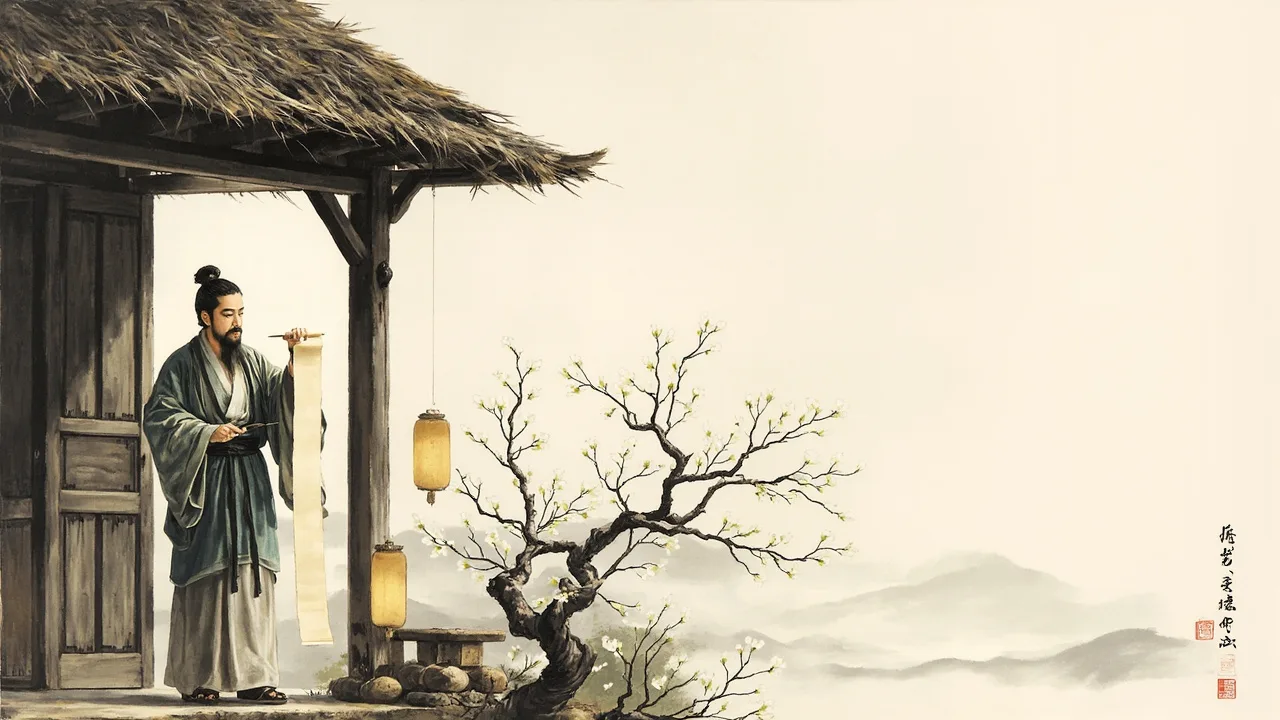
Su Shi: The Poet Who Ate Lobster on a Lake and Changed Chinese Literature
A Complete Guide to Su Shi (Su Dongpo) for American Readers
Here is a sentence that sounds like the beginning of a food documentary but is actually the opening line of one of the most beloved poems in Chinese history: “Bright moon, tonight the water is just like in the sky — I drank alone by the lake at the Mid-Autumn Festival, and the only person who understood what I was feeling was four hundred miles away.”
The poet who wrote those lines was Su Shi, and he wrote them while he was exiled to a dusty town on the edge of the Yangtze River, missing his brother, eating persimmons, and trying not to go crazy from boredom. He had been sentenced to death for the crime of writing poetry that a jealous political enemy claimed was insulting the emperor. The emperor at the time commuting the sentence to exile instead, which Su Shi considered a favor.
That is Su Shi in a nutshell: a man who kept finding reasons to be joyful even when his life was falling apart, who wrote some of the funniest and most heartbreaking poems in Chinese literature, and who is still famous in China for two things that seem unrelated — his poetry and his cooking. He invented a dish called Dongpo pork that is still served in restaurants across East Asia, and he wrote a letter to his brother that is one of the most famous pieces of prose in the Chinese language.
This guide is for American readers who want to understand who Su Shi really was, why his story feels surprisingly modern, and how to start reading his work without getting lost in a thousand years of literary history.
Background: The Song Dynasty and the World of Su Shi
To understand Su Shi, you need to know a little about the Song Dynasty (960–1279), which was one of the most economically advanced civilizations in the world at the time. The Song period saw the invention of gunpowder, the compass, and paper money. Cities were larger and more commercialized than in Tang Dynasty times. A middle class of merchants, craftsmen, and scholars had emerged alongside the traditional aristocracy, and literacy was spreading.
The Song also had one of the most elaborately developed civil service examination system in world history. Young men from any background — as long as they were male — could theoretically rise to the highest ranks of government through competitive exams. Su Shi came from a scholarly family that had produced officials for generations, and he and his younger brother Su Zhe both passed the imperial exams at the highest level in 1057, which was a remarkable double achievement that made them famous in the capital.
The examination system also created a dense network of literary friendship and rivalry. Scholars in the Song period corresponded, debated, and competed with each other constantly, and the quality of their poetry and prose was a direct reflection of their moral and intellectual character. A man who wrote well was assumed to be a man who could govern well. This made literary reputation a form of political currency, which meant that literary rivalry could be genuinely dangerous.
Su Shi was a brilliant exam taker but a politically naive man. He rose quickly through the government ranks and became an advisor to the emperor, where he got involved in a series of fierce policy debates between reformers and conservatives. The reformers, led by the chancellor Wang Anshi, wanted to restructure the government economy and reduce the power of the aristocracy. Su Shi was on the conservative side, arguing for traditional methods. These were genuine philosophical disagreements about governance, but they also became factions, and factions in the Song civil service could destroy careers.
In 1079, Su Shi’s enemies collected lines from his poems and letters and presented them to the new emperor as evidence that he had been insulting the throne. The technique was called “using literature as a criminal case,” and it was devastatingly effective. Su Shi was arrested, put in a bamboo cage for over a hundred days, interrogated, and sentenced to death. The emperor was persuaded to commute the sentence to exile instead, and Su Shi was sent to Huangzhou (modern Huanggang, Hubei Province), a poor market town where he would spend the next three years as a minor official with no real power.
It was in Huangzhou that Su Shi became Su Shi. Or more accurately, it was where the public image of the cheerful, wine-drinking, philosophically serene Su Shi that Chinese culture loves today was largely created. The exile did not break him. It gave him time to think, to write, and to cook.
The Red Cliffs Poems: Memory as a Fortress
The Red Cliffs (Chibi) are a series of cliffs on the Yangtze River near the city of Wuhan, and they are one of the most famous sites in Chinese history because of a battle fought there in 208 AD between the warlords Cao Cao and Sun–Liu alliance. Cao Cao, who controlled northern China, tried to annex the south. His fleet of hundreds of ships was destroyed by a combination of fire attacks and a favorable wind that the legendary Zhou Yu and Zhuge Liang (the " Sleeping Dragon") arranged at just the right moment. It was one of the decisive battles of Chinese history, and it became the subject of one of the great cycles of storytelling and poetry in Chinese culture.
Su Shi visited the Red Cliffs in 1082, three years after his exile to Huangzhou, and wrote the three texts that would make him immortal: “The Red Cliff,” “Chanting at Red Cliff,” and “Mid-Autumn Night.” These are not historical accounts of the battle. They are something more interesting: conversations between the past and the present, between the transience of human ambition and the permanence of the natural world.
Here is the opening of “Chanting at Red Cliff,” which is the most famous of the three:
The autumn moon is bright. I drank in the boat until dawn, And recited the ancient poems. A hawk soared past, white as snow, sleek as a kite, A rare and beautiful sight.
The poem goes on to describe Su Shi and two friends drifting in a small boat near the cliffs at night. One friend starts playing the guqin (the seven-stringed zither), and the music is so beautiful it makes the fish and birds listen. Then Su Shi reflects on the transience of everything: the ancient warriors who fought at this spot, the river that has been flowing for millions of years, the way time turns great events into stories and then stories into poems. The conclusion is not sad but philosophical: “Of what shall the ancient lords feel regret? / I only laugh at myself, setting forth my feelings.”
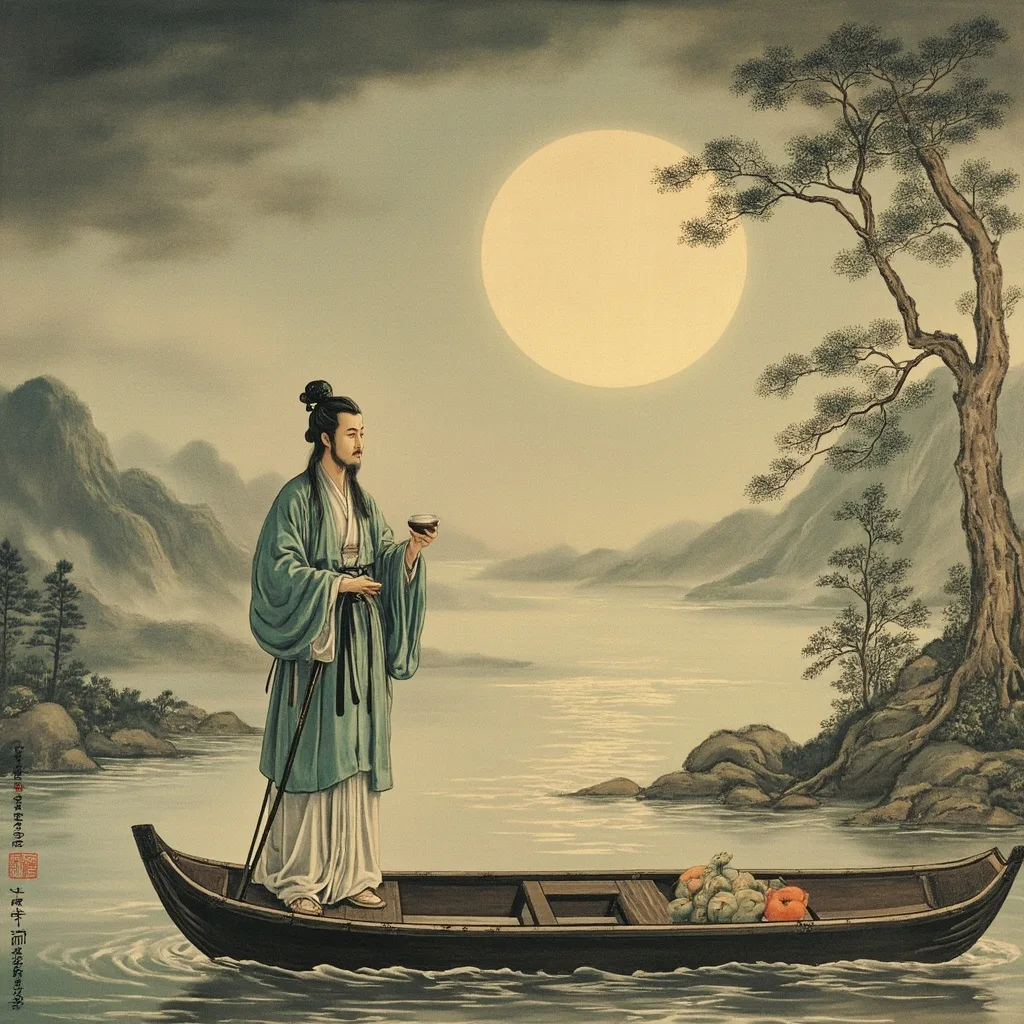
The famous “Mid-Autumn Night” poem, written the same year, is about the same subject but more personal. Su Shi was alone on Mid-Autumn Festival night — a holiday for family reunions — and he was missing his brother Su Zhe, who was also in exile, four hundred miles away. He drank by himself and wrote:
Bright moon, tonight the water is just like in the sky — I raise my cup and invite the invisible moon. It shadows me as I dance among the flowers on the ground. What a fine night, what a fine year, to be alive.
This is followed by the famous admission of loneliness — “People have their joys and sorrows, and none are quite alike — / The moon may be bright or dark, wax or wane. / I only wish we may live long, / And share in this beauty, though four hundred miles apart.” The last line is what makes this poem so famous: “But for the moon, let there be no嫉妒” — wait, let me put that differently. The poem ends with the hope that they will both be well and see the same moon, even at a distance.
What is remarkable about these poems is the emotional complexity. Su Shi is genuinely sad and lonely, but he is also funny, philosophical, and resilient. He does not wallow. He does not pretend everything is fine. He says, “I am four hundred miles from my brother and I am drinking alone and the moon is beautiful and this is also funny.” That kind of emotional honesty is what makes his work feel modern to American readers.
Su Shi the Cook: Dongpo Pork and the Art of Finding Joy
Su Shi’s exile to Huangzhou gave him something he might not have found in the capital: time to cook. He had always been interested in food — his family had a tradition of good eating — but in Huangzhou, with limited money and a small kitchen, he developed recipes that would outlast his political career.
The most famous is Dongpo pork (Dongpo rou), a slow-braised pork belly dish made with soy sauce, rice wine, and sugar. The pork is cut into large cubes, browned, then braised for hours until it becomes tender and glazed with a rich, sweet-salty sauce. It is a humble dish made elegant through patience and technique, and it is still served in Chinese restaurants around the world.
Su Shi wrote about his cooking in his letters and poems with the same attention he gave to landscape. He described the smells, the textures, and the pleasure of eating well even when your circumstances are poor. He was, in modern terms, a food writer — someone who understood that cooking is not just nutrition but a way of finding satisfaction in life.
This is connected to something larger in Su Shi’s philosophy. He was a lifelong student of Chan Buddhism (the Chinese ancestor of Zen), which emphasizes the presence of the sacred in the everyday. For a Chan practitioner, there is no difference in spiritual quality between meditating in a temple and cooking dinner in a small kitchen. Su Shi brought this attitude to everything he did: drinking wine, watching the moon, cooking pork, writing letters to his brother.
His political enemies tried to make him miserable by exiling him to poor areas. Instead, he made friends with the local people, explored the landscape, developed recipes, and wrote some of the most joyful prose and poetry in Chinese literature. His response to suffering was not stoic endurance but active, creative engagement with whatever was in front of him.
Later Life: Another Exile and a Final Lesson
Su Shi was recalled from Huangzhou in 1081 and eventually returned to high office. But the factional politics of the Song court had not improved, and Su Shi found himself exiled again in 1093, this time to Hainan Island — an island so remote and underdeveloped at the time that it was essentially a tropical backwater with a small number of fishermen and local officials.
Hainan was much harder than Huangzhou. The climate was brutal, the food was scarce, and the local government had orders to give Su Shi a hard time. He lived in a small hut, grew vegetables, and continued writing and cooking. He also continued studying Buddhism and Taoism, and this second exile produced some of his most philosophically complex work.
When he was eventually pardoned and allowed to return to the mainland, he died on the journey home in 1101, at the age of sixty-four. His last poem, written on the day he died, is characteristically light:
My heart is not afraid of the long road, I only worry that this boat will not cross the river.
It is a poem about trust — in the boat, in the water, in the journey. He died as he had lived: moving forward, not quite sure what would happen next, but unwilling to stop.
Cultural Connection: Su Shi and Mark Twain
The comparison that most often comes up between Su Shi and American culture is with Mark Twain. Both men were humorists first and serious artists second in the public imagination. Both had a gift for making friends and keeping them for life. Both wrote about ordinary life — food, travel, friendship, boredom — with a light touch that concealed a deeper philosophical seriousness. Both were eventually exiled or marginalized by political circumstances, and both responded by doubling down on their craft.
The difference is that Su Shi’s philosophy was fundamentally Taoist and Buddhist — he believed that the natural world was the best guide to living — while Twain was a nineteenth-century American with a working-class skepticism toward institutions and a belief in individual common sense. Both, though, had a quality of not taking themselves too seriously, which is one reason both of them are still widely read.
There is also something of Benjamin Franklin in Su Shi. He was curious about everything: science, medicine, gardening, calligraphy, painting, cooking, and philosophy. He wrote essays on topics ranging from the construction of water clocks to the proper way to roast a pig. He was the kind of person who could not stop learning, even when learning was inconvenient.
Practical Tips: How to Read Su Shi
Start with the Red Cliffs poems. They are long but not difficult, and they showcase everything that makes Su Shi remarkable: his historical imagination, his emotional honesty, his humor, and his philosophical depth. The Stephen Owen translation is excellent, or try Burton Watson’s shorter collection.
Read his letters. Su Shi wrote hundreds of letters to friends and family that read like emails from a funny, observant friend. They are full of jokes, complaints about his food, descriptions of the local scenery, and reflections on what it means to live well in difficult circumstances. They are available in translation in “Su Dongpo: Selections from the Song Dynasty Poet.”
Try making Dongpo pork. The recipe is not complicated, but it requires patience — you have to brown the pork, then braise it for two to three hours. The result is a rich, savory-sweet dish that tastes like something a poet would invent in exile.
Listen to the Chinese pop song “Riverside.” The 1980s song “Riverside” (jianghu) by Xia Hu is based on a Su Shi poem, and it is one of the most famous Mandarin pop songs ever recorded. Hearing the poems set to music is one of the best ways to remember them.
Related Products
If you want to go deeper with Su Shi, these resources can help:
Su Dongpo: Selected Poems translated by Stephen Owen — The best scholarly translation available. Owen’s introduction places Su Shi in his Song Dynasty context with clarity and wit.
The Song Dynasty: A New History by Albert Dien — An accessible academic history of the Song period, with good chapters on the civil service examination and the literary culture Su Shi came from.
Dongpo Pork Spice Set — A curated set of the spices and rice wine needed for authentic Dongpo pork, with a recipe card adapted from the traditional method.
A Set of Chinese Ink Brushes for Calligraphy Practice — Su Shi was also one of the great calligraphers of the Song Dynasty. Practicing with a brush is one of the best ways to understand the physical act of writing Chinese poetry.
Conclusion
Su Shi is the Chinese poet Americans most often say they wish they had known about earlier. He is funny in a way that crosses cultural lines — his jokes about being exiled to a place with nothing to eat but persimmons and bad wine read the same in English as they do in Chinese. He is philosophical without being pretentious. And his emotional range is extraordinary: the same man who wrote “I drank alone by the lake and the moon was beautiful” also wrote “I invented this pork recipe in exile and it turned out better than anything I ever ate in the capital.”
What makes him most appealing to modern readers is his refusal to be defeated by circumstances. He was exiled twice, arrested, interrogated, and nearly executed. He lost most of his political battles. His personal life had real sorrows — his first wife died young, and he was separated from his brother for long periods. And yet the overwhelming impression his work gives is of a man who found life genuinely interesting and worthwhile.
That is a rare thing in any century. It is one reason Su Shi is still being read, cooked, and argued about eight hundred years after his death.
Next: Hanfu: The Ancient Clothing System That Came Back from History