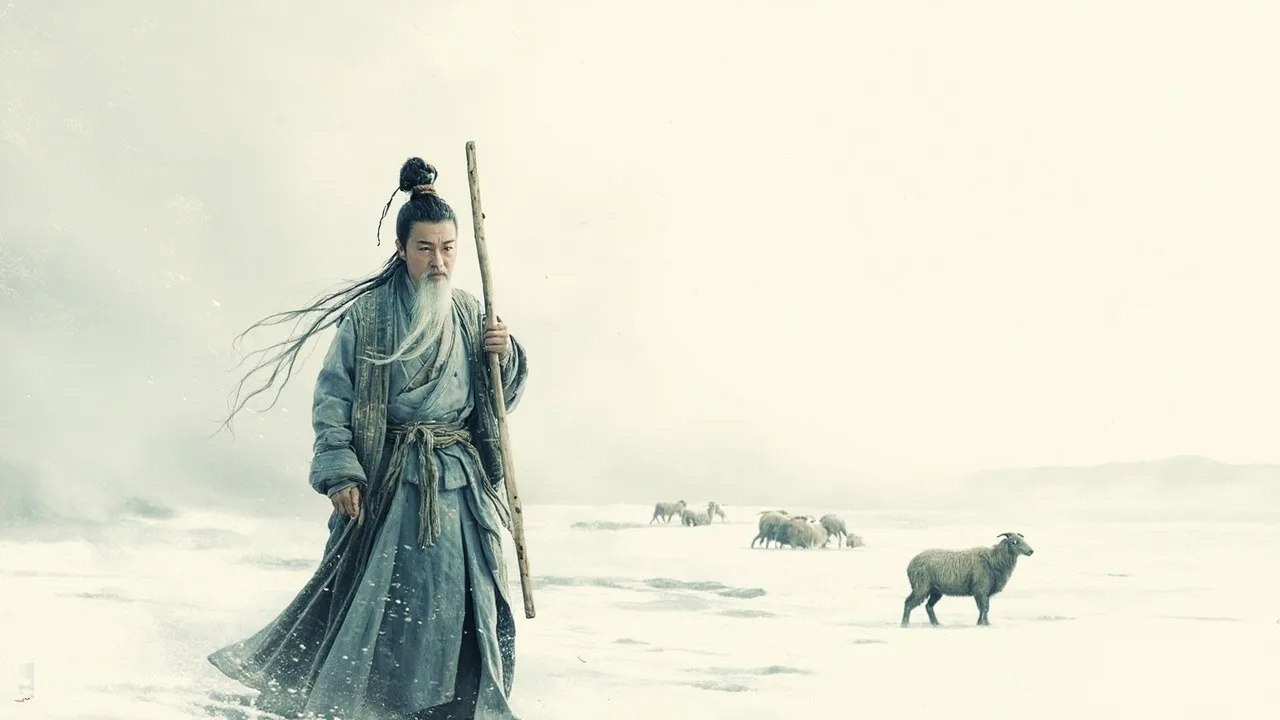
The wind off the lake tasted of iron and old wool. Out across the ice, a ram coughed a wet, rattling sound, and the sound died in the grey. The man who heard it did not turn. He had stopped turning, years ago, when he realized that turning only reminded him how far he was from anything that mattered. He stood very still with both hands wrapped around a wooden staff, watching the snow fill in the prints he had just left behind him.
The staff was seven feet long. The yak-tail ornament that had crowned it when he left Chang’an — the bundle of white hairs that marked him as a servant of the Son of Heaven — was long gone. He had lost every hair of it, one by one, to wind, frost, and the small rough habits of a lonely man. He had kept the bare wood anyway. It was, by then, the only thing left.
His name was Su Wu (苏武). He had been gone from the Han empire for nineteen winters.
The Diplomatic Mission That Started a 19-Year Ordeal
The year was 100 BC, and the Han empire was at the height of its swagger. Emperor Wu of Han (汉武帝, r. 141–87 BC) had spent the better part of two decades pushing the borders of the known world outward, hammering the Xiongnu confederation on the northern steppe, opening the first threads of what would later be called the Silk Road, and turning Chang’an into the most expensive city on earth. The Xiongnu — a loose federation of horse nomads who had controlled the Eurasian grasslands from Mongolia to the edges of Manchuria for two centuries — were, for the first time in living memory, on the back foot. They were not broken. They never would be. But they were talking.
In the autumn of that year, an unusual envoy arrived at the Han court. His name was Wei Lü. He was a defector, a Xiongnu aristocrat who had fled south, taken Han citizenship, and been given a post at the frontier. Wei Lü now claimed he could deliver his old master — the Chanyu, the supreme ruler of the Xiongnu — into a hostage arrangement that would lock in the peace. Emperor Wu, ever the optimist about deals with rivals who rode better horses than his, agreed to send an escort to bring Wei Lü back north and to negotiate the details in person.
He picked Su Wu for the job. Su Wu was about forty years old. He had risen through the bureaucracy with the slow, careful steps typical of a Confucian-trained official — clerk, junior magistrate, eventually second-in-command of the imperial guards. He was not famous. He had written no poetry that anyone remembered. He had fought in no great battles. He was, in the eyes of the court, exactly the kind of steady, unremarkable man you sent to a routine foreign assignment.
He was given the credentials of office: a ceremonial staff called a 旄节 (máo jié) — a tall wooden pole crowned with a tuft of dyed yak hair — that marked him, in the visual language of the Han court, as the personal voice of the emperor. So long as he carried it upright, he carried the emperor’s authority with him. To let it touch the ground was to let the throne fall.
The staff would outlive everything else.
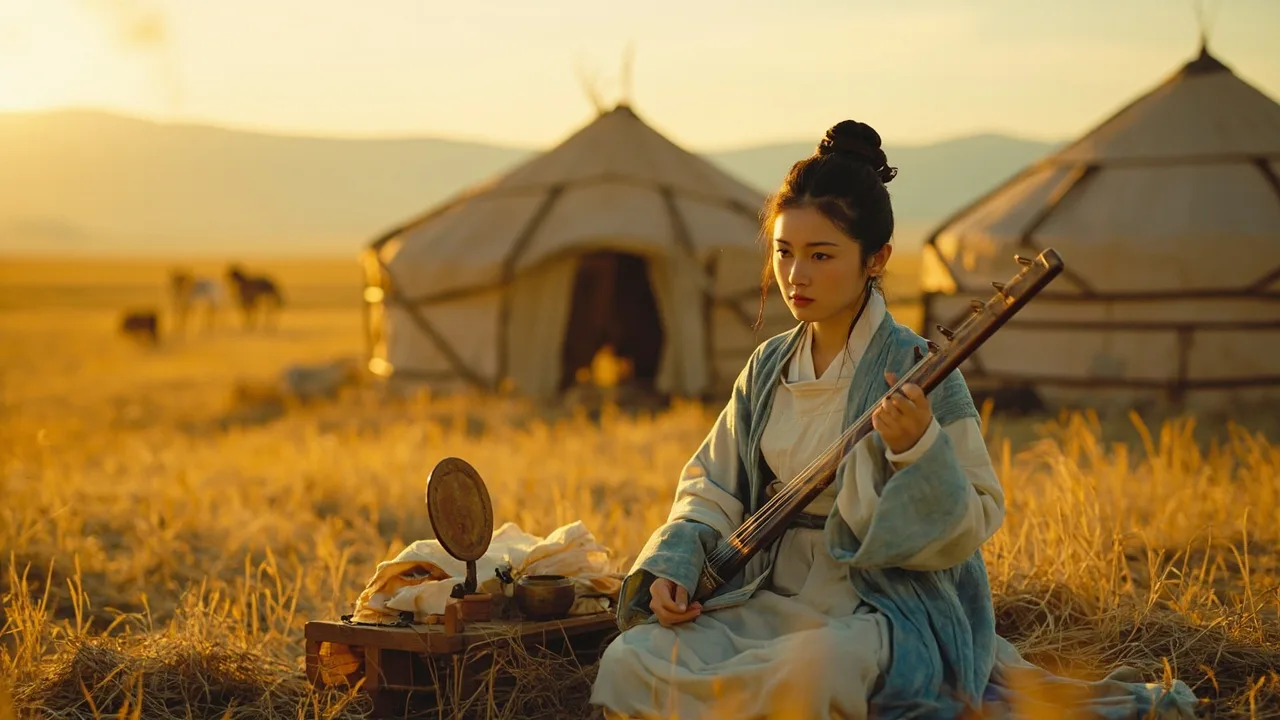
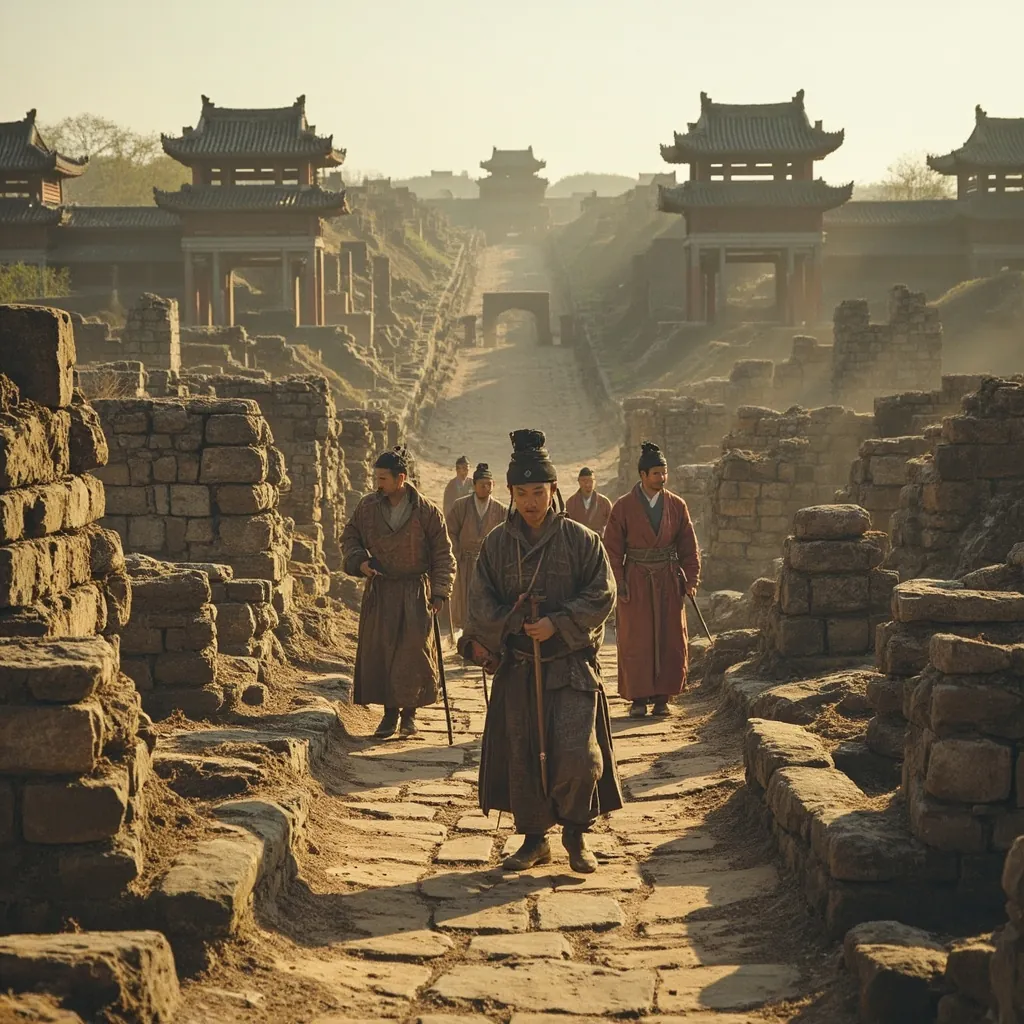
Su Wu’s deputy on the mission was a man named Zhang Sheng (张胜), an old soldier with blood feuds of his own and a short temper. The third in command was Chang Hui (常惠), a younger official who kept his head down. A small cavalry escort and a handful of grooms rounded out the party. They rode north in the dry autumn weather, through the Ordos loop of the Yellow River, past the rubble of older walls, and into the open grass. By the time they reached the Xiongnu court, the season had turned. The first snows of the steppe were blowing in off Mongolia.
The mission went wrong almost immediately.
Wei Lü, it turned out, had not defected. He had been sent south to lure the Han into a trap. Within days of Su Wu’s arrival at the Xiongnu court, an armed revolt broke out — a coordinated Xiongnu raid intended to kidnap the Chanyu himself and deliver him bound to the Han. Zhang Sheng, the deputy, knew the conspirators. He had a relative among them. Without telling Su Wu, he agreed to participate.
The plot collapsed in a single night. Soldiers were seized, confessions extracted, and the trail led straight back to Zhang Sheng. Su Wu learned what his deputy had done from the interrogations of others. He had not been told, but in the eyes of the Xiongnu court, that did not matter. The chief envoy’s name was on the diplomatic seal. If Zhang Sheng had plotted rebellion against the Chanyu, then Su Wu’s mission had been a cover for an assassination attempt.
Su Wu responded the only way he knew how. He pulled out his knife and cut his own throat.
His aide caught him before he finished. The slash was deep — you can still feel the scar in the sources — but he lived. He lay in a Xiongnu hut for weeks, the wound held shut with horsehair stitches, half-conscious, with a fever that smelled like copper. When the Chanyu’s men came to question him again, they found him on his back, staring at the tent roof.
It was not enough to save him. The Xiongnu, who admired courage but did not feel obliged to reward it, decided to keep him.
The Imperial Staff That Lost Its Yak Tail
The Chanyu summoned Su Wu and made him a personal offer. Lay down your staff. Acknowledge me as your lord. Marry one of my daughters, take a Xiongnu name, and live out your days as a noble of the second rank, with pastures, servants, and horses. The offer was generous by the standards of the steppe. By the standards of Han China, it was an obscenity.
Su Wu refused. He refused once, twice, until the Chanyu lost his temper and walked out of his own tent.
What followed was a sentence disguised as a joke.
The Chanyu ordered Su Wu sent to the 北海 (Běihǎi) — the Northern Sea — which the Chinese annals place on the shores of what we now call Lake Baikal. He was given a herd of rams. He was told he could return to Han when the rams bore young, and when the wooden staff he carried had turned white again. Both conditions were impossible. Rams do not give birth. Wood does not whiten on its own.
It was, in its way, an elegant cruelty. The Chanyu was not punishing Su Wu so much as removing him from the world. A man alone on the edge of a Siberian lake, with no company but castrated sheep and no food but what he could dig out of the snow, would either die, go mad, or eventually forget. The steppe had no use for stubborn men.
The staff, though — the staff was the Chanyu’s mistake.
In the visual grammar of Han diplomacy, the 旄节 was not a decoration. It was the physical extension of imperial authority. To drop it was to drop the throne. To let it rot was to let the empire rot with it. The Xiongnu understood this perfectly; that was why they had chosen it as the condition for release. They assumed Su Wu would let it go within a year. He had nothing to defend with a stick, and no one to defend it against.
What they did not understand was how seriously a Confucian official of the late Western Han took his symbols.
Su Wu kept the staff upright. He set it in the snow beside his hut every morning, with the yak-tail crown facing east, toward Chang’an. He carried it when he walked. He leaned it against the wall of his shelter at night. When the first hairs came loose in the wind, he tucked them back into the binding. When the binding frayed, he re-tied it with sinew from the sheep he slaughtered. When, after some unspecified number of years, every hair was gone and the staff was bare wood, he continued to set it upright in the snow each morning, in the direction of a capital he could not see.
The records note the staff without sentiment. He held the 节 until the hair fell out, the Han shu (Book of Han) says, in the same tone it might use to record a tax assessment. And yet the image is what has survived: a half-frozen man on a frozen shore, polishing a stick.
Lake Baikal in Winter: Mice, Snow, and a Man’s Faith
Lake Baikal is not a kind lake.
In January, the surface temperature drops below minus thirty. Ice a meter and a half thick creaks and shifts under the wind. The wind off Siberia is a different animal from the wind off Mongolia — drier, colder, and it carries nothing. There are no trees on the western shore for shelter. Snow that falls in October is still lying in May.
Su Wu had been given no house. No yurt. No second man. He had a small hut of branches and felt, a fire pit, and the herd of rams that the Chanyu had allotted him as a kind of jest. The rams could not feed him — they were the wrong kind of animal for milking, and he had been forbidden from slaughtering them for meat unless one died of natural causes. He could not breed them. They were the wrong kind of animal for breeding.
He ate what he could find.
The Chinese sources are specific about this, in the dry, factual way Chinese dynastic histories tend to be: he ate 鼠 (shǔ) — wild mice — and 草籽 (cǎo zǐ), grass seeds. He dug them out from under the snow with his hands. He chewed the seeds raw because he had no way to grind them. In the worst stretches — the deep weeks of the second and third winters, when the lake froze so solid that foxes walked across it and the sun came up grey and went down grey — he ate his own clothes and the leather of his belt.
He did not kneel.
The Xiongnu, who came by occasionally to check on their stubborn prisoner, found him thinner each time. They found his hair grown long and tangled. They found his fingernails cracked and black. They found, every time they visited, the same staff standing in the snow outside his door, pointing east.
There are stories from later centuries — some probably apocryphal — about a Han lady who heard of Su Wu’s suffering and supposedly sent him a package. When he opened it, he found nothing inside. The story is told as proof of his incorruptibility: he had been offered the chance to flee in a shipment of goods, and he had refused. The story is almost certainly wrong. But it tells you what people a thousand years later wanted to believe about him: that he was so committed to his post that he would turn down even an escape hatch.
What is not in doubt is the duration. He was there for nineteen years. The exact count varies in the sources — some say eighteen, some say twenty — but the rough figure holds. The 100 BC envoy was a forty-year-old man when he arrived. The man who eventually stood up from the lakeside in the cold dawn of his release was a man of nearly sixty. He had grown old at the edge of the world.
The fact that the lake did not kill him is its own kind of miracle. The fact that he emerged still carrying a bare wooden staff is the miracle that has echoed.
The Return of the Ghost: Su Wu Comes Home to Han
In 81 BC, the political weather on the steppe shifted.
The old Chanyu was dead. His successor, a younger man named Hunxie, came to the throne during a famine and a small rebellion among the western Xiongnu tribes. He needed peace with Han to keep his own coalition together. He sent an envoy south, asking for a hostage exchange and a reopening of the frontier markets.
The Han court sent back a list of long-missing prisoners to be returned, as a precondition. Su Wu’s name was on the list.
The Xiongnu court, by now, may genuinely have forgotten what they had done with him. Or they may have decided that admitting the truth — that their prisoner of nearly two decades was still alive, sitting on the shore of a frozen lake, holding a stick — was a humiliation too far. They tried a small deception. They sent back a man who claimed to be Su Wu.
Chang Hui, the third member of the original mission — the one who had kept his head down nineteen years ago and survived long enough to return home — was by this time serving again in the imperial bureaucracy. He heard the rumor of a returned Su Wu. He asked to see the man. He stared at him for a long time. Then he addressed the court directly.
This is not Su Wu, he said. Su Wu’s beard was full. This man’s beard is half-white. Su Wu walked with a slight limp from his self-inflicted wound. This man walks evenly. Su Wu had a scar from the throat-cut, visible just below the collar. This man’s throat is unmarked.
The Xiongnu were, by all accounts, embarrassed.
They sent a small party north to the lake. They found Su Wu exactly where they had left him, except older. The rams were gone — most had died in the famine — and so were most of his teeth, and so was most of the meat on his bones. The staff was still with him.
They brought him south.
The journey home took weeks. By the time Su Wu reached Chang’an, Emperor Wu had been dead for six years. His successor, Emperor Zhao, was a young man on the throne. The court regarded Su Wu with the bewildered respect one reserves for a returning ghost. He had been written off as dead. His property had been redistributed, his rank abolished, his family pension stopped.
Emperor Zhao restored his rank, gave him a small estate, and made him the figurehead of what remained of the bureau that dealt with the Xiongnu. Su Wu lived another twenty years. He died around 60 BC, a court elder, the keeper of a story he had been living inside. The staff, the sources say, was hung in a temple of loyal officials.
Su Wu in Chinese Memory: The Birth of a Cultural Archetype
Su Wu did not write a memoir. He did not compose a defense of his actions. He did not lecture his juniors about what he had learned. He did not, in the modern Western sense, leave a philosophy.
He left a posture. The Chinese word for what Su Wu embodied is 忠 (zhōng) — loyalty. Not loyalty in the bland, contractual sense of an employee keeping his contract. Loyalty in the older, heavier sense: the willingness to keep a thing upright when it would be easier to drop it. The willingness to keep a staff pointing east when east is invisible from where you are.
Within a century of his death, Su Wu was a fixed point in Chinese moral imagination. The Shiji and the Han shu recorded him as one of the exemplary lives a Confucian student was expected to memorize. By the Tang, his story had migrated into poetry, drama, and painting. A Tang poet, Liu Yuxi, wrote that “Su Wu’s old bones are still in the northern desert / every night, they say, his staff shines with the frost.” A Yuan-dynasty zaju play, Su Wu Pasturing Sheep (《苏武牧羊》), turned his isolation into a stage spectacle with snow effects, dream scenes in which Su Wu talks to his absent wife, and a culminating moment in which the staff, finally, is recognized by the returning envoys.
By the Ming and Qing dynasties, Su Wu was a fixture of children’s primers, taught alongside Yue Fei, Wen Tianxiang, and a handful of other figures who had refused to bend. The phrase 苏武牧羊 — “Su Wu herding sheep” — became a Chinese idiom. It still is. To call someone a Su Wu is to say: he stayed.
What is striking about the endurance of the story is what it does not contain. There is no romance. There is no last-minute rescue. There is no military victory. Su Wu did not kill anyone. He did not save anyone. He did not convert the Xiongnu, escape to a hidden kingdom, or discover a secret of the steppe. He survived, and he held a stick.
That was enough.
There is a reason Su Wu’s story keeps getting told. In a culture that has lived through dynasties, occupations, civil wars, and now the particular vertigo of a country that has changed faster in fifty years than most places change in five centuries, the image of a man who refused to abandon a piece of wood because it pointed toward home is not quaint. It is useful. It tells a younger generation that there is a kind of courage that does not require an audience, a weapon, or a victory. It requires only the ability to keep pointing in the same direction, year after year, until someone comes back.
The man who herded sheep at the edge of the world for nineteen winters is still, more than two thousand years later, the figure the Chinese reach for when they want to remind themselves what it means to keep going.
If you find yourself, at some point, in a position where you are being asked to give up the thing you were sent out to do — and you will, everyone is, eventually — there is a staff leaning somewhere in your imagination. It is bare wood. It points east. The man holding it has been holding it for a very long time, and he has not let go.
You can let go of yours whenever you want.
The point is that he didn’t.