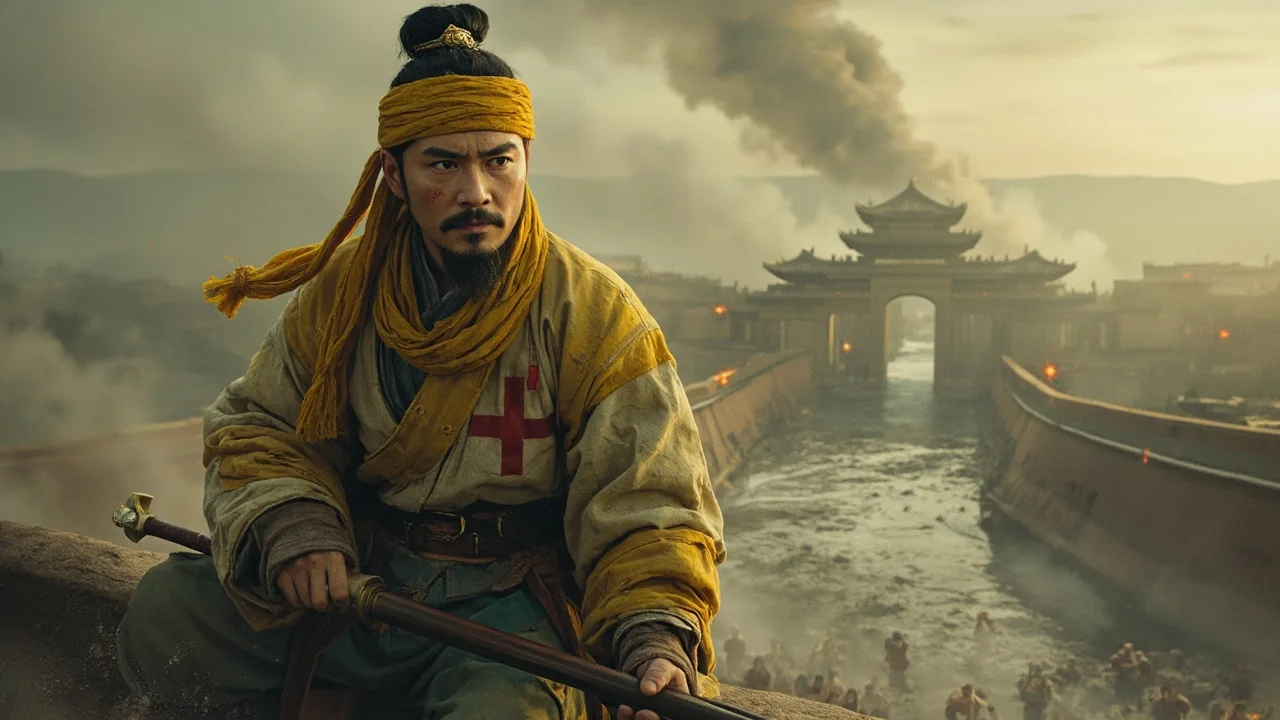
In the spring of 1853, a dust-caked army of perhaps a hundred thousand men, women, and children poured through the gates of Nanjing. They carried no imperial banners of the Qing. They carried long yellow flags stitched with Chinese characters and an unfamiliar symbol — a cross. Their leader, a slight man in a dragon-yellow robe who claimed to be the younger brother of Jesus Christ, had marched them more than a thousand miles in a year. Behind them, the Yangtze ran red for miles, choked with corpses. Within weeks they had renamed the city Tianjing — “Heavenly Capital” — and declared the Taiping Heavenly Kingdom, 太平天囯 (the second character an archaic variant they chose themselves, declaring their break with the Manchu order). For fourteen years, between 1850 and 1864, they would set fire to the Qing Dynasty in a civil war so devastating that scholarly estimates of the dead now range from twenty million to over seventy million — a range itself a measure of how catastrophically the war tore Chinese society apart. No event between the fall of the Tang and the revolution of 1911 did more to determine what modern China would become.
This is the story of the Taiping Heavenly Kingdom — a millenarian religious revolt, a brutal military campaign, a regime that tried to outlaw foot-binding and redistribute land while simultaneously executing its own generals in palace coups.
The Failed Examiner Who Heard God Speak: Hong Xiuquan’s Visions
The Taiping story begins not with a sword but with a book. Hong Xiuquan (洪秀全, 1814-1864) was born into a Hakka (客家) family in Guangdong. The Hakka — literally “guest people” — were Han Chinese whose ancestors had migrated south over centuries and lived as relative strangers among the dominant Cantonese population. They were disproportionately poor, mobile, and receptive to the millenarian sects that flourished along southern China’s linguistic frontiers. Hong’s father was a farmer, and the boy’s only escape from manual labor was the imperial examination system — the ancient Confucian ladder by which a brilliant boy from nowhere could rise to the highest ranks.
Hong took the exam four times. He failed four times. The third failure, in 1837, broke him. He collapsed into a fevered delirium. In that fever he dreamed — or later claimed to have dreamed — of ascending to heaven, where he met an old man with a golden beard who lamented that the world was full of demons and that Hong had been chosen to destroy them. He also met an elder brother who told him his mission was at hand. The elder brother, in later tellings, would be identified as Jesus Christ. Hong recovered, tried the exam a fourth time, failed again, and drifted into village teaching with a growing reputation for strangeness.
In 1843, a cousin lent him a Christian tract — a Chinese-language summary of Protestantism written by the missionary Liang Fa (梁发), trained in Canton by Western missionaries. Hong read it. He realized, in a flash of revelation mixing insight with arrogance, that his fever dream had been a divine vision. He had been called to be the younger brother of Jesus, sent to Earth to slay the demons of Qing China and establish the Heavenly Kingdom before the Second Coming.
The theology he built was emphatically heterodox, not orthodox Christianity. Hong borrowed the Bible, the cross, the idea of one God, and the vocabulary of sin and redemption — but read them through a Hakka peasant’s lens. He produced pamphlets that recast the Old Testament God as a Chinese-style supreme emperor, cast himself as Christ’s appointed earthly regent, rewrote the Ten Commandments to forbid opium and foot-binding while permitting polygamy among the elect, and called the Qing Manchus demonic usurpers. Missionaries from the London Missionary Society who met his followers in the late 1840s were horrified. They tried, politely then firmly, to point out that the Taiping theology was nonsense. They were shown the door. Hong had heard God speak. He knew what He had said.
The early converts were peasants, miners, charcoal-burners, and displaced Hakka migrants — exactly the kind of people receptive to a message that combined religious ecstasy with promises of land and revenge against the established order. By 1850 the movement had perhaps thirty thousand armed followers in the hills of Guangxi. Hong’s lieutenants included Yang Xiuqing (杨秀清), a former charcoal seller who claimed the ability to channel God the Father’s voice; Wei Changhui (韦昌辉), a Hakka landowner with military talent; and Shi Dakai (石达开), a young Hakka aristocrat whose battlefield brilliance would make him the most respected Taiping general of the war. In January 1851, Hong declared himself the Heavenly King and proclaimed the Taiping Heavenly Kingdom.
For collectors interested in the era’s material culture, a [product_affiliate: Qing Dynasty history books covering the late imperial crisis and Taiping rebellion] gives the broad political and military context, while a [product_affiliate: Hakka culture and migration history book] traces the centuries of southward movement that produced Hong Xiuquan’s particular corner of Guangdong.
The Long March South: How a Peasant Army Captured Nanjing
From their Guangxi base, the Taiping armies — disciplined, fanatical, commanded by men who believed they were carrying out divine orders — swept north and east through Hunan and Hubei, down the Yangtze valley, and toward Nanjing. They were joined by tens of thousands of dispossessed peasants, miners, and ethnic minorities. They were opposed by Qing forces that were corrupt, badly led, and unable to coordinate a response.
The Qing military system that faced the Taiping in 1850 was a ruin. The Eight Banners, the Manchu hereditary organization that had conquered China in the seventeenth century, had long since been hollowed by garrison routine. The Green Standard Army, the Han infantry that supplemented the banners, was a hereditary joke — positions sold, ranks inherited, soldiers running shops rather than training for war. The Taipings were not initially tactically superior; they were simply better motivated and better led.
The march on Nanjing is the single most extraordinary campaign of nineteenth-century Chinese warfare. The Taipings left Guangxi in autumn 1852 with perhaps fifty thousand combatants and a much larger train of camp followers. They fought north into Hunan, were briefly repulsed, then turned east across Hubei. Wuchang fell in January 1853 after Taiping sappers tunneled under the walls. Nanjing fell on March 19, 1853, after a brief siege. The Qing garrison and Manchu population — perhaps twenty thousand — were given the choice of conversion or death. Almost none converted.
By the time Nanjing fell, the Taiping army had marched more than a thousand miles, fought dozens of pitched battles, taken major cities including Wuchang and Anqing, and destroyed several Qing provincial armies. Hong Xiuquan entered Nanjing in spring 1853, declared it renamed Tianjing (天京, “Heavenly Capital”), and withdrew almost entirely from public life. He had fought his war. Now he would rule from behind increasingly elaborate curtains.
The decision to halt the offensive at Nanjing is one of the great strategic puzzles of the war. Two possibilities present themselves. The first is that Hong believed his mission was now to rule rather than conquer. The second is that the Taiping leadership had over-extended its supply lines and lost too many veteran commanders. Whatever the cause, the halt gave the Qing court the breathing space it desperately needed.
For readers who want the broader diplomatic and economic context — the Opium Wars, the unequal treaties, the failing Qing fiscal system — a [product_affiliate: 19th century China studies covering Opium Wars and major rebellions] ties the Taiping movement to the larger crisis of the late empire.
The Heavenly Kingdom and the Tianjing Incident: A Regime Eats Itself
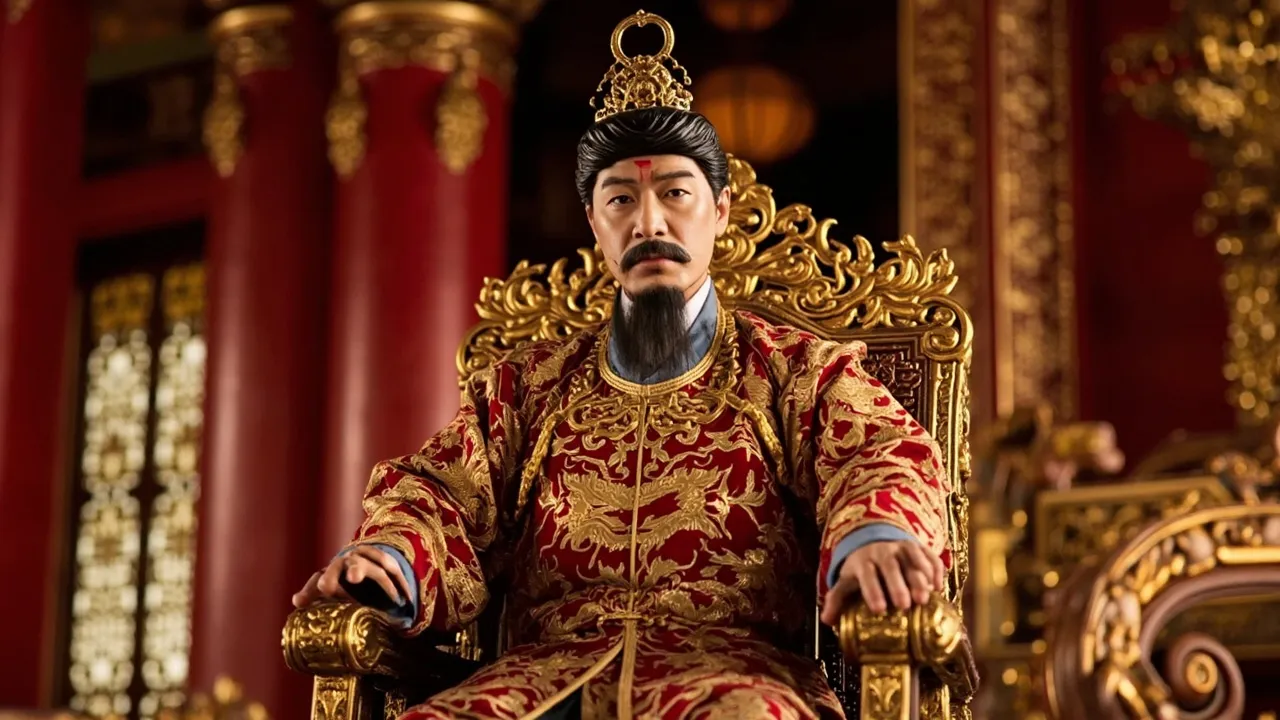
The Taiping regime that governed Tianjing and the Jiangnan heartland for the next eleven years was, in almost every respect, an unmitigated disaster. Hong Xiuquan himself spent most of his reign inside the refurbished Ming imperial palace, attended by dozens of concubines, issuing occasional edicts written in peculiar bureaucratic-religious jargon, and gradually retreating into eccentric mysticism that made him functionally unavailable for governance. Real power passed to his lieutenants — particularly Yang Xiuqing, the former charcoal-burner who now claimed the ability to channel God the Father’s voice directly.
Yang Xiuqing was, briefly, the most powerful man in Taiping China. He commanded the armies. He controlled the palace eunuchs (a Chinese institution the Taipings had inherited from the imperial tradition they had claimed to overthrow). He issued orders in the name of “God the Father” — speaking, he claimed, with the literal voice of Jehovah — and Hong Xiuquan, remarkably, accepted the humiliation. The Heavenly King had his dignity trampled in his own court by a man who claimed to be his divine superior. Historians still debate how much of Yang’s claim Hong genuinely accepted and how much he tolerated for political reasons. Either answer is unflattering.
The Tianjing Incident (天京事变) of September 1856 is the moment the Taiping regime lost its chance to win the war. Yang Xiuqing had become too powerful, too arrogant, too publicly dismissive of Hong. Wei Changhui, the third-ranking leader of the Taiping, decided — with what level of Hong’s authorization remains contested — to act. Wei led three thousand men into Tianjing at night, surrounded Yang’s compound, and murdered Yang Xiuqing along with his family, his retainers, and approximately twenty-seven thousand of his supporters over the course of about three weeks. (Other estimates put the death toll at “tens of thousands”; the precise number has never been recovered.) The bodies were thrown into the Yangtze. The river, contemporary observers reported, ran foul for days.
Wei Changhui’s coup solved nothing. Within two months, Hong Xiuquan had Wei arrested and executed for his presumption, summoned Shi Dakai to return from the front, and tried to reconstruct a working court. But the trust between the Taiping leadership had been destroyed. Shi Dakai, the most talented remaining general, left Tianjing in 1857 with his own army rather than continue serving a regime he no longer trusted. He fought an independent campaign in southern China for another six years before being captured and executed in Sichuan in 1863, famously refusing to kneel even at the moment of his beheading. With Shi Dakai’s departure, the Taipings lost their last field commander capable of independent strategic thought.
The religious character of the regime hardened into something increasingly bizarre. Hong Xiuquan issued theological tracts — written, by all accounts, in a Chinese so idiosyncratic that even his own officials struggled to parse them — that further distanced Taiping Christianity from anything resembling orthodox Protestantism. The regime banned opium, banned foot-binding (a genuinely progressive reform that prefigured twentieth-century movements), banned prostitution, banned slavery, mandated the separation of men and women in residential quarters, and tried to redistribute land according to a quasi-Biblical formula. None could be enforced consistently across a war zone. The land redistribution in the Jiangnan countryside is credited by some historians with inspiring later Communist policy; it was also credited by contemporary observers with driving neutral peasants into the arms of the Qing.
A [product_affiliate: scholarly monograph on the Taiping Heavenly Kingdom in English] is almost necessary for anyone who wants to make sense of the contradictions — because the regime was at once the most radical social experiment in nineteenth-century China and a dysfunctional theocratic horror show that executed its own leading generals by the tens of thousands.
The Xiang Army and the Long Siege: How the Qing Won
If the Qing Dynasty survived the Taiping challenge, it did so because of one man and the army he built. Zeng Guofan (曾国藩, 1811-1872) was a Confucian scholar-official of the most orthodox kind — a man who had passed the imperial exams at the highest level, served loyally in the Hanlin Academy, and understood, with the patient clarity of a man who had studied the late Ming collapse, that the Qing court could not save itself. In 1853, as the Taiping tide swept down the Yangtze, Zeng was given permission to raise a regional militia in his home province of Hunan. The force he built became known as the Xiang Army (湘军), and its history is the history of the Taiping war’s second half.
Zeng Guofan was not, by nature, a military man. He was a moralist, a calligrapher, a letter-writer, a deeply Confucian man who wrote daily letters to his brothers about the proper conduct of life. But he understood three things the regular Qing forces did not. First, that a regional army recruited from kinship networks would fight harder than a hereditary banner unit. Second, that Confucian moral discipline — exact tribute to fallen comrades, careful treatment of prisoners, paternal care for the families of soldiers killed in action — would produce a better army than the routine brutality of the Qing military system. Third, that the war could not be won by pitched battles alone. It would be won by supply lines, by patient siege craft, by the slow suffocation of Taiping-controlled cities.
Zeng and his key subordinates — Li Hongzhang (李鸿章), who commanded the parallel Huai Army; Zuo Zongtang (左宗棠), the future conqueror of Xinjiang; and Zeng’s own brother Zeng Guoquan (曾国荃) — fought a long, grinding war of attrition from 1853 to 1864. The decisive moment was the siege of Tianjing, which began in earnest in 1862 and ground on for two more years. The Xiang Army surrounded the city, cut its supply lines from the lower Yangtze, and waited. Disease, starvation, and despair did most of the work. Inside, Hong Xiuquan had by 1863 largely withdrawn from public life; rumors circulated that he had become convinced he was now God the Father himself.
In June 1864 Hong Xiuquan died. The official Taiping announcement said he had ascended to heaven in person. Modern historians generally accept that he died of illness — probably food poisoning from eating suspicious wild herbs, possibly suicide, possibly mercury-based traditional medicines. His son Hong Tianguifu (洪天贵福), a teenage boy with no military or political experience, was proclaimed the new Heavenly King.
The end came on July 19, 1864. Zeng Guoquan’s Xiang Army breached the city walls after a two-year siege. The Taiping defenders fought to the last. Hong Tianguifu supposedly broke out through a gap in the siege lines and was captured days later; he was executed, age fifteen or sixteen. The bodies of the dead in the ruins of Tianjing were burned for weeks. Zeng Guofan himself, characteristically, ordered the destruction kept modest — the dead buried where possible, the fires under control. His diary entries from those weeks, written in famously elegant small-character calligraphy, are among the most-quoted documents in modern Chinese history.
For collectors who want a tangible reminder of the era’s material culture — Qing imperial furniture, Jiangnan silks, late Qing porcelain — a [product_affiliate: Qing imperial decor and Asian art replica set] gives the visual texture of the court Zeng Guofan had just saved.
The Legacy: How Twenty Million Dead Shaped Modern China
The Taiping war killed somewhere between twenty million and seventy million people. The range is real, and the disagreement among historians is itself a measure of the war’s devastation. The 1958 study by Ping-ti Ho estimated roughly twenty million dead; Tobie Meyer-Fong and Stephen Platt have produced substantially higher estimates. Nobody knows precisely — but the death toll was comparable to the population losses the Soviet Union would suffer in World War II, applied to a society a third the size.
The Qing Dynasty survived the Taiping war — technically. It would last another forty-eight years, until 1912. But it never recovered. The fiscal system was bankrupt. The military had been replaced by regional armies under semi-independent commanders like Zeng Guofan and Li Hongzhang — the same commanders who would build China’s first modern arsenals, railways, and diplomatic corps. The Opium Wars, the unequal treaties, the Taiping war, the concurrent Nian (捻军) and Muslim revolts in northwestern China — these crises between 1840 and 1870 broke the Qing in ways no single one would have done alone.
The Taiping legacy is contested. Sun Yat-sen came from a Hakka family whose ancestors had moved near the Taiping heartland. The Chinese Communist Party’s founding generation included leaders from regions the Taipings had controlled, and Mao Zedong repeatedly drew analogies between his own peasant revolution and Hong Xiuquan’s — though his verdict was mixed: he admired their mass base and anti-imperialism but condemned their religious mysticism. The Hong Xiuquan of Communist historiography is a proto-revolutionary peasant leader whose progress was arrested by superstition. That judgment is itself revealing.
What the Taipings actually built, in eleven years of rule over the Jiangnan heartland, was less than their rhetoric promised and more than their enemies admitted. They redistributed some land, banned opium, banned foot-binding decades before any other Chinese government would try. None of these reforms survived the dynasty’s fall. But they were attempts, and they left a mark.
For modern readers, the Taiping war killed more people than the Napoleonic Wars, more than the American Civil War, more than every war the British fought in the eighteenth and nineteenth centuries combined. The Qing, between 1850 and 1870, was fighting for its life on multiple fronts — Taipings in the south, Nian rebels in the north, Muslim rebels in the northwest, Western powers on the coast. It survived the Taipings only because of one man’s stubborn Confucian commitment to the institutions he served.
To understand the Qing in its final decades, see our article on the Qing Dynasty. For the curious afterlife of late Qing religious culture, the story of Li Shutong, the Hongyi Master, traces how the Buddhist-tinged reformist milieu of the late empire gave rise to one of twentieth-century China’s most remarkable cultural figures.
The Taipings lost. But the world they imagined, briefly, in the Yangtze heartland in the 1850s — a world without opium, without foot-binding, without the Qing order — has never quite gone away. It surfaces, in different vocabularies, in every Chinese political movement that has tried since to remake the country from below.